By Arline, Volunteer
Researched and written for the Grounds for Appeal Project.
In 1914 Great Broughton was a small village on the edge of the North York Moors with a population of about 500 living in 120 houses. It was mainly agricultural, but there were many independent villagers running their own businesses at this time – including the Myers family.
Ernest Myers was born on the 1st of July 1885 in Great Broughton to George and Sarah (nee Bradley) Myers. He had two older brothers – George William (born 1878) and Matthew Henry (born 1883), and two older sisters – Elizabeth (born 1876) and Hannah Ada (born 1879). Another son, Thomas Spencley, was born in 1887, and a final daughter, Rhoda, born in 1889.
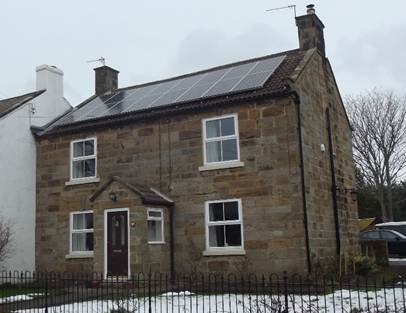
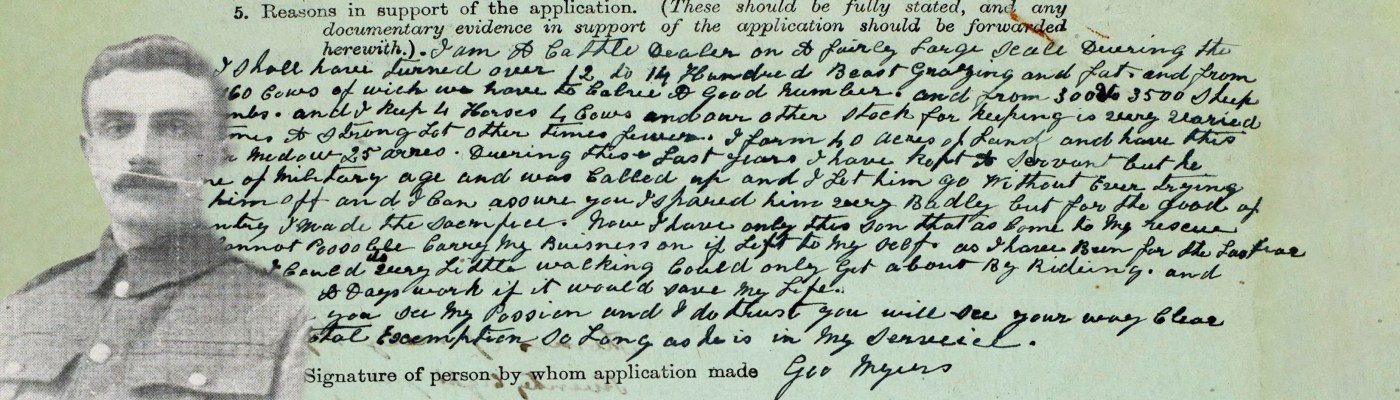
The family lived at Garth Villa on the High Street in Great Broughton, and father George had his own business as a cattle dealer and farmer.
They were a staunchly Methodist family, and were instrumental in establishing the Primitive Methodist Church on the High Street in 1907, where George, along with his sons, were trustees (source: Great Broughton Methodist Church, Wensleydale Press, 2007, p.18).
Image of Garth Villa, used with permission from Kirby, Great Broughton & Ingleby Greenhow Local History Group.
On the 2nd of October 1913 Ernest married Edith Robson in Durham, and they went on to live at Lynwood, Ingleby Road, in Great Broughton. They had a daughter, Muriel Ernestine, in July 1914.
Ernest attested on the 30th of August 1916 but was given an exemption from the Medical Board at this time due to having recurring bouts of appendicitis and was passed for ‘Home Service’. In May 1917 he asked for a renewal of this exemption.
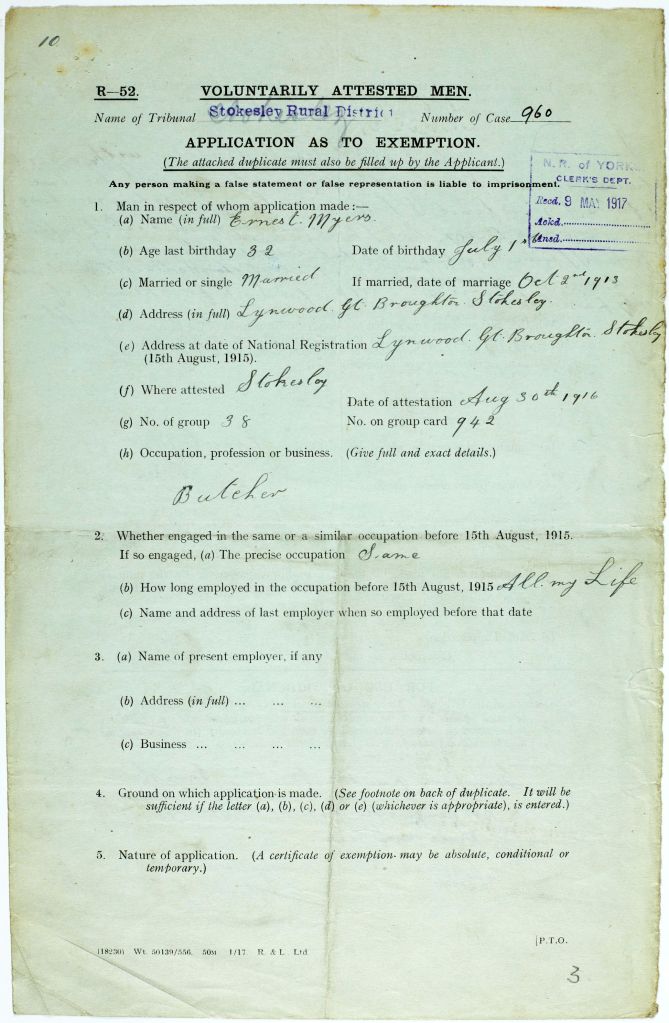
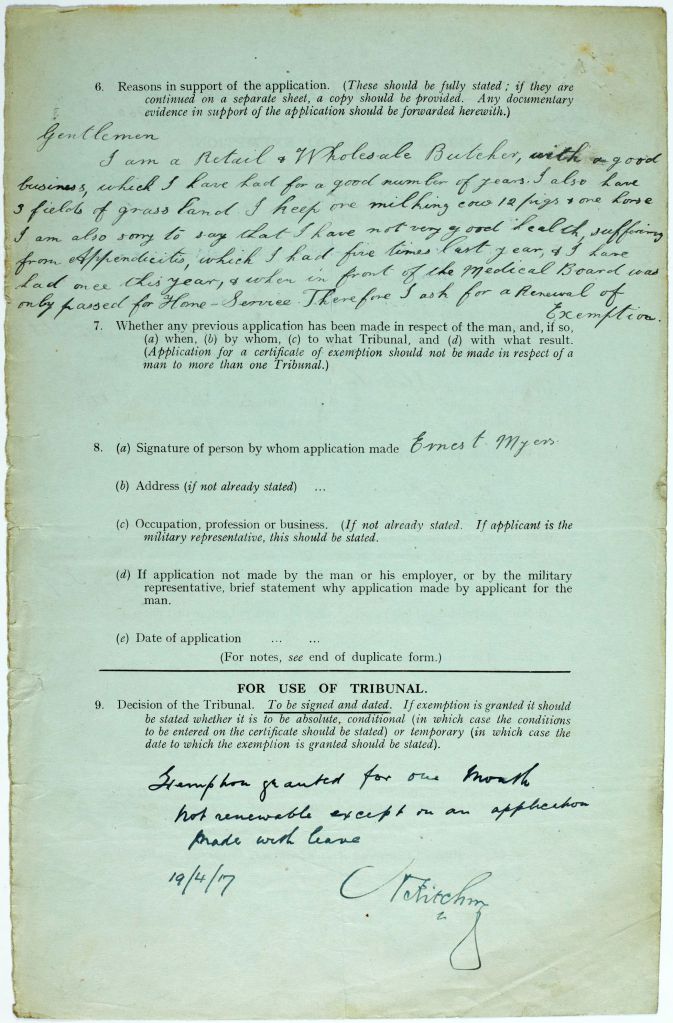
The Stokesley Local Tribunal dismissed his application, but gave him a month to sort out his affairs. He appealed against their decision and in a longer statement described himself as ‘wholesale & retail butcher‘ and ‘killing on a average per week to the takings of 50 pounds‘. He also explained he had three fields and a horse to help with his business, which he managed on his own. He wrote that he had been passed as C1 by the Medical Board (able to march 5 miles, see to shoot with glasses and hear well, thus able to stand service in garrisons at home), was a member of the VTC (Volunteer Training Corps) and did two days a week of ‘National work’.
To help with his appeal he employed a solicitor from Geo. Crombie & Sons, Stonegate, York, to appear for him at the tribunal on the 17th of May 1917. The appeal was heard in Middlesbrough, and the solicitor produced a certificate from the doctor showing Ernest had been seen by the doctor five times in the last eighteen months. The appeal was dismissed on the grounds that there were three other butchers in Great Broughton and Ernest had two brothers who ‘could doubtless keep his business going for him in his absence’. They acknowledged his C1 category, but did not consider it enough to offer him exemption.
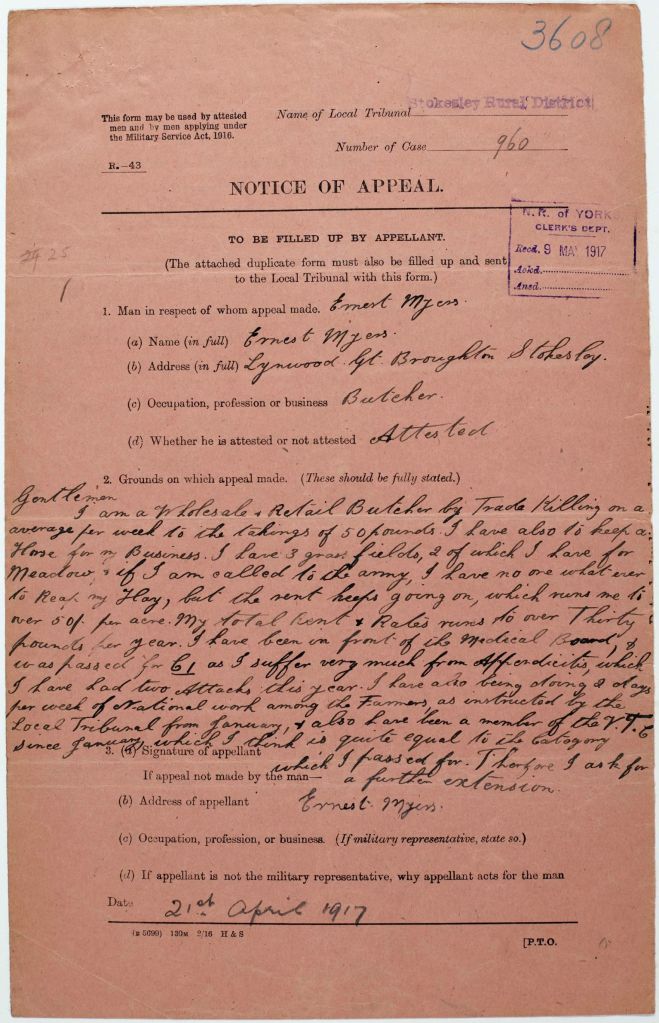
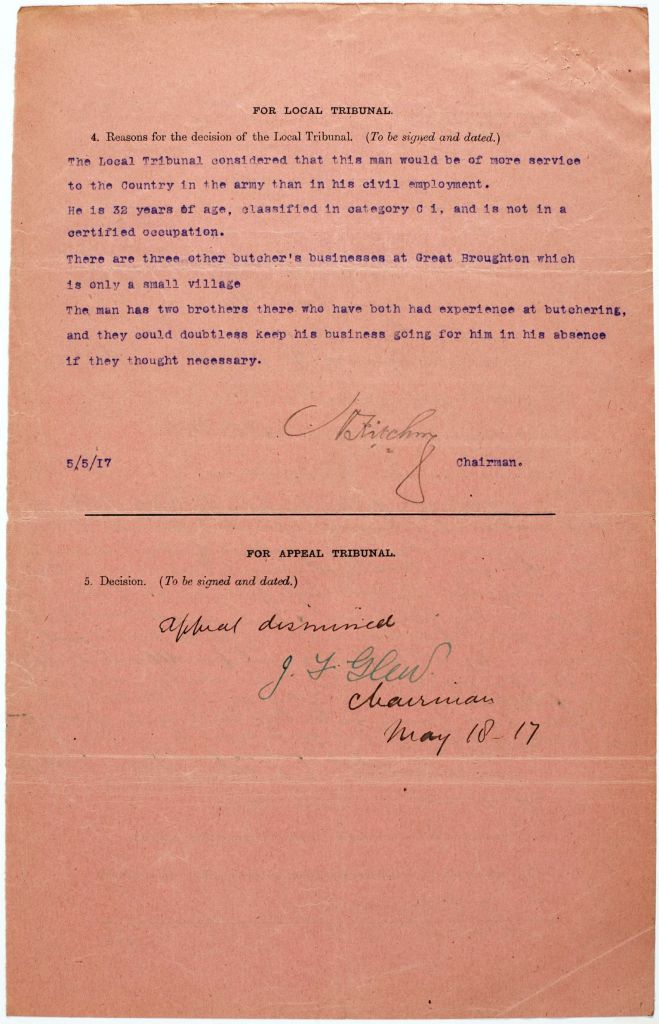
However, Ernest did not give up. A further letter on the 29th of May 1917 from his solicitor evidenced that Ernest had been admitted to Middlesbrough Hospital for an operation. The solicitor suggested that the matter should go before the Local Tribunal again as they understood that ‘a man is not fit after an operation for appendicitis for a period of six months’. The Clerk to the North Riding Appeal Tribunal replied that the case should probably be made before the Appeal Tribunal, but in return the Appeal Tribunal replied that they were not prepared to reconsider the case as it should go before the Medical Board or the Recruiting Officer.
The solicitor went ahead with the appeal to the Local tribunal, and the Town Clerk, Percy Spalding, became involved in the discussion as to whether the case should be before the Local or Appeal Tribunal. The case was resolved by Ernest ‘communicating with the Recruiting Officer in Middlesbrough’ and a suggestion that he went before a Medical Board again.
The paper trails ends there, and there are no Army Service records available for Ernest, so we cannot trace his military career. However, a newspaper article in the Whitby Gazette reported in October 1918, that ‘Gunner Ernest Myers, Heavy Battery R.G.A., is in hospital at Longleat, near Warminster, suffering from a fracture and sprained ankle‘. It goes on to report he joined the Colours in February 1918, and had been abroad two months.
Ernest survived the war, and the 1921 census shows Ernest, a butcher, with wife Edith and daughter Muriel living again at Lynwood. The 1939 census describes him still working as a butcher and cattle dealer, but now living at Greenacres, Great Broughton, whilst also acting as a Special Constable during WW2. But what of his brothers?
Thomas Spenceley Myers was born on the 27th of September 1887 in Great Broughton. He was the youngest son of George and Sarah (nee Bradley) Myers.
On the 19th of August 1915 Thomas married Florence Ethel Bainbridge (of Bilsdale) at the Primitive Methodist Chapel, and they went to live at Bon Lea, Ingleby Road in Great Broughton.
Photograph of Thomas used with permission from Kirby, Great Broughton & Ingleby Greenhow Local History Group.
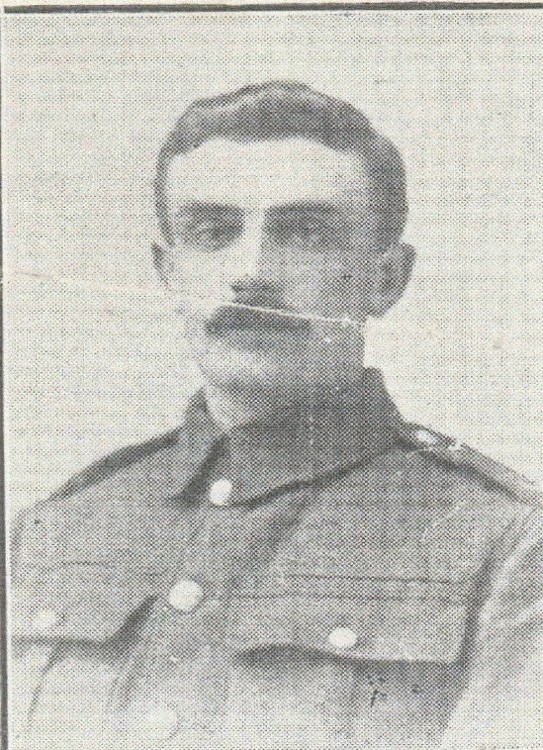
Similar to Ernest, there are no Army Service records available for Thomas to determine when exactly he joined, though his Application as to Exemption form shows he voluntarily attested. His exemption form, made in July 1916, was submitted by his father, as his employer, who claimed that he needed his son to help manage their 150 cows, 20 sheep, and 40 acres of farmland.
George asserted that he had already lost one farm hand and his son had stepped in to help, as he, George, was now unable to walk far and had to be away from home on business 3-4 days a week as the poor train services did not allow him to return home.
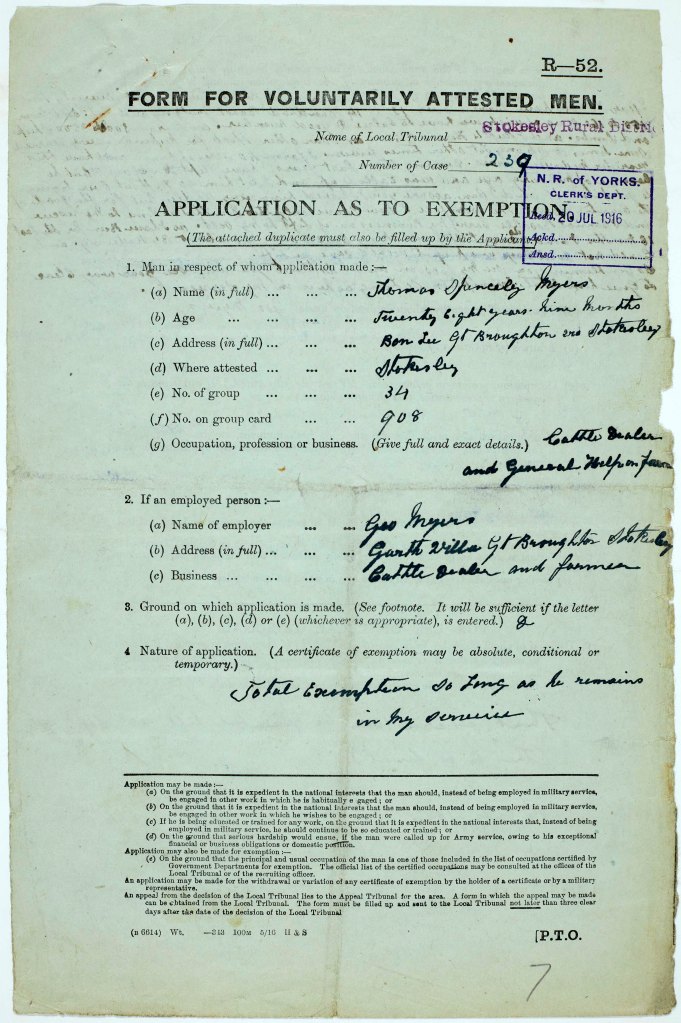
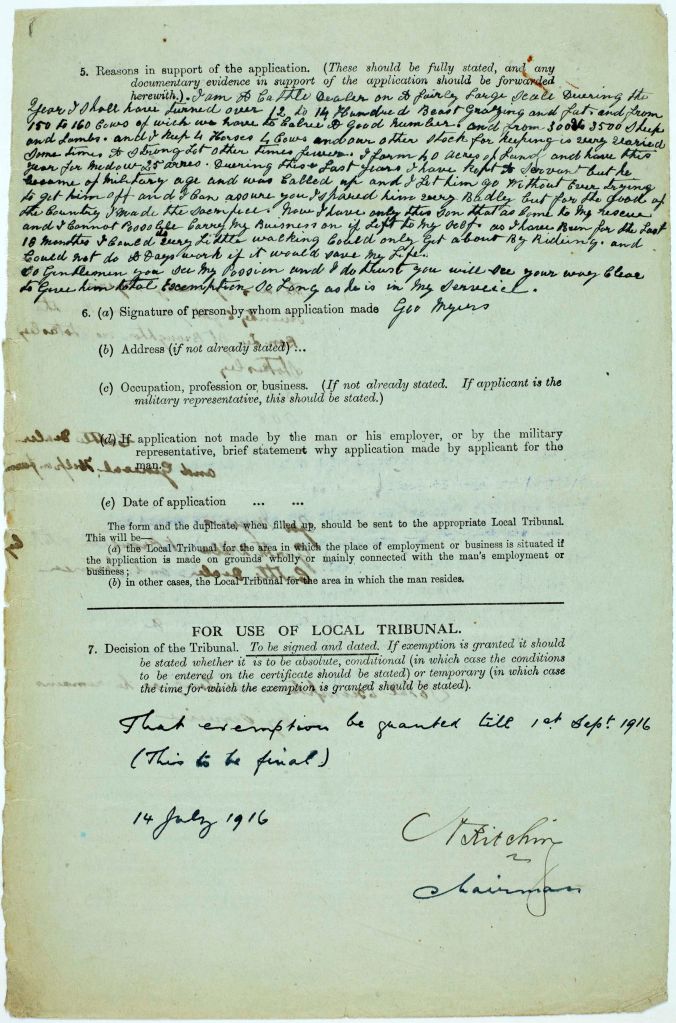
George’s application for his son was rejected on the grounds that he had three other sons to help him with his business, as well as a wife and two daughters still at home. The Appeal Tribunal did allow Thomas’s delay into the Army until after September 1st, when the hay would have been harvested. Not even a week later, the Tribunal rejected their appeal of its decision on similar grounds.
A month later, George sadly died away from home in August 1916. Although he had fought, without success, to keep his son at home, he was spared the heartbreak and loss that would soon befall his family.
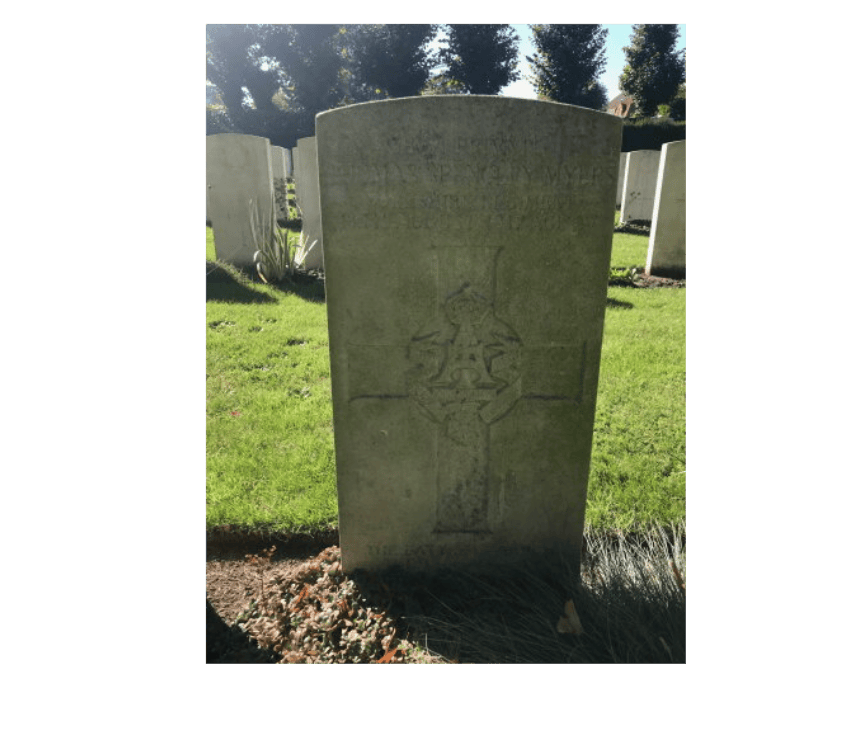
Thomas was killed in action a year later on the 14th of August 1917 aged 29 near Ypres, Belgium.
At the time, he as a private enlisted in the Princes of Wales’ Own Yorkshire Regiment, 6th Battalion.
He was buried in the Ypres Town Cemetery (photograph of headstone from Ancestry).
An Army Register of Soldiers’ Effects listed the sum of £1.16s.3d left to Thomas’ widow Florence. His awarded British War and Victory medals were also sent to Florence as his next of kin.
Florence remained a widow until 1926 when she married Alfred Stockdale, a farmer in Busby. Thomas’ family dedicated a christening font to him in the Primitive Methodist Church in Great Broughton, in memory of the son they lost (source: Great Broughton Methodist Church, Wensleydale Press, 2007, p.33).
We do not hold Appeal papers for the other sons in the Myers family, George William and Matthew Henry, though, newspaper articles report that Matthew sadly died in 1918 at home in Great Broughton age 35 from long-term illness (meaning he likely was not fit for military service initially).
The Whitby Gazette wrote on 10 May 1918…
‘Much sympathy is felt in a wide area for the Myers family, who have sustained three bereavements in less than two years. Mr George Myers, the head of the family, died suddenly whilst away from home in August 1916, and less than a year later his youngest son, Private Thomas Spenceley Myers, of the Yorkshire Regiment, fell in action.’

