By Marilyn, Volunteer
Some well-known names from the entertainment world were born in York and you’ve probably heard of most of them – Judy Dench, Frankie Howerd, John Barry, Mark Addy. But Rich Hayes? Chances are you haven’t heard of him. He is unique for having his World War 1 appeal papers come to light in the records of North Riding County Council held at North Yorkshire Archives. It seems he was quite a celebrity during his working lifetime and certainly travelled the world.
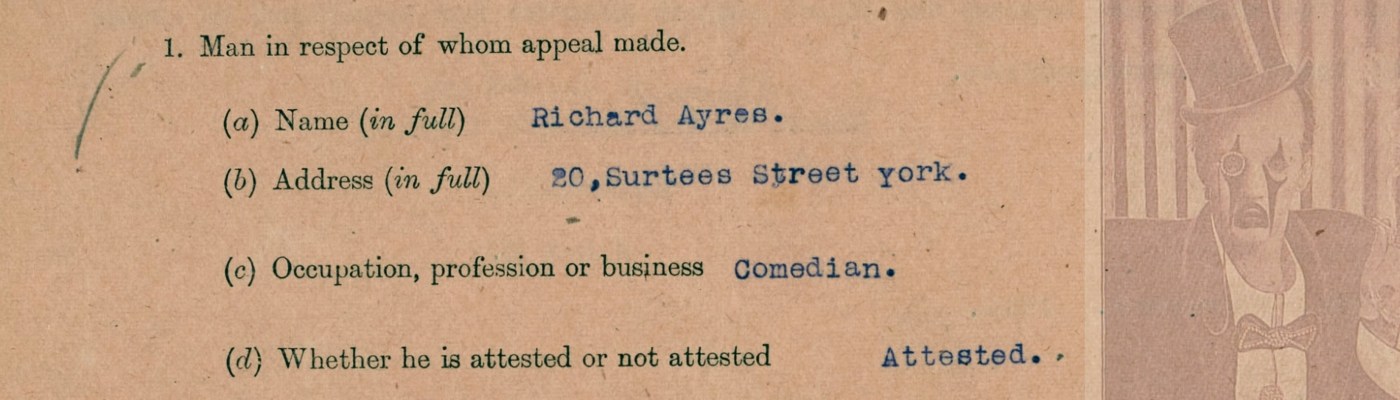
Hayes was his stage name, but he was born Richard Ayres, that being the name on his application for exemption form when he submitted it to the York City Local Tribunal on 29 September 1916. He was aged 26, married and living in Surtees Street in the Clifton area of York, not far from Rowntree’s chocolate factory. His recorded occupation for the last eight years had been Artist (Variety). He was applying for absolute exemption on the grounds of illness and infirmity. He stated the reasons in support of his application as being “During my African tour I was taken ill which left me pains in the back and side and was treated in England for muscular rheumatism by Dr Hood, Castlegate, York. Also having Double Hurnie” (his spelling). He had also engaged a solicitor to help with his appeal.
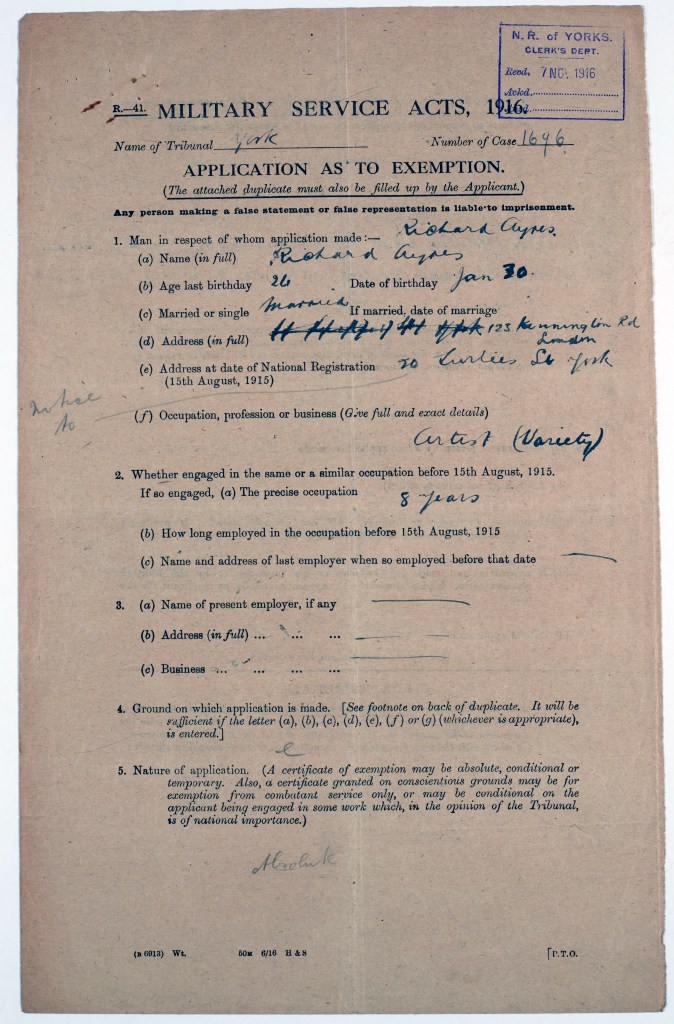
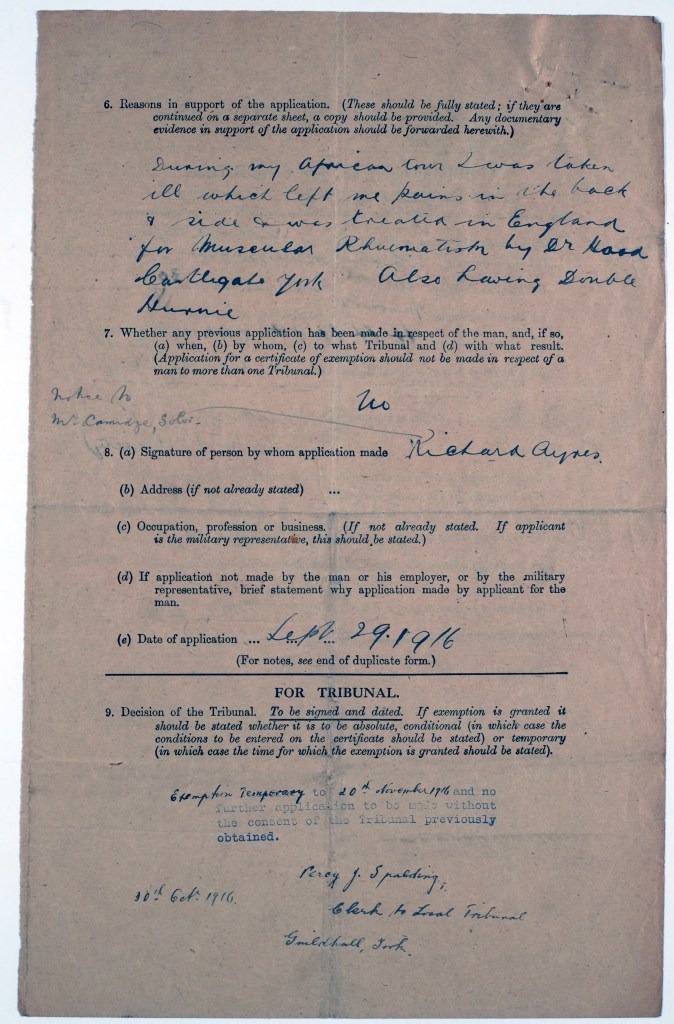
On 10 October 1916, the Military Representative for Rich’s case sent his short, but not so sweet, comments to the Local Tribunal in just five words; ‘Not assented to. Insufficient reasons.‘ The decision of the Local Tribunal dated 30 October 1916 and signed by Percy J Spalding, Clerk to the Local Tribunal, was a three weeks temporary exemption until 20 November 1916. Percy J Spalding was Town Clerk of York for 21 years. Interestingly, Spalding Avenue close to where the Ayres family lived was named after him.
More on his appeal later, but what exactly did Richard do as Artist (Variety)? Well he certainly didn’t have a family background in entertainment. On the 1911 census he was living in Surtees Street with his father, a grocer’s assistant, his mother Annie, brother Arthur aged 18 working in Rowntree’s Factory Advert Department, brother Stanley aged 17, a clerk, and sisters Jessie, Mary and Nellie, all schoolgirls. Only Richard, aged 21, was in the business, a Music Hall Artist, unemployed.
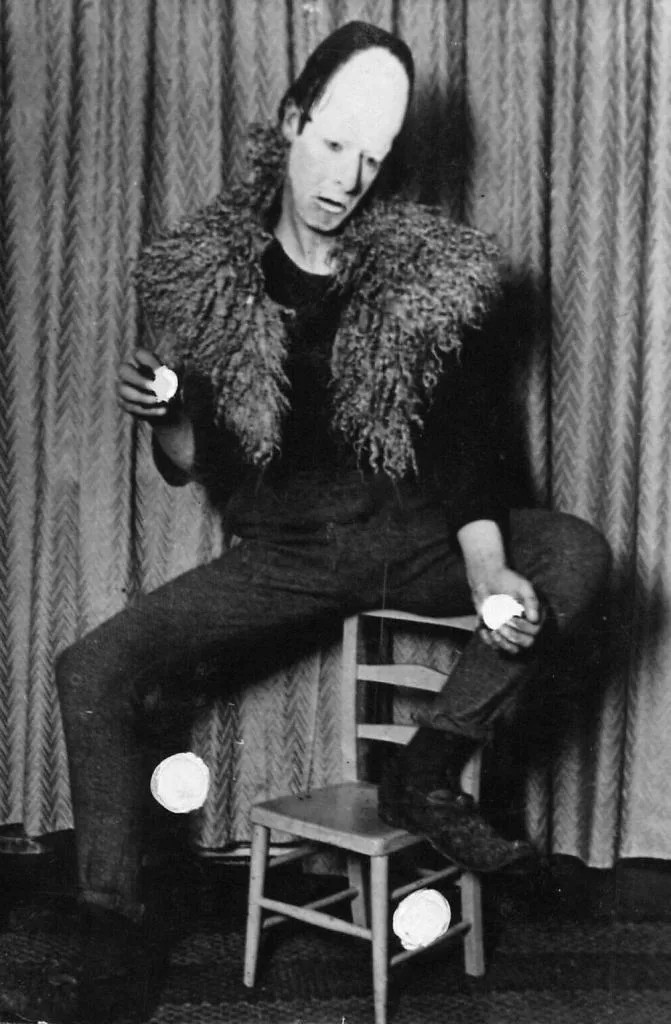
It seems that when he wasn’t unemployed, he had a very successful career as described in a post on the International Jugglers Association website by professional juggler and juggler historian, David Cain (https://www.juggle.org/rich-hayes-eccentric-juggler/). He was a comedy juggler and clown going under the name of Rich Hayes, or “The Lazy Clown”, because of his laid-back routine, sometimes while smoking a cigarette. He could hold eight tennis balls in his hands at the same time and for a while was joint world record holder for bouncing and juggling eight balls. His speciality was bouncing the balls off a sloping wooden platform, sometimes when blindfolded.
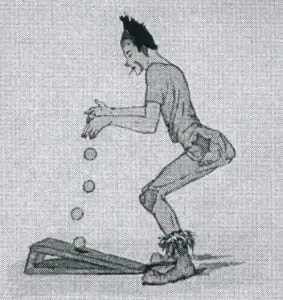
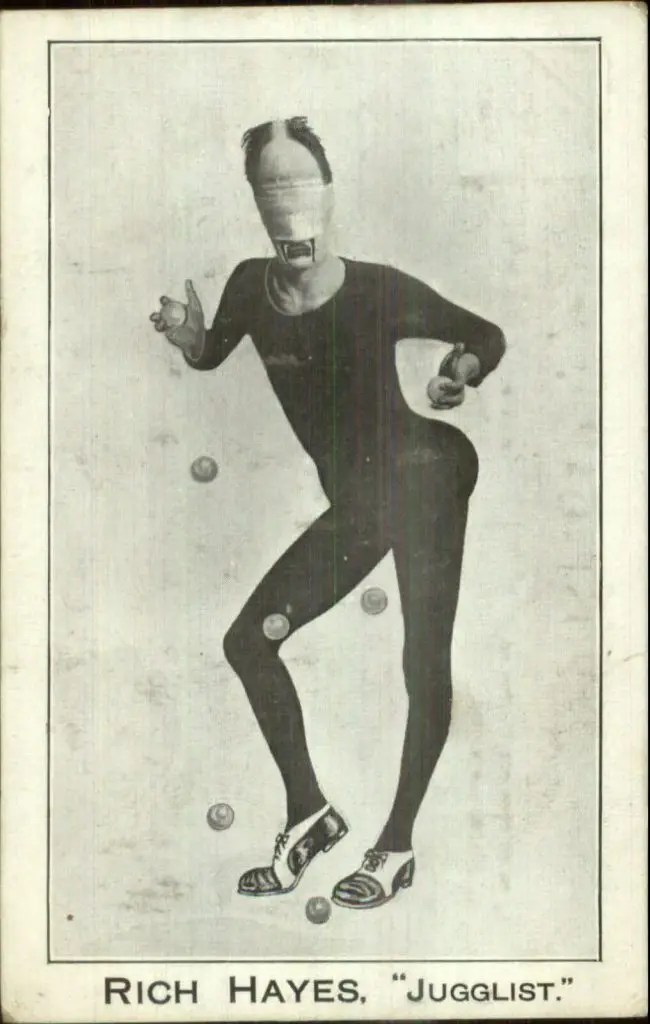
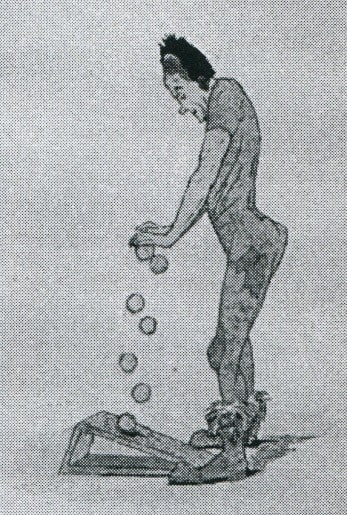
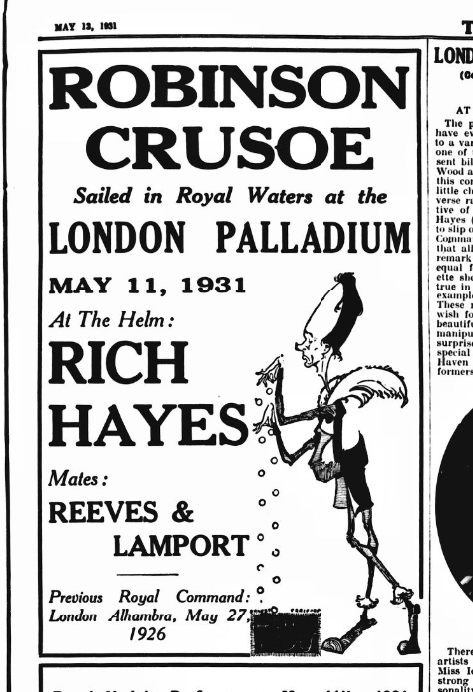
He padded his bottom and extended his forehead for comic effect and wore black tights on his long thin legs. He was 6ft tall according to his army record. He also performed as a clown between the juggling sessions, and at times had an assistant. One of his famous comedy sketches was as Robinson Crusoe with his very short assistant as Man Friday. A Chiswick Empire advertisement in the West London Observer on 19 June 1925 (seen online on the British Newspaper Archive) says Rich Hayes will be Exploring with Man Friday on Crusoe Island. The same website has numerous references to his appearances all over the country over many years.
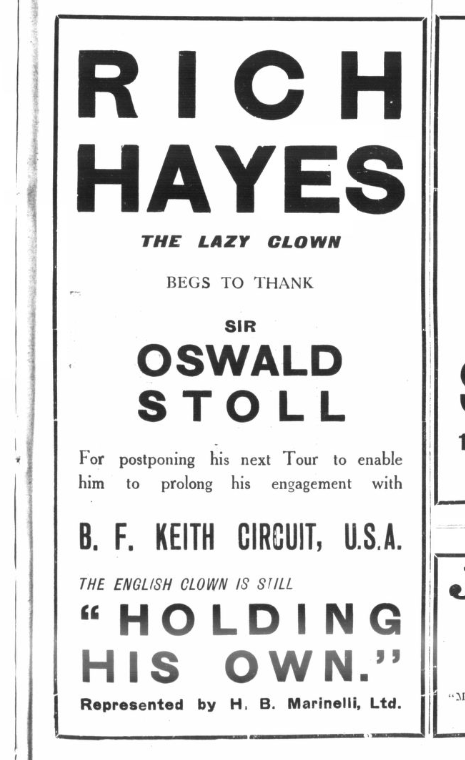
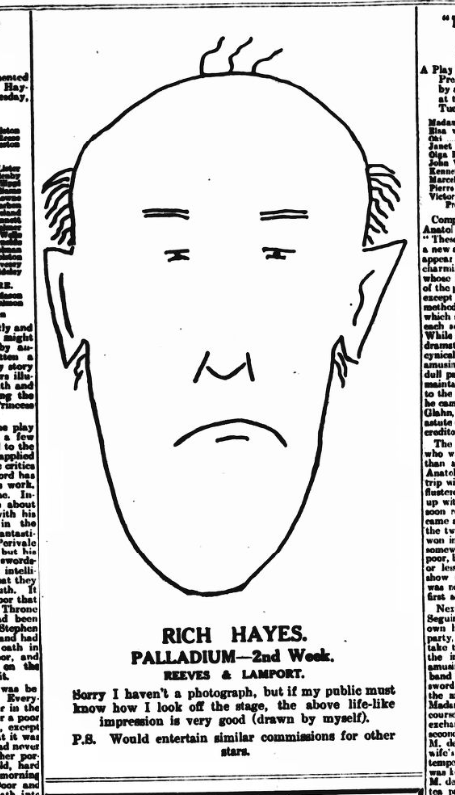
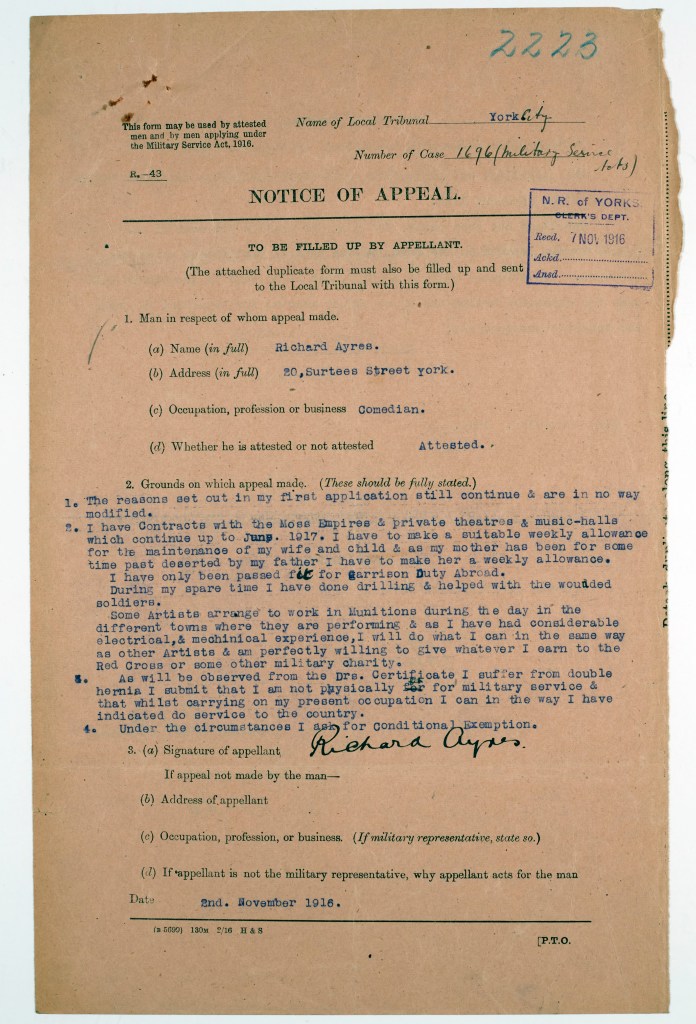
Rich submitted his notice of appeal to the North Riding Appeal Tribunal on 2 November 1916. This time his occupation is described as Comedian and he expands the grounds on which he is making the appeal. He says the reasons he gave in his first application still continue and are in no way modified, but now he adds “I have contracts with the Moss Empires and private theatres and music halls which continue up to June 1917.” At that time Moss Empires was a company that in 1910 owned more than fifty theatres in the UK, so presumably Rich had plenty of bookings. He also said he needed to make a suitable weekly allowance for his wife and child (Winifred born in 1913), and because his mother had been deserted by his father, he had to make her a weekly allowance too.
He added that he had only been passed fit for Garrison duty abroad. During his spare time he had attended drilling and had helped with the wounded soldiers. He goes on to say “Some artists arrange to work in munitions during the day in different towns where they are performing, and as I have had considerable electrical and mechanical experience I will do what I can in the same way as other artists and am perfectly willing to give whatever I earn to the Red Cross or some other military charity.” He also writes that he is submitting a doctor’s certificate confirming the double hernia. He is requesting conditional exemption.
On the appeal form, the Local Tribunal state two reasons for their decision. One was that Richard had been passed for medical grade B1 (meaning that he was able to march at least 5 miles, see to shoot with glasses and hear well). The other was that he had made no mention of the double hernia on his initial application and it was not on his doctor’s certificate. In fact, having seen the original papers, he certainly did mention his double hernia – even if he didn’t get the spelling quite right! Unfortunately for Rich, the decision went against him again. The form went back to York and the outcome dismissed was signed and dated by the Appeal Tribunal Chairman Sir Henry Beresford Peirse (of Bedale Hall) on 2 December 1916.
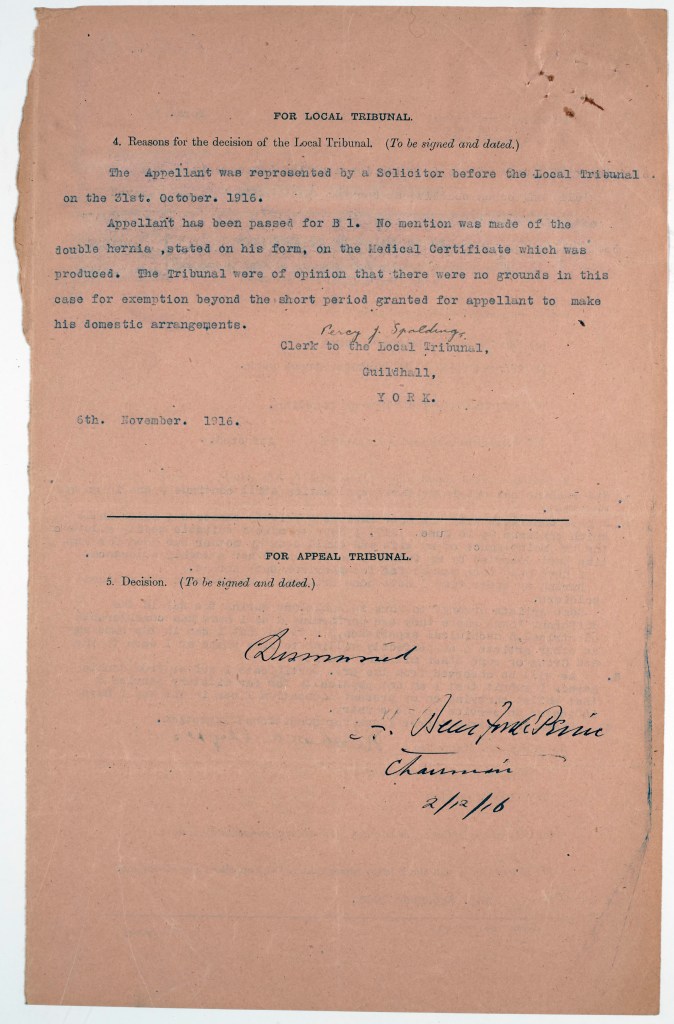
On the same day that the appeal was dismissed by the North Riding Appeal Tribunal, Richard’s solicitor sent a letter to the Secretary of the NRAT asking if permission would be given for an appeal to the Central Tribunal in London. On 5 December 1916 the Clerk responded saying he was enclosing the form of notice of appeal to the Central Tribunal (R45-46), which had to be filled in, returned to him and he would “bring the same before the Appeal Tribunal and see whether they will give permission for the case to be re-heard by the Central Tribunal. Leave is only given when some question of principle is involved.” It wasn’t looking promising for Rich was it?
There the appeals paper trail ends, but we can assume that permission to appeal to the Central Tribunal was refused because by 11 May 1917 Richard Ayres had a Military Record sheet (listed online on the British Army WW1 Pension Records 1914-1920). He was in the Army Service Corps as an electrician. By December 1917 he was discharged as being no longer fit for war service, but with the proviso that he could be “Liable to be sent a Statutory Order requiring him to present for medical re-examination.”
As far as we can tell that was the end of his short-lived spell in the army, but his career as a variety artist continued almost until his death sixteen years later. According to the Hull Daily Mail on 2 October 1933 announcing his death, “Rich Hayes was telegraph messenger, programme seller and chocolate boy as a youth and yet later he appeared twice in three years at Royal Command performances.” It reported that he had received his first chance as a solo act at the old Hull Empire in 1911. Hayes said everything went wrong and the manager wanted to pay him off but Rich pleaded and got another chance.
His luck had certainly changed by 1926, when he had become a regular hit in vaudeville theatres around the world. He mentioned his Africa tour in his application to the York Local Tribunal and had regular bookings in the UK, in Hamburg and Berlin where he appeared at the Wintergarten Theatre, and especially in America. This was a time when variety halls were at the height of their popularity. By the end of the 1920s public tastes were changing with the coming of the cinema ‘talkies’, but Rich Hayes was a big attraction in vaudeville for twenty years.
The Daily News (London) reported on 21 May 1926 that “Mr Richard Hayes travelled 3000 miles to appear at the Royal Performance. He was at Omaha, Nebraska when he received a telegram informing him of his selection.” There is no mention of how he travelled from Omaha to London, but in 1926 it would have been quite a journey. Probably by train across America, then ocean liner across the Atlantic from New York or Montreal. We can only hope King George V was impressed by the act and by the effort Rich had made to get there – and it seems he did impress, because Rich appeared there again a couple of years later.
Image courtesy of David Cain
There seems to be no record of Richard Ayres on the 1921 census, so perhaps he was touring abroad. His wife Lavinia Ayres was now living in Falsgrave Crescent, still in the same area of York as Surtees Street, with her widowed mother. Their 8 year old daughter Winifred was a boarder pupil at the Blind and Deaf School and Home in Leeds. Winifred went on to work as an adult as a machinist, and married in Leeds when she was 22.
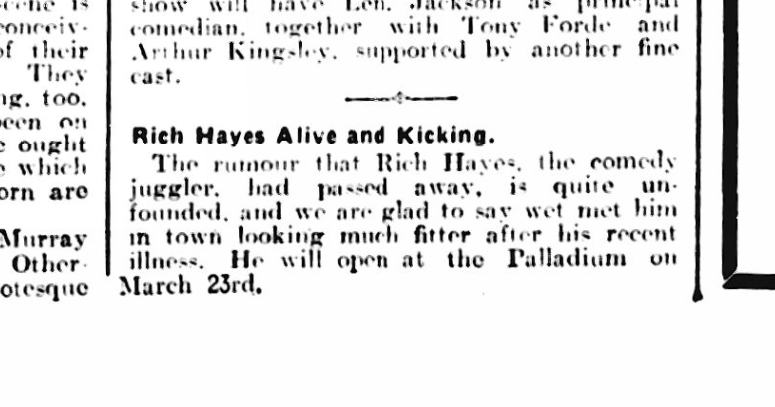
The Era Newspaper, which reported on lots of theatrical news items, wrote, ‘Rich Hayes Alive and Kicking‘ in one of its columns on 23 February 1931 followed by “The rumour that Rich Hayes the comedy juggler had passed away is quite unfounded and we are glad to say we met him in town looking much fitter after his recent illness. He will open at the Palladium on March 23rd.” (BNA)
Unfortunately Rich Hayes/Richard Ayres died of consumption in Isalee Nursing Home in Harrogate in October 1933, at the age of 43. His funeral was held at St Mary’s Church in York where he had sung as a choirboy. It was attended by a large number of members of the theatrical profession. In his will he left effects valued at £5496.17s to his wife Lavinia, which today would be worth around £511,000.
Photos and drawings are courtesy of David Cain, owner of the Museum of Juggling History (historicaljugglingprops.com). The utmost thanks to David for allowing us the use of the images from his blog post.
All newspaper clippings are taken from the British Newspaper Archive.

