John Harrison was born to Margaret Blenkinsop and John Harrison on the 19th of May 1891 in Sunderland. The 1891 census shows his parents, both aged 26, living in Monkwearmouth, Sunderland, with daughters, Lilian Margaret aged five and Enid Agnes aged two. Terribly, tragedy struck the following year when John’s father died in 1892 at the age of just twenty-seven.
Left a widow to three children, John’s mother Margaret soon remarried to Charles Reynolds, a Suffolk-born clothier, who would become the central male figure in John’s upbringing. The family quickly expanded, with the arrival of John’s half siblings – Charles Henry in 1894 and Margaret Hannah in 1896. By 1901 the family had settled in Whitby.
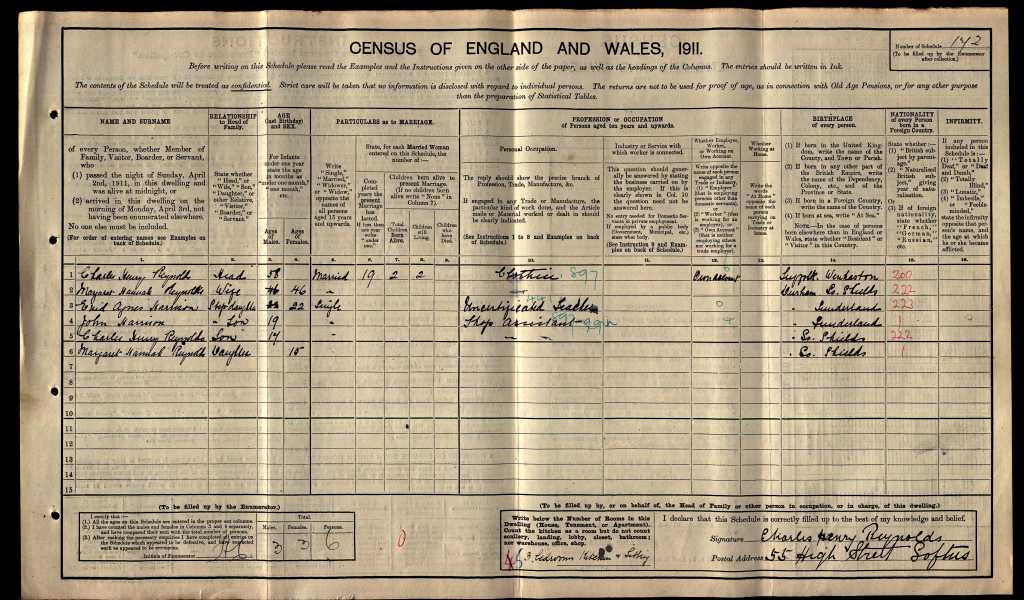
Ten year later, in 1911, John, now nineteen, is working as a shop assistant whilst living at 55 High Street, Loftus. The family remain together, both parents and siblings, and despite the upheaval of his father’s death so early in his life, John seems to lead a normal, stable life – though like most, the war brought about enormous change.
In February 1916, at the age of twenty-four, John appeared before the Loftus Local Tribunal seeking absolute exemption from military service – his case grounded entirely on deeply held moral and political beliefs. His initial written statement offered a passionate defence of socialism:
“I believe in the principles of socialism which recognises the brotherhood of man.”
He goes on to argue that war substituted “passion for reason” and that violence could never truly resolve disputes. He condemned the destruction wrought by conflict, describing war as something that killed the innocent while often protecting the guilty.
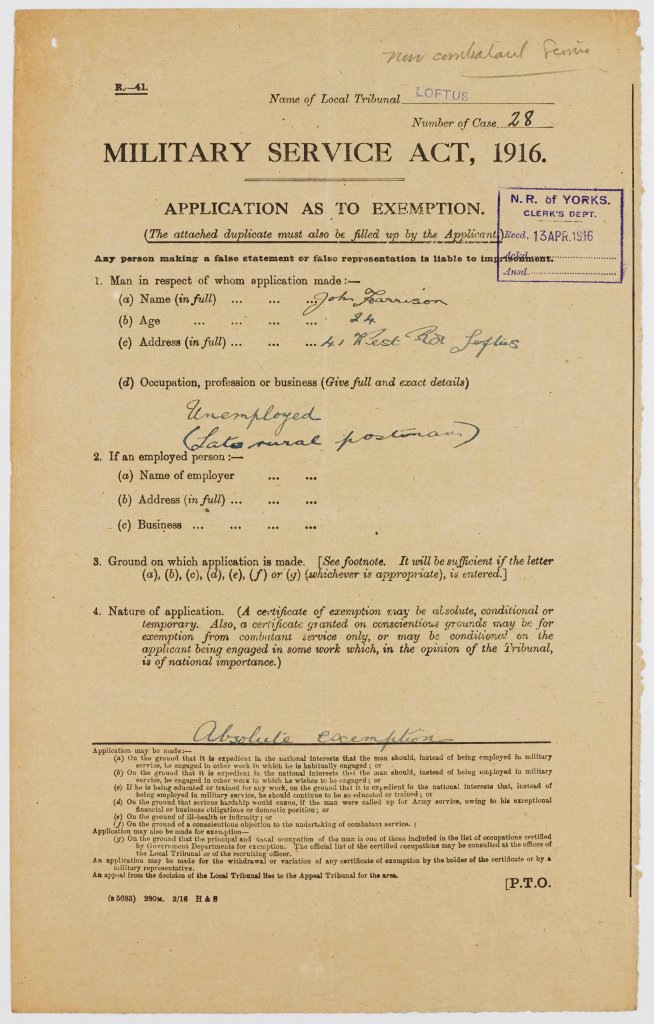
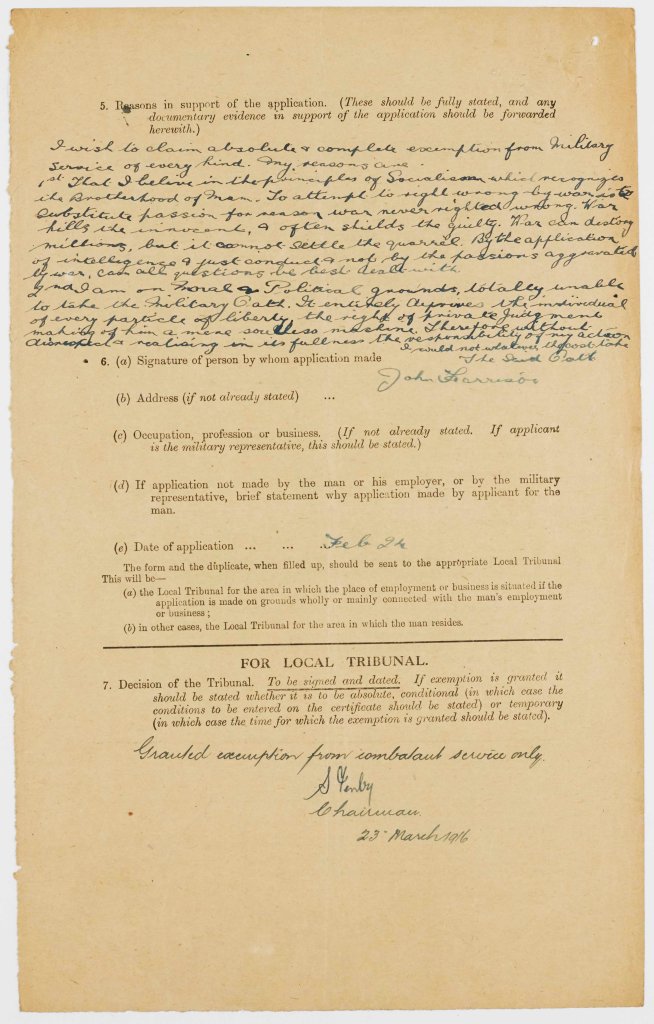
The tribunal granted him exemption from combatant service only on 23 March 1916, and for some, that might have been enough – but not for John, or his family.
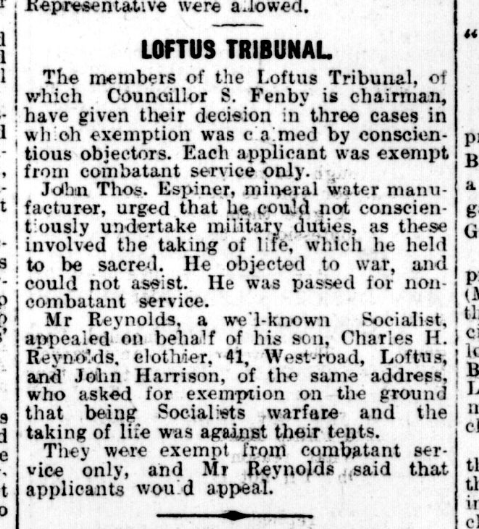
Reporting on the Loftus Tribunal, the Stockton Herald describes John’s stepfather, Charles Reynolds, as a “well-known socialist” and that Reynolds appeared on behalf of his son, Charles Henry, and stepson, John.
Though a brief report on the tribunal, the article provides insight into the nature of John’s stepfather, Charles, who may have had a hand in shaping John’s conviction – that social justice and human brotherhood offered a better path than war.
– The Stockton Herald, 1 April 1916
Within days of the exemption they appealed. John making clear he was prepared to suffer imprisonment rather than compromise his beliefs.
“Gentlemen, at the Loftus tribunal I asked for total exemption from all forms of military service, as I was opposed to war in all its forms. That tribunal granted me exemption from combatant service. Against that decision gentlemen, I appeal today to put me into the non-combatant section of the military service is to entirely misunderstand my position. I do not want to release another person by taking his place and sending him to the trenches. That would be the act of an arrant coward, and, gentlemen, I am no coward. I would sooner a thousand times die in prison, than sneak behind someone else for them to do the fighting. I have counted the cost of my principles, and will cheerfully abide the consequences, and gentlemen, I cannot accept a conditional certificate for non-combatant service.” 25 March 1916
The appeal tribunal ruled on 20 May 1916 that John could remain exempt from all military service provided he undertook work considered to be of national importance – of which, John complied.
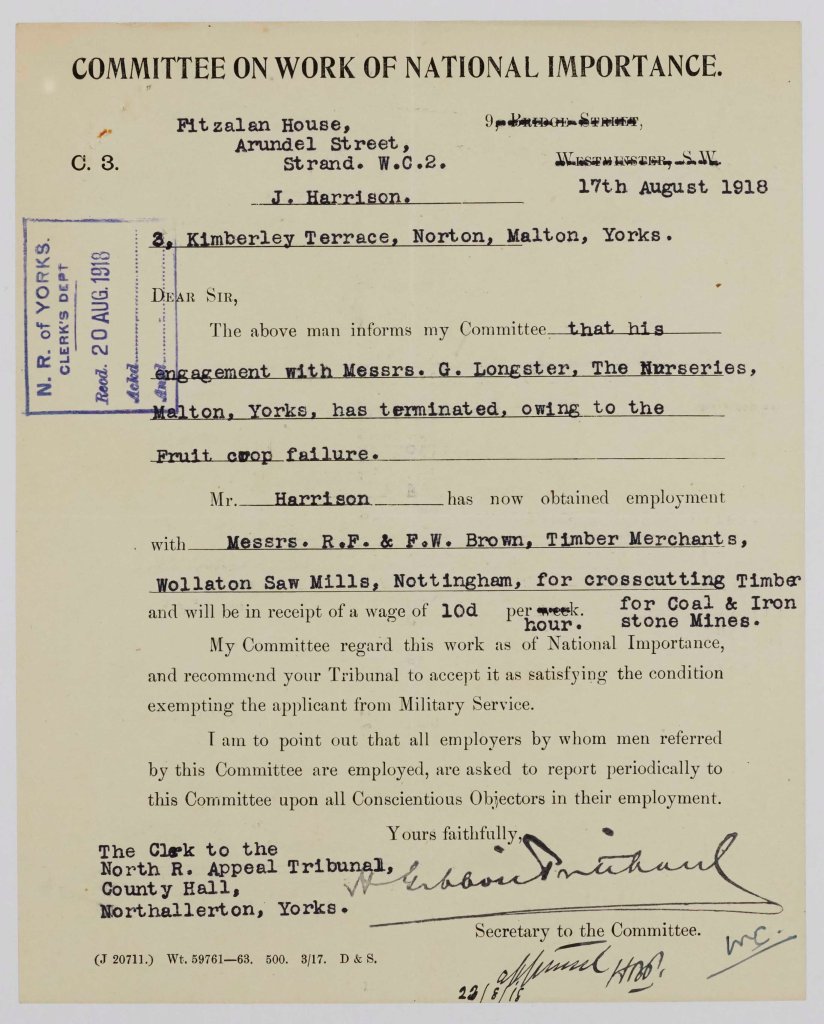
By 1918 John had been working at a nursery near Malton, but poor fruit harvests led to the termination of that work. He then secured employment with a timber merchants, R.F. & F.W. Brown at Wollaton Sawmills in Nottingham, alongside his half-brother, Charles Henry.
Following the war, we’ve managed to uncover that John returned to his childhood home of North Yorkshire.
The 1921 census places him as a visitor at his parents’ house in Whitby. At thirty years old he is working as a fish merchant “on his own accounts” from 40 West Road, Loftus, alongside his brother-in-law. In April 1922, John marries Ada Boyes. She appeared in the 1921 census alongside his family, and she would become his lifelong companion.
By the time of the 1939 register, John and Ada are living at 10 Rose Avenue, Whitby. At forty-eight years old, John is listed as a ‘furnisher remover’ undertaking what is recorded as ‘heavy work’. The couple do not appear to have had children.
John Harrison died in Whitby in 1981 at the age of ninety. His wife Ada survived him by only a year, dying in 1982 aged eighty-eight.
The tribunal appeal papers allow us to hear John’s own voice, determined and thoughtful, and unwilling to compromise on his principles – an insight into a life that we might never have seen otherwise without the survival of these records.

