Accounts sent to Sir Bellingham, 5th Baronet, concern the education of his two daughters, Miss Elizabeth and Miss Catherine (Kitty) Graham between 1776-1779.
As can be seen, from one example below, the two girls were given lessons in painting, drawing, music, dancing and geography, as well as how to make their own pens and a penknife. Expenses, such as ‘red Moroco pumps’ and the apothecary’s bill are covered, and pocket money for the holidays is paid to them too.
What was less certain, was where the teaching was taking place, until the discovery of a covering note in a very fragile state, which had become separated from the invoices. It shows the sender of the accounts, Mary Stockley, being based at Blacklands House. We were intrigued to see if we could learn anything further about this school, and whether it had been well renowned.
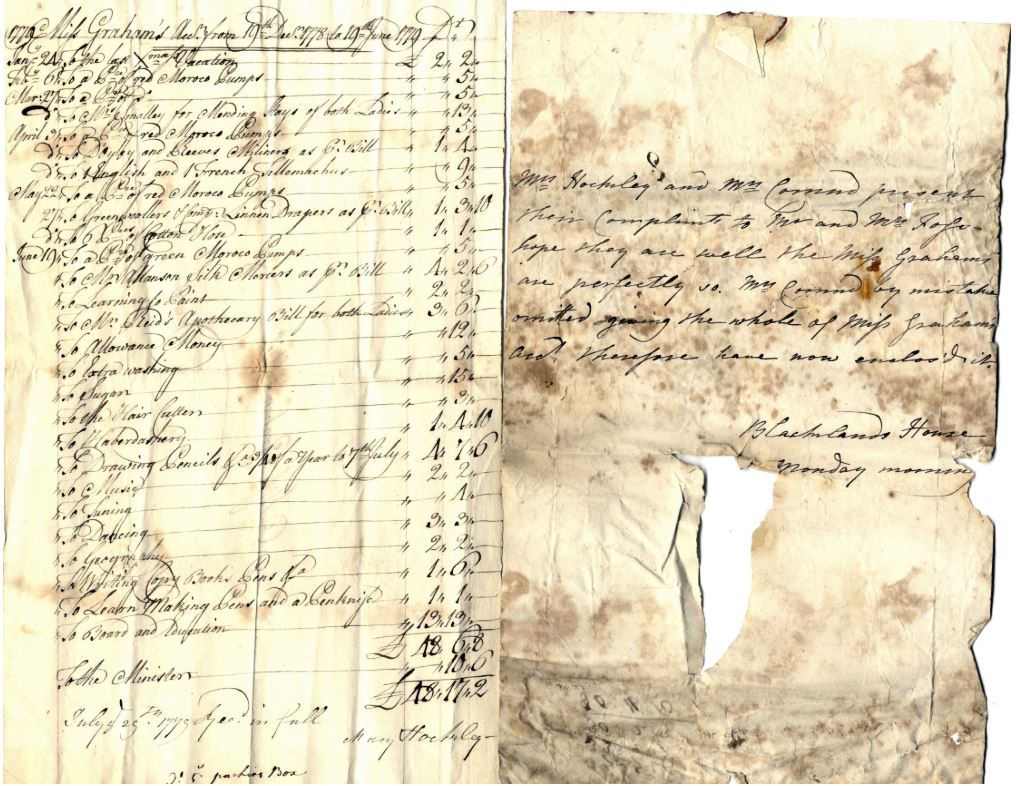
Invoice and covering letter [ZKZ]
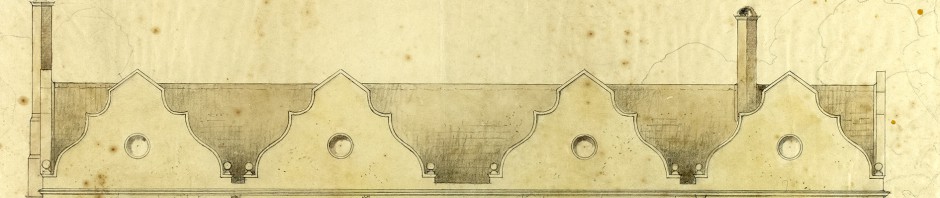
Research identified the property as being located in Blacklands Terrace, on the north side of Marlborough Road in Chelsea, London. We could not establish when it was built, but in 1655 it was understood to have been the residence of Charles Cheyne, later Lord Cheyne and Viscount Newhaven. In 1684, the recorded occupant was Count Montefeltro, survived by his Countess who was still residing there in 1696.
As of 1702, it was occupied by Mrs Judith Nazareau (or Nezerauw), who ran an expensive French boarding school for elite young ladies until the late 1720s. During 1715, Sir Robert Walpole’s two daughters were attending. It was thought to have continued in use as a fashionable boarding school, but the sources seem to have dried up somewhat, so it’s rather significant that this receipt from 1779 shows that this was definitely the case and that, presumably, Mary Stockley was the owner and headmistress there. Furthermore, we discovered a Miss Fearnside, a former pupil and later mistress at the school, died in 1811 aged 54, meaning that it was most likely she was teaching there when the Misses Grahams were in residence.
The function of the property changed in 1829 when it operated as a private asylum, until 1861, under the direction of Alexander John Sutherland (1811-1867), an established metropolitan physician and his son Alexander Robert Sutherland. After the death of the elder Alexander, it continued as an asylum for the insane with fifteen male inmates recorded in 1871.
In 1890, the Cadogan Estate bought out the Blacklands asylum and gave one acre of the estate to the Guinness Trust for working-class housing. The Guinness Partnership (as it is now known) still operates today, even though the property itself, sadly, has long gone.

