Prior to 1752, 25 March marked the first day of the new year, roughly coinciding with the spring equinox. It is known as Lady Day (Feast of the Annunciation) and was a day when accounts were settled. It was one of the quarter days used in England for financial and legal proceedings, the others being 24 June – Midsummer (Feast of St John the Baptist), 29 September – Michaelmas (Feast of St Michael and All Angels), and 25 December – Christmas Day (Feast of the Nativity).
In Scotland, the quarter days are 2 February – Candlemas (Feast of the Purification), 15 May – Whitsuntide (Pentecost), 1 August – Lammas (Long Mass), and 11 November – Martinmas (Feast of St Martin).
One item from the Graham collection provides details of tenants on the Nunnington Estate, and records the half year rent payments made on Lady Day in 1656. The document itself is dated 19 June 1656 (see below).
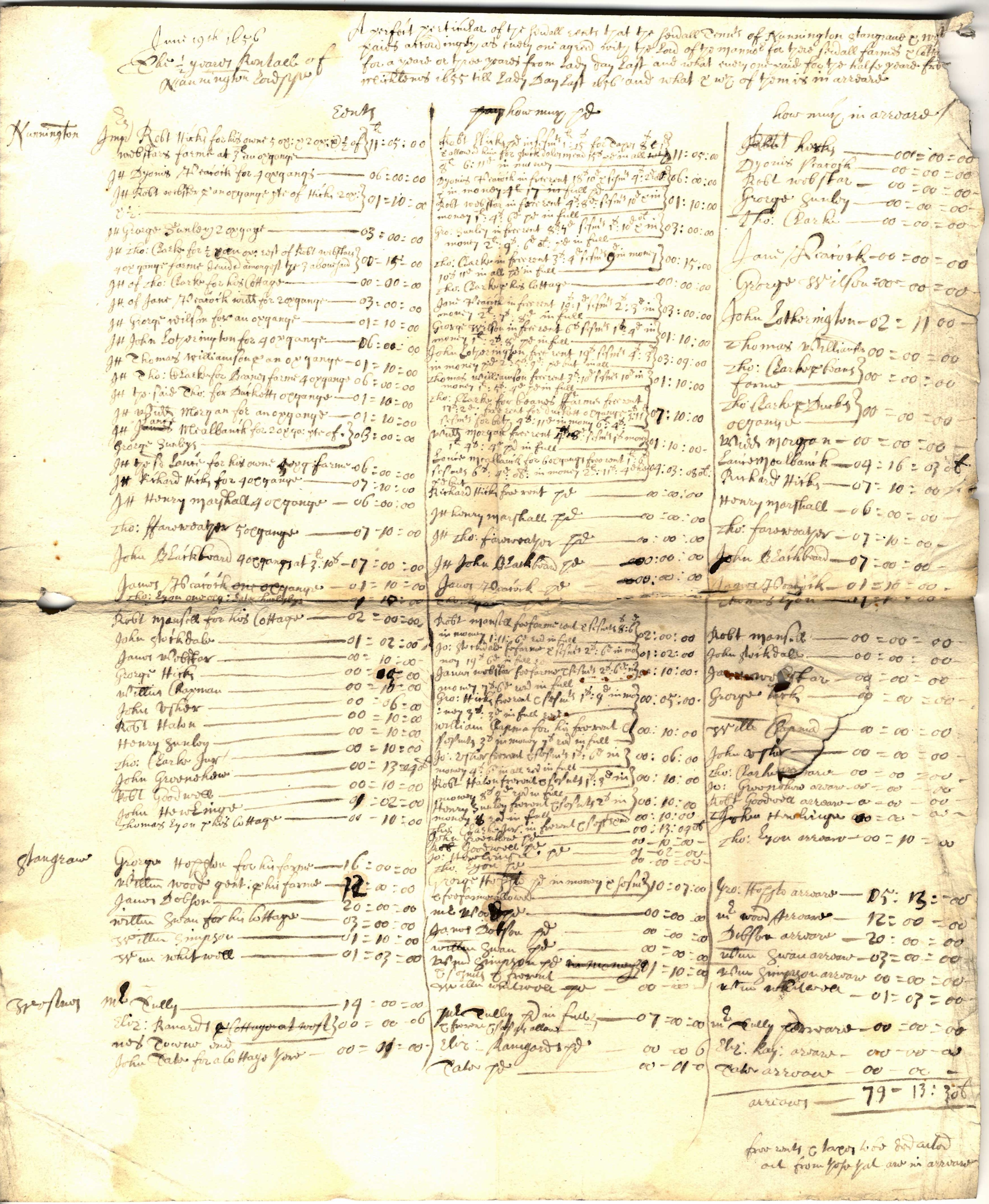
Nunnington estate rental, 19 June 1656 [ZKZ]
The initial statement reads:
“A perfect particular of the severall rents that the severall tenants of Nunnington, Stonegrave and West Ness paid accordingly as every one agreed with the Lord of the Mannor for there severall farmes and cot[tages] for a yeare or three yeares from Lady Day last and what every one paid for the halfe yeare from [torn] Michaelmas 1655 till Lady Day last 1656 and what and which of them is in arrears.”
The Lord of the Manor at this time was Ranald Graham, uncle to Richard Graham, 1st Baronet of Norton Conyers. Named tenants include John Blackbeard who rents 4 oxganges (a land measurement equal to 60-80 acres, based on fertility rather than purely size) for £7 0s 0d (£756 in today’s equivalent), but he is in arrears for this amount. Robert Mansell has paid his rent in full for his cottage and Elizabeth Ranard has paid for her cottage in West Ness.
Needless to say, other sources (such as maps, for example, if they survive) need to be consulted in tandem to try to identify where exactly these places/properties were located. This, in turn, helps to build up a picture of who was living where, what monies were being paid, and how this was administered. A document such as this gives a solid starting point from which to continue.

