by Jo Faulkner, Archives Assistant
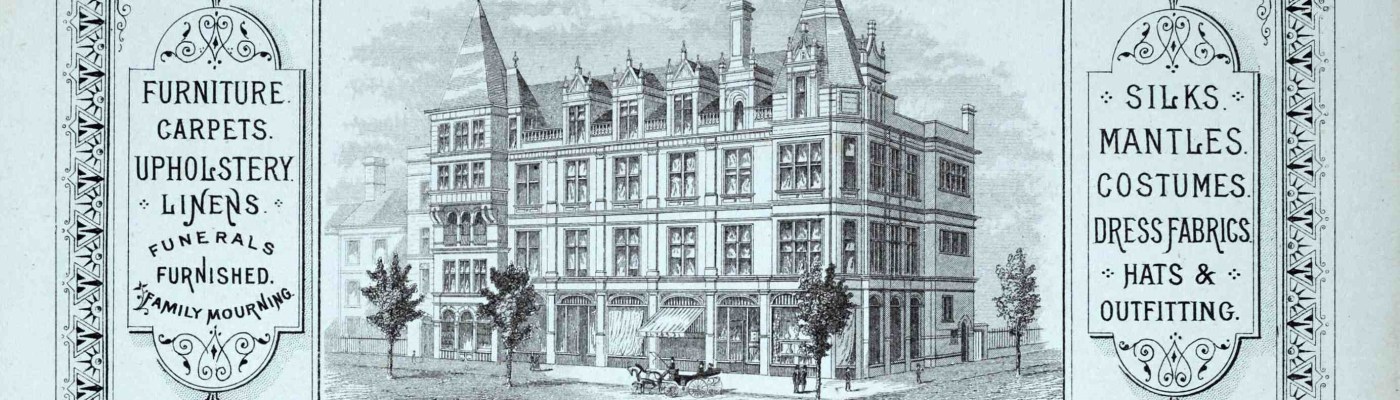
Rowntrees was a prestigious department store based in Scarborough. Some residents and visitors will remember the impressive Victorian building on Westborough. It was for many years renowned for its spectacular shop and window displays. Built in 1882, it was the first store in Scarborough to be lit by electricity. In 1988, the building was demolished to create the Brunswick Shopping Centre, which is presently scheduled for redevelopment.
In 1975, the manager of Debenhams, who had taken over the building some years earlier, deposited a collection of items relating to Rowntrees with the North Yorkshire County Record Office, now North Yorkshire Archives [ZSJ]. It is a collection containing a window into the world of retail in times gone by including a wealth of information on life as an employee and some curiosities!
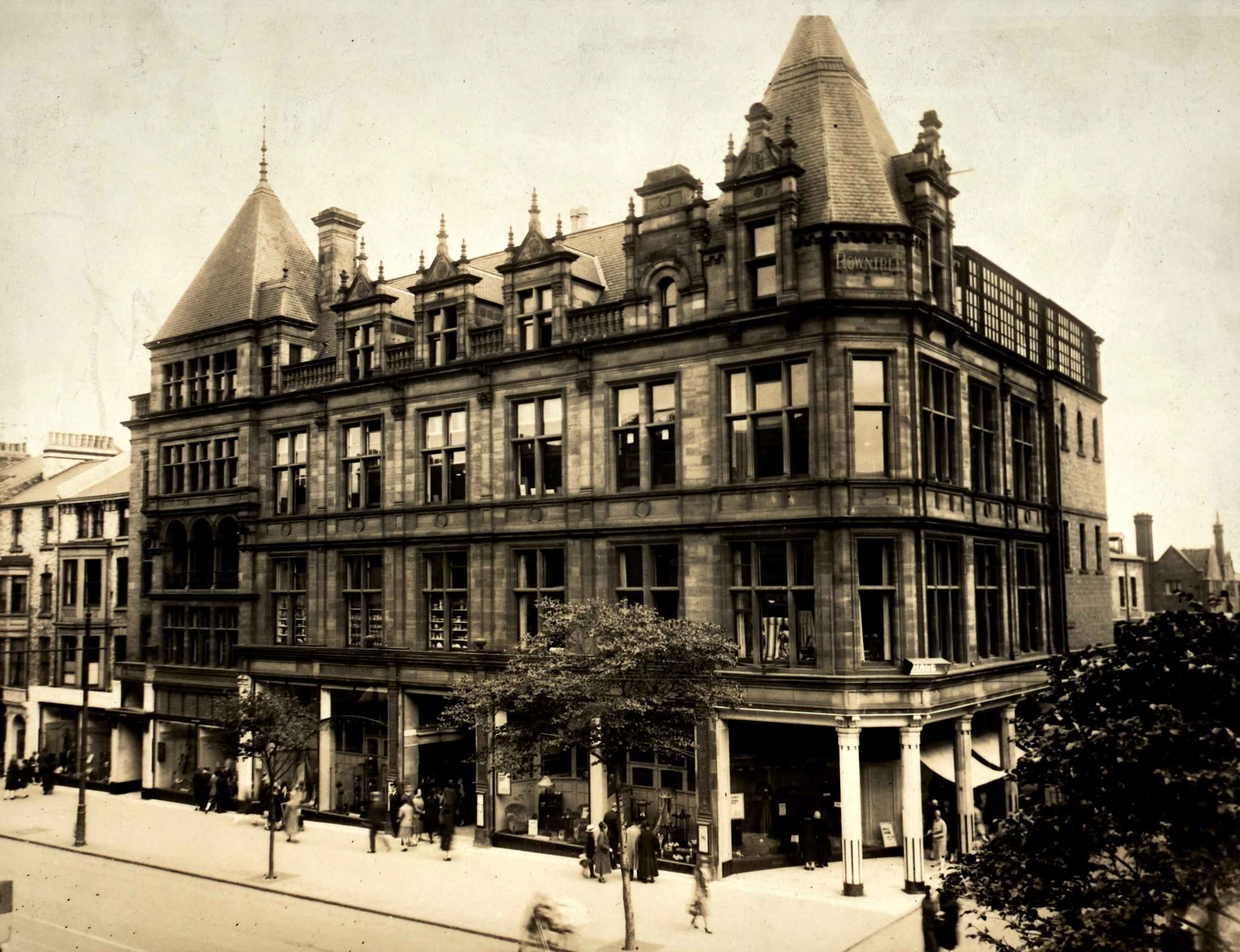
Rowntrees of Scarborough shop exterior in the mid-20th century [ZSJ 3/11]
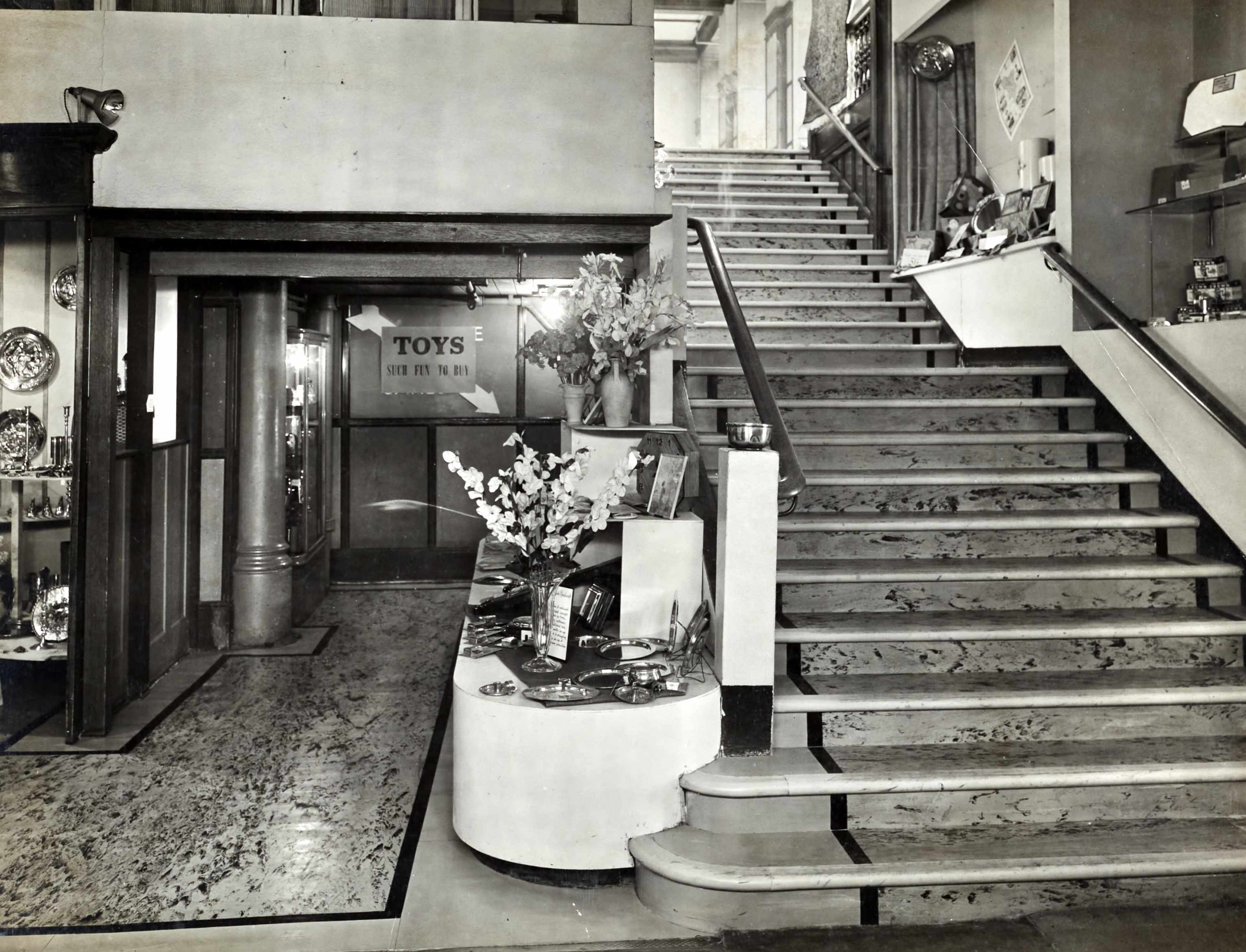
One of several photographs from the collection showing interior features of the shop in the 1940s [ZSJ 3/15]
A Quaker family
The Rowntrees were a prominent family in Scarborough. John Rowntree (1757–1827) set up a grocer’s shop in Bland’s Cliff. His youngest son Joseph (1801-1859) moved to York and set up a grocer and tea dealer’s shop at 28 Pavement. He became the head of the very well-known and successful York branch of the family.
Joseph’s oldest brother William (1786–1849) ran a business in Gateshead. His son John (1821–1894) returned to Scarborough, as an apprentice to his uncle John (1785–1845), who was a grocer and draper. The younger John took over the business when his uncle died. His first son, John Watson Rowntree, became a partner in the grocery business. He extended and developed the store at 33 to 39 Westborough, Scarborough.
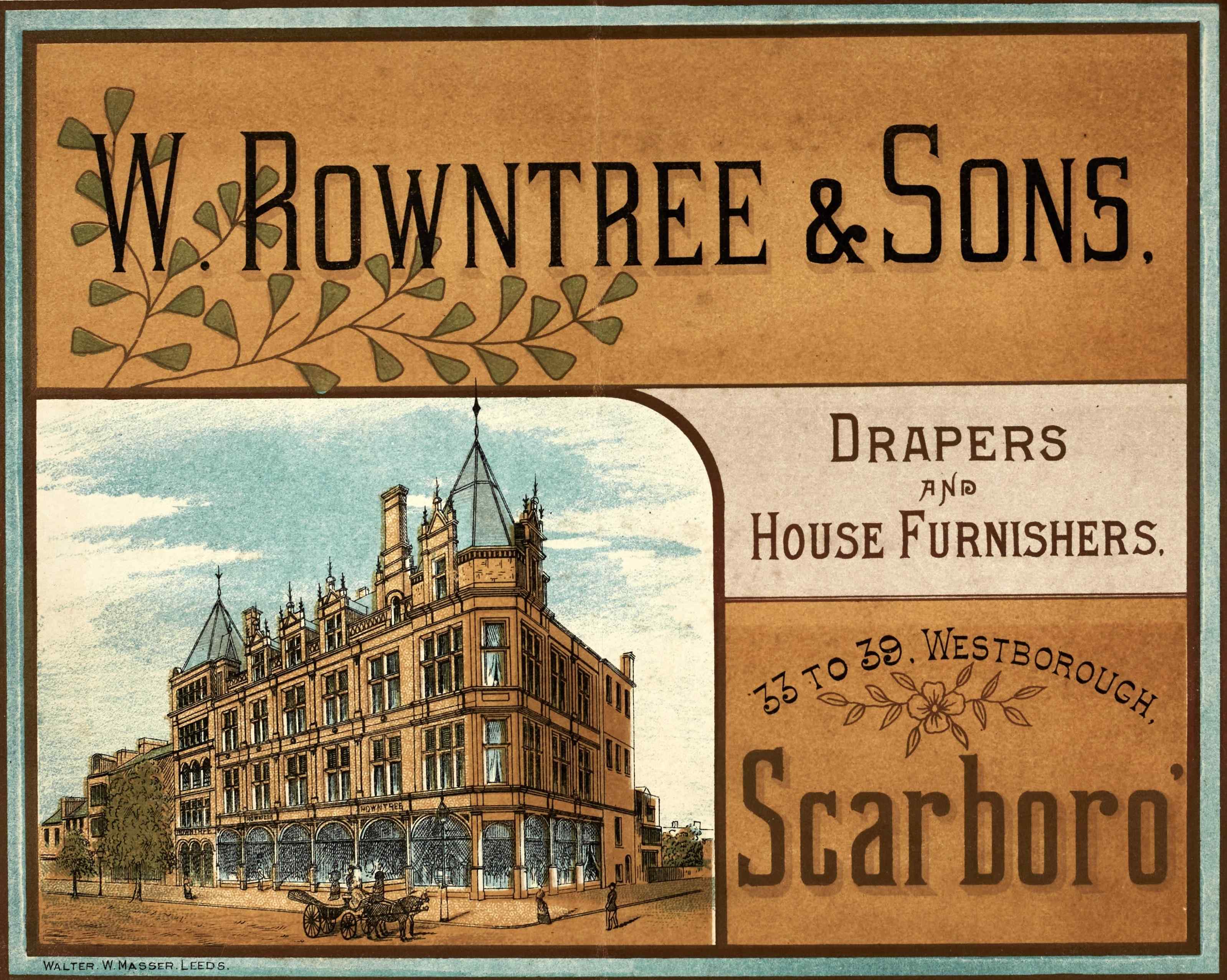
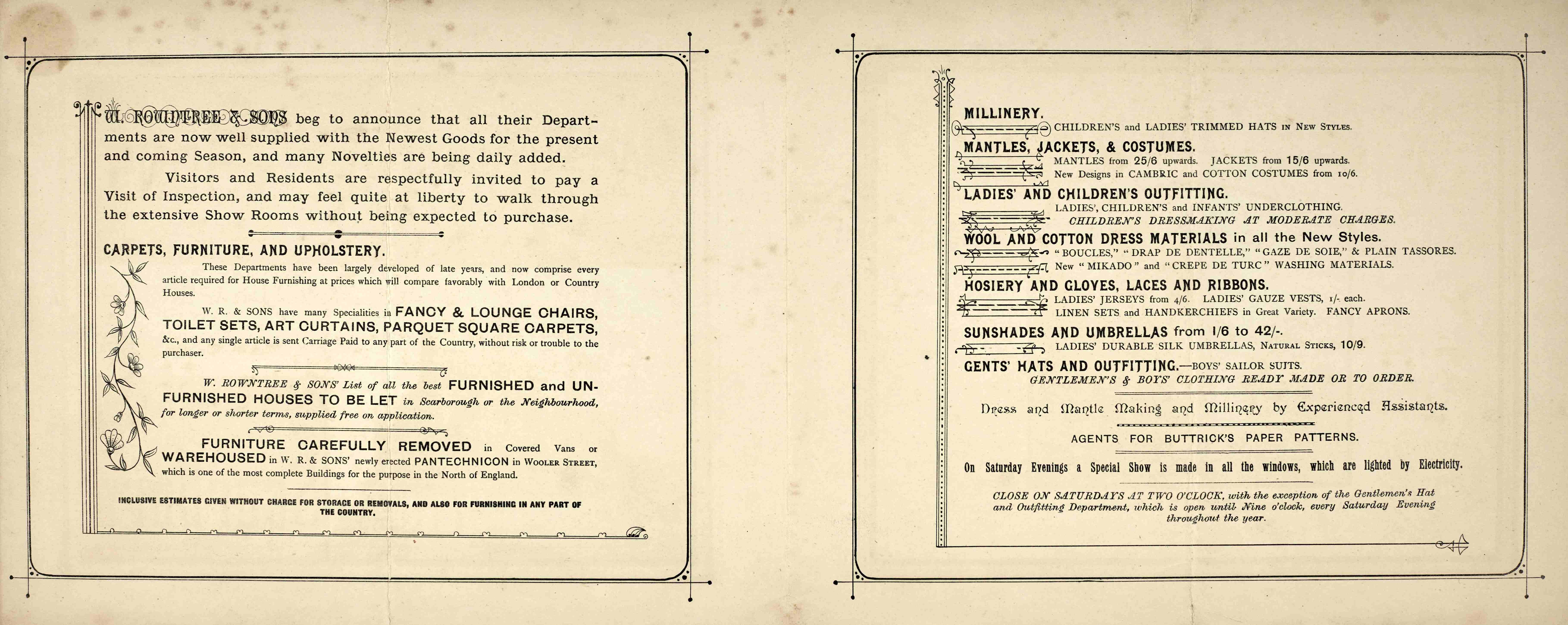
Advertising circular featuring an illustration of the Westborough store [ZSJ 2/14]
The family were dedicated Quakers; their Quaker beliefs influenced their working and social ethics. In a handwritten document in the collection headed ‘The Psychology of Business’, William Rowntree states:
‘The strong sense of the value of every human personality which lies at the very foundation of the Quaker faith made it likely that Friends should resist longer than others this tendency to regard their employees and customers in the mass rather than as individuals’.
He continues that, as in many Quaker businesses:
‘every assistant was really one of the family’ and ‘the relation between buyer and seller was often one of friendship as much as of trade’.
Development and technology
The company introduced their new store in their October circular of 1882:
’W. Rowntree & Sons beg to inform their friends that they have removed their business to more extensive and commodious premises situated at no’s 33 to 39 Westborough, Scarborough’.
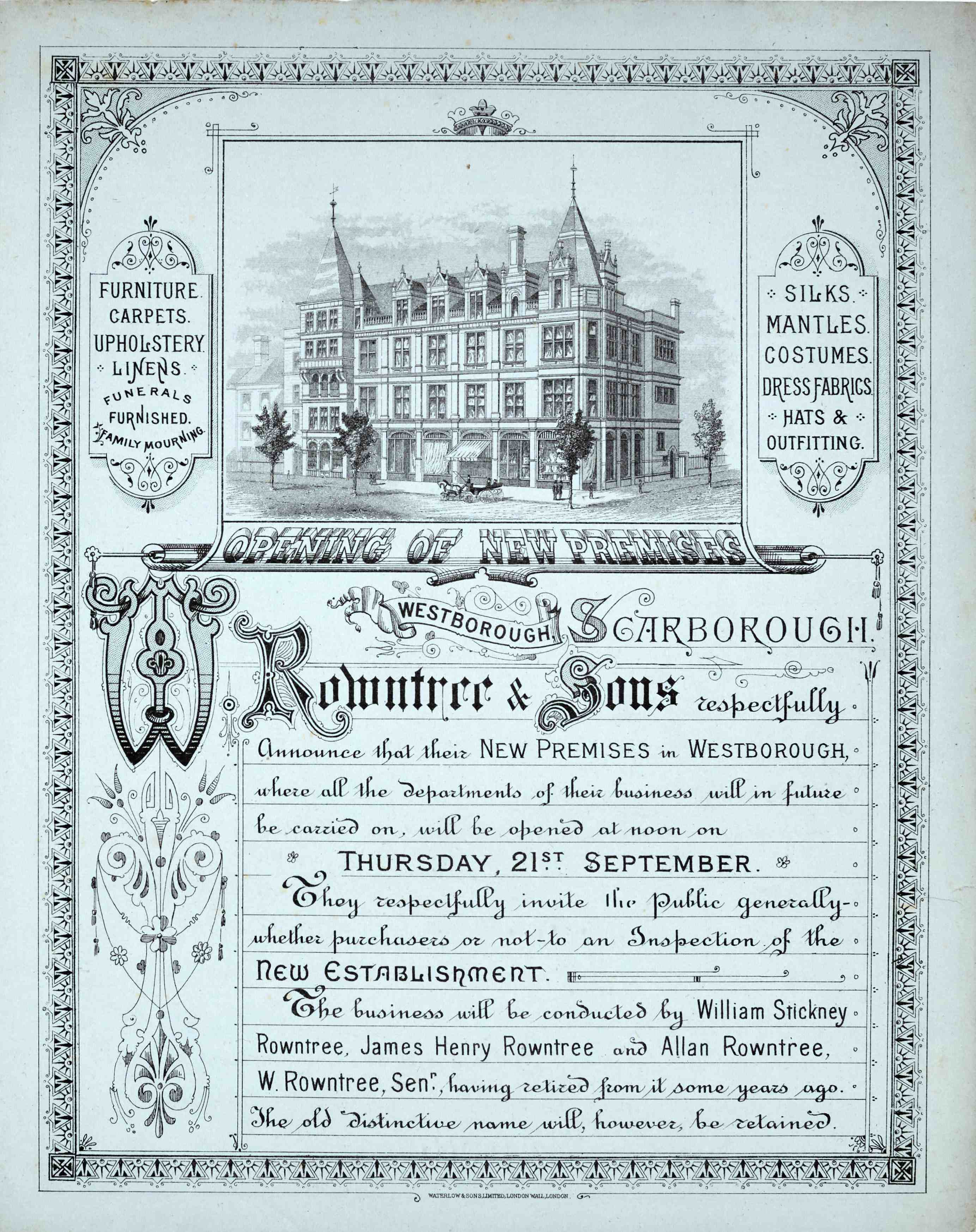
Circular promoting the opening of the new store [ZSJ 2/3]
The Rowntrees embraced technology and innovation. Visitors to the shop were some of the first shoppers to be provided with the comfort and convenience of electric lighting and hot-water heating.
They explained:
‘It is the intention of W Rowntree & sons to sell everything at the …scale of profit and for this purpose the custom of allowing discount will be discontinued and all goods will be marked in plain figures at net prices. Interest will be …on overdue accounts….the establishment will be lighted by Swan Incandescent electric lamps (the motive power being supplied by an Otto gas engine) thus rendering the atmosphere more pure and facilitating the selection of colours when daylight is gone’ and ‘the large outlay incurred in the erection of new, commodious and handsome premises’ a considerable investment.’
In 1885, the store was connected to the telephone network; the telephone number was 7. A leaflet explains to customers (most of whom would not have their own telephone) that they could contact the store by one of three designated public telephones for 3d, which would be refunded.
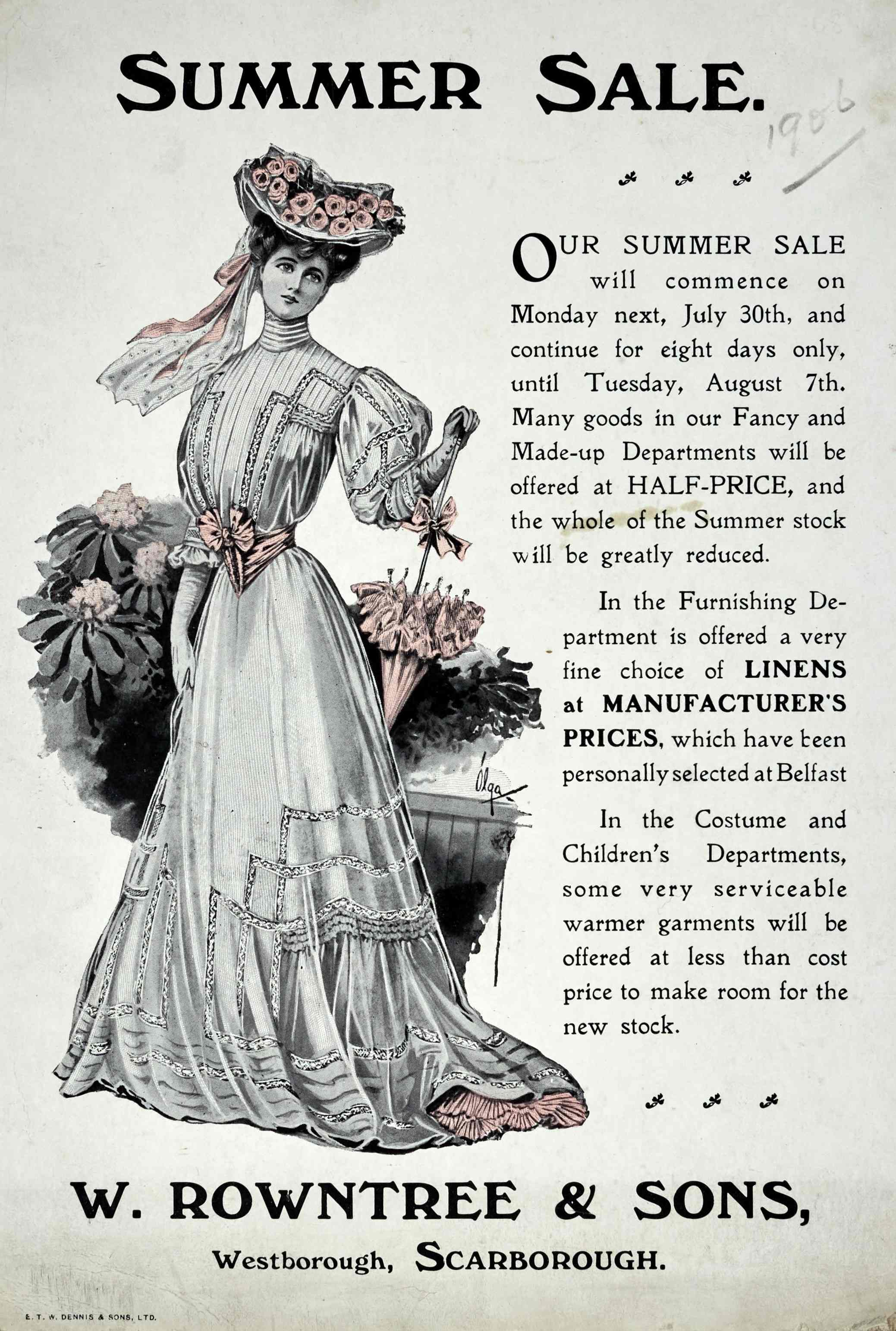
Summer sale circular, 1906 [ZSJ 2/8]
Services offered
The Rowntree family recognized that offering extra services could put them ahead of the game in the emerging modern world of retail. The store opened on Saturdays (although most departments closed at 2pm) and for those who found visiting the store inconvenient, a salesman could visit them at home.
Alongside the retail business, the Rowntrees operated several additional services. They furnished and conducted funerals, offered a removal and storage service and acted as estate agents.
The services offered by W. Rowntree & Sons in furnishing funerals appears to have extended to pets. This curious photograph has a note on the back describing that the image shows a ‘coffin made for an old lady with a miniature coffin for her pet (probably a parrot) which she requested to be buried with her.’ The man on the right is identified as Billy Gatus, a cabinet maker employed by Rowntree’s.
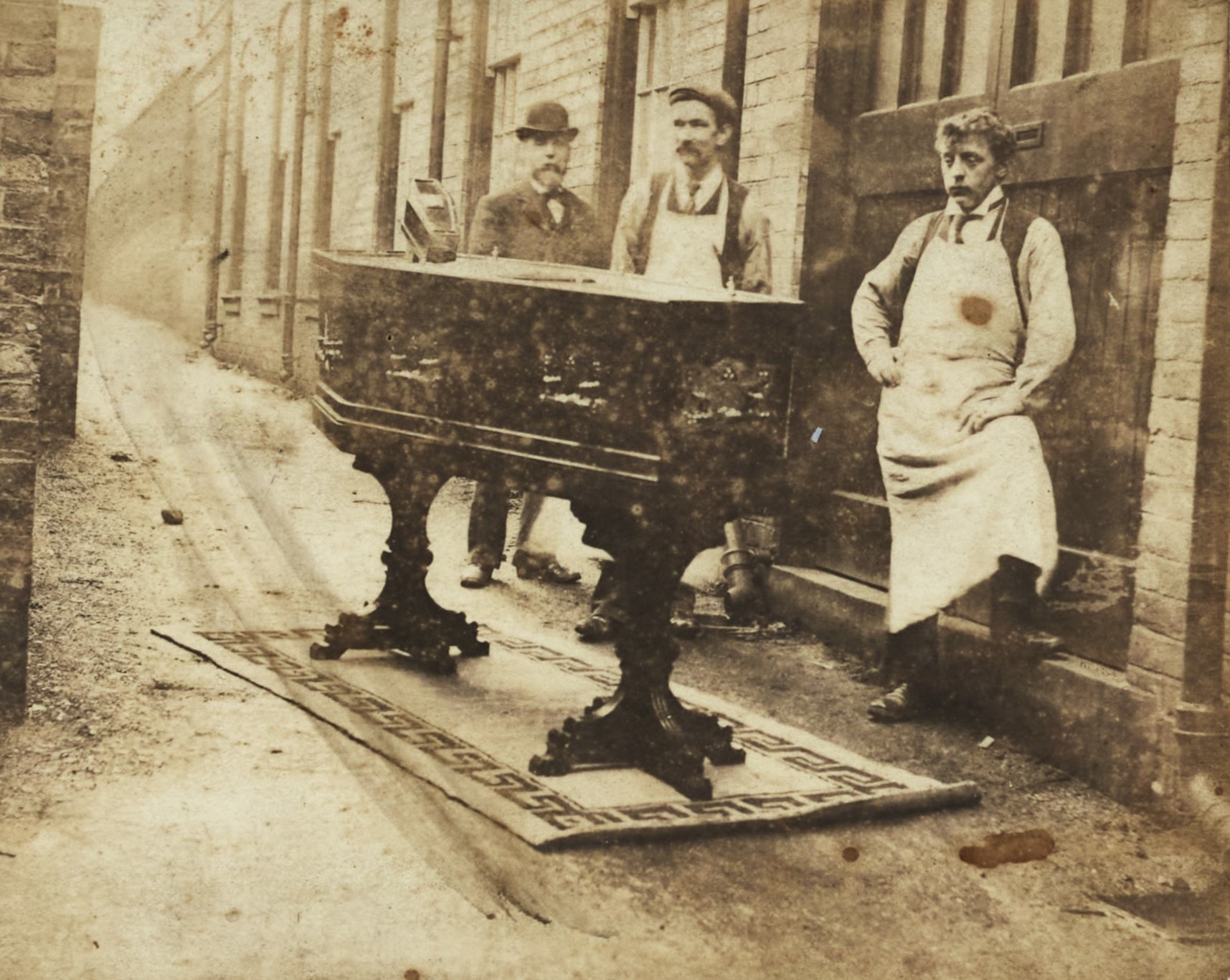
Photograph of a coffin and miniature coffin supplied by Rowntree’s craftsmen [ZSJ 4/16/1]
Transport was key to the services offered by Rowntrees. They advertised:
‘Houses completely furnished …funerals furnished and conducted throughout” and “furniture removed in covered vans or warehoused at moderate rates.’ ‘Nine specially constructed vans of various sizes for both large and small removals with the least possible expense for dead weight of the vans themselves.’
Rowntrees was the first business in Scarborough to make use of the commercial possibilities of the aeroplane. They received their first batch of goods (gowns and blouses) by air on 5 June 1919.
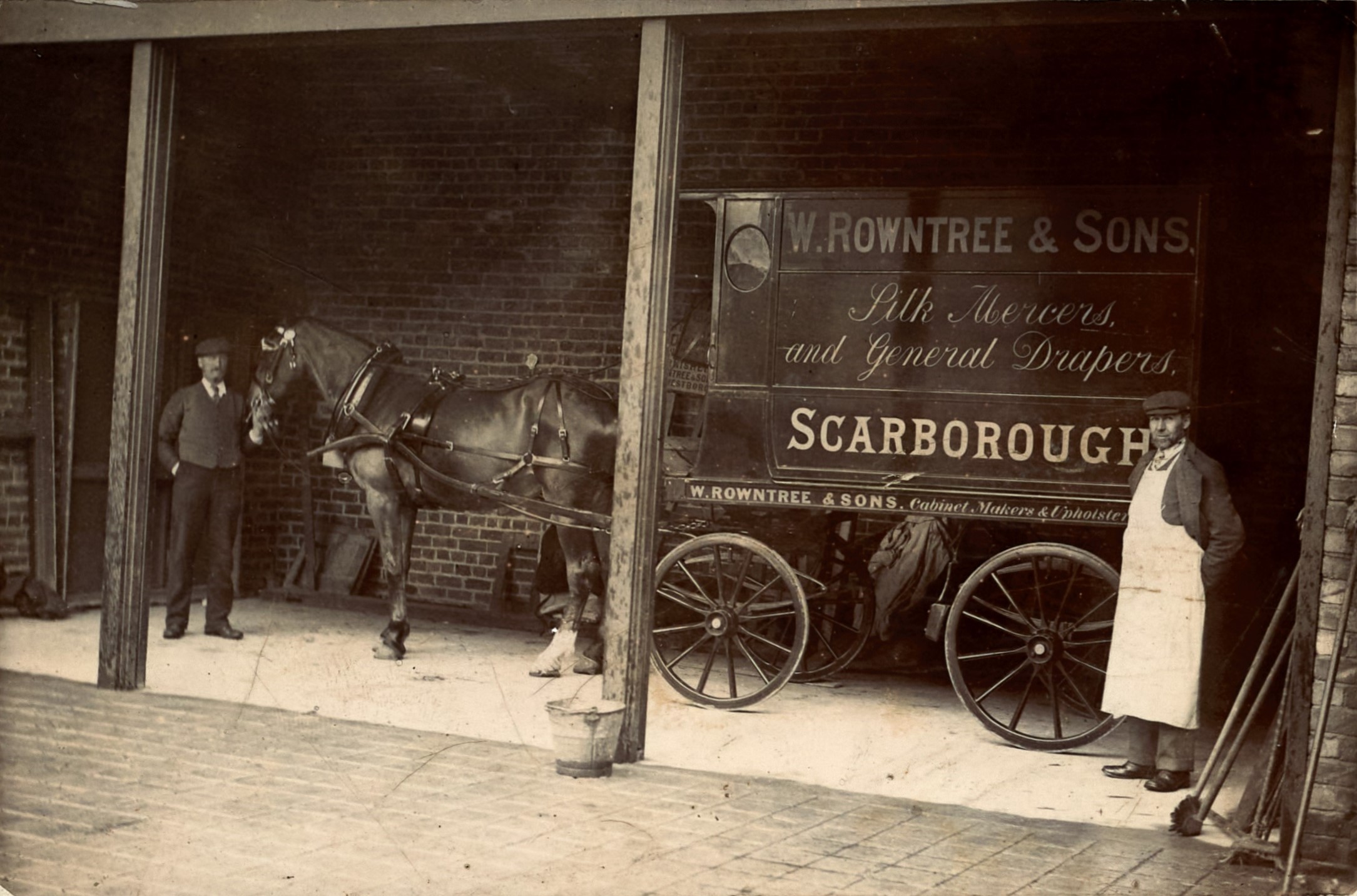
Horse-drawn vehicle used by Rowntrees [ZSJ 4/16/3]
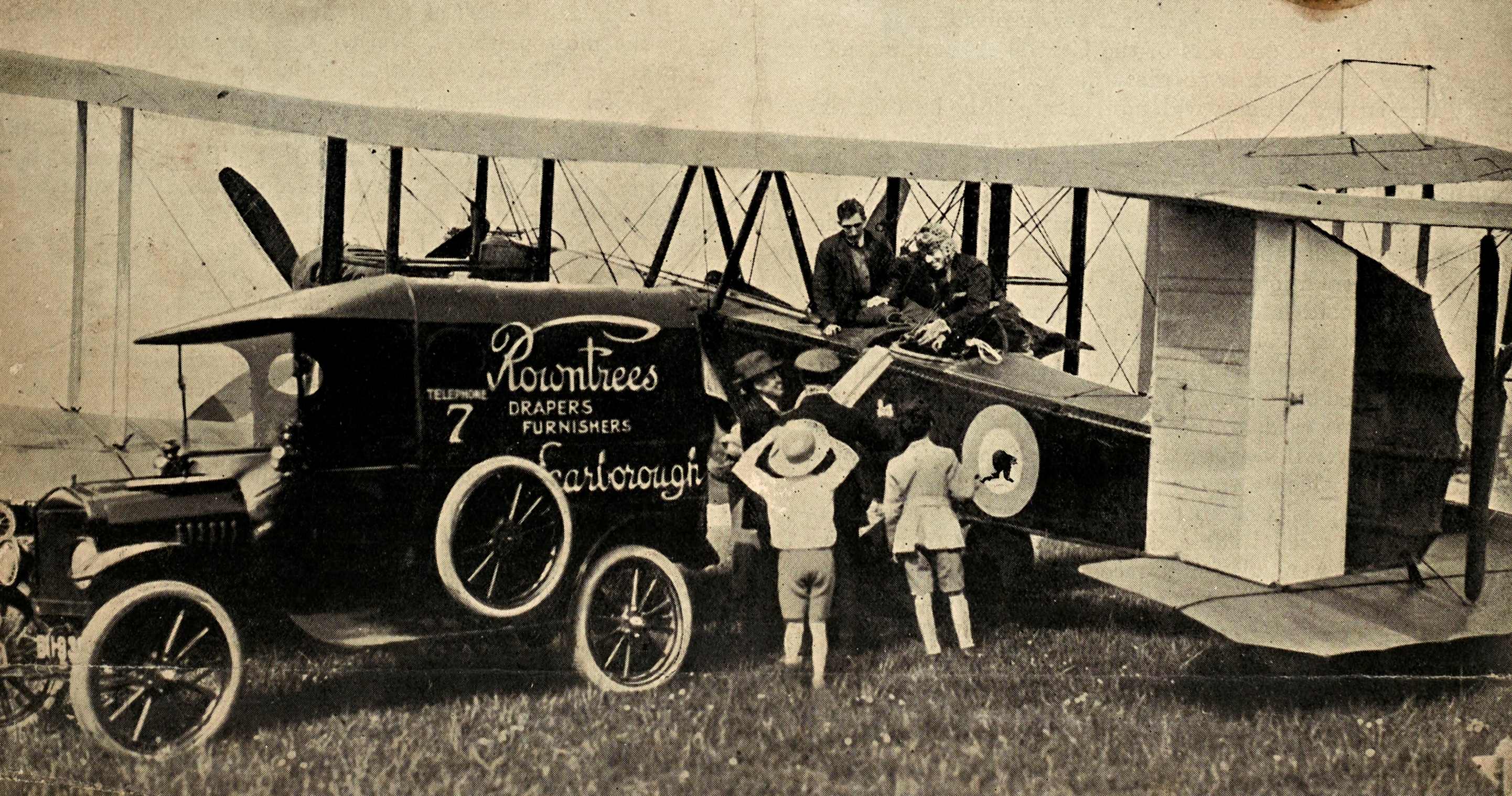
Delivery by aeroplane, 1919 [ZSJ 3/5]
Staff
In 1820, the business employed only one journeyman and two apprentices. By the 1930s, Rowntrees employed almost 400 people. Although the collection does not include extensive lists of staff, it does include names of some Rowntree staff (pre-dating the Westborough store) etched into 2 wooden boards. The origin of these boards is unrecorded.
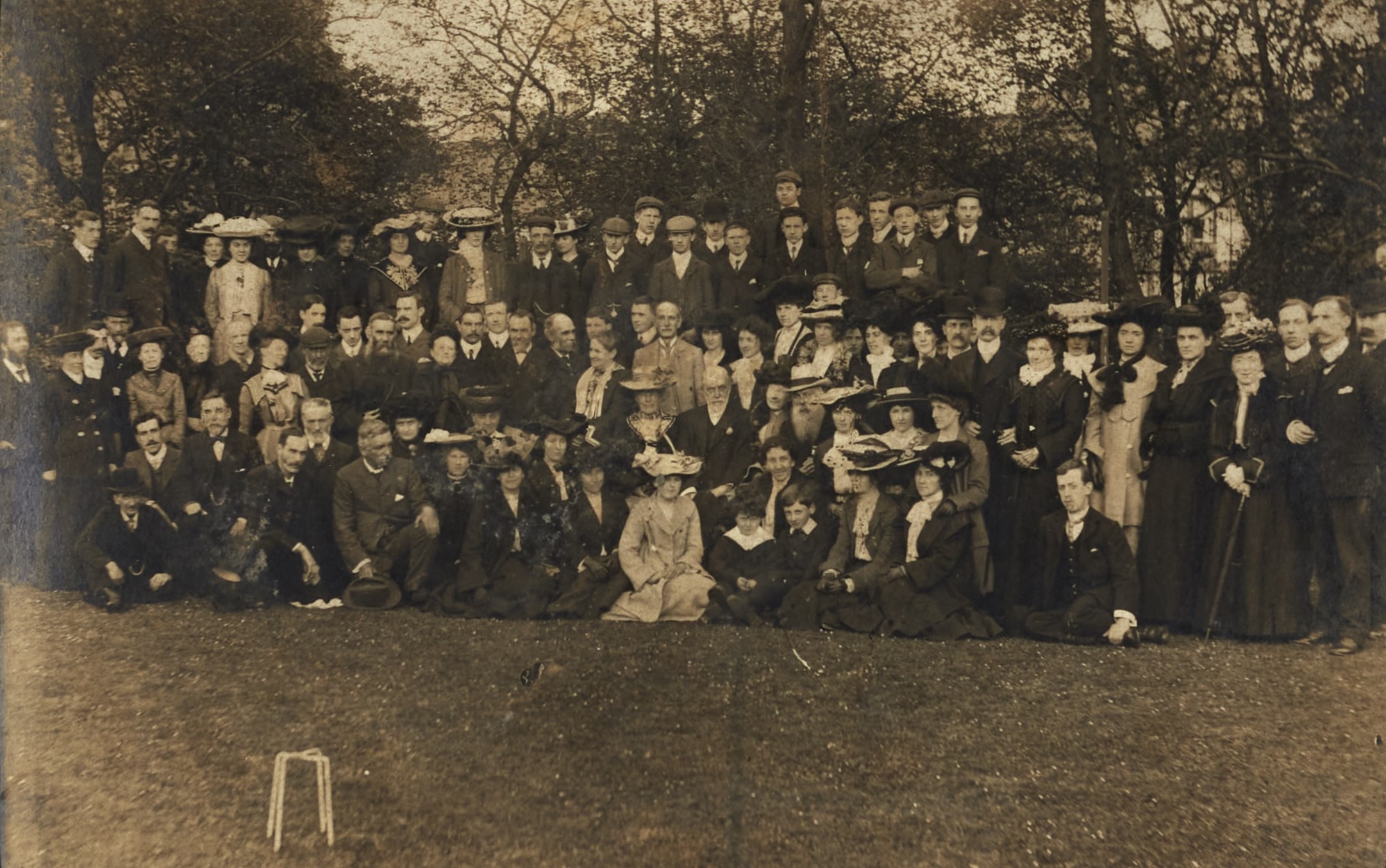
A staff picnic outing, 1910 [ZSJ 4/16/9]
The staff at Rowntrees operated a staff council from around 1918. Records of the staff council dating between 1918 and 1946 offer a glimpse into the social life of the staff and the benefits afforded them as employees of the firm and members of the council.
Various committees operated services such as the canteen, library service and investment fund. Apprentices were supported with guidance and lectures. Staff and their families could access a welfare fund for grants and loans in times of hardship, and they could enjoy sports and recreation at the Oriel Crescent pleasure ground. Excursions were organised to destinations as far afield as Edinburgh, with special trains providing transport. Staff and their families were allowed to attend these excursions, and the number of attendees frequently exceeded 200 people. Events such as whist drives, high teas and dances raised money for charities such as Barnardo’s and St Dunstan’s. Covering the years of the Second World War, the collection includes notes and correspondence relating to ‘fire-watching’ and air raids. Papers also show that staff were involved in fund-raising efforts for the war. A knitting circle was set up and ‘woollies’ were sent to service personnel and later to people suffering hardship in Europe. The records from the staff council also show that staff were consulted on issues such as opening hours, length of breaks and holidays.
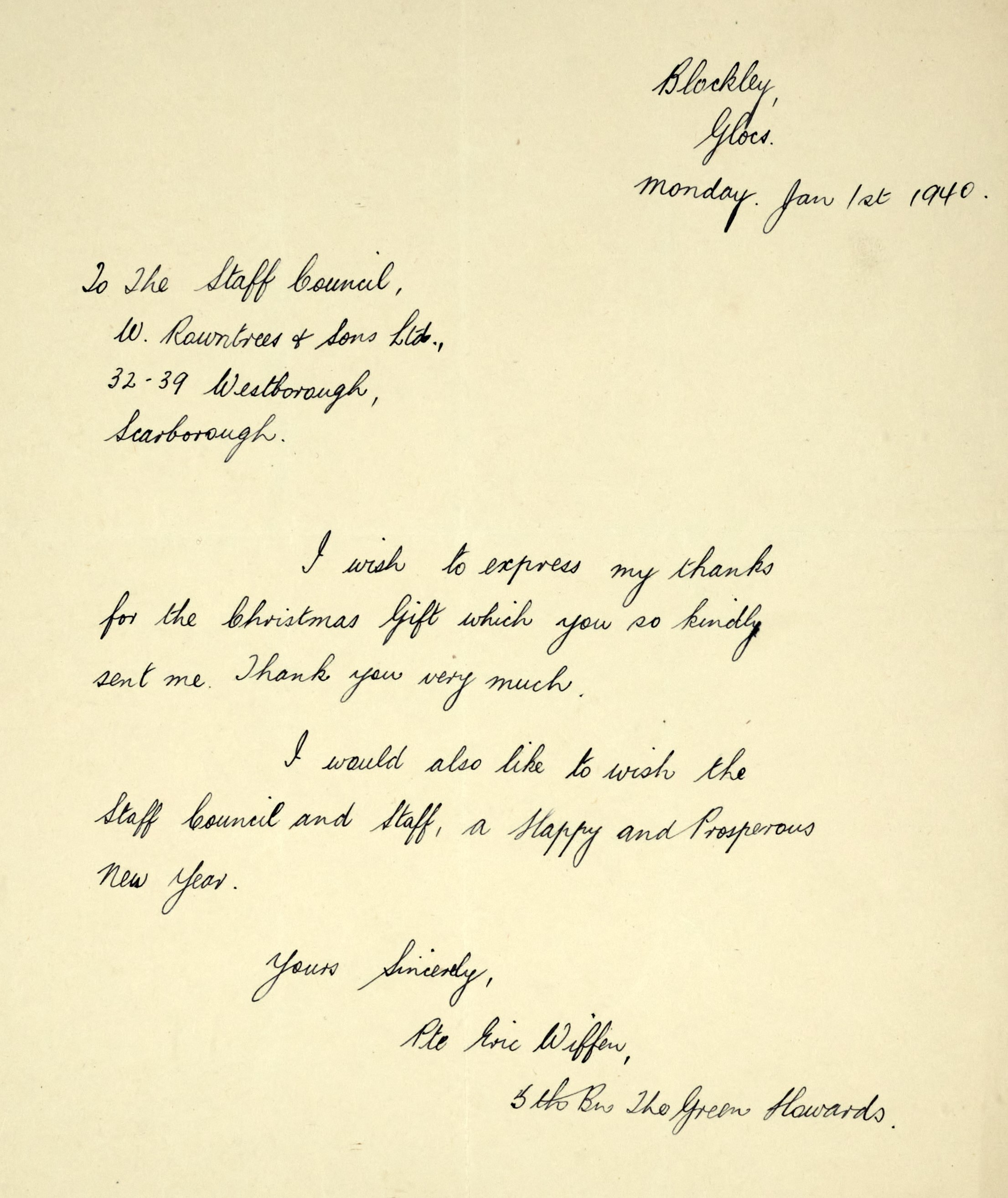
Letter of thanks to the staff council from Private Eric Wiffen serving with the Green Howards, 1 January 1940 [ZSJ 4/11] – Eric would not survive the war; he died at Tobruk in 1942 aged 21 years and is buried in Libya
A small collection of items relates to George Wilson, who was a driver for Rowntrees. George began working for the company in 1867 and did so for over 50 years. There appears to have been a personal connection between the Wilsons and their employers. A pair of dolls boots knitted for George’s granddaughter Edith by Mrs Rowntree is among the small group of objects.
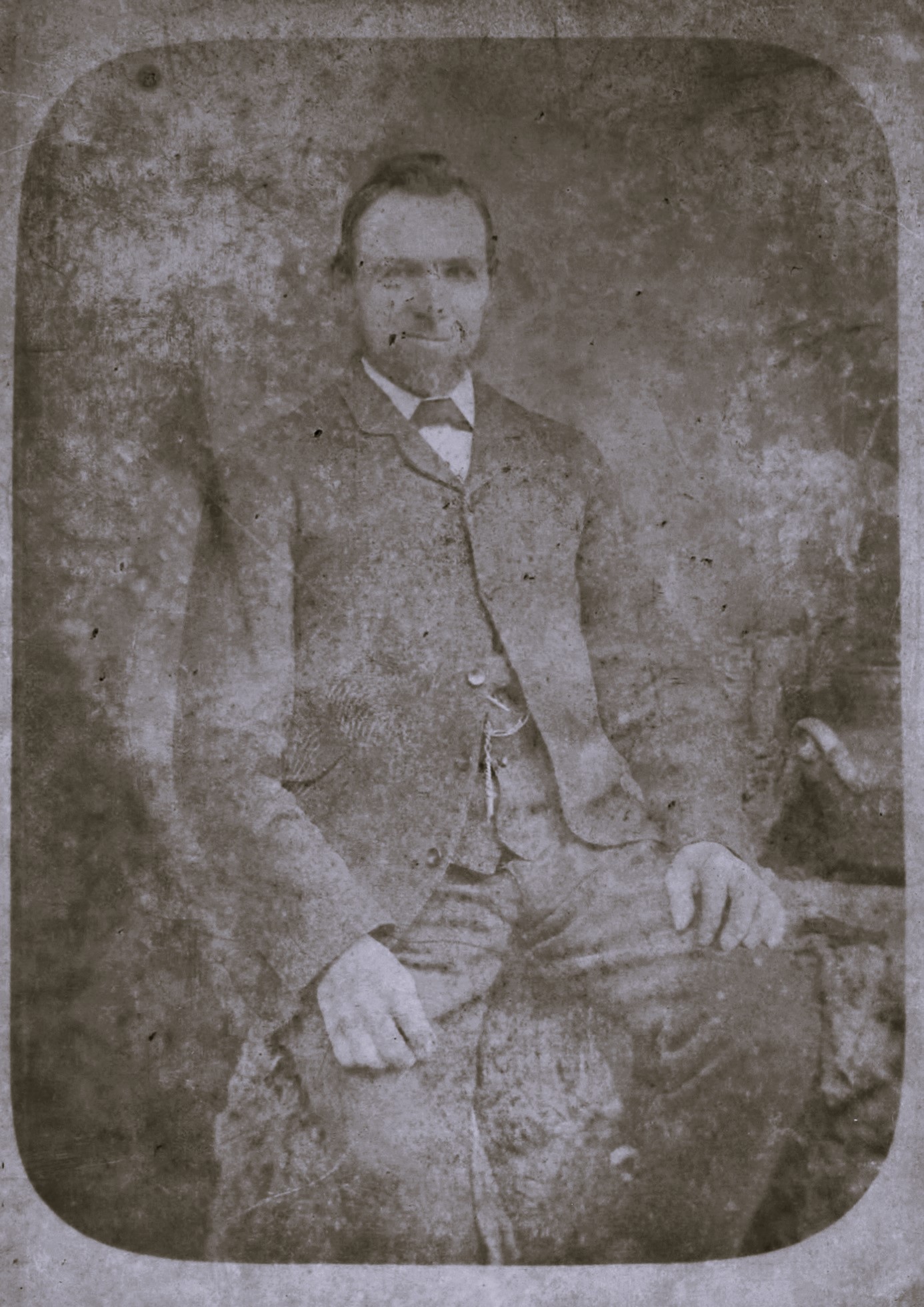
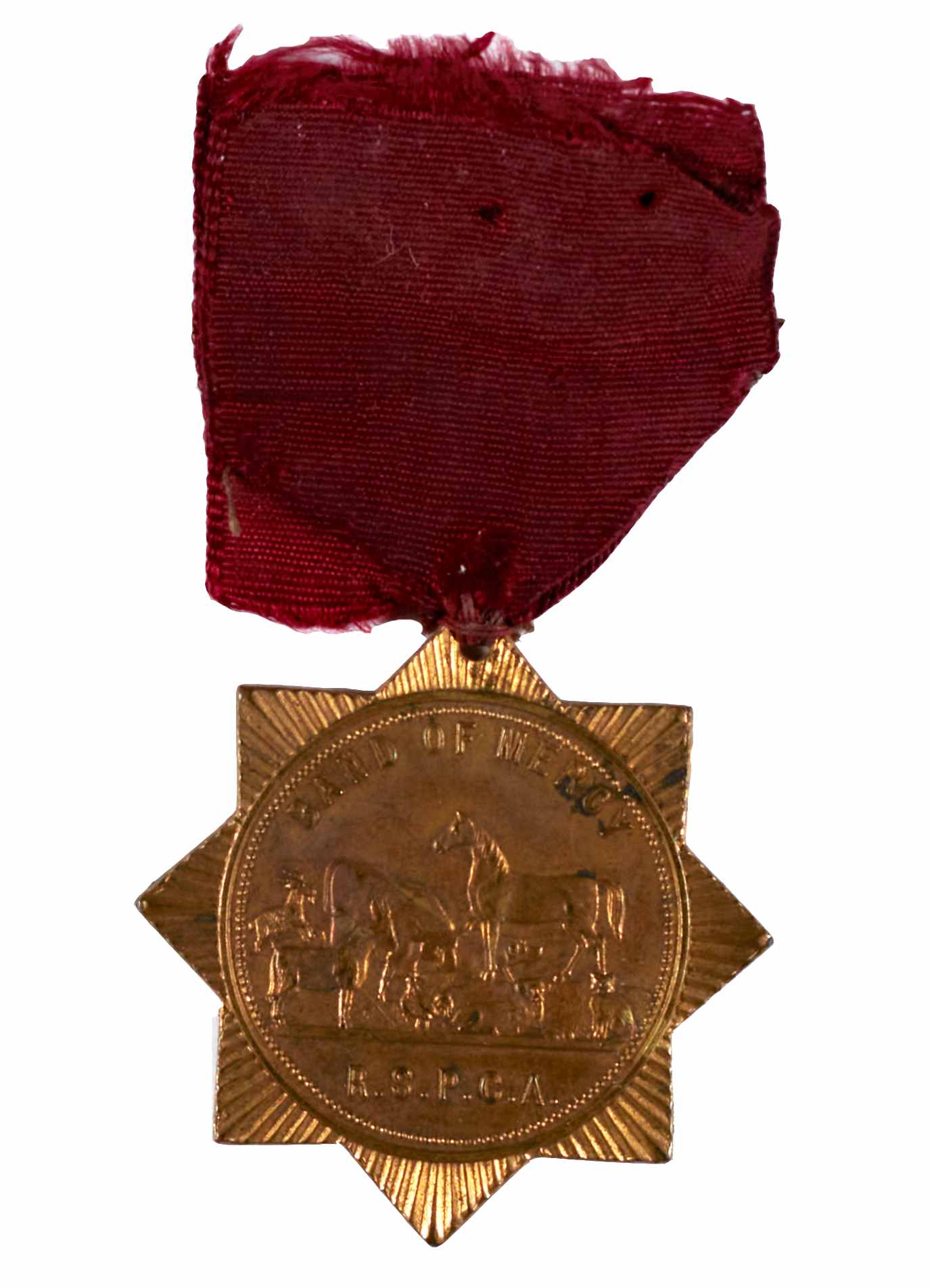
Photo of employee George Wilson [ZSJ 4/16/2] and RSPCA medal belonging to George Wilson [ZSJ 4/17]
The collection relating to George Wilson includes a small medal issued to members of the ‘Band of Mercy’, a youth organisation formed in 1875 to campaign against animal cruelty. The ‘Band of Mercy’ became part of the Royal Society for the Prevention of Cruelty to Animals (RSPCA) in 1883. Members were required to sign a declaration stating, ‘We agree to be kind to animals, and to do all in our power to protect them from cruelty and promote their humane treatment.’ George was responsible for caring for the horses which pulled the vehicles transporting goods for Rowntrees.
Painted glass fragment
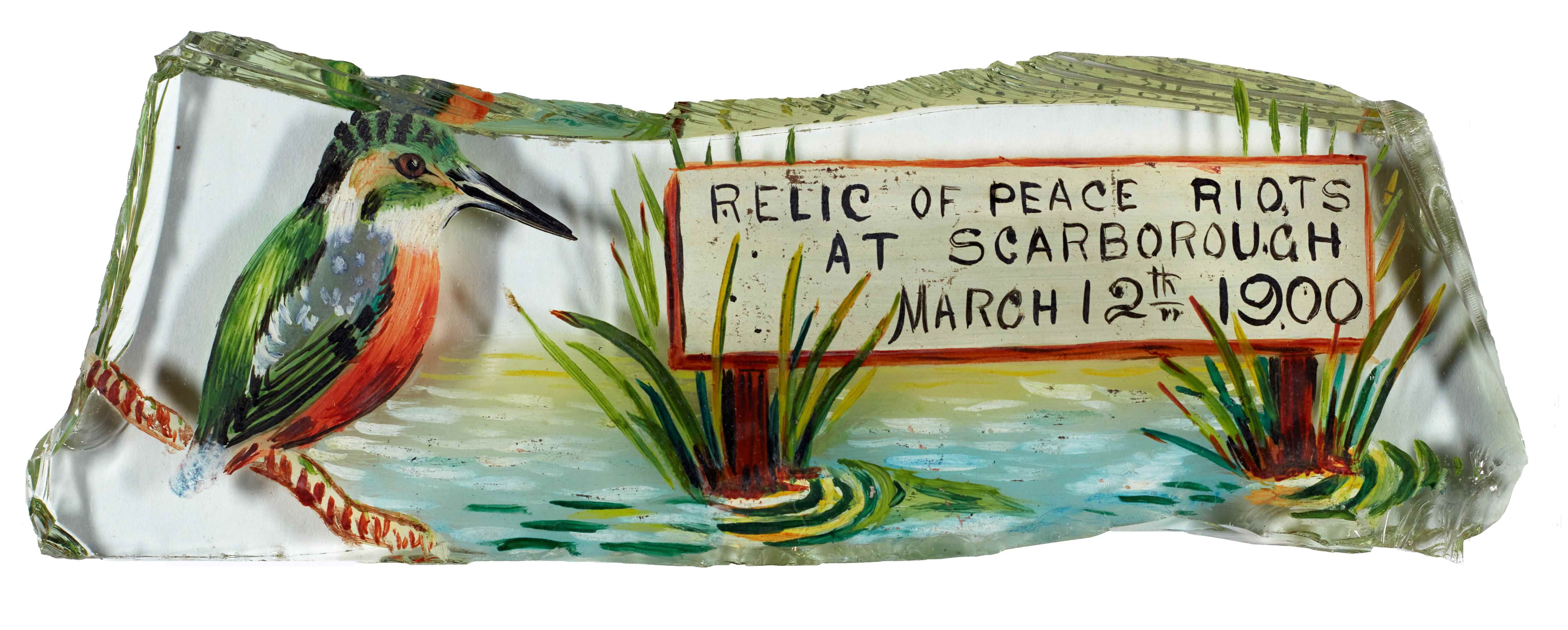
Glass window fragment kept as a relic of the Scarborough riot, 12 March 1900 [ZSJ 4/23]
The Rowntree collection is unusual in that it includes some objects. A glass fragment from a window broken on 12 March 1900 has been preserved and decorated. It tells the story of a tumultuous time in Scarborough and unruly events centred around the Rowntrees and their businesses.
The incident became known as the ‘Schreiner riots’ after pro-Boer advocate Samuel Cronwright- Schreiner. Joshua Rowntree was president of the South African Conciliation Committee that opposed the Boer War. He had invited Schreiner to visit the town to promote an end to the Boer War. On the evening before Schreiner’s lecture, a private meeting at John Rowntree’s café in Westborough was planned. In the evening, groups of people opposing Schreiner began to gather in Westborough. The assembled crowd sang ‘Soldiers of the Queen’, ‘Rule Britannia’, and ‘God save the Queen’. The police were brought in to keep these crowds away from the café. A stone was thrown at the windows of the café and it was reported that ‘the crashing of glass heralded several hours of smashing and wrecking’, the crowd cheering each time a pane was shattered. It was also reported that one enterprising local was selling stones to be hurled.
The assembled committee decided that the meeting should be cancelled, and they left using a side entrance on to Huntriss Row. They faced jeers, calls of ‘Judas’ and some violence.
The rioters continued to attack the café and the police, who rode through the crowd. The crowd, moved on to John Rowntree & Sons Grocers shop and then to the W. Rowntree & Sons store and broke all exposed windows. The Mayor and the Chairman of the watch committee contacted the military authorities for assistance. Eighty soldiers marched towards the rioters. Instead of attacking the soldiers, the crowd again began to cheer and sing ‘Soldiers of the Queen’. After a plea from the Commanding Officer to let his men go home to bed, the crowd began to disperse in the early hours of the morning.


a really interesting article Jo, I learned a lot. Thank you.