Born in Bloomfield Essex on 17 April 1889, Abbott was the son of a Pork butcher. He had three siblings, two from his father’s first marriage and one, Harold, from his father’s second marriage.
In 1911, C.C. Abbott was working as a School Master at the Grammar School in Streatham. In 1918, he was working at a secondary school of 330 pupils in Middlesbrough teaching English. He, or his employer, had appealed against his conscription and the local and North Riding Appeal Tribunal had given him exemption, conditional upon his remaining in his current post. The Military Representative disagreed with this and appealed to the Central Tribunal, who decided that C.C. Abbott “be not exempt from military service.”
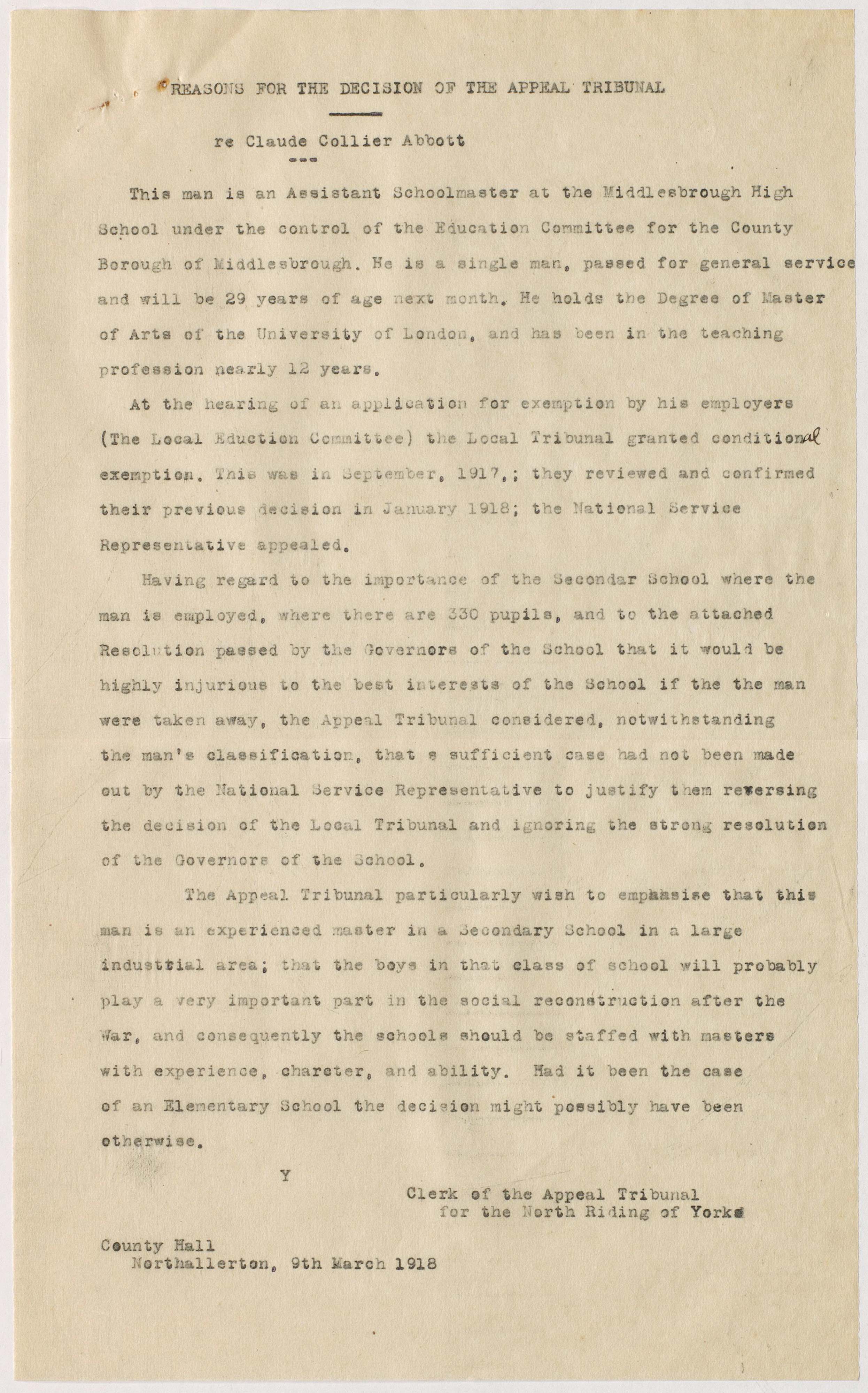
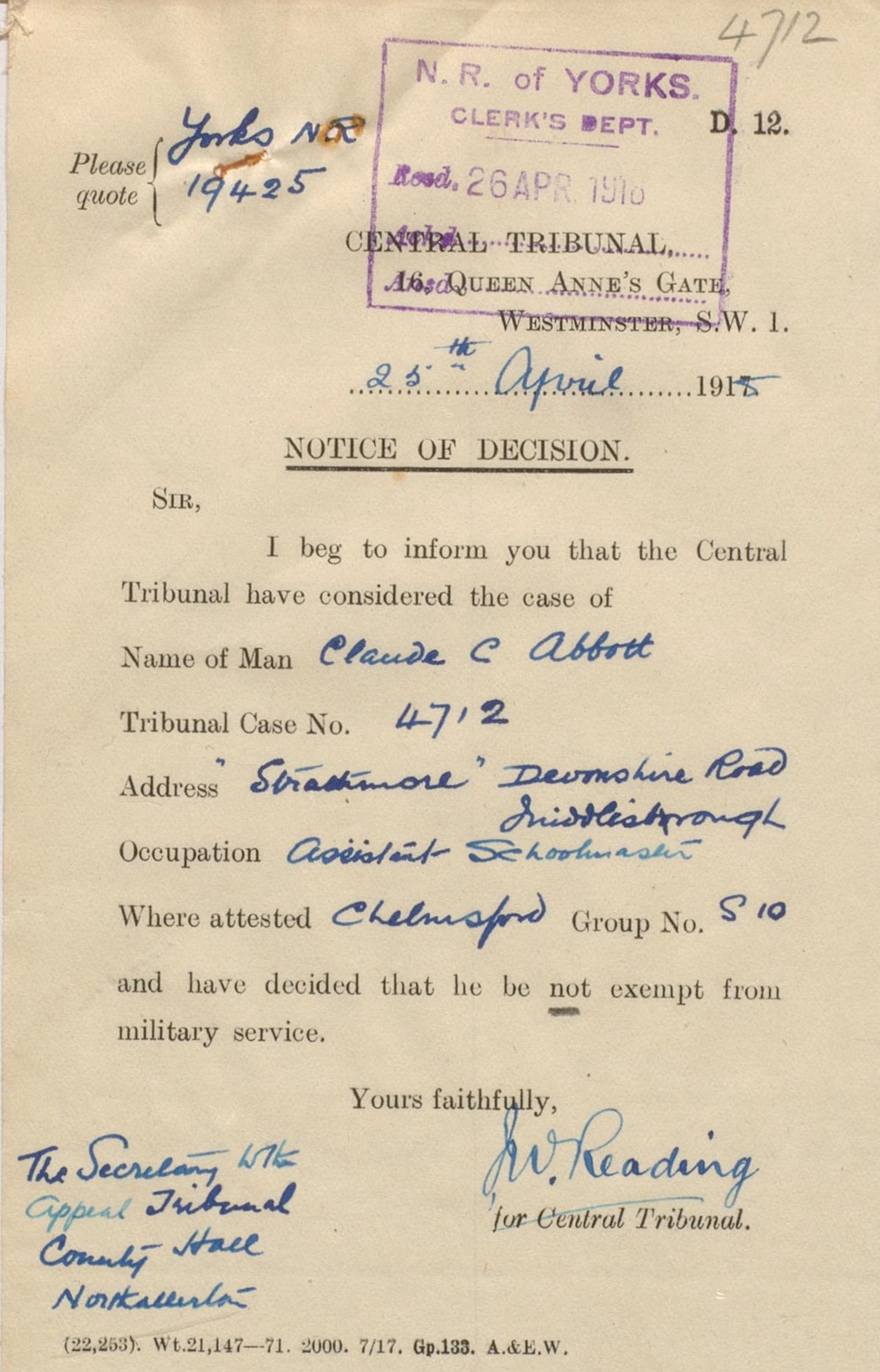
Appeal Tribunal papers for C.C. Abbott: Reason for decision, 9 March 1918 & Notice of Decision, 25 April 1918 [NRCC/CL 9/1/4712]
In 1918, C.C. Abbott joined the Artists Rifles as a private. The regiment was formed in 1859, and was organised in London by Edward Sterling, an art student. Various professional painters, musicians, actors, architects and others involved in creative endeavours joined the ‘Artists Rifles’. On 28 February 1860, it became the 38th Middlesex (Artists’) Rifle Volunteer Corps, with headquarters at Burlington House, London. By 1914, it particularly attracted recruits from public schools and universities.
After the war, C.C. Abbott lectured at Aberdeen and Durham Universities, before becoming Professor of English at Durham, 1932-1954. He collected 19th– and 20th-century British art as well as manuscripts and books. He was also a published poet. His collection of manuscripts and papers is held at Durham University Library, Special Collections, Palace Green, Durham. Following his death on 17 September 1971, C.C. Abbott’s library was bequeathed to the University of East Anglia and his art collection to Carlisle Art Gallery.

