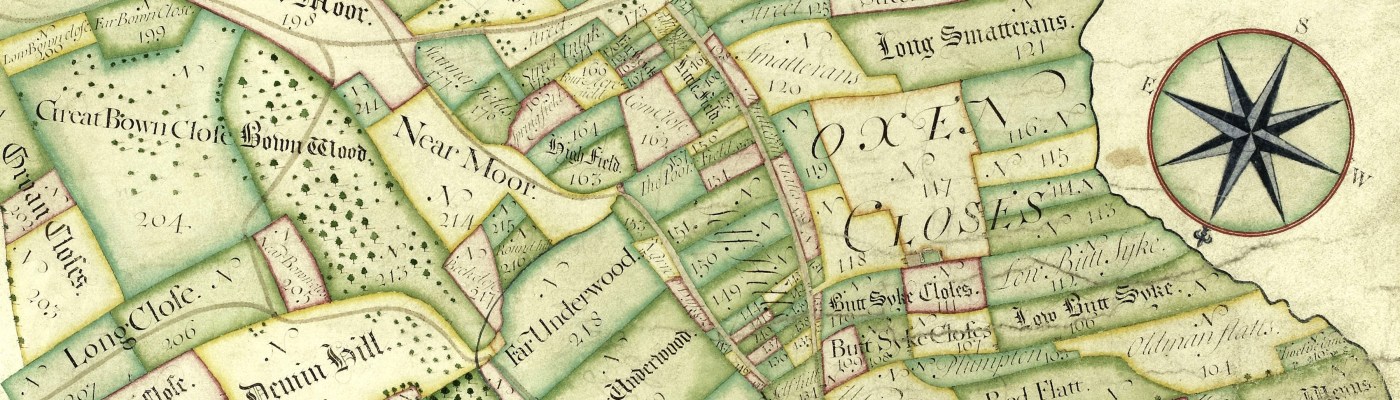
An area of surviving earthwork remains of the medieval field system at Walburn is designated as a scheduled monument of national archaeological importance; historic documents in the archive can tell us about land ownership and field names
Medieval documents and historic maps held in the archives provide us with written evidence of the names of some of these fields and how they have changed over time.
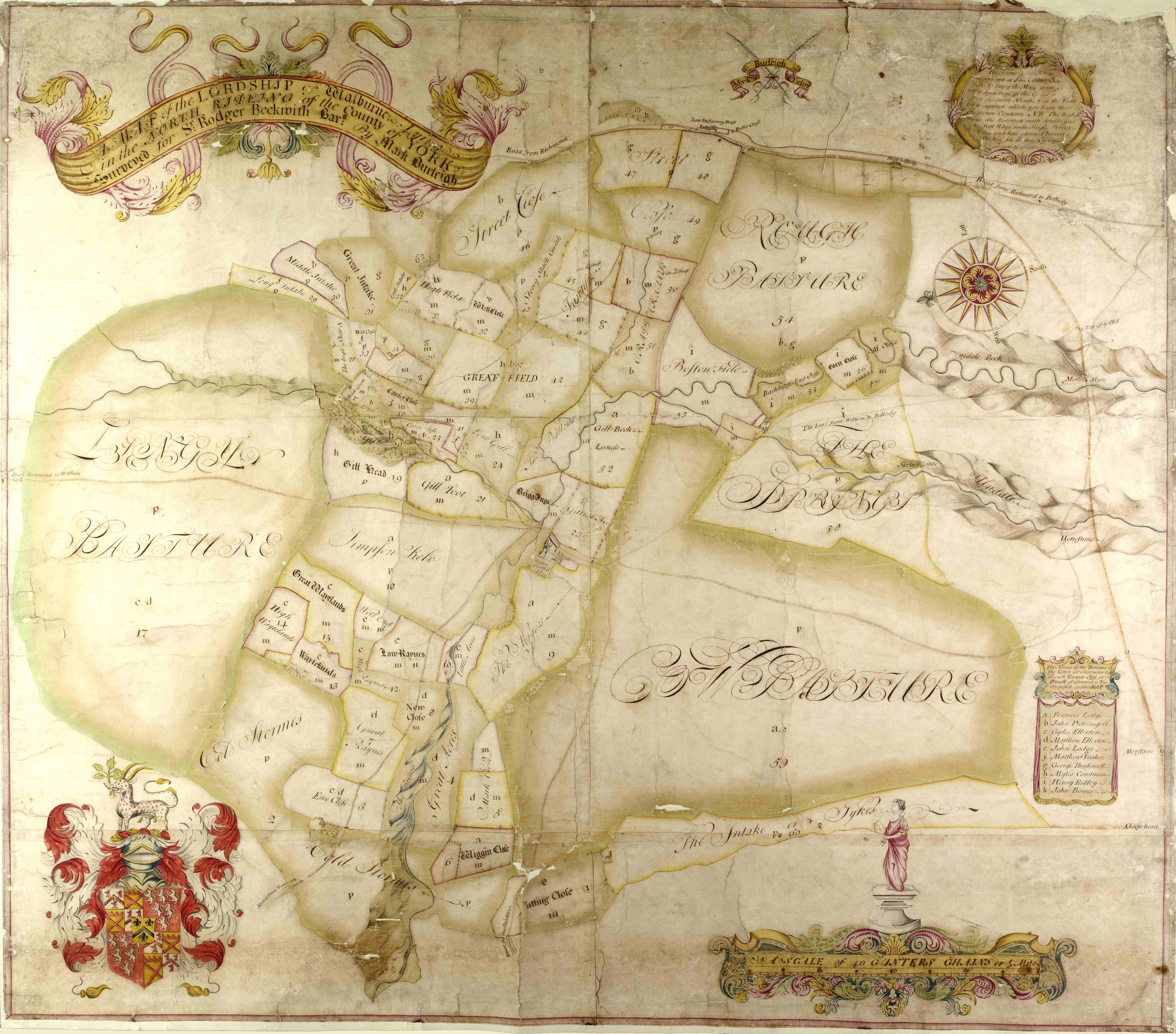
Map of the Lordship of Walburn surveyed for Sir Roger Beckwith, Baronet, by Mark Burleigh, undated (early-18th century) [ZAZ M1]
Before the dissolution of the monasteries in the 16th century when church lands were redistributed, Jervaulx Abbey, Coverham Abbey and Ellerton Priory all held lands in Walburn. A collection of over 150 Walburn property deeds survives in the records of the Hutton family of Marske, telling us much about medieval land use and ownership. John Hutton acquired the estate in 1755 on the death of Sir Roger Beckwith, who had commissioned the above map in the early-18th century.
By the time of this 18th-century map, much of the estate had been enclosed, evidenced by field patterns and names ending in ‘close’. ‘Cold Stormes’ on this map is a survival of one of 32 names mentioned in a lease of 1471, and is also mentioned on a later map of 1821 (see both below). Of the medieval field system and former village, only earthwork remains now survive. Their layout suggests a formal planned settlement introduced by the Normans in the years after the Conquest in the late-11th to 12th century. A LiDAR image of the visible earthwork remains of the medieval settlement and open field system can be seen on the SWAAG website.
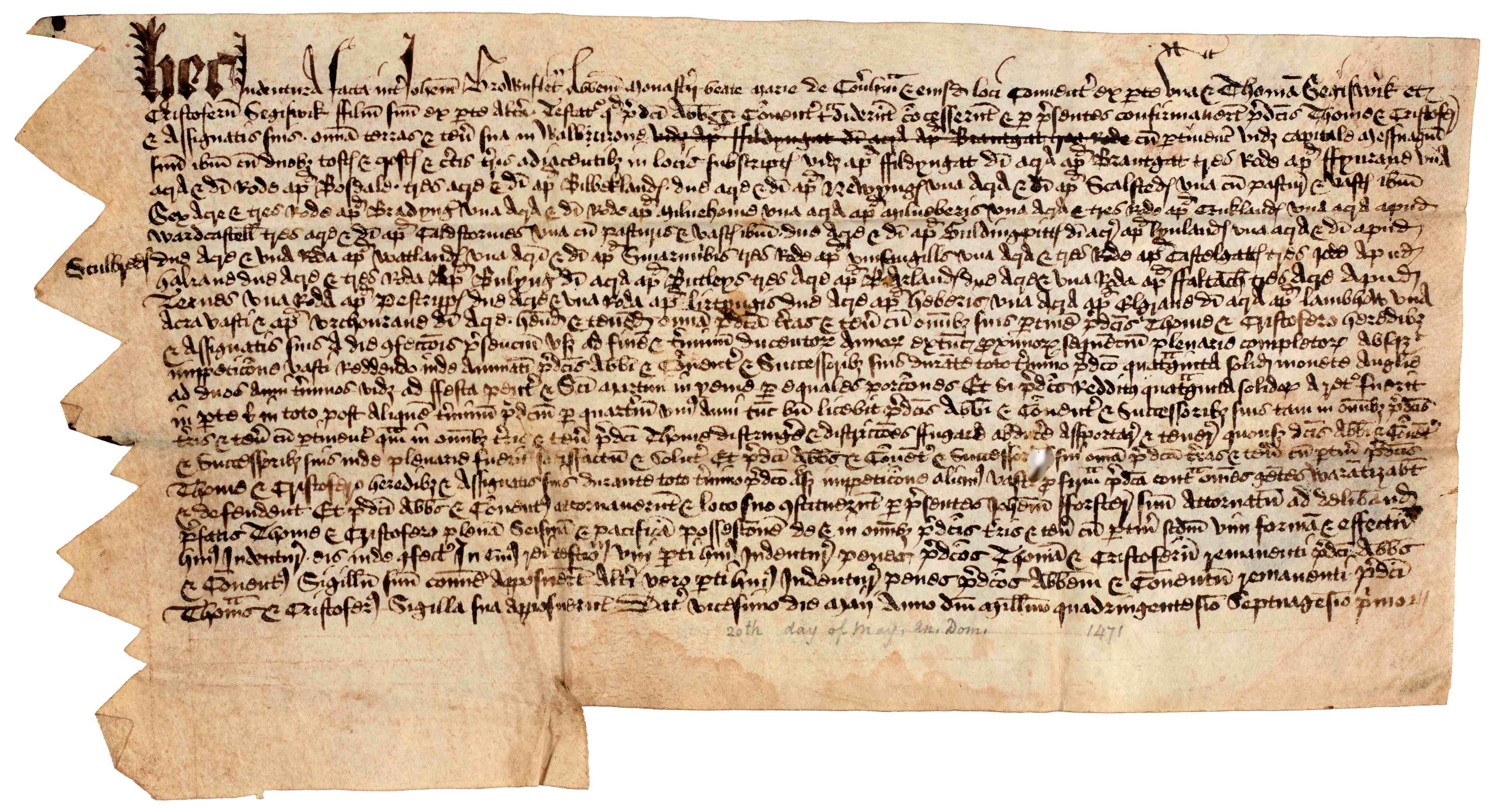
Lease for 200 years between John Brownfleet, Abbot of Coverham Abbey to Thomas Segiswik and his son Christopher Segiswik of a messuage and lands in Walburn for 40 shillings per year, from the records of the Hutton family of Marske, 20 May 1471, in Latin [ZAZ 25 (5)]
This document of 1471 records many names, including:
“… two acres at Fildyngate, a half-acre at Brantgate, three roods at Fynrane, one acre and a half-rood at Bosdale, three acres and a half at Bilbekland, two acres and a half at Newyng, one acre and a half at Scalsted, together with pasture and waste there, six acres and three roods at Bradyng, one acre and a half-rood at Milnehome, one acre at Milneberis, one acre and three roods at Crukland, one acre at Wardcastell, three acres and a half at Caldstormes, together with pastures and waste there, two acres and a half near Suldingpitt, half an acre near Lynland, one acre and a half at Sculbred, two acres and one rood at Watland, one acre and a half at Smarmibis, three roods at Umsangills, one acre and three roods at Castelgatt, three roods at Halrane, two acres and three roods at Bulyng, half an acre at Butleys, three acres at Barland, two acres and one rood at Faltach, three acres at Ternes, one rood at Pestripp, two acres and one rood at Lirtyngis, two acres at Heberis, one acre at Elgrave, half an acre at Lambhow, one acre of wasteland and half an acre at Urchonrane.”
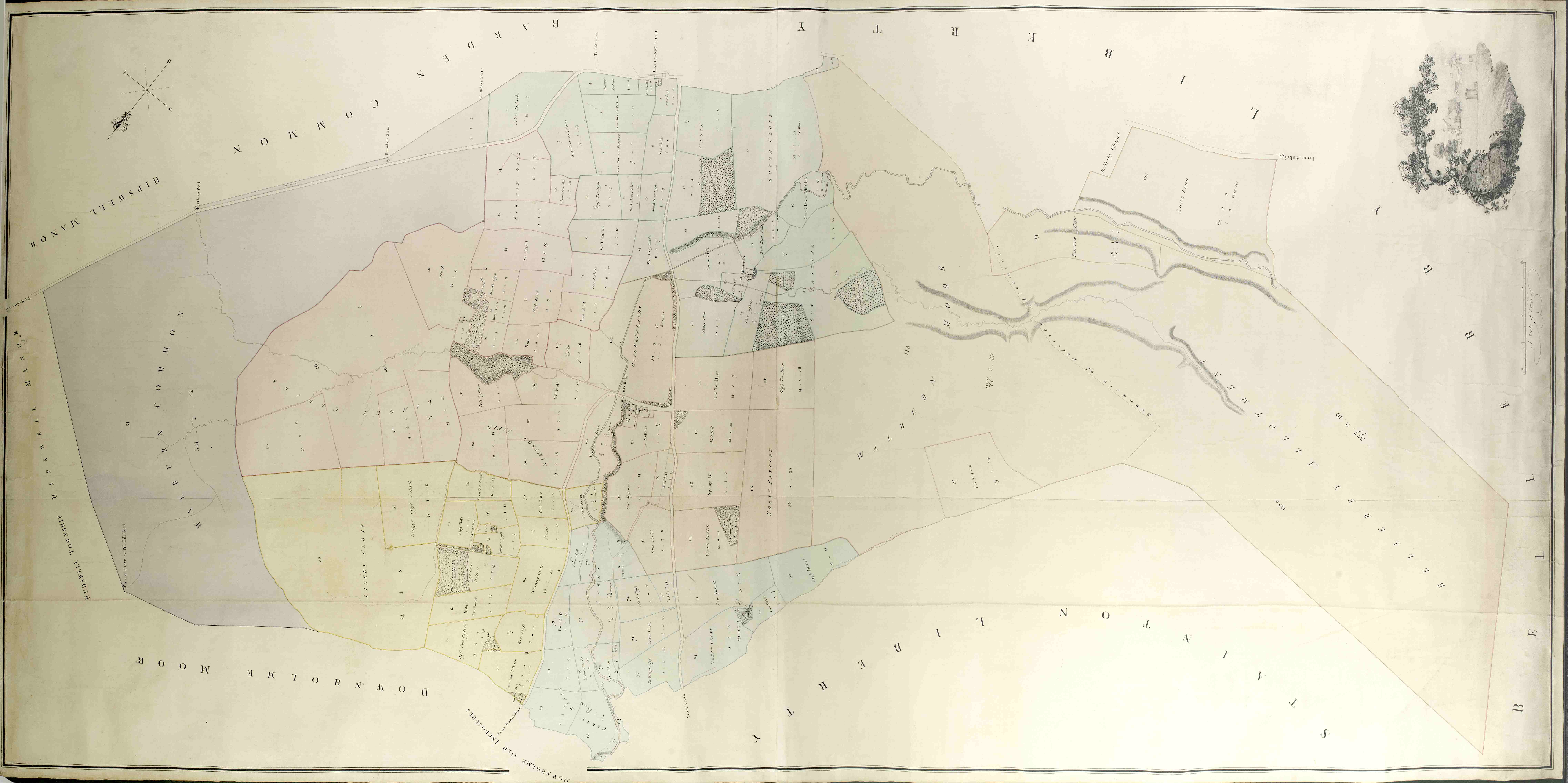
Plan of an estate at Walburn belonging to T. Hutton esquire by T. Bradley, Richmond, 1821 [ZAZ M13]
Further reading:
Monastic Charters and other documents relating to Medieval Piety in the North Yorkshire County Record Office, edited by M.Y. Ashcroft and E.A. Jones, 2009 (2 volumes, 797 pages; North Yorkshire County Record Office Publication 71) – A collection of all medieval documents in the North Yorkshire County Record Office identified as relating to religious houses, religious and charitable organisations and religious piety. Transcriptions in Latin or English are provided for many of the documents, but in some cases documents are presented in summary form, particularly where good transcripts are published elsewhere. Volume 2 includes Walburn charters.
Medieval settlement and field system at Walburn Hall – scheduled monument designation record, list entry no. 1019102
Walburn Medieval Village – Swaledale and Arkengarthdale Archaeology Group (SWAAG) webpage
3D LIDAR model of Walburn Hall and deserted settlement on Sketchfab by Stephen Eastmead of SWAAG

