The Graham family papers also include those belonging to the Cage and Slingsby families, who had been resident at Kippax Hall, West Yorkshire and received a regular income from the coal mined there. Elizabeth Cage died without issue in 1710, and the Kippax estates devolved to Sir Reginald Graham, 4th Baronet.
Previously, William Slingsby had bought the property and mining interests from Francis Baildon in 1624. They subsequently passed to his grand-daughter Elizabeth, who married Adlard Cage, a solicitor in Holborn, in 1697. What rapidly became a mystery was a reference to a ‘sonne’ in letters between the two. He appeared to be of full age, as he was ‘in want of a wyfe’, but we could not find a birth record for him, only that of a daughter born to the couple, named Ann (1697-1698). Neither could we find a previous marriage record for Adlard, who was potentially aged fifty plus when he married Elizabeth, though a baptism date for him has not been found as yet either.
Subsequent reading of the Cage correspondence showed that the ‘sonne’ referred to, was a Richard Garth (1682-1727) who held estates in Morden, Surrey. Ownership of these estates was in dispute (perhaps his need of a solicitor initiated the relationship?) as his great-grandmother had married twice, firstly to John Cotton, and secondly to John Carleton, from whom Richard Garth was descended. She had died without leaving a will, resulting in ongoing wranglings as to who had legal ownership between Garth and the Cotton descendent, another John.
Why Richard should be refererred to as a son, is, for the time being, unclear. If he had been legally adopted, he might have inherited the Kippax estates. Furthermore, his natural mother was still alive at his time of writing, as can be seen below, not to mention the acquisition of a wife!
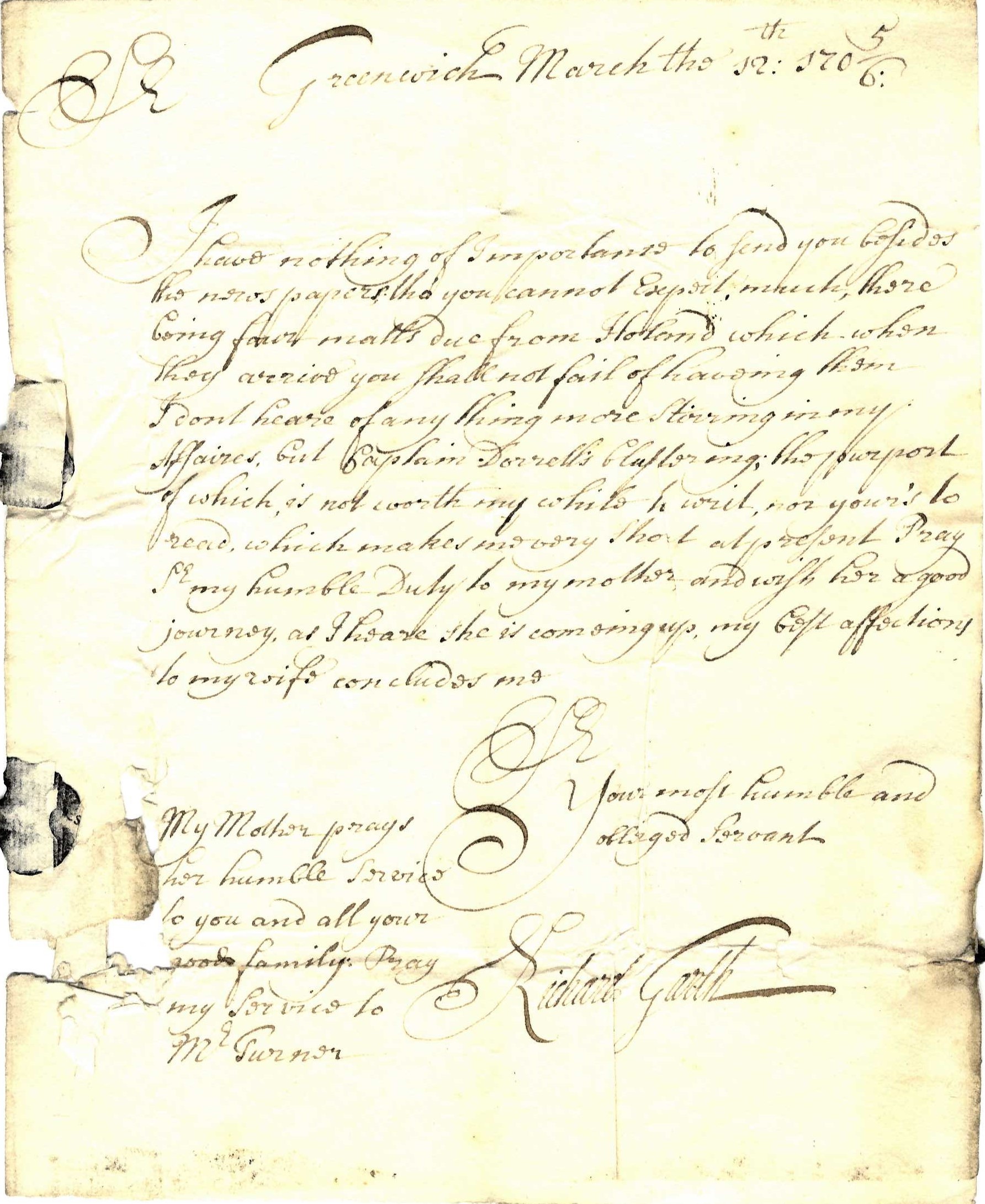
Letter written to Adlard by Richard Garth, Greenwich, 12 March 1705/6 [ZKZ]
The letter pictured above, written to Adlard, declares ‘Pray, Sir my humble duty to my mother (Elizabeth Cage) and wish her a good journey’, but at the foot of the letter, he states ‘My mother prays her humble service to you and all your good family’ – most confusing!
One of the other Cage correspondents, E Boevey, is connected in some way too, as Richard appears to be lodging with her in Greenwich. She writes very chatty letters, including details of the Cotton dispute, but Richard’s natural mother was Catherine, née Stone – so no solution there, but a son of Richard’s was christened Bouvey….
If this puzzle is ever solved – we’ll be sure to post an update here!
Update now available below….
Since initially writing this post, one of the project volunteers, Heather, has been able to dig a little further and answered part of the conundrum as can be seen from her comment below. The Registers of Morden, Surrey, 1634-1812 help explain, albeit somewhat paraphrased here for brevity:
Richard Garth married Catherine and died without issue. In his will dated 15th May, 1697, proved in P.C.C, 1st August, 1700, he states that he had no children by his wife, Catherine, (nor presumably by his second wife Jane), therefore he bequeathed all his estates in default of issue to the use and behoof of Richard Boevey, son of Elizabeth Boevey, who was sister to Jane:
“soe that he take upon him, calls, and writes himselfe, by the sirname of Garth always after any part of my estate shall come to him in possession by virtue of this my will.”
It’s also somewhat amusing to note a Jane Austen reference here, as the maiden name of sisters Elizabeth and Jane was Bennett! Great result Heather – thank you!

