
Treasures from the Parish Chest: exploring North Yorkshire’s church history from archives to architecture
Material relating to churches and the work of officers of the parish can be found in many other types of archive collections held at the Record Office, not just within parish records. A selection of such material from a variety of collections is shown below.
Family and estate collections
Wealthy individuals from many of the historic landed estates across North Yorkshire provided funding and patronage to their local parish churches. They may have held the position of rector, or been members of the clergy themselves.
Kirkleatham Hall estate records
Amongst the many architectural drawings from the Kirkleatham Hall Estate archive is an 18th century drawing of the Turner mausoleum by James Gibbs (1682-1754) [ZK 11115]. The mausoleum was commissioned by Cholmley Turner of Kirkleatham Hall in memory of his only son, who died in 1739 at the young age of 21 in Lyons, France en route to Italy whilst on the Grand Tour. Gibbs was a Scottish architect of the late-17th/early-18th centuries, who trained in Rome and designed a number of important buildings in England, including the circular, neoclassical Radcliffe Camera in Oxford.

Attached to the north side of the chancel of St Cuthbert’s Church in Kirkleatham, the mausoleum is entered from inside the church. Written along the bottom of the drawing is “This Mausoleum was erected to the memory of Marwood William Turner Esqe the best of sons, 1740”. These words are inscribed around the exterior of the building, below the circular windows. It is a Grade I listed building in recognition of its architectural significance.
Drawing by James Gibbs of the Turner Mausoleum, Kirkleatham, 1739 [ZK 11115]
The Fitzwilliam family of Malton archive
The Fitzwilliam family of Malton archive is an example of an estate collection containing a quantity of material relating to several churches in and around the town of Malton, including St Leonard’s and St Michael in New Malton and in St Mary in Old Malton [ZPB VII 1-6].
St Leonard’s is a Grade II* listed building and became the first English parish church to be returned to Roman Catholic use in 1971, now dedicated to St Leonard and St Mary. Its spire is a dominant feature of the town of Malton’s skyline.
Founded in the later-12th century as a chapel of ease for the Gilbertine Priory of St Mary at Old Malton, the church retains a significant amount of medieval fabric. The spire was added in the 19th century and extensive restoration and rebuilding was carried out in 1907, and again in the 1980s.
Elevation drawing of St Leonard’s showing the steeple, unsigned and undated [ZPB VII 2/5]

North Riding Quarter Sessions
Until the creation of County Councils, the Justices of the Peace were responsible for local government in the shire or riding. They had both judicial and, from the sixteenth century onwards, administrative functions. The Quarter Sessions were local courts presided over by the Justices, that were held four times each year. Their records cover crime, roads and bridges, weights and measures, vagrancy, houses of correction, licensing, dissenters, Roman Catholics, county rates, militia, police and various taxes [QSB]. In several aspects, including poor relief, bastardy, settlement and apprenticeship there is considerable similarity and overlap between parish records and Quarter Session records where overseers of the poor and churchwardens were involved.
In July 1796, a petition of the minister, churchwardens and principal inhabitants of the township of Boltby in the parish of Felixkirk was made to the Justices of the Peace asking for a brief to raise money to rebuild the chapel, which was described as being ‘in great decay and is so ruinous that it cannot be used for worship‘. There is also a related plan of the proposed new chapel to be built at Boltby, and an estimate of the cost for the rebuilding and the demolition of the existing ruinous structure.
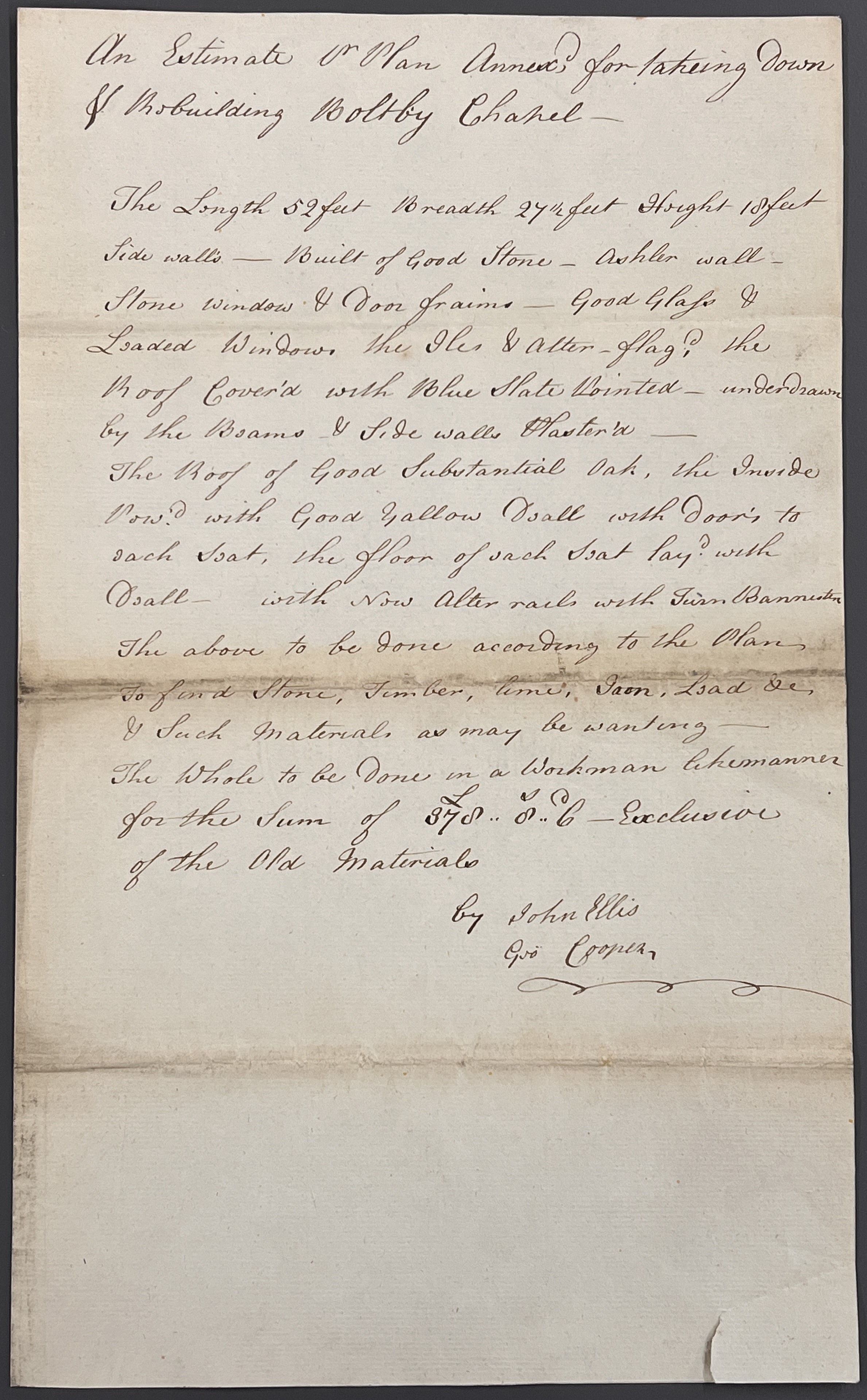
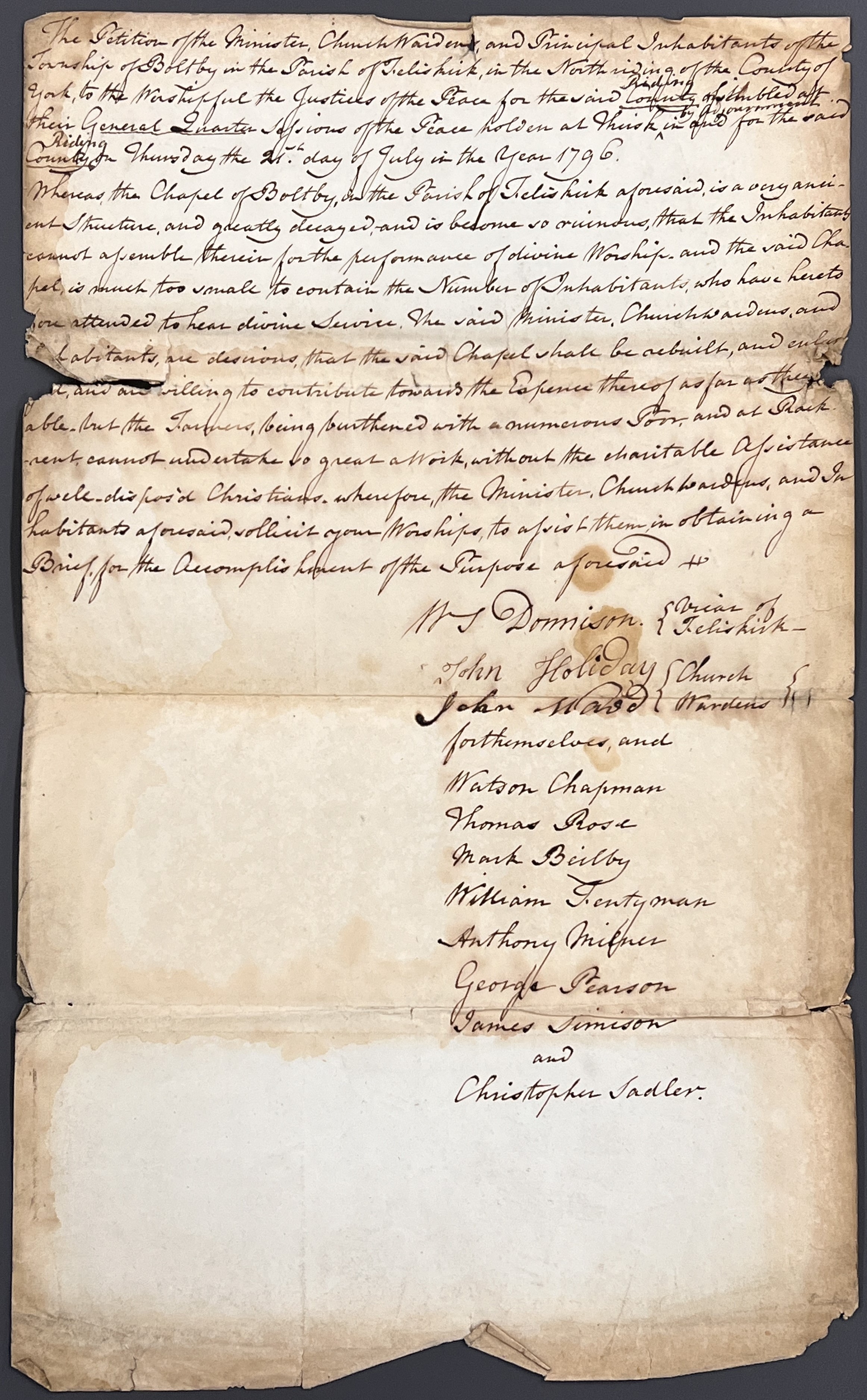
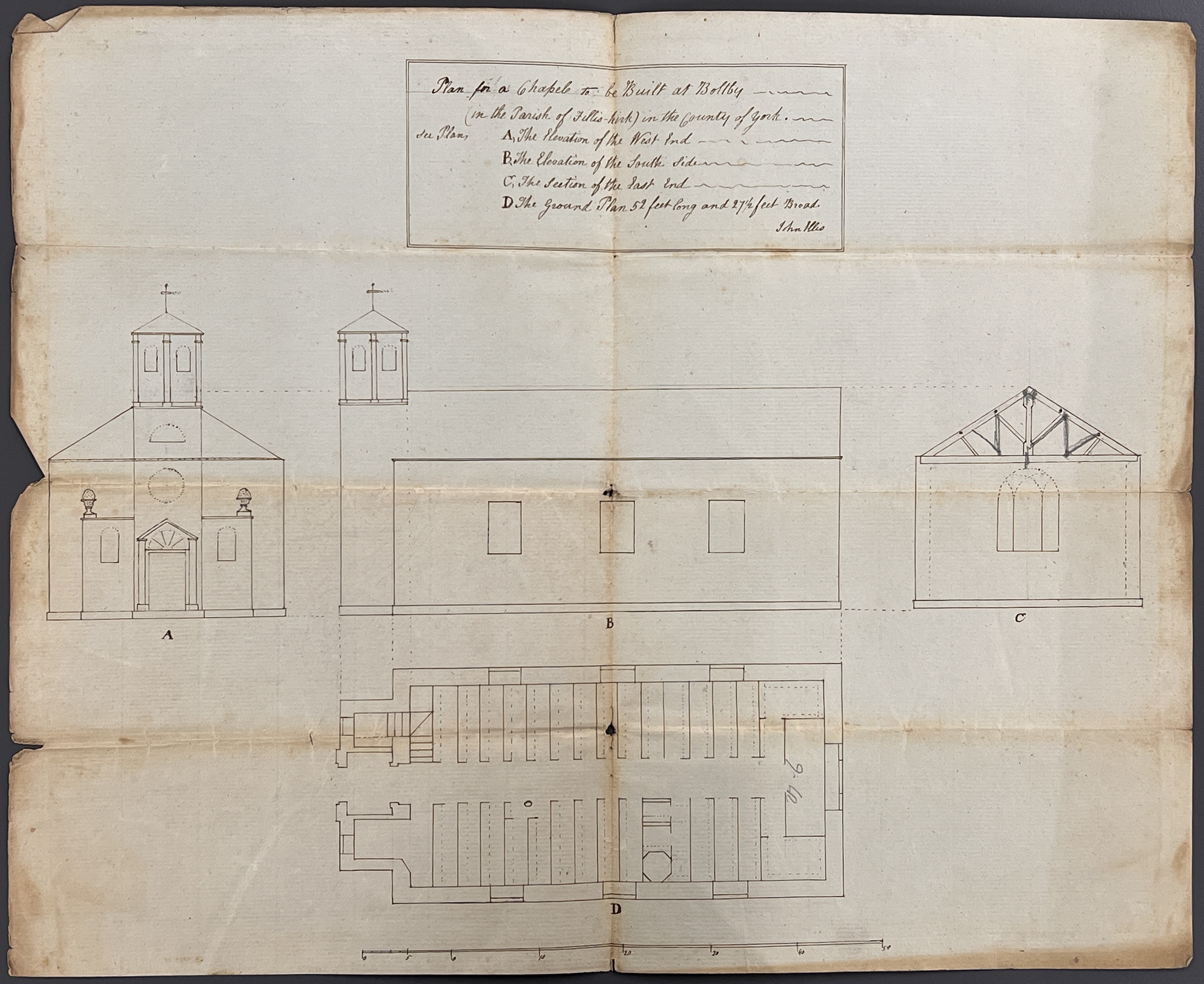
Papers relating to the rebuilding of the chapel at Boltby, 21 Jul 1796 [QSB 1796 3/14/2]
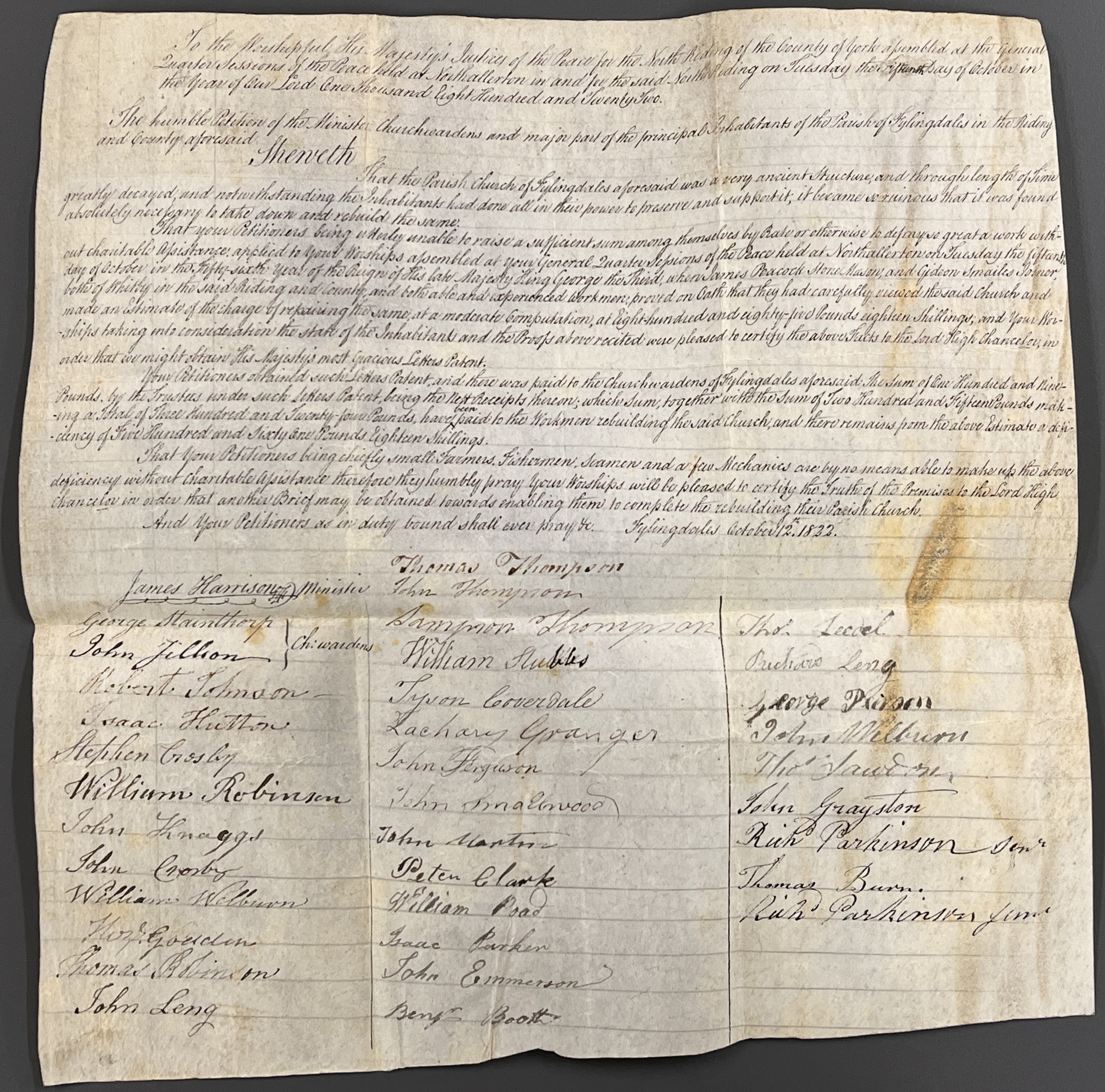
A similar petition was made to the Justices in 1822 by the minister, churchwardens and 33 inhabitants of Fylingdales in the North York Moors. Their church had become decayed and, despite efforts to preserve it, it had to be demolished and rebuilt. On 15 October 1816, the petitioners had previously applied to the Justices who, after James Peacock stonemason and Gideon Smailes joiner, both able and experienced workmen of Whitby, estimated the cost of repair at £885 18s, certified this to the Lord Chancellor so that they could obtain letters patent. Following this, the churchwardens received £109 which, together with a further £215, has been paid to workmen rebuilding the church. They now ask the Justices to certify the facts again, so that another brief may be obtained.
Petition to the Justices from the minister, churchwardens and inhabitants of the parish of Fylingdales [QSB 1822 4/14/2]
The working papers of the court for Easter 1882 contain interesting information on the Reverend George Sanger, who was vicar of Carlton-in-Cleveland from 1866 to 1894. Sanger was charged with arson following the burning down of St Botolph’s church in October 1881 and, although the case seems to have been tried at the Petty Sessions courts, the papers were passed to the Quarter Sessions and the bundle contains a number of depositions regarding the fire and the accusations made [QSB 1882 2/4 & 2/8/1]. You can read more about this case in a related blog.
Petty Sessions
Petty Sessions, meetings of two or three Justices, appeared gradually until, in 1828, courts of Quarter Sessions were empowered to create divisions for Petty Sessions within the county [PS]. These Petty Sessions met more frequently than the Quarter Sessions, and dealt with many minor offences; they were the predecessors of the magistrates courts of today. Early petty sessions records are rare, but some were returned to Quarter Sessions and can be found with the Quarter Sessions bundles (see QSB above). The Petty Sessions may keep lists of the parish officers appointed as overseers, constable and surveyors, for example. They may have also dealt with bastardy and settlement cases.
Parish and District Council records

This assessment and account book for Selby township, includes accounts of the disbursements of the churchwardens, the overseers of the poor, the constables and the surveyors of the highways 1711-1719.
Selby township assessment and account open to show page of disbursements of the churchwardens for 1713 [DC/SBU 9/2/1]
Artwork and illustrations
Papers of the Jackson family
A wide range of illustrations of churches, including sketches and drawings, prints and engravings can be found across many different collections.
For example, the papers of the Jackson family, including drawings by John Jackson R.A. (1778-1831) [ZFO]. Jackson, a portrait painter and skilful copyist, was born in Lastingham and in November 1826, he prepared eight architectural drawings for the restoration of Lastingham Church, some of which are featured in a related blog on John Jackson R.A. Reproduced below are a series of engravings by F. Smith based on Jackson’s drawings of the church.


Engravings after John Jackson R.A. (1778-1831) of Lastingham, St Mary, undated, showing a ground plan of the church and font, and exterior view and view of the crypt (below)[ZFO]
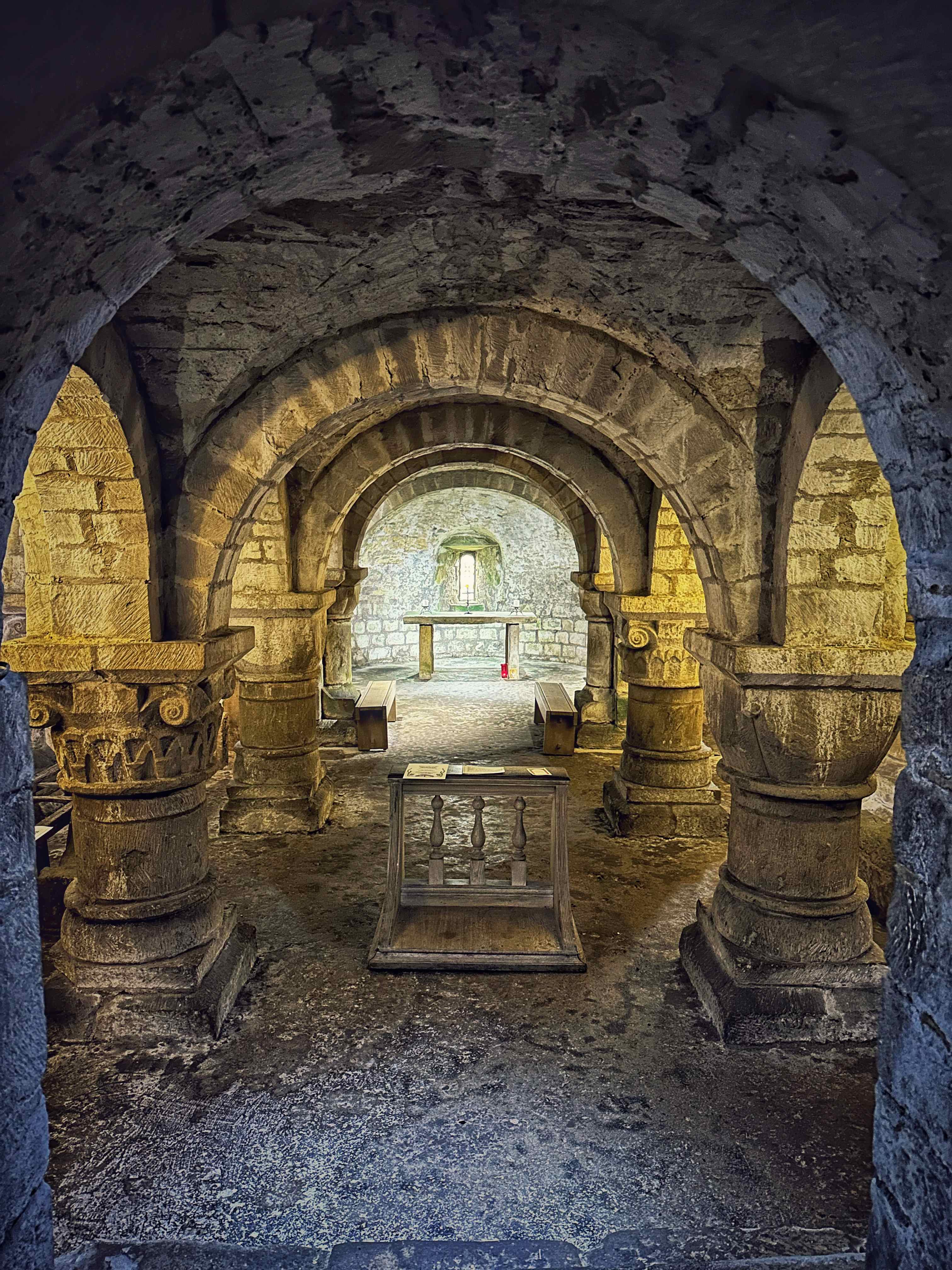
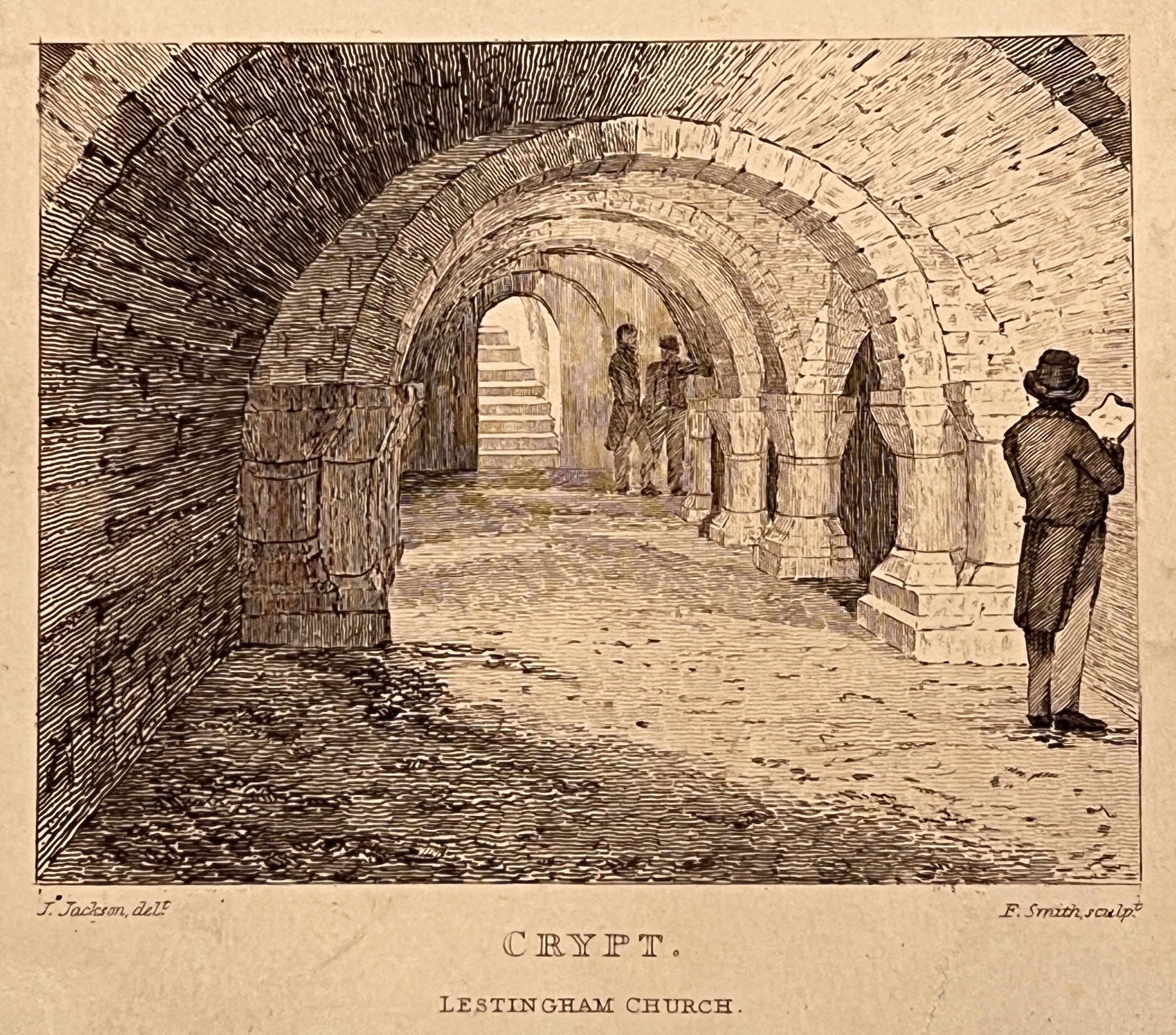
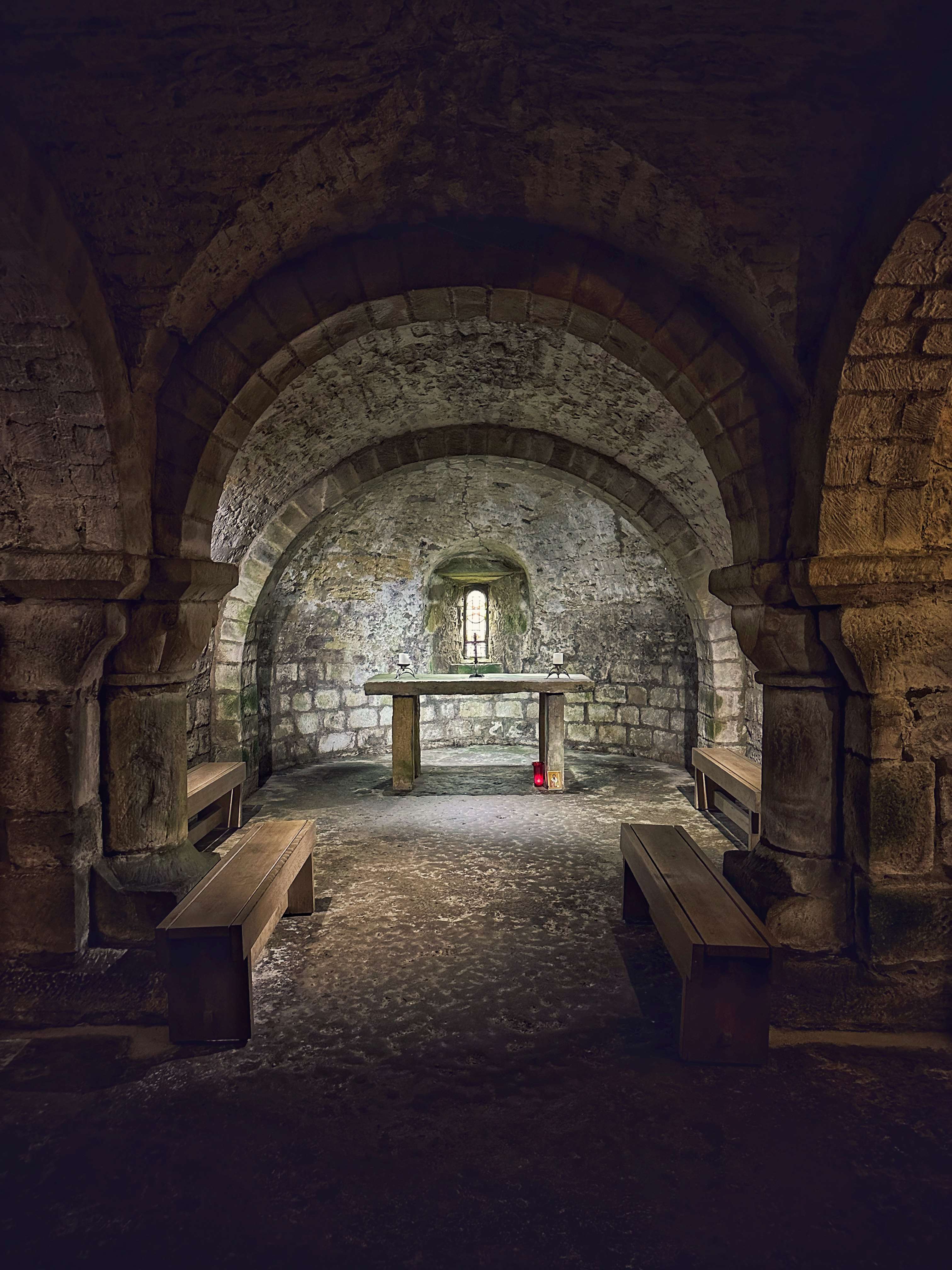
Photographs of the crypt at Lastingham, St Mary © Sophie Cawthorne, flanking engraving of the crypt after John Jackson R.A. [ZFO]
The Azerley Chase archive
The sketches and drawings of Henrietta Matilda Crompton (1793-1881) in the Azerley Chase archive include a number of churches in Yorkshire and further afield [ZCM]. Living for most of her life in York, from a wealthy family, she made many excursions, taking her sketchbooks with her on her travels.

All Saints’ Church in Kirby Underdale lies to the east of York on the Yorkshire Wolds, on a slope leading down to a small stream. A Grade I listed building, this Norman church was restored in 1870-1871 by G.E. Street, a Victorian architect noted for many church restorations in the Gothic Revival style in this part of Yorkshire. Henrietta’s drawing shows the church before its restoration. There are notes along the bottom edge of the drawing naming people depicted: “Admiral Sir Charles Richardson handing Lady Herries over the bridge” and “Rev Erskine comes down the hill.”
Drawing of Kirby Underdale, All Saints by Henrietta Matilda Crompton prior to restoration in 1870-71 [ZCM]
The sketch itself is undated, contained within a sketchbook dated 1840 on the flyleaf, although some of the other drawings in the same sketchbook are dated several years later. Erskine was Rector of Kirby Underdale from 1841-1859, and Admiral Richardson lived at Painsthorpe Hall in the neighbouring village and died in 1850 aged 81, so the drawing is c. 1840-1850. Lady Herries lived at Everingham Hall, c. 14 miles to the south.
Sketchbook from the Pickard and Peckitt records
This leather-bound sketchbook contains drawings and watercolours of churches around York and Yorkshire [ZTJ 23/1]. Many of the drawings are dated 1779 and some are signed by T. Beckwith, although we do not know any more about the artist.
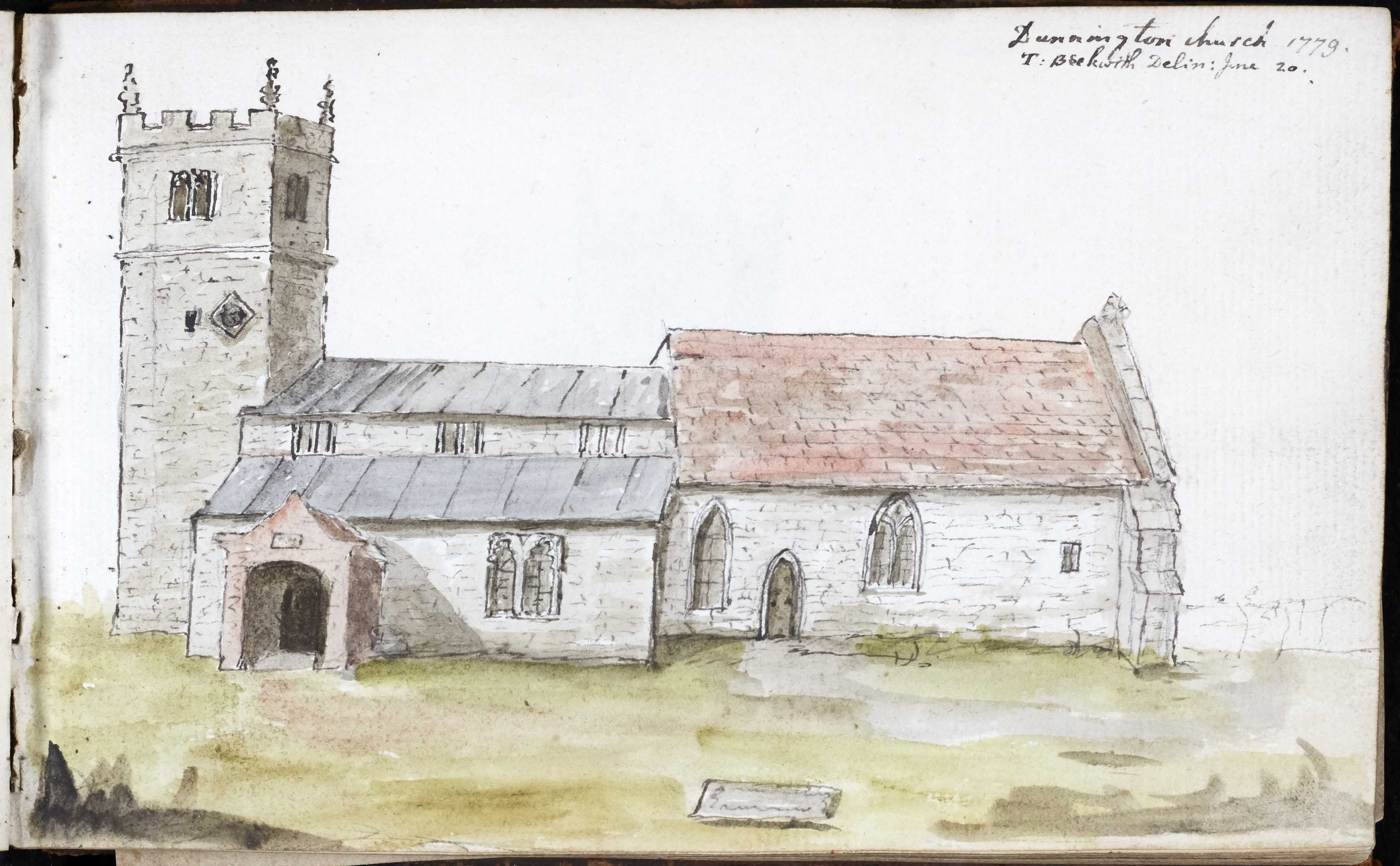

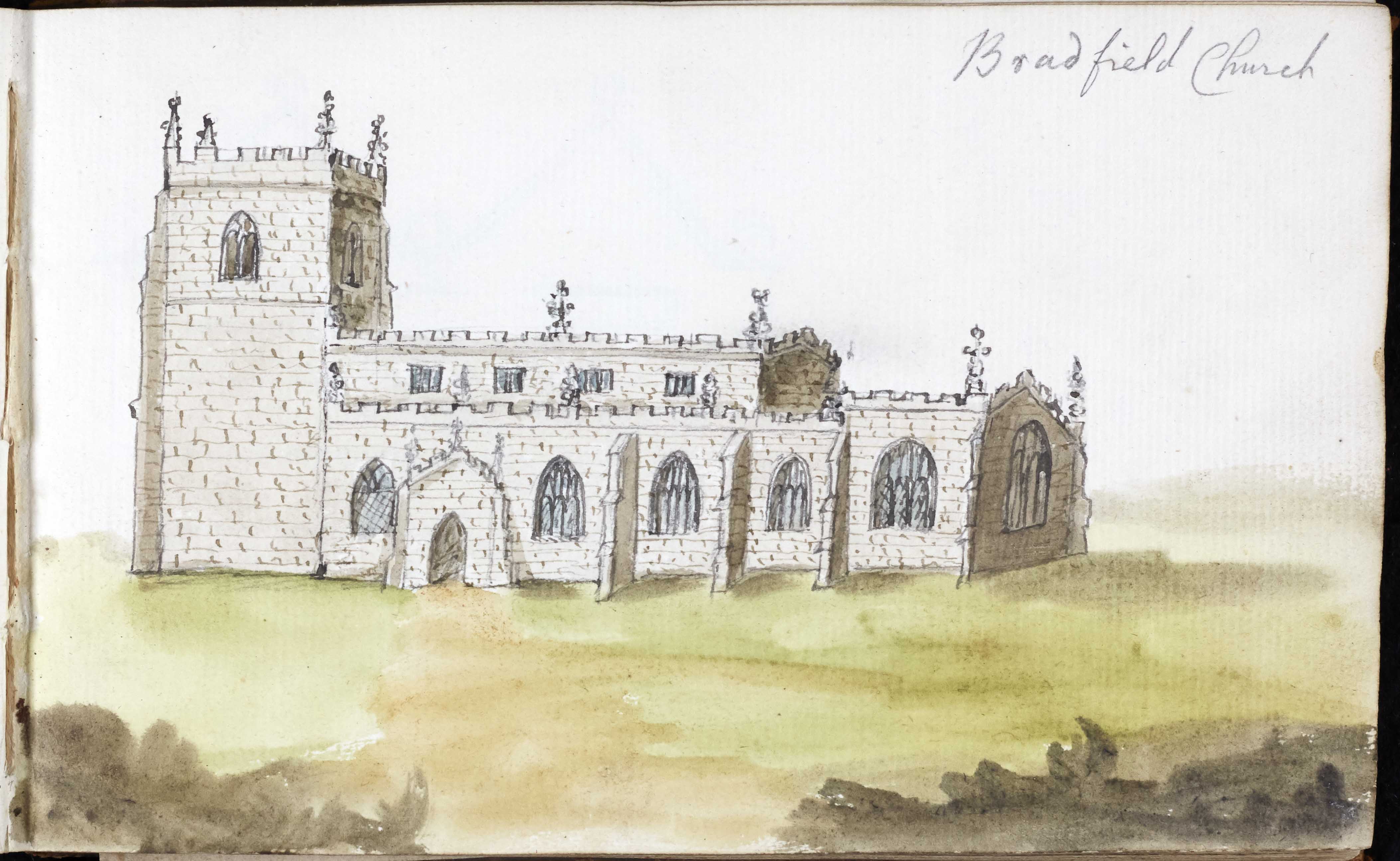

Sketchbook containing drawings and watercolours of churches, made about 1779 [ZTJ 23/1]
- Dunnington, St Nicholas T. Beckwith delin., 1779
- Sutton-on-Derwent, St Michael and All Angels, 1779
- Bradfield, St Nicholas (near Sheffield)
- The church of Cliffe near Weighton, 1779
Architectural sketch and notebook about churches
This single-item deposit in the collections is a sketchbook filled with drawings and notes on various English churches and aspects of church architecture, some written in shorthand [Z.303]. Yorkshire sites include Coniston, York, Easby, Kildwick, Skipton, Bolton Abbey and there are examples from further afield in Norfolk, Oxford, Winchester, Buckinghamshire, Berkshire, Nottinghamshire, Derbyshire, Cambridgeshire, Kent and Wales. There is no hint of a date or watermark, and the name of the artist is also unknown. There are page numbers and references amongst the notes and drawings, so these are presumed to have been copied from illustrated publications, rather than drawn from originals.


Pages from an architectural sketch and notebook, mostly about churches and church architecture, undated (c.19th century) [Z.303]
Historic photographs
The Record Office holds a collection of historic photographs, many of which can be viewed in our online shop. Some of these are by named photographers, many are undated and by unknown photographers.
Bertram Unné collection
These images were taken by local, Harrogate photographer Bertram Unné. He created a unique record of the way of life in the Yorkshire Dales and North Yorkshire countryside between 1940 and 1979. You can read more about him in a related blog post.
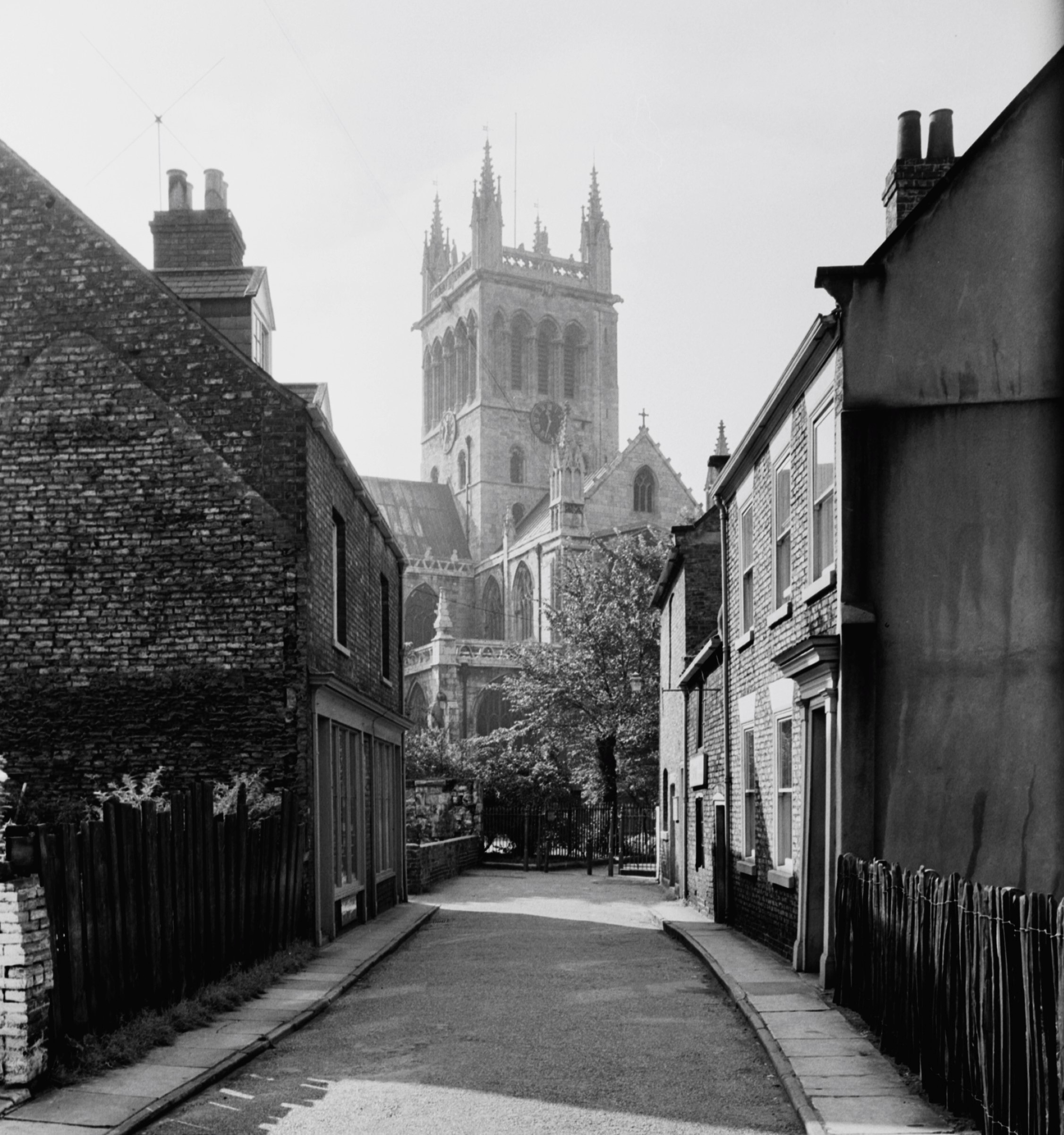
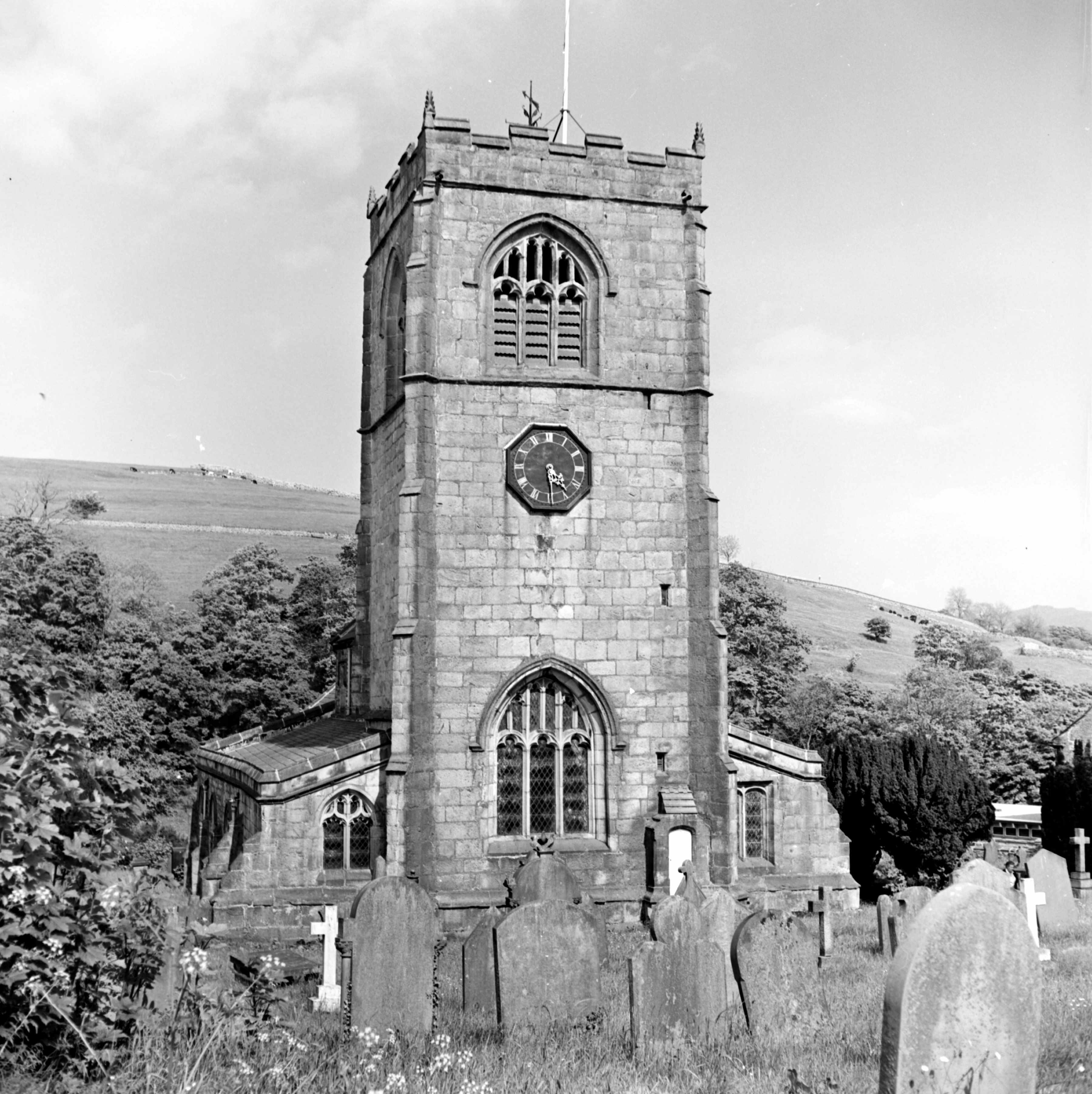


The Grade II listed church in the small hamlet of Beckwithshaw, to the west of Harrogate, was designed by the architect William Swinden Barber in the Gothic Revival style. Mr and Mrs Henry Williams of nearby Moor Park Hall were the donors; in addition to funding the building of the church, they also provided a vicarage and endowed the vicar’s living, as well as a village institute. The foundation stone was laid on 29 September 1884, the date of Michaelmas, the feast day of St Michael. On that same date two years later, in 1886, the church was dedicated and consecrated by Mrs Williams’ uncle, The Bishop of Ripon.
Beckwithshaw, St Michael and All Angels under construction, unknown photographer [LS09-28]
Hird’s Annals of Bedale
Robert Hird, a local shoemaker, compiled a history of Bedale and surrounding areas known as ‘Hird’s Annals’ between c.1808 and his death in 1841 [ZBA 27/1/17-19]. He was a recorder of acute detail, providing us with a rich source of local and social history for the North Yorkshire market town of Bedale. its inhabitants and daily life. The notebooks are handwritten in verse, containing 3000 quatrains, a type of stanza or poem consisting of four lines in which alternate lines rhyme. Alongside the verse, there are additional notes and anecdotes providing additional information about the subject matter, including references to alterations to the church.
You can read more about the church of St Gregory, Bedale on this page and about Hird’s Annals in a related blog.
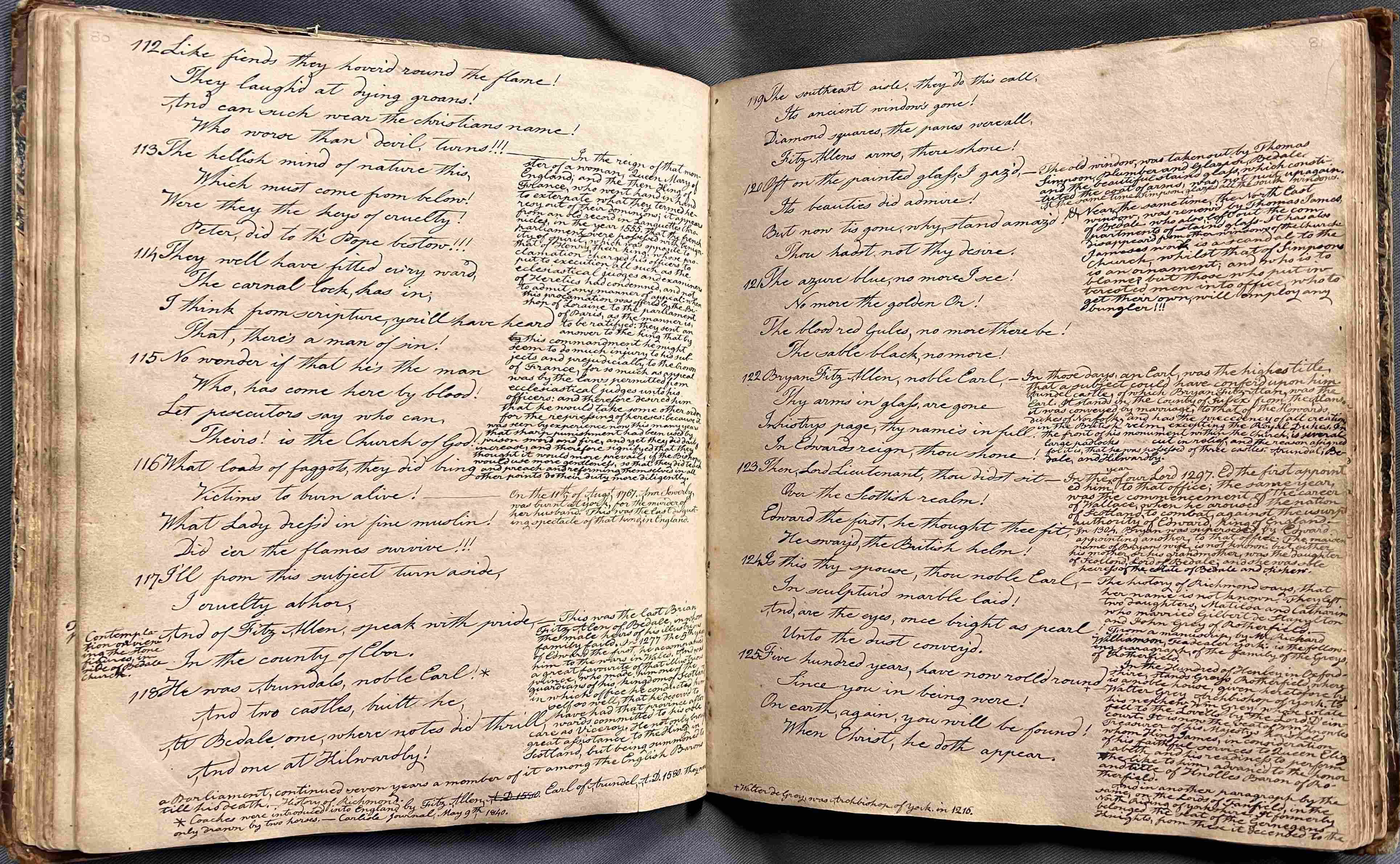
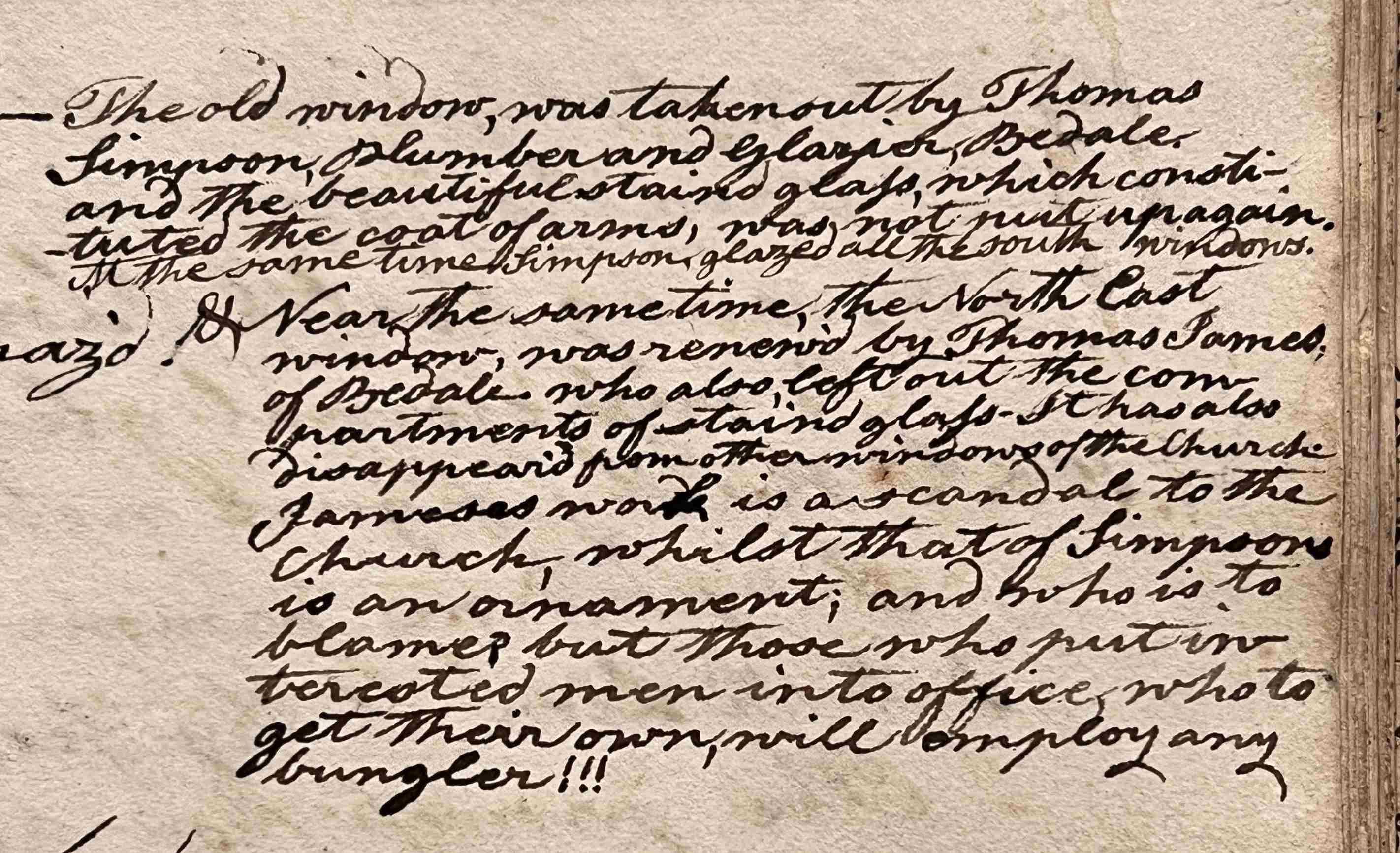
Pages from Hird’s Annals, with verse and adjacent notes recording the removal of stained glass in the church of Bedale, St Gregory by Thomas Simpson and Thomas James [ZBA 27/1/19 – I 81, 119a-122a and note 62]
"The southeast aisle, they do this call,
Its ancient window's gone,
Diamond squares, the panes were all,
Fitz Allen's arms, there shone.
Oft on the painted glass I gaz'd,
Its beauties did admire,
But now 'tis gone, why stand amaz'd,
Thou hadst not thy desire.
The azure blue no more I see,
No more the golden Or,
The blood red Gules, no more there be,
The sable black, no more.
Bryan FitzAllen, noble Earl,
Thy arms in glass are gone,
In hist'ry's page, they name's in full,
In Edward's reign thou shone."
The Burnsall manuscript
The Burnsall Manuscript is a mid-19th century volume of manuscript notes and drawings compiled by Reverend William Bury, relating to the parish of Burnsall and the surrounding area [Z.1570]. Reverend Bury was rector of the parish of Burnsall, on the banks of the River Wharfe in Craven in the Yorkshire Dales from 1839 to 1875. He started writing the book upon his arrival in the parish and added to it throughout his incumbency.

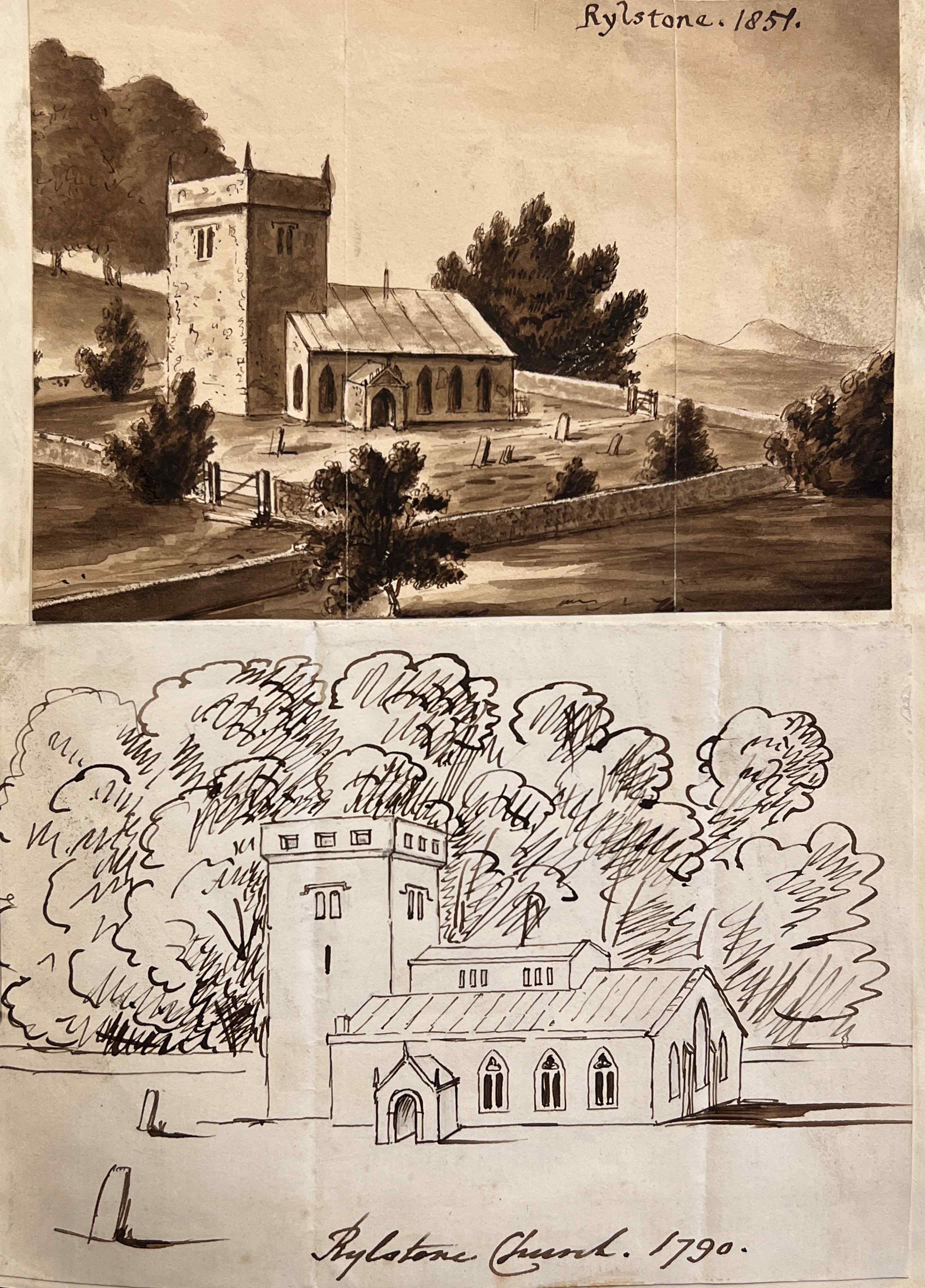

The Burnsall manuscript, containing drawings by the Revd Bury of Rylstone, St Peter: exterior views dated 1790 and1851, and interior view of 1841 [Z.1570]
The notebook contains over 300 pages of handwritten notes on the history of the townships within his parish, their churches and parishioners. These record anecdotes about church matters, local tales and legends. There are also many beautiful pen and ink drawings and sketches of churches and their interiors, the local landscape and local buildings. You can read more about the church of St Wilfrid, Burnsall on this page and about the Burnsall Manuscript in a related blog.
Historic maps and plans
The Record Office holds an extensive collection of historic maps and plans, including Ordnance Survey maps, tithe maps and apportionments, enclosure maps and awards, estate plans and surveys. You can find out more about the different types of maps and plans in our collections and how to find details of our holdings in this related blog page from our online researching house history guide, as well as a guide to undertaking a map regression exercise.

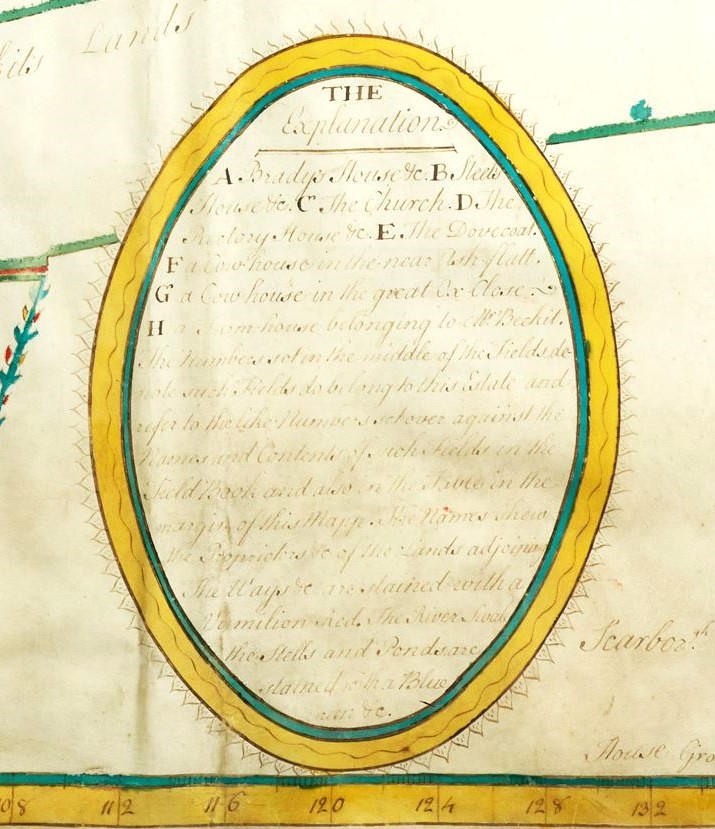

An accurate survey of the estate belonging to Sir B Graham Bart. of Pickhill cum Roxby taken in the year 1765 by Christopher Wilkinson, Land Surveyor [ZKZ 5/26]
The village of Pickhill is shown in colourful detail on this estate map of 1765, including individual houses, the gates in the field boundaries, even down to the red flowers in the Rectory garden. A key to this map identifies the letters and numbers, including the names of the fields and their ‘occupation’, whether arable, pasture or meadow, and that the church at Pickhill is dedicated to All Saints, and in the patronage of Trinity College, Cambridge. The following College lands can be identified from the map:
35 : The Church Yard
36 : The Rabbit Hill
37 : The Garden &c
38 : The Dove-coat Close = Pasture
C : The Church
D : The Rectory House &c
E : The Dovecoat

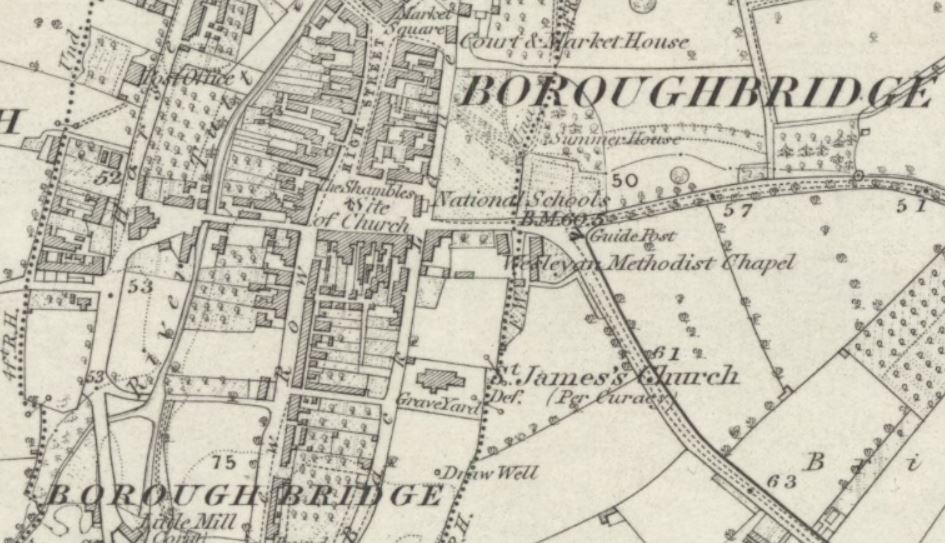
Extracts from Boroughbridge tithe map 1846 and OS Sheet 138 surveyed 1852, published 1855
The 1846 Boroughbridge tithe map shows the medieval church of St James, in its original position in the heart of the town at the southern end of the High Street (now known as St. James Square). This church was demolished in 1851 and a new St James’ church, designed by Mallinson and Healey, built further to the south in Church Lane (previously Back Lane) the following year incorporating some items from the original structure. The 1st edition 6-inch to a mile Ordnance Survey map, surveyed in 1852 and published in 1855, shows the original location as ‘site of church’ and the newly-built church in its new position.
Publications, notes and transcripts
The Record Office holds collections of published and unpublished works, including a reference library of books and an assortment of notes and transcripts comprising copies of secondary sources, including a selection of church guidebooks and other unpublished hand- or typewritten documents and reports on a wide variety of topics, including churches [CRONT].
Aerial photography and archaeology

Oblique aerial photograph of St John the Baptist’s Church, a redundant Anglican church in the village of Stanwick St John cared for by the Churches Conservation Trust [ANY 362/6]
The Record Office holds an extensive collection of both oblique and vertical aerial photographs from the 1940s-1980s, which provide a birds-eye view of buildings, settlements and landscapes. The above image shows the church at Stanwick St John within its distinctive circular churchyard, suggesting an early, pre-Conquest origin.
This ancient church is interesting not only for its early history, but also its location. It sits within an extensive area of prehistoric earthworks, enclosing almost 300 hectares, known as Stanwick Late Iron Age oppidum, dating to the early-1st century AD, the area is designated as a scheduled monument of national archaeological importance.

A small number of archaeological reports are held at the Record Office, accompanied by the documentary archives from non-productive fieldwork, such as archaeological watching briefs, undertaken in response to small-scale works in churches and churchyards [ZBK]. The primary sources for archaeological and historic building data are local Historic Environment Records; relevant weblinks for these are included on the further information and links page.
Further information
You can find details of our holdings of maps and plans, listed alphabetically by place, in our searchroom Guides:
Guide no. 3: List of North Yorkshire & North Riding Maps & Plans
Guide no. 4: List of North Yorkshire & North Riding Enclosure Awards & associated documents
A selection of our historic maps and photographs are available to view and/or purchase via our online shop.
 North Yorkshire Archives Blog