Within the North Riding Quarter Sessions records held at the Record Office, the working papers of the court for Easter 1882 contain interesting information on the Revd. George Sanger, who was vicar of Carlton-in-Cleveland from 1866 to 1894. Sanger was charged with arson following the burning down of St Botolph’s church in October 1881 and, although the case seems to have been tried at the Petty Sessions courts, the papers were passed to the Quarter Sessions and the bundle contains a number of depositions regarding the fire and the accusations made.
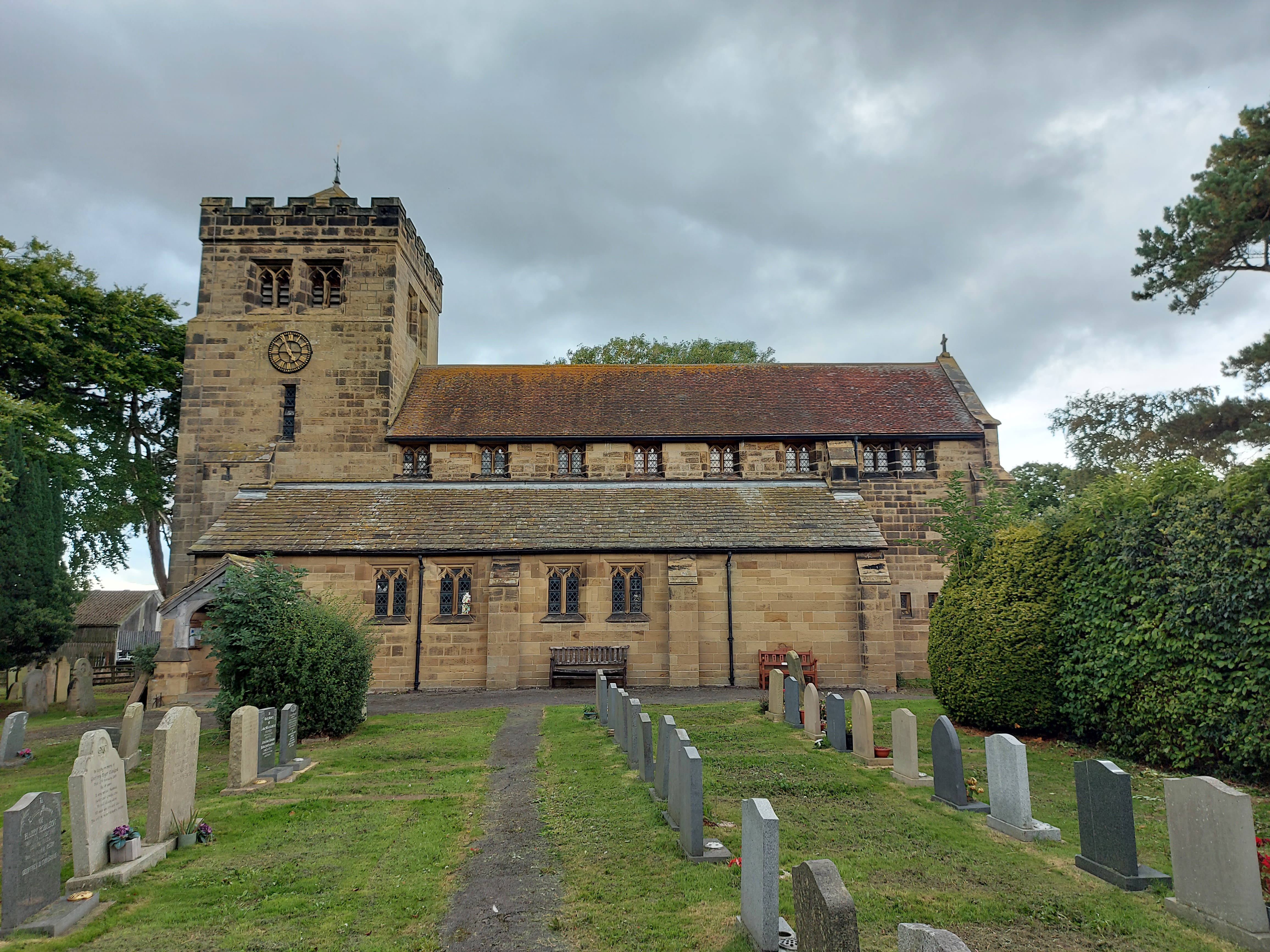
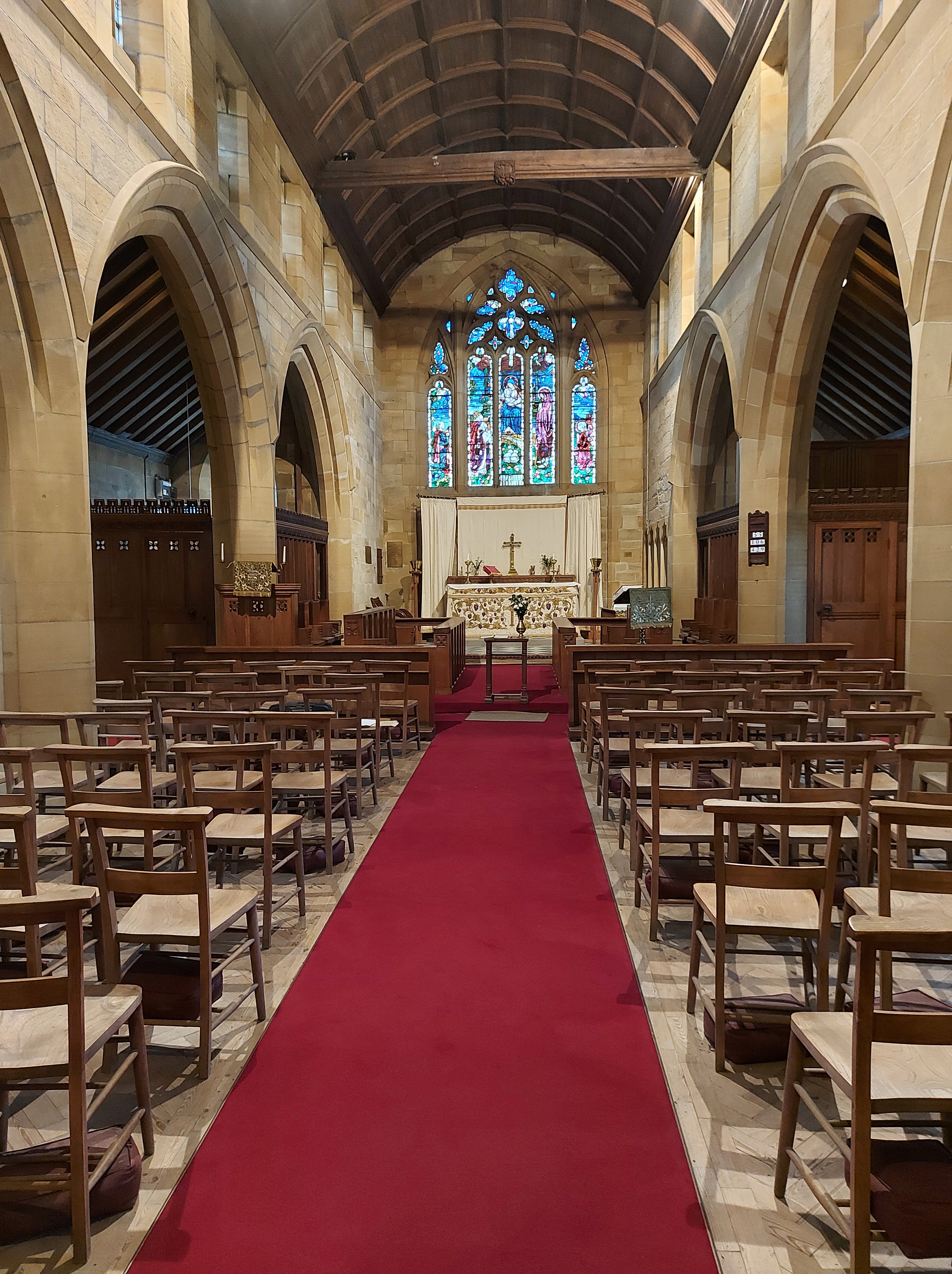
Photographs of the exterior and interior of St Botolph’s church, Carlton taken in September 2022 by G Falkingham
John Ramsdale, the sexton of St Botolph’s Church, testified that he had been woken between 3 and 4 o’clock in the morning to see flames coming out of the roof of the church and had immediately gone to rouse the vicar, who had been sleeping soundly (QSB 1882 2/8/1, see images below). The vicar was said by several witnesses to have expressed little regret over the destruction of the church but the sexton defended him, saying that he had done a lot of work on rebuilding the church in recent years and would have no reason to burn it down.
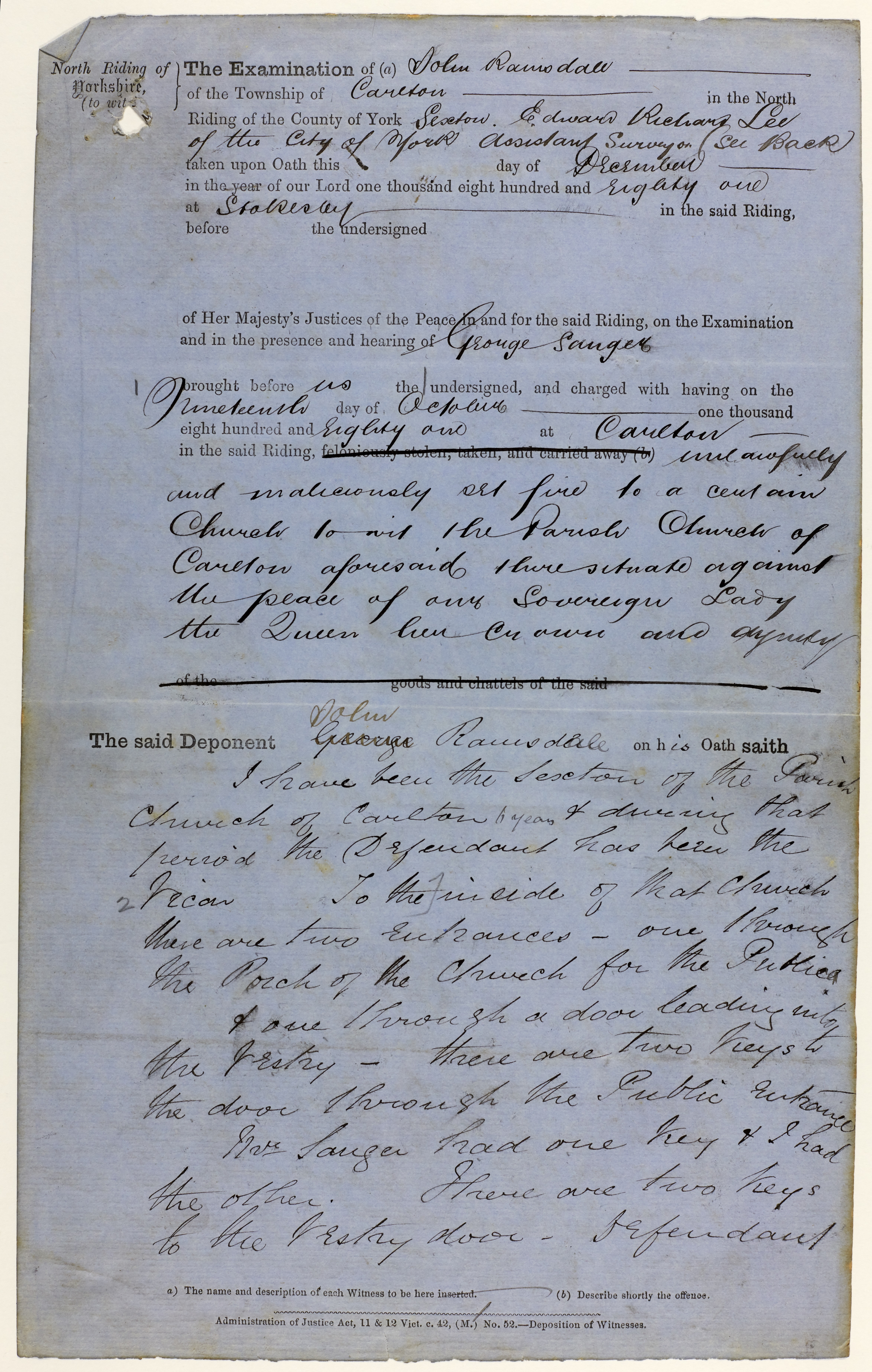
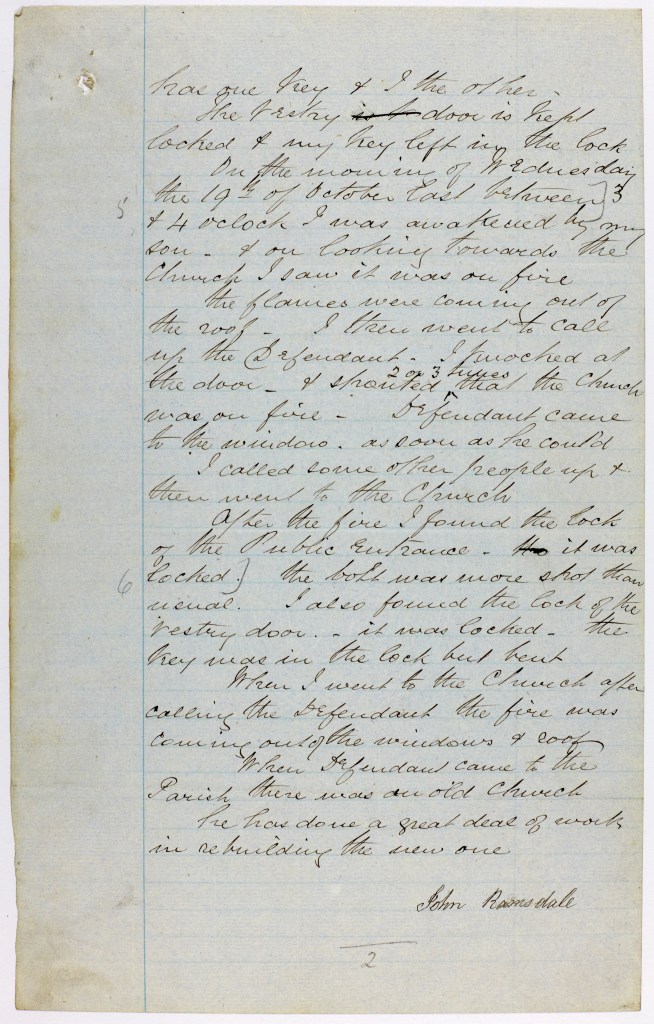
QSB 1882 2/8/1 Pages from the deposition of John Ramsdale, church sexton, from the North Riding Quarter Session papers, Easter 1882
Sanger believed himself to be the victim of a campaign against him. He told a witness that he did not believe the fire to be accidental and that he had received an anonymous letter some time before threatening “to put a bullet through him” if he did not leave the parish. He could not produce the letter, which he said he had burned because it caused him worry, but believed he had recognised the writing as that of a former schoolmaster at Carlton.
Within the bundle of North Riding Quarter Session papers, there is a surviving threatening letter, written in pencil (see image below), which reads as follows:
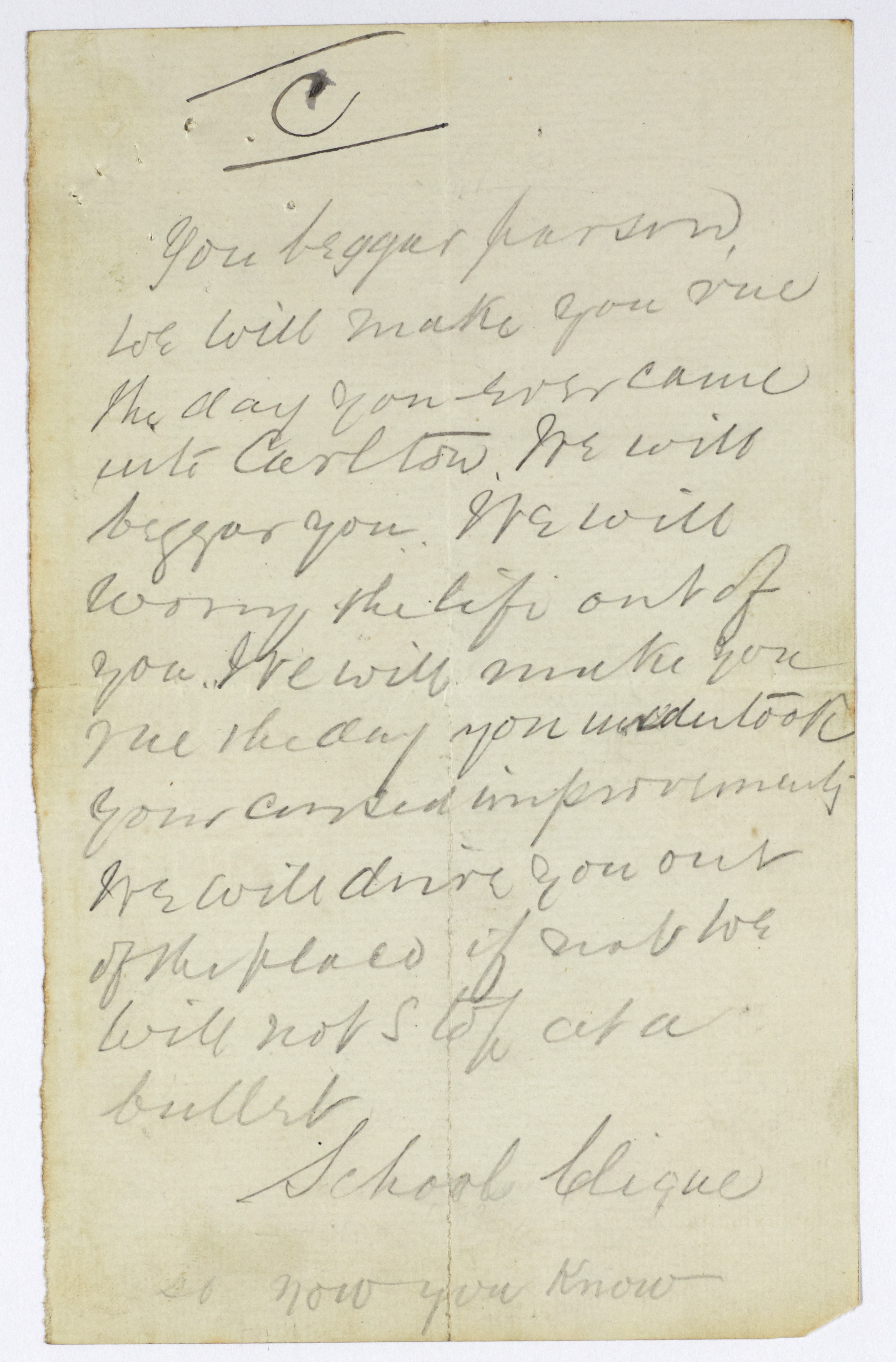
“You beggar parson, we will make you rue the day you ever came into Carlton. We will beggar you. We will worry the life out of you. We will make you rue the day you undertook your cursed improvements. We will drive you out of the place, if not we will not stop at a bullet.
School Clique
so now you know”
QSB 1882 2/8/1 Threatening letter from the ‘School Clique’.
A boy living at the vicarage also reported acts of vandalism, stones being thrown at the summerhouse, cucumbers ripped up in the garden, tools broken, and that remarks about the defendant had been written on the coach house door. The police, however, said that no such incidents had been reported to them.
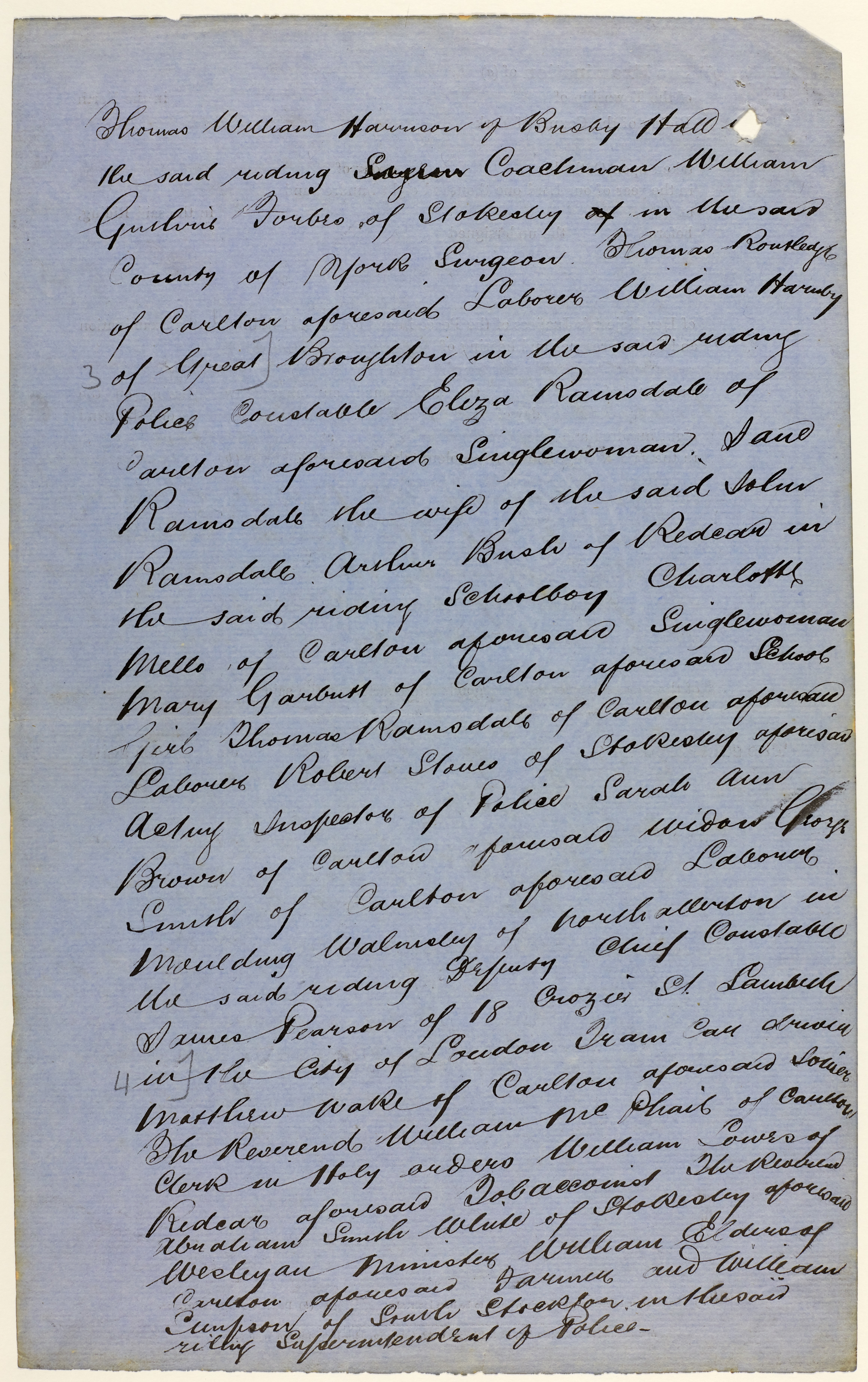
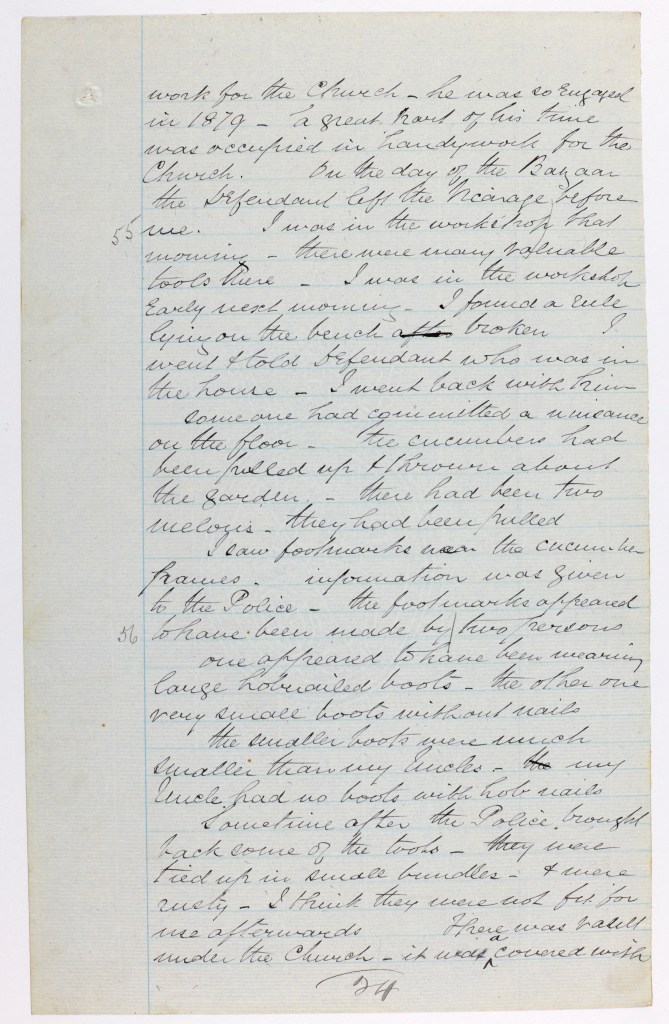
QSB 1882 2/8/1 Further pages from the depositions listing those who were called to give evidence (left) and referring to the damage to the cucumbers, from the North Riding Quarter Session papers (right), Easter 1882
Sanger was arrested in London on 25 December 1881 in the company of two women. He had taken lodgings claiming to be a mechanic by the name of Wilkinson, travelling with his wife and his niece. It was only when the police arrived that his true identity, and that of the two ladies, was revealed. They were Miss Kingston and Miss Bush, both from Carlton. Miss Kingston and Sanger were subsequently married at Lambeth.
The Quarter Sessions papers contain correspondence dated 11 March 1882, which indicates that Sanger complained about “having been confined from the Saturday until Monday in a damp cell at Stokesley in January last [1882]”. The Justices of the Peace, who subsequently examined the cells, told the local constabulary that “there was nothing to complain about” (QSB 1882 2/4, see below left).

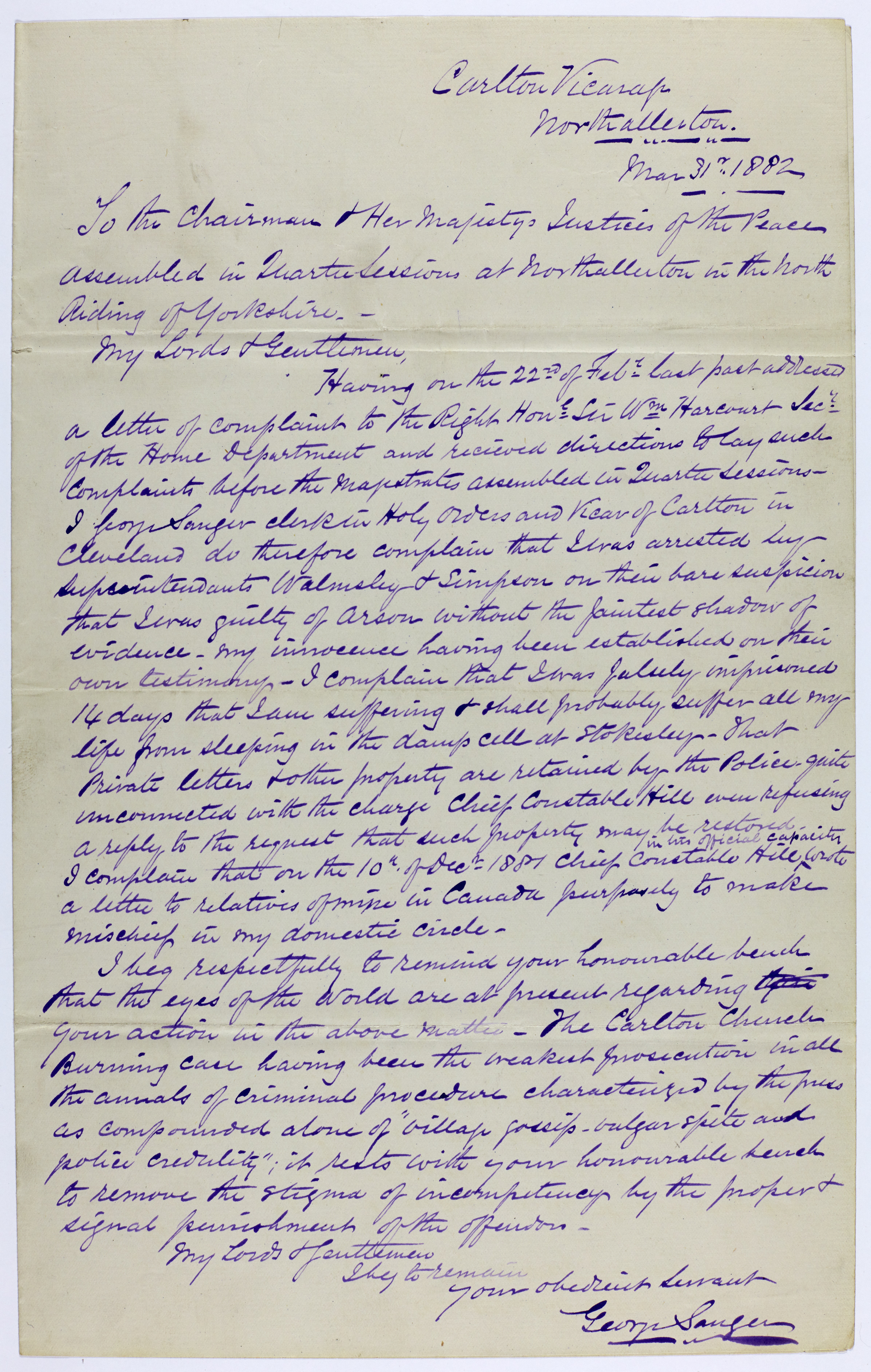
- QSB 1882 2/4 Left: Letter reporting the conclusion of the Justices of the Peace having visited the police cells at Stokesley, 11 March 1882
- Right: Letter from George Sanger to the Justices of the Peace, 31 March 1882
In a letter of 31 March 1882, written by Sanger from Carlton Vicarage to the Justices of the Peace, we see that he protested his innocence (QSB 1882 2/4, see above right):
“I George Sanger clerk in Holy Orders and Vicar of Carlton in Cleveland do therefore complain that I was arrested by Superintendents Walmsley & Simpson on their bare suspicion that I was guilty of arson without the faintest shadow of evidence. My innocence having been established on their own testimony, I complain that I was falsely imprisoned 14 days, that I am suffering & shall probably suffer all my life from sleeping in the damp cell at Stokesley, that private letters & other property are retained by the Police quite unconnected with the charge, Chief Constable Hill even refusing a reply to the request that such property may be restored. I complain that on the 10th of Dec 1881 Chief Constable Hill, in his official capacity, wrote a letter to relatives of mine in Canada purposely to make mischief in my domestic circle. I beg respectfully to remind your honourable bench that the eyes of the World are at present regarding your action in the above matter, the Carlton Church Burning case having been the weakest prosecution in all the annals of criminal prosecution characterized by the press as compounded alone of “village gossip, vulgar spite and police credulity”; it rests with your honourable bench to remove the stigma of incompetency by the proper and signal punishment of the offenders.
My Lords & Gentlemen, I beg to remain your obedient servant, George Sanger.”
In a separate collection within the Record Office holdings, there is a small bundle of correspondence from the Revd. Sanger (Z.1542). In a copy letter dated 28 October 1881, written from Albert Cottage, Esplanade, Redcar, Sanger thanks Mrs Reeve, the lady of the manor in Carlton, for offering “a reward for the apprehension of the scoundrels who have so wantonly destroyed my 5 years work” (see below). He further states:
“I am quite unconscious of having injured anyone in the Parish and have always put up with the annoyances, since 1872, without retaliation. At a consultation with the Chief of Police, it was strongly urged that I should at once leave the Parish, which I did on Saturday, closing the Vicarage and taking this furnished cottage. Not that I think there was any danger, but my household were extremely nervous and agitated. I have written the Archbishop for advice how to act. Our Ar[ch]deacon seems to advise my immediate resignation, that however I shall not do without due consideration and consultation with my friends. I am most sorry that the insurance had been allowed to lapse. I paid the first premium myself...”
“It is the opinion generally that fire must have been applied at different points. Mr Marwood’s coachman passed by the Church at 1 o’clock or after, went to the Hall [nearby Busby Hall], and after putting up the horses, walked to the village. He is quite sure that up till about 2 o’clock there was no light anywhere, and yet at 1/2 past 3 the church is a ruin. I have received heaps of letters of condolence and sympathy, also expressions of desire to assist me to rebuild. But I am now, I think, too old and too broken to undertake anything like a restoration again. The thing must of necessity go into younger hands.”
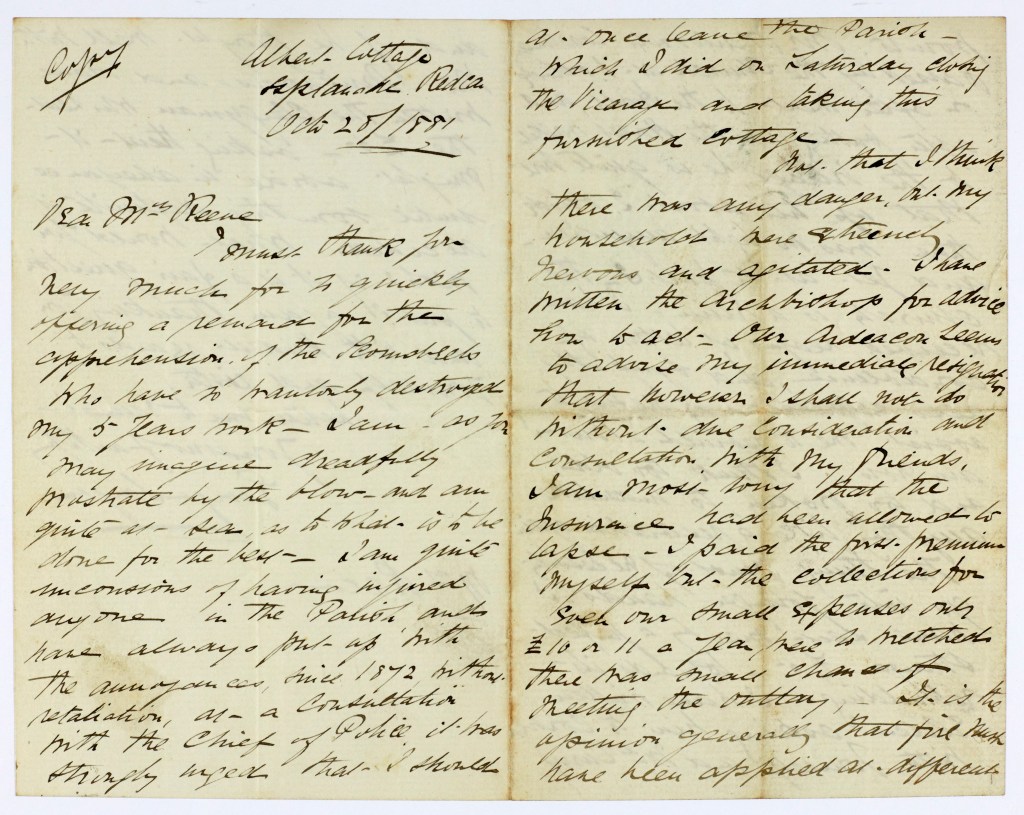

Z.1542 Letter from George Sanger to Mrs Reeve, lady of the manor, 28 October 1881
This collection also contains a letter to a Mr Elders, undated, but written from the same address in Redcar as the above correspondence (see images below). In it, Sanger states:
“I have employed Messrs Bainbridge and Barnley of Middlesbro to prosecute the slanderers in the village and with the co-operation of the Police I hope soon to punish them. Not content to ruin me financially, their limits must extend to ruin in character if possible. However, that I am resolved this time to stop with a firm hand. The Archbishop has written me a letter which I think leaves little alternative but that of resignation. I have almost concluded arrangements with a clergyman to take my place for a short time until I either resign or come back amongst my friends & foes. He will, I suppose, come into the parish next week. If I resign, I shall probably do so under the Act by the advice of my friends….Do not write me here, my doctor advises my leaving the sea side as soon as I am at all fit to go. I will write my address as soon as I have decided, but in my present state of health, to come back to Carlton amidst implacable foes would mean death. I feel very much for the majority of my people feeling assured that during this present trouble I have more for me than against me. Although that is a difficult matter to judge, I had no conception last time that the entire parish would be against me for an act which was most manifestly for their benefit, the discharge of a manifestly unfit man to be schoolmaster…”
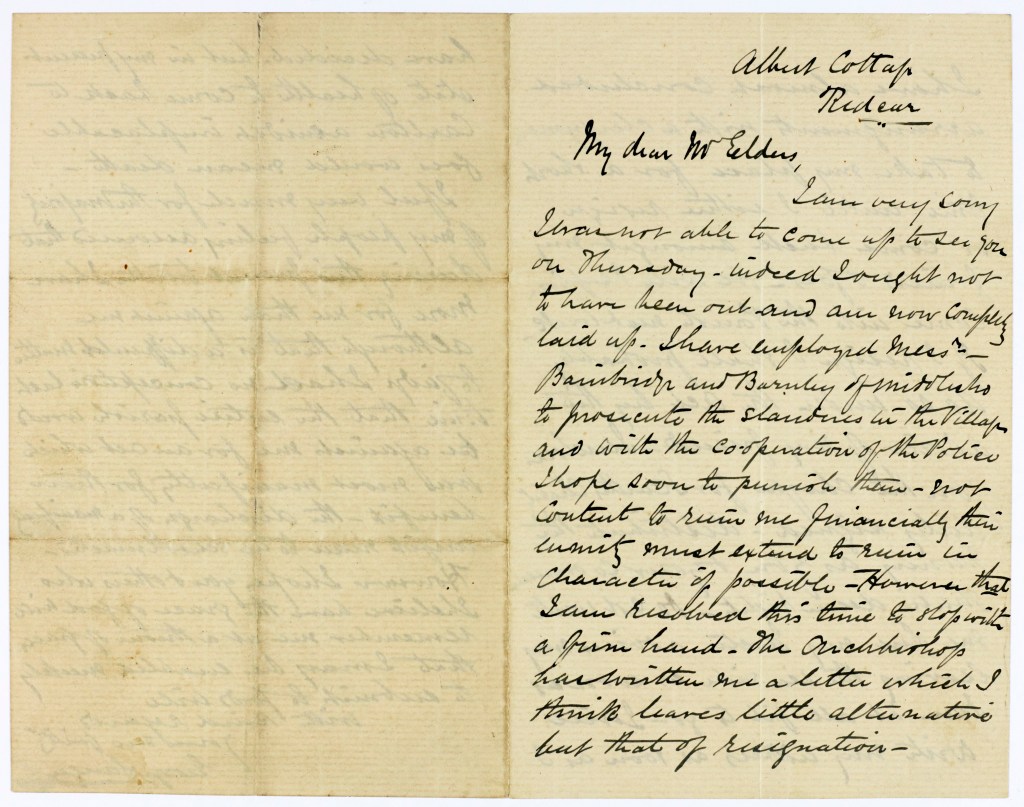
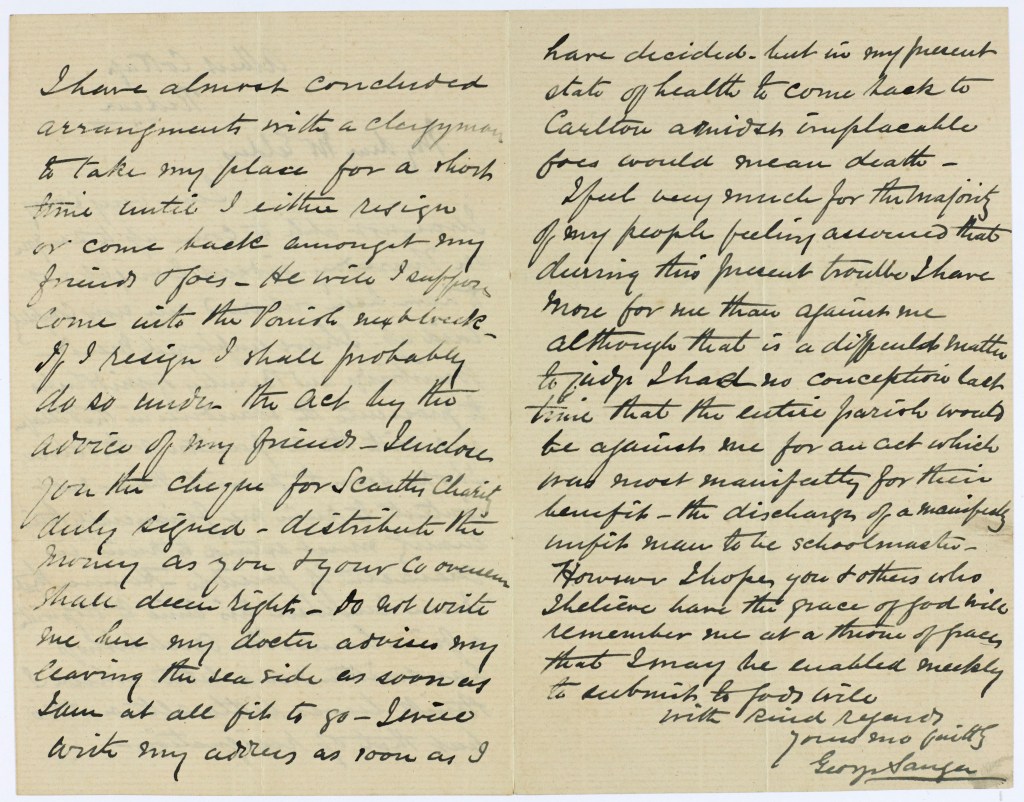
Z.1542 Letter from George Sanger to Mr Elders, undated [c. October 1881]
There is no record of the verdict of the case heard at the North Riding Quarter Sessions, but Sanger seems to have been acquitted of starting the fire. Certainly, judging by the depositions, there appears to be no firm evidence against him. Bulmer’s History, Topography and Directory of North Yorkshire (1890) records that Carlton church “was destroyed by fire, the origin of which was never ascertained, and it now lies in ruins, no attempt having been made to rebuild it… the Rev. G. Sanger, who is not resident… holds an occasional service in the ruins”.
The rebuilding of the church
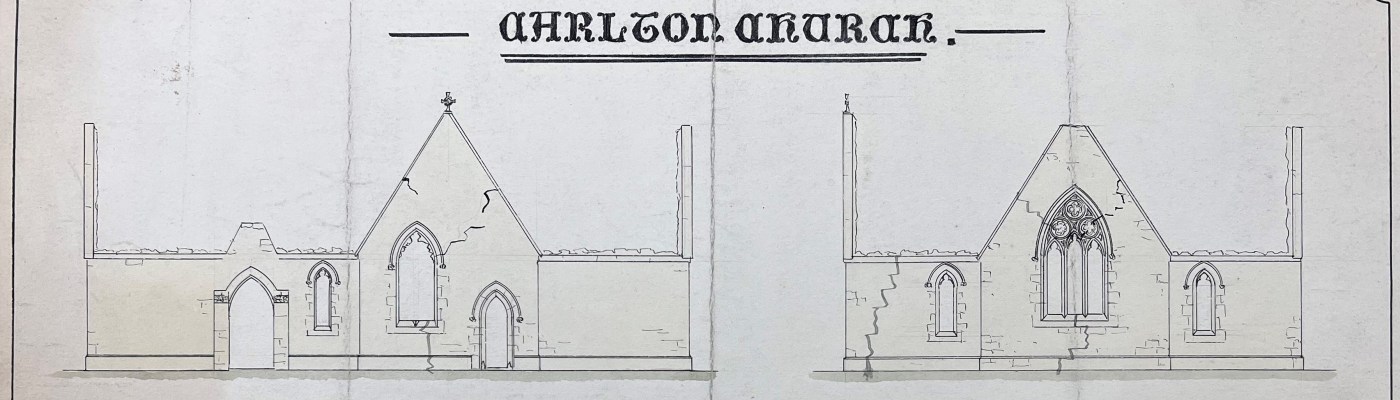
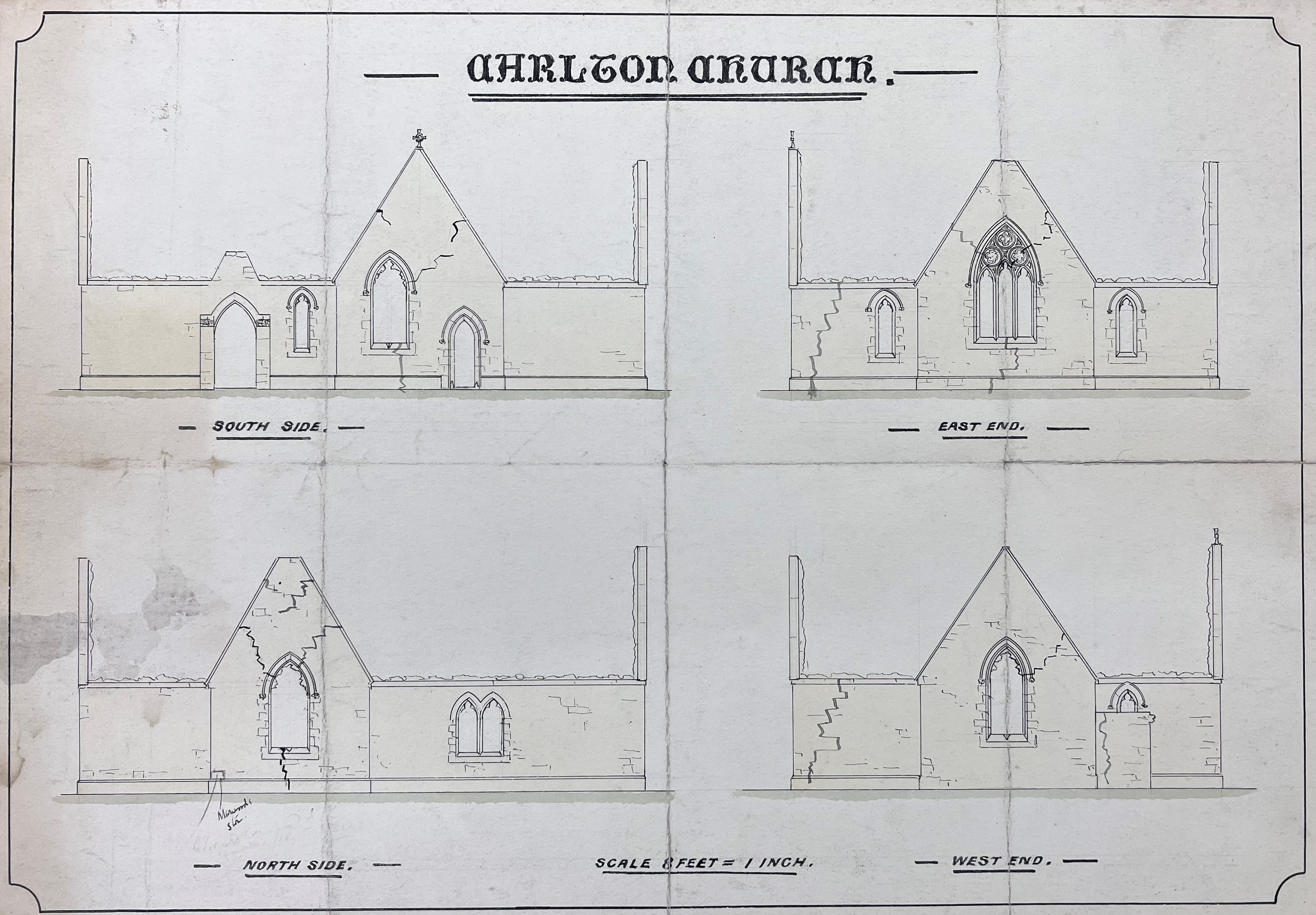
The church was eventually rebuilt over a decade after the 1881 fire, in 1896/7, to the designs of the architect Temple Moore of London (1856-1920); the vicar at this time was the Revd. J.L. Kyle. A series of plans, sketches and elevation drawings are held as part of the Carlton-in-Cleveland parish church archives in the custody of the Record Office, including several signed by Temple Moore (PR/CTC 8, see images below).
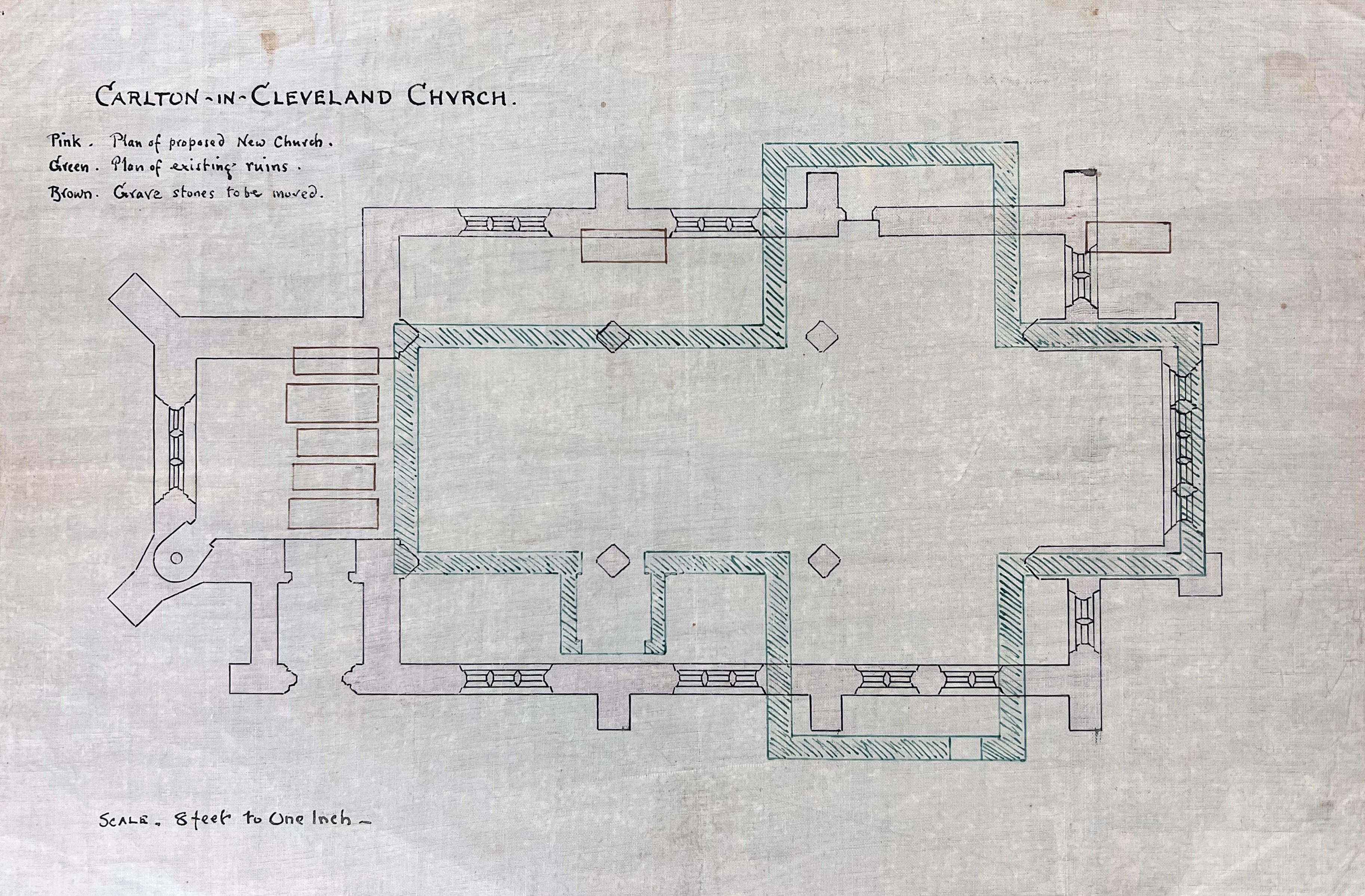
- PR/CTC 8 Left: Drawing showing the ground plans of the existing ruins (in green) and proposed new church (in pink) at Carlton, unsigned and undated [c.1896]
- Right: Elevation drawings of the existing ruins before rebuilding, unsigned and undated [c.1896]
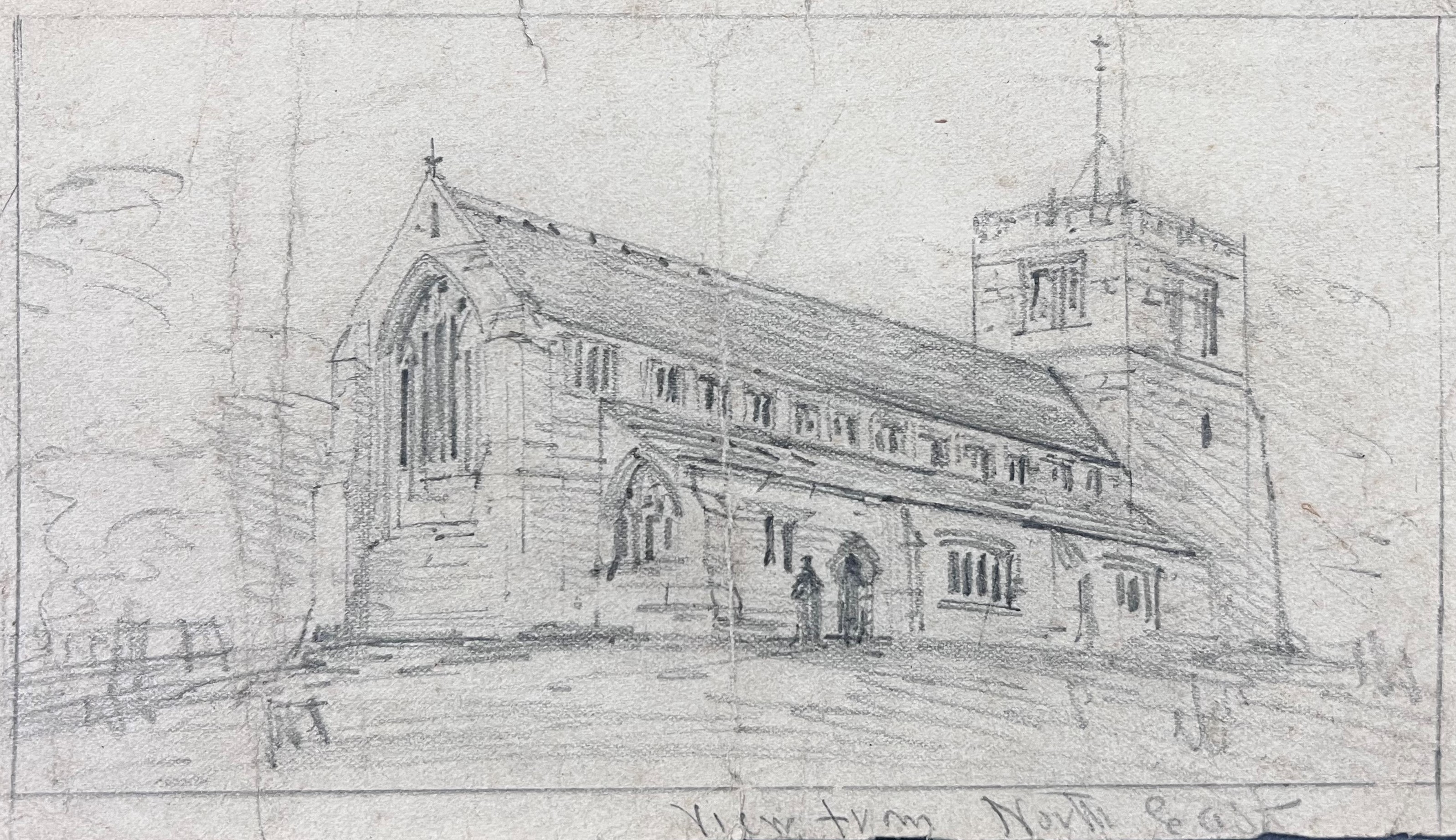
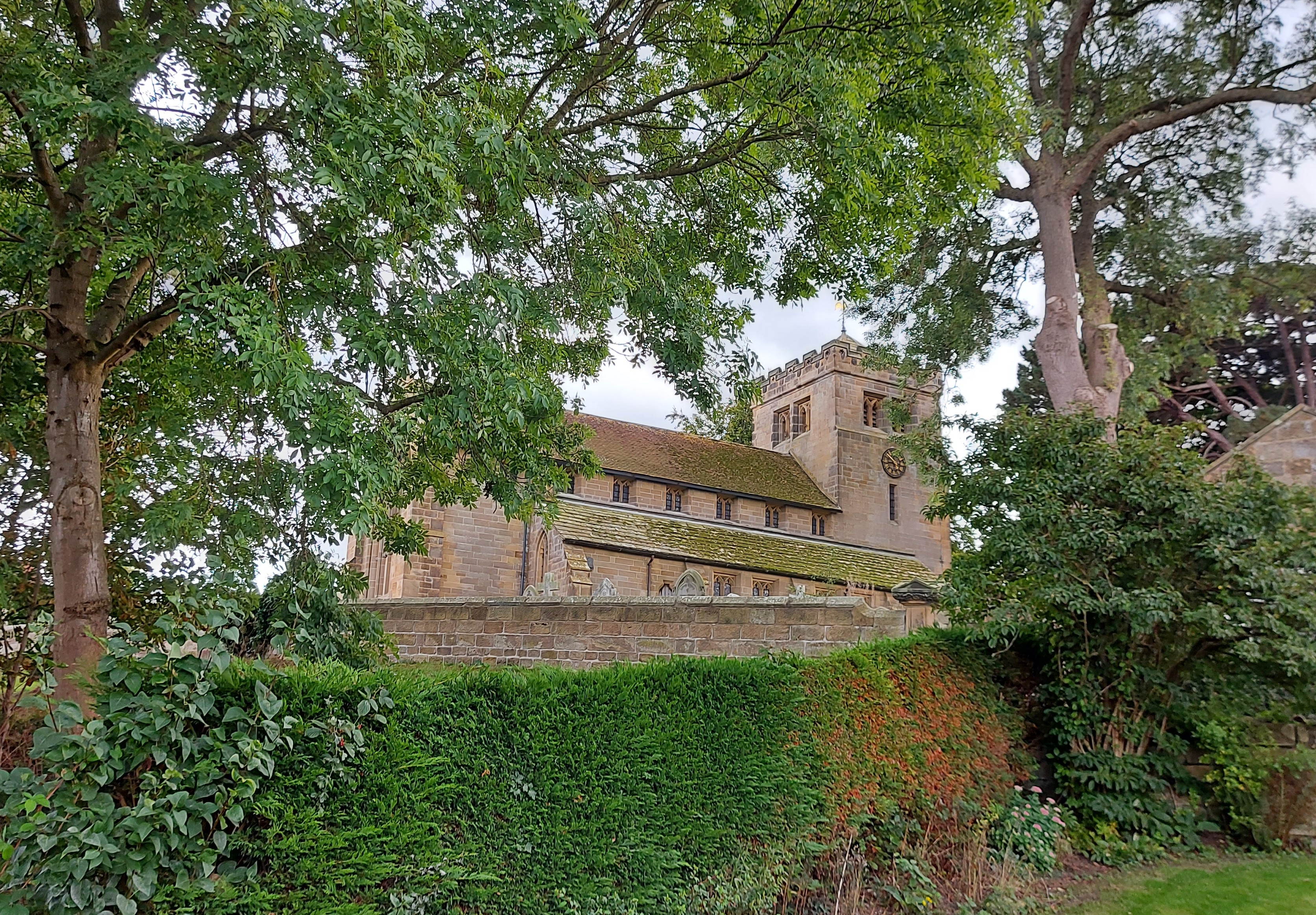
- PR/CTC 8 Left: Pencil sketch of Carlton church from the north east, possibly by Temple Moore, unsigned and undated [c.1896]
- Right: Photograph of a similar view taken in September 2022 by G Falkingham
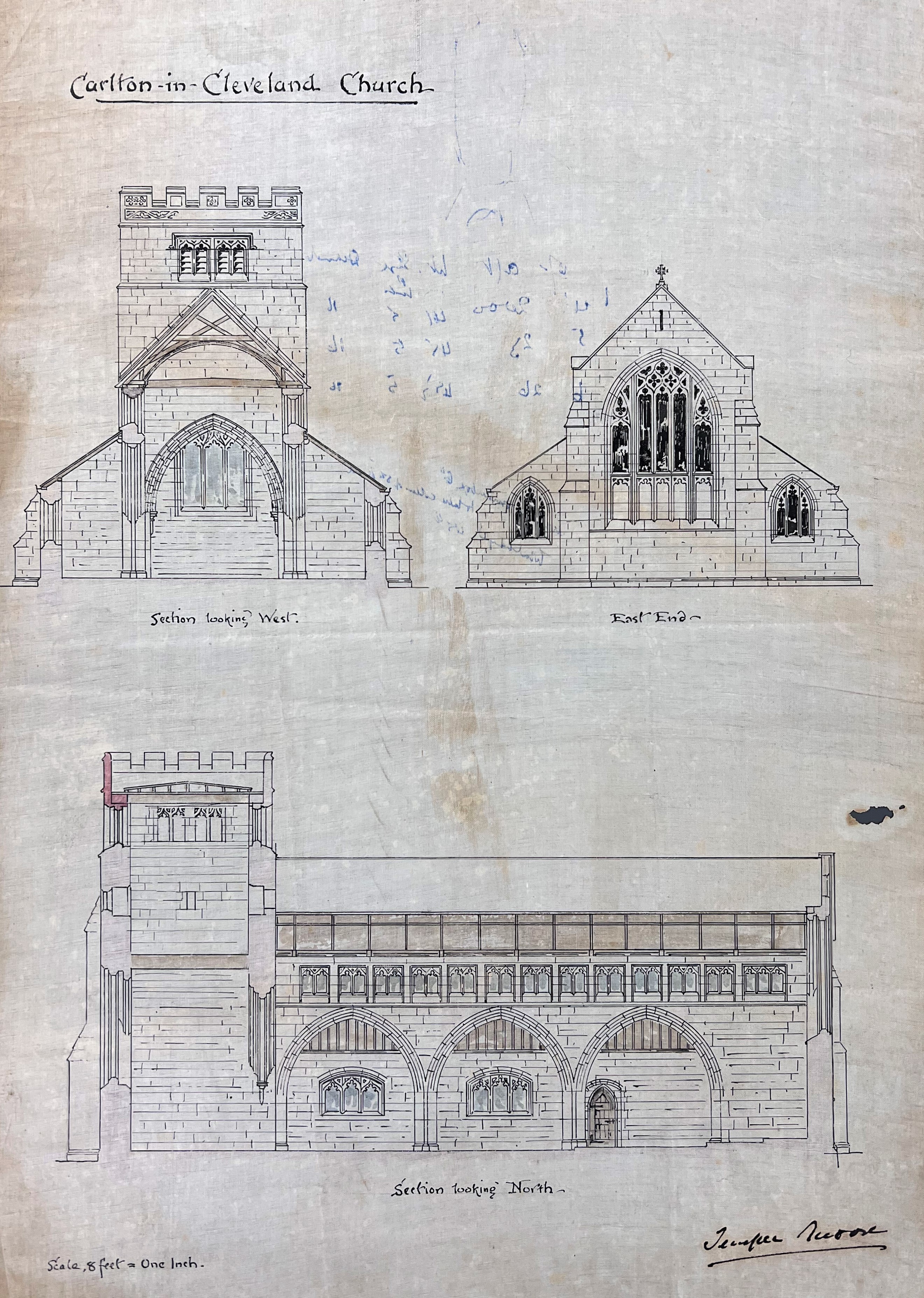
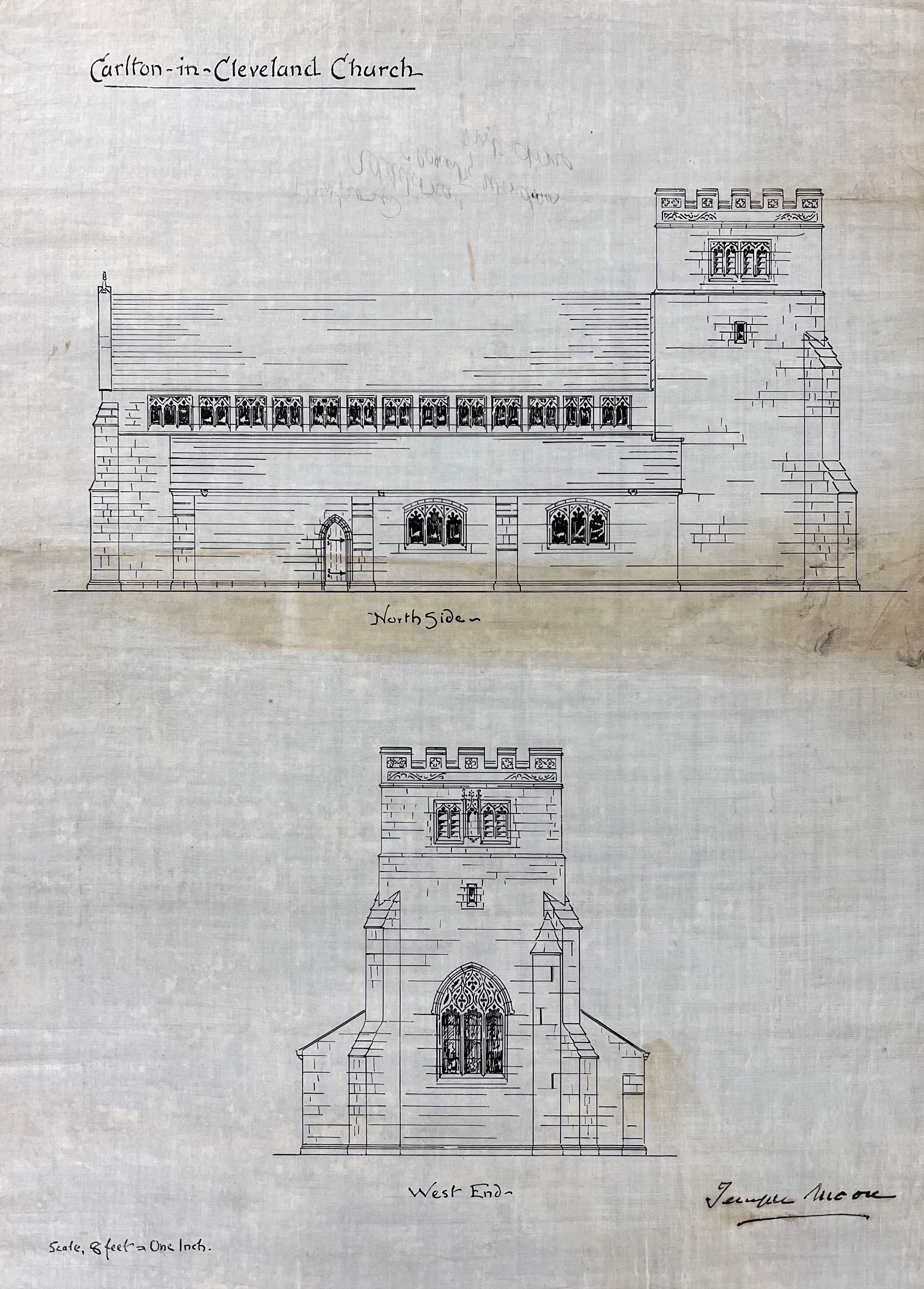
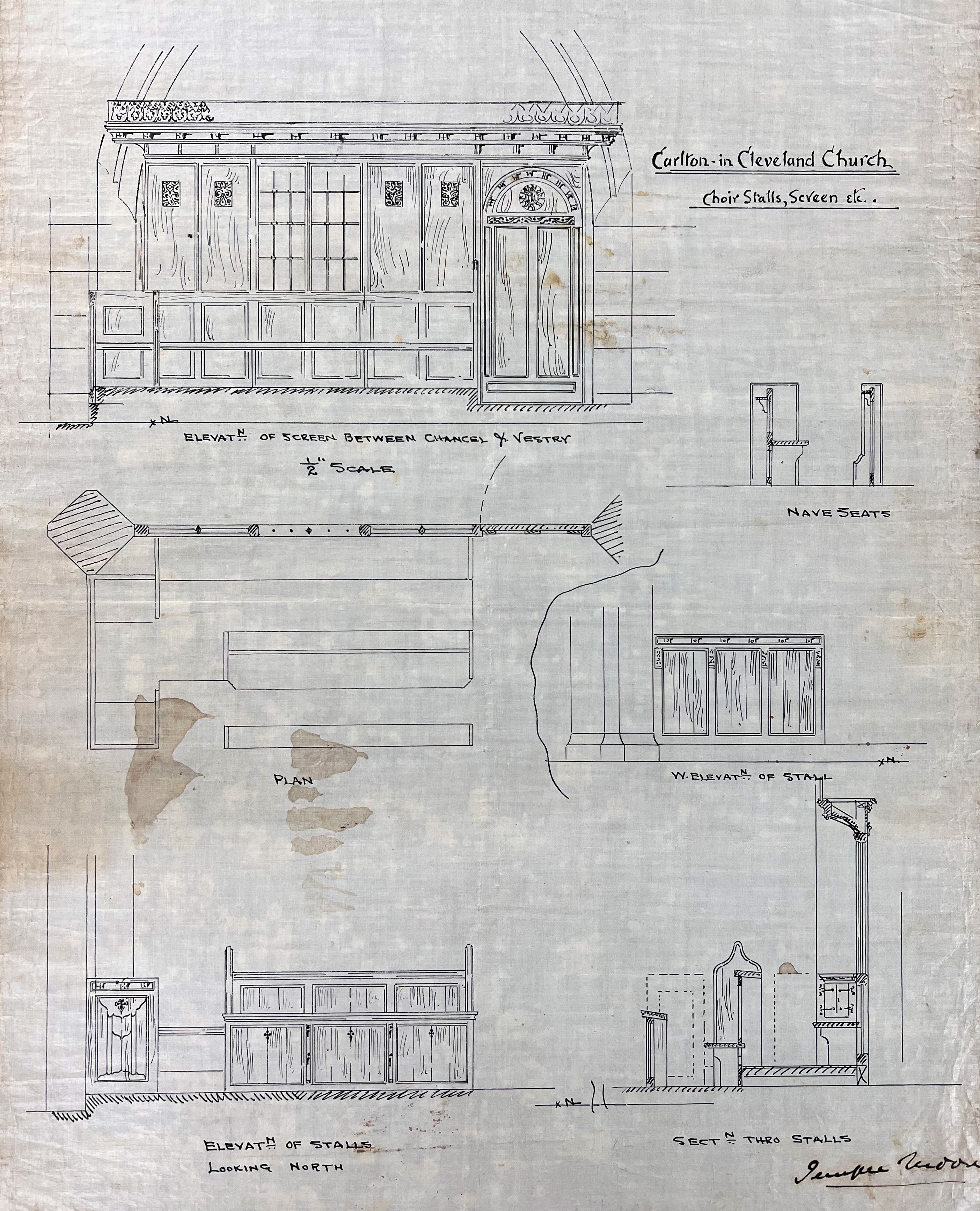
PR/CTC 8 Elevation and section drawings of the proposed new church at Carlton, plus details for the new choir stalls, screen &c, signed by Temple Moore, undated [c.1896]
This parish record collection also includes Temple Moore’s estimate of work to be done in building the new church, dated March 1896 (PR/CTC 6/1).
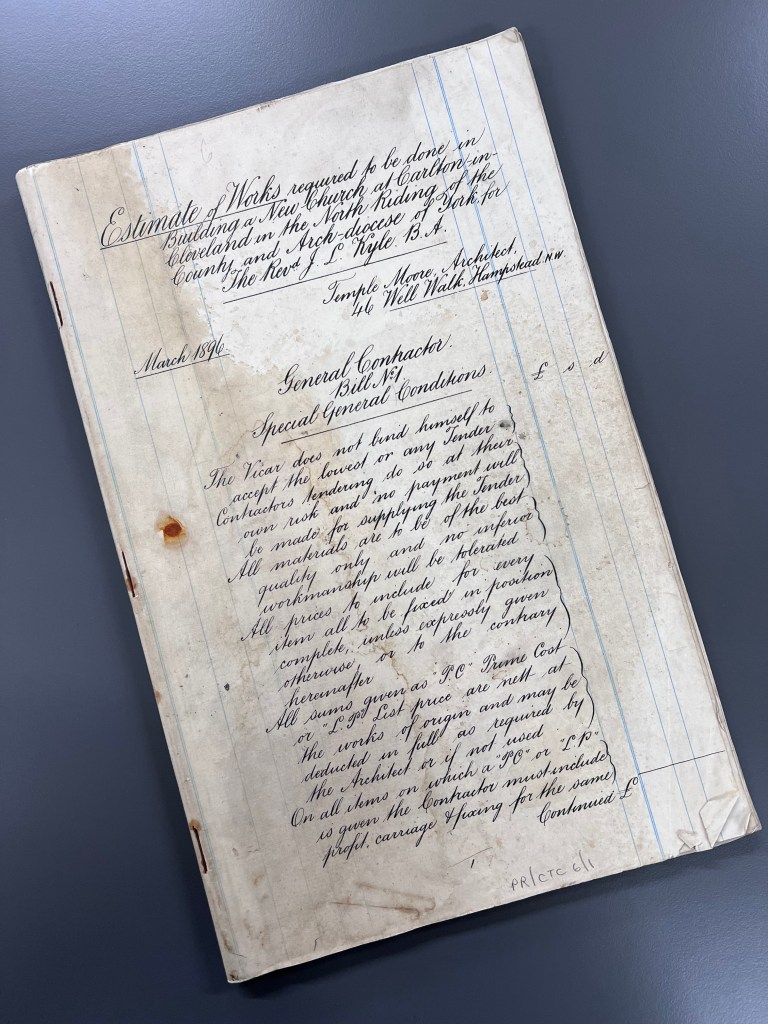

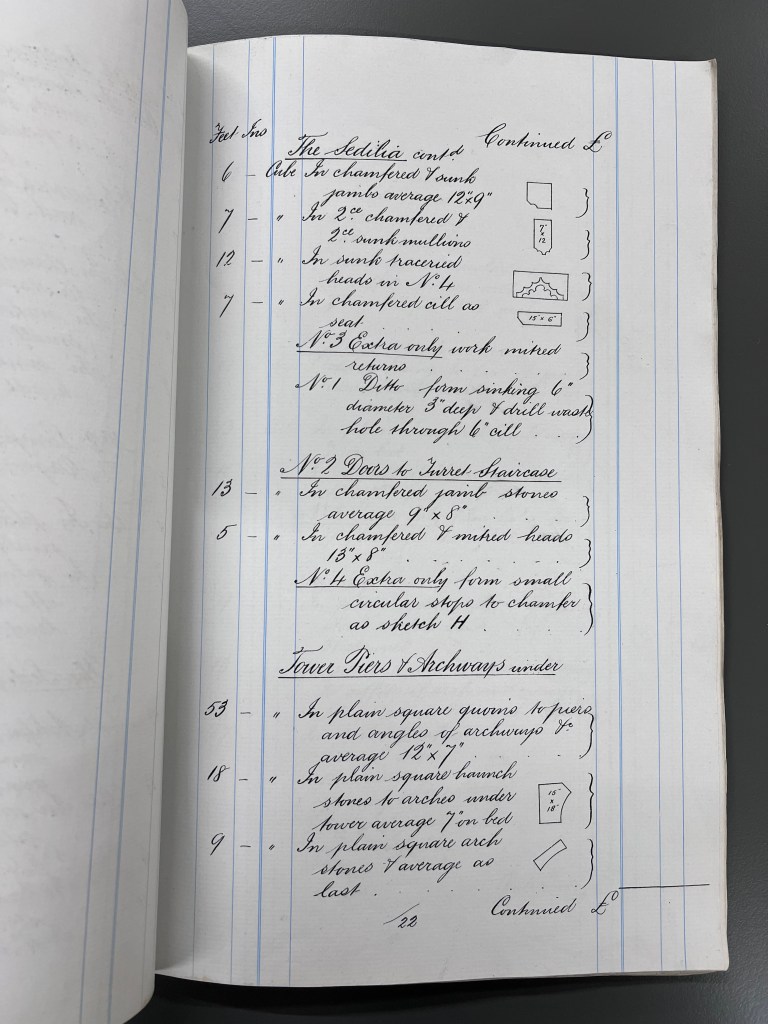
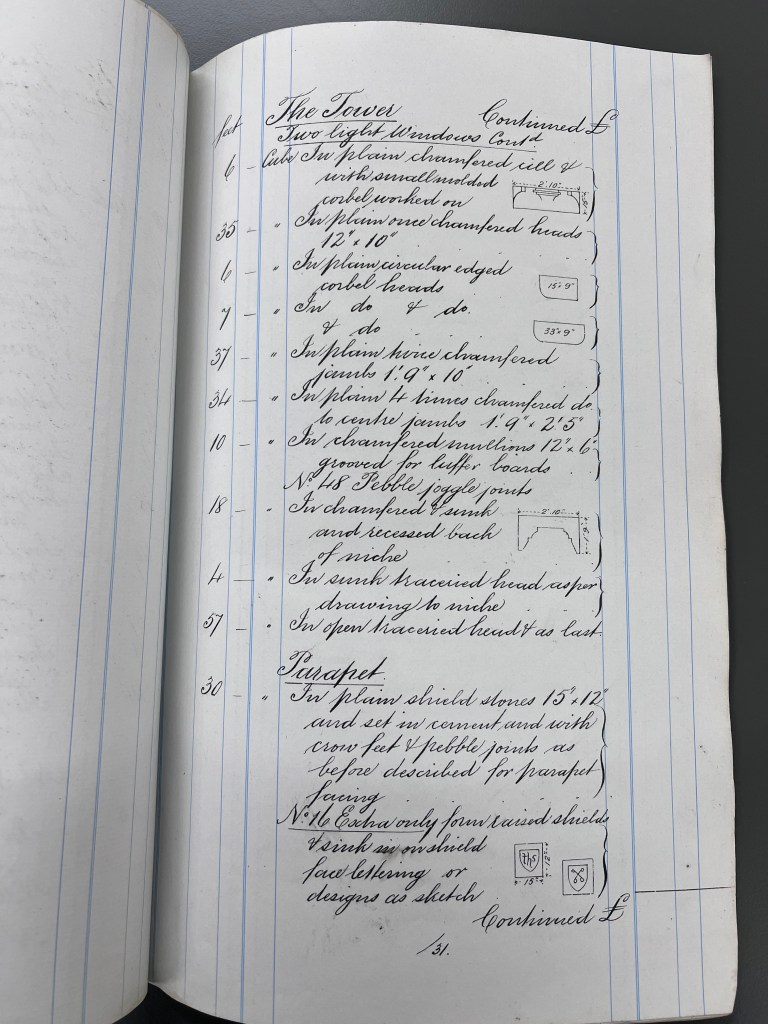

PR/CTC 6/1 Pages from the ‘Estimate of works required to be done in building a new church at Carlton’ prepared by Temple Moore of 46 Well Walk, Hampstead, to be put out to tender to contractors, March 1896
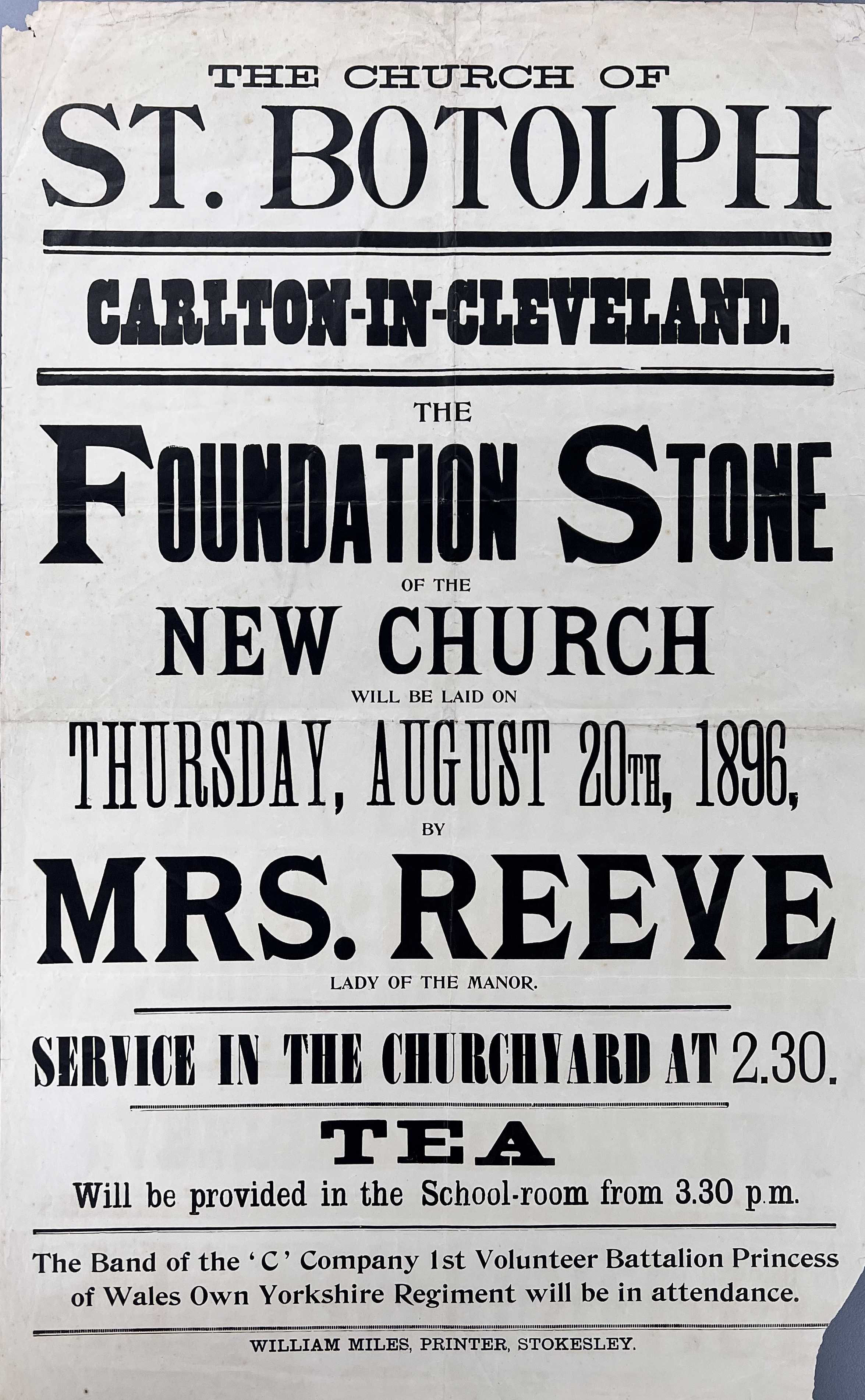
Poster advertising a service in the churchyard at 2.30pm on Thursday 20 August 1896 for the laying of the foundation stone of the new church by Mrs Reeve, lady of the manor, to be followed at 3.30pm by tea in the school room (PR/CTC 9/1).
Further information
The listed building description for St Botolph’s church
The Church of England’s online heritage database, the Church Heritage Record entry for St Botolph’s church, Carlton
Webpages on the History of St Botolph’s Church, Carlton in Cleveland, which include additional information about the Revd George Sanger and the church fire.
 North Yorkshire Archives Blog
Thank you for those documents, John Ramsdale was my great-great grandfather, so it is good to have that interesting family history. There was also lots of newspaper coverage. My great-aunt Eliza Ramsdale had to give evidence aged only 14.