by Gwyneth Endersby, Record Assistant
Introduction
This year marks the 400th anniversary of the birth of George Fox (1624-1691), generally acknowledged to be the founder of the Society of Friends, commonly known as Quakers, and certainly one of the most prominent early members.
We are, therefore, taking the opportunity to showcase a selection of Quaker records for Guisborough and Richmond Monthly Meetings spanning over 350 years, together with Quaker-related items from wider collections we hold. This blog coincides with an exhibition of a selection of the items featured, on display at the Record Office until 18th October 2024.
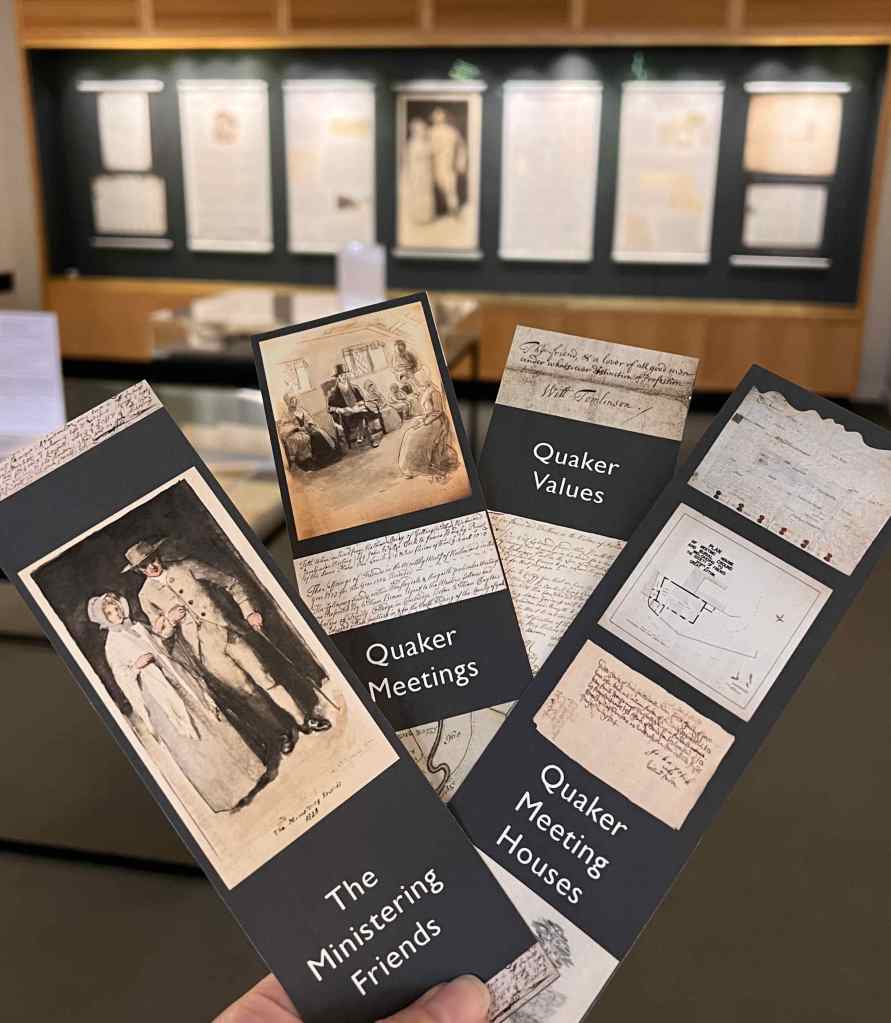

In this blog, you can explore records showing how Quakers organised themselves locally and nationally, with international connections, from the latter half of the mid-17th century. We highlight records reflecting the key Quaker values influencing Friends’ daily lives, activities, and commitments. You can also gain insight into the persecution experienced by Quakers and their resilience shown, through examples of their correspondence and formal recordings of sufferings from the 17th to 19th-centuries.
- Background
- Quaker Values
- Quaker records
- Quakers represented in wider collections at the Record Office
- Further reading
[Click on the images below to open full-screen versions when viewing online]

A map of the Meetings belonging to the Quarterly Meetings of Lancaster, Westmorland, Cumberland, Northumberland, Durham & York, by James Backhouse, 1773 [R/Q/R 12/1]
Quarterly Meeting areas are further subdivided into Monthly Meeting districts – those under the auspices of the York Quarterly Meeting are outlined in red. Meetings were organised at local (Preparatory), district (Monthly), regional (Quarterly) and national (Yearly) level.
Background
Born in July 1624 into a Puritan family in Leicestershire, George Fox became disillusioned as a young man with the established Anglican church and felt compelled to travel in search of a better religious life.
In 1652, whilst on the summit of Pendle Hill, Fox experienced a vision “of a great people to be gathered”. He didn’t assume, however, that this divine revelation automatically guaranteed him pre-eminence. For Fox firmly believed that each person possesses a God-given inner light, and as such all persons are equal before God, requiring no intermediary (such as a priest) to experience a true and direct relationship with God.
Fox shared these ideas as he travelled on foot throughout the northern counties of England during the 1650s. He rapidly attracted a following of like-minded people, known initially under various informal names, but who progressively called themselves Quakers and eventually became formalised under Fox’s guidance as the Religious Society of Friends. Despite facing public hostility and serious official opposition – especially after the restoration of the monarchy in 1660 – the Quaker movement became widespread, extending beyond Britain to parts of Europe and to British colonies in the Caribbean and America. The influential Quaker William Penn, a close friend of Fox, founded the colony of Pennsylvania in the early 1680s.
Until the passing of the Toleration Act of 1689, many Quakers were persecuted and imprisoned for their beliefs and actions – especially in their refusal to take oaths, to show deference to officials, or to pay church rates and tithes.
The Quakers were among several dissenting religious groups (including Puritans, Pilgrims, Seekers and Ranters), which sprang up during the turbulent years of the early to mid-17th-century. Quakers separated entirely from the established church, abandoning formal church services and hierarchy in favour of small, and often silent, gatherings as equals in Meeting Houses.
Quaker values: equality, moral integrity, humanitarianism, education and peace
Since the Society’s formation nearly 400 years ago, it has been important to Quakers to endeavour to live simply and honestly. These values, together with the tenets that all persons are equal, and that God can be personally experienced through everyday living, have informed their wider activities and commitments.
Equality
Quakers regard all people as equal and worthy of respect, regardless of background or circumstance. As such, they eschew hierarchy and deference. In seeking to uphold the notion of equality in their daily life, many early Quakers appearing before the Justices because of their religious persuasion, received tougher punitive sentences for refusing to remove their hats in officials’ presence. Sometimes they were forced to remove them – as encountered by the Quakers appearing before the Lord Chief Justice at York Castle in 1684, and who were subsequently imprisoned there, described by Richard Butterfield at York in a letter to Phillip Swale (R/Q/R 9/345). Phillip Swale was treasurer at Richmond Preparatory Meeting and later became Lord Wharton’s agent for his lead mines in Swaledale and Kettlewell. Upon his death in 1687, Swale left money to found charitable trusts to assist the poor. The Swale family papers, to which Butterfield’s letter belongs, are incorporated into the Richmond Monthly Meeting collection [R/Q/R 9].
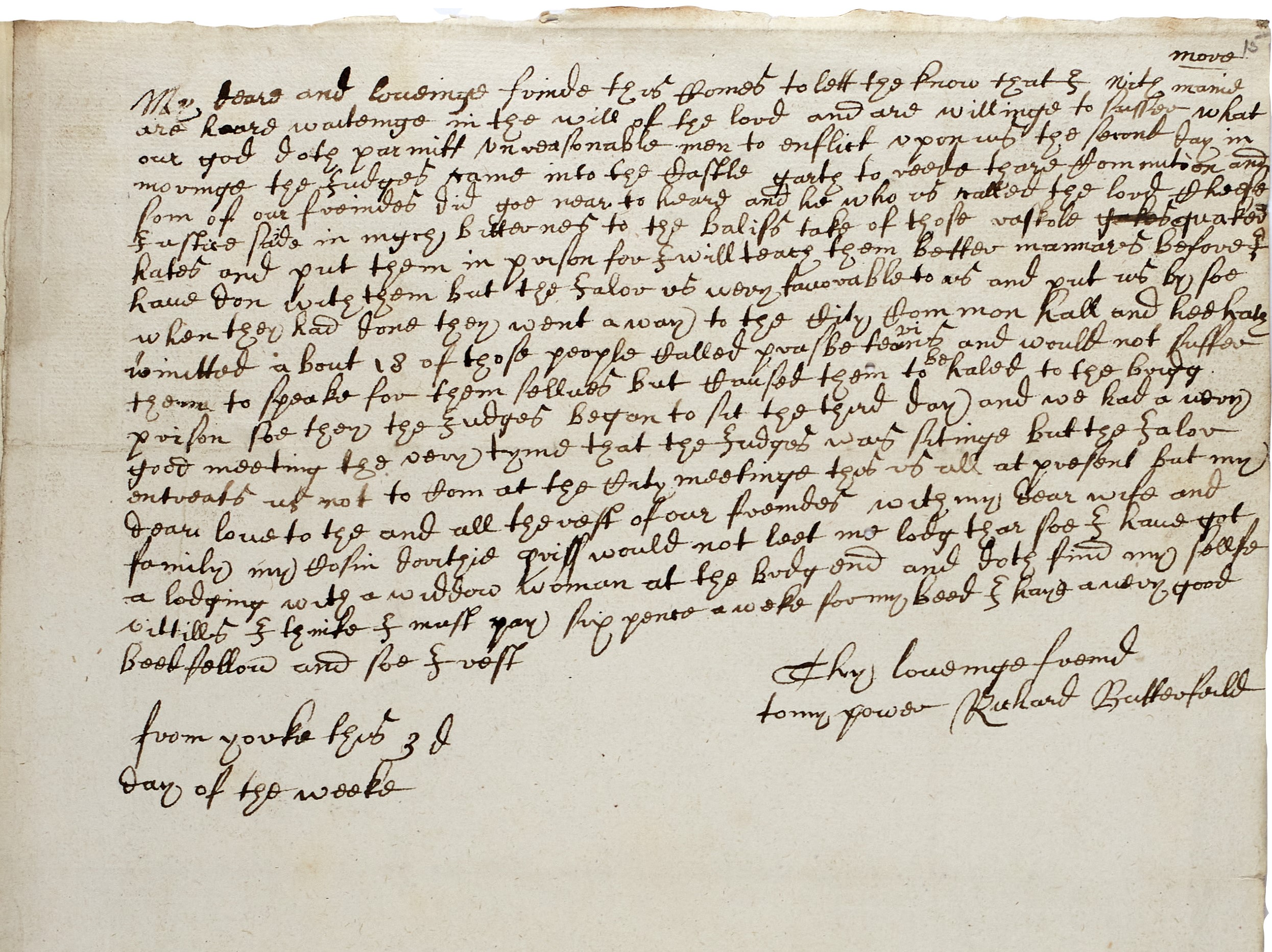
Letter from Richard Butterfield at York to Phillip Swale, July 1684, describing how the visiting Lord Chief Justice to York Castle forced Friends to remove their Quaker hats and ordered the gaoler to: “put them in prison for it will teach them better manners before I have done with them” [R/Q/R 9/345]
Equality as a virtue is also strongly evident in Friend William Tomlinson’s letter of August 1680 to the Reverend George Parish, regarding the latter’s harsh treatment of Quakers in the parish of Helmsley (ZEW X, see below). Having berated the Reverend for using his position of power in society to oppress, Tomlinson signs his letter under the maxim: “Thy friend, and a lover of all good men under whatsoever distinction of profession they are”.

Detail from a letter by William Tomlinson to Revd George Parish, 17 August 1680 [ZEW X]
Hand in hand with the notion of equality is the Quaker principle of honesty and truthfulness. It was thus very common for early Friends to refuse to swear oaths, on the basis that all are equal and that a Quaker’s word ought to be accepted as sufficient.
Moral integrity, humanitarianism and animal welfare
Central to the personal and public lives of Quakers is acting with conscience. So important is this, that records from the 17th and 18th-centuries reveal that Friends found transgressing prescribed moral boundaries could find themselves publicly disowned based on testimonies issued against them by fellow Quakers. Though an extreme measure, disownment was only a last resort, after all attempts at conciliation were exhausted. The Richmond Monthly Meeting collection contains a bundle of testimonies spanning the dates 1770 to 1835, dealing with a wide range of perceived misconduct, including gambling, debt, business mismanagement, clandestine marriage and licentious behaviour.

Disownment of Margaret Sidgwick, singlewoman, by Friends of Richmond Monthly Meeting held at Aysgarth, for being “…openly scandalous in both speech and conduct”, despite being “many times visited and laboured with by her well- wishing Friends”, 3 July 1766 [R/Q/R 15]
Testimony and disownment of Adam Fawcet of Carperby by Friends of Richmond Monthly Meeting held at Swinithwaite, for being “guilty of acting unjustly by running into debt time after time” and “Endeavouring to deceive his creditors by false pretences of payments, till now it is apparent there will be considerable loss by him”, 3 May 1747 [R/Q/R 15]

Two friends in each Meeting were usually appointed to gently guide fellow members, notifying the Meeting of any issues arising. The correspondence of Richmond Monthly Meeting includes Queries of the Women’s Quarterly Meeting at York (c. 1780), which ask:
“Have you two or more faithful Friends deputed in each particular Meeting to have oversight thereof? And is care taken when any thing appears amiss, that the Rules of our discipline be put in practice?”

Queries were sent from one Meeting to another and encouraged Friends there to consider their spiritual and everyday lives collectively and individually, improving where necessary.
Queries of the Women’s Quarterly Meeting at York, circa 1780 [R/Q/R 7/59]
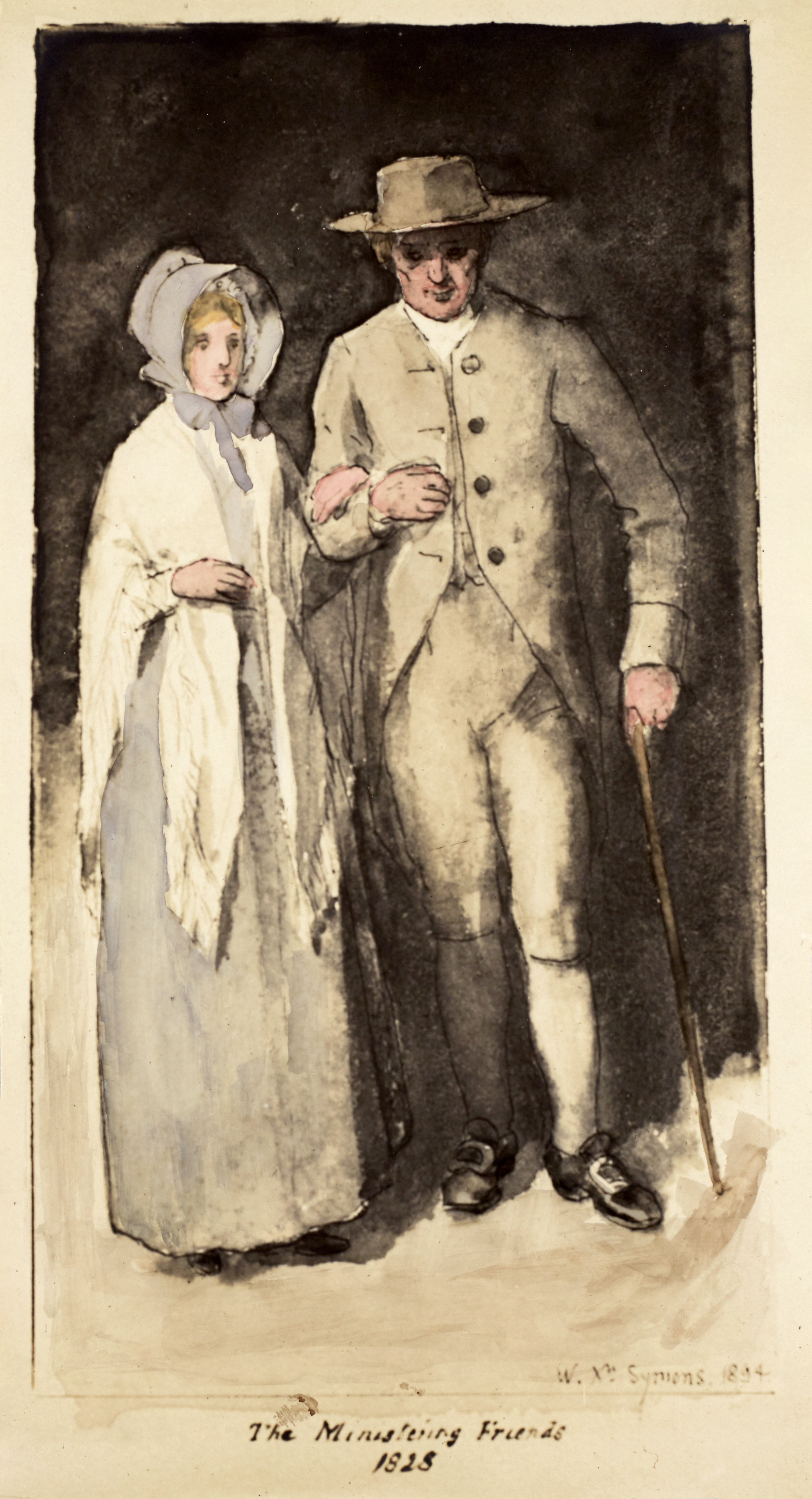
Isabella Harris (1822-1868), in her memoir “In the Days of Old: A Quaker Child, by ‘Granny’” [ZYZ], describes a such a pair of visiting Friends, who lodged with her shipbuilding family during their ministering visits around the neighbourhood.
‘The Ministering Friends, 1828’, an illustration from “In the Days of Old: A Quaker Child, by ‘Granny’”, a loose-leaf typescript memoir by Isabella Harris (née Tindall), no date [ZYZ]
Such moral soundness naturally led to the embracing of causes designed to ease suffering and inequality on a wider scale. Poor relief and temperance work at local and national levels were joined in the 19th-century by pertinent overseas causes such as anti-slavery, famine relief in India and medical support to war zones. Animal welfare was also supported via the 1890s home-based campaign for anti-vivisection.
The correspondence of the Richmond Monthly Meeting (1650-1964) contains a variety of late-19th century letters, printed circulars, declarations and reports on various humanitarian and animal welfare issues, both at home and abroad.
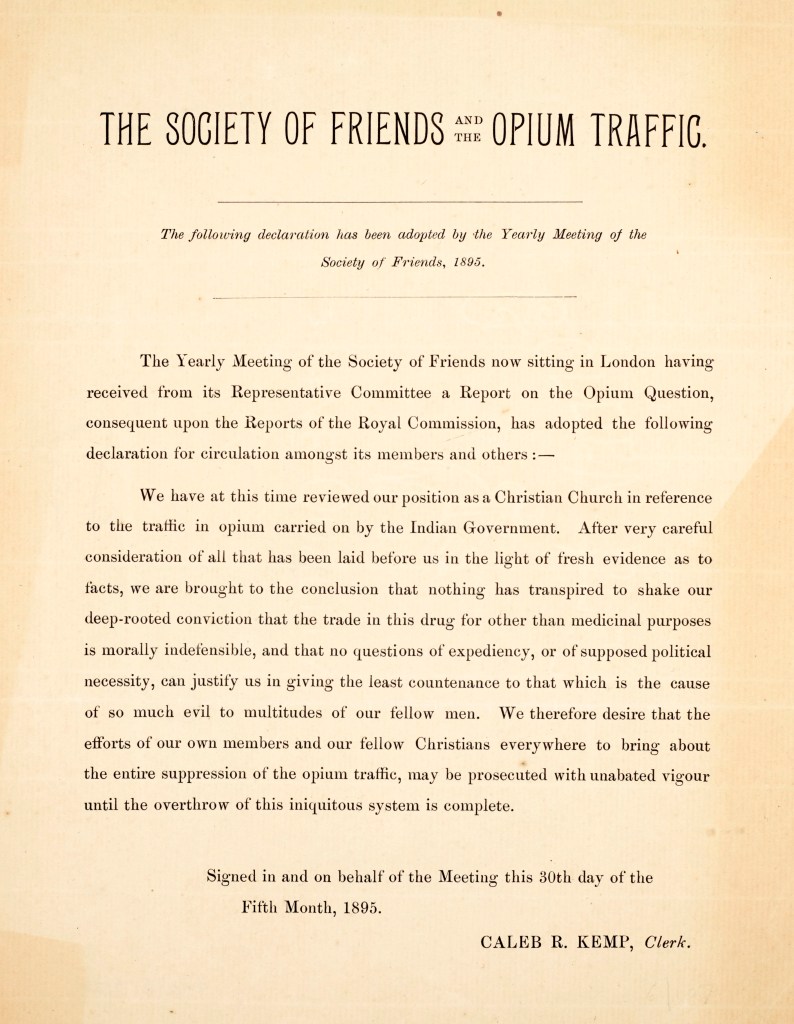
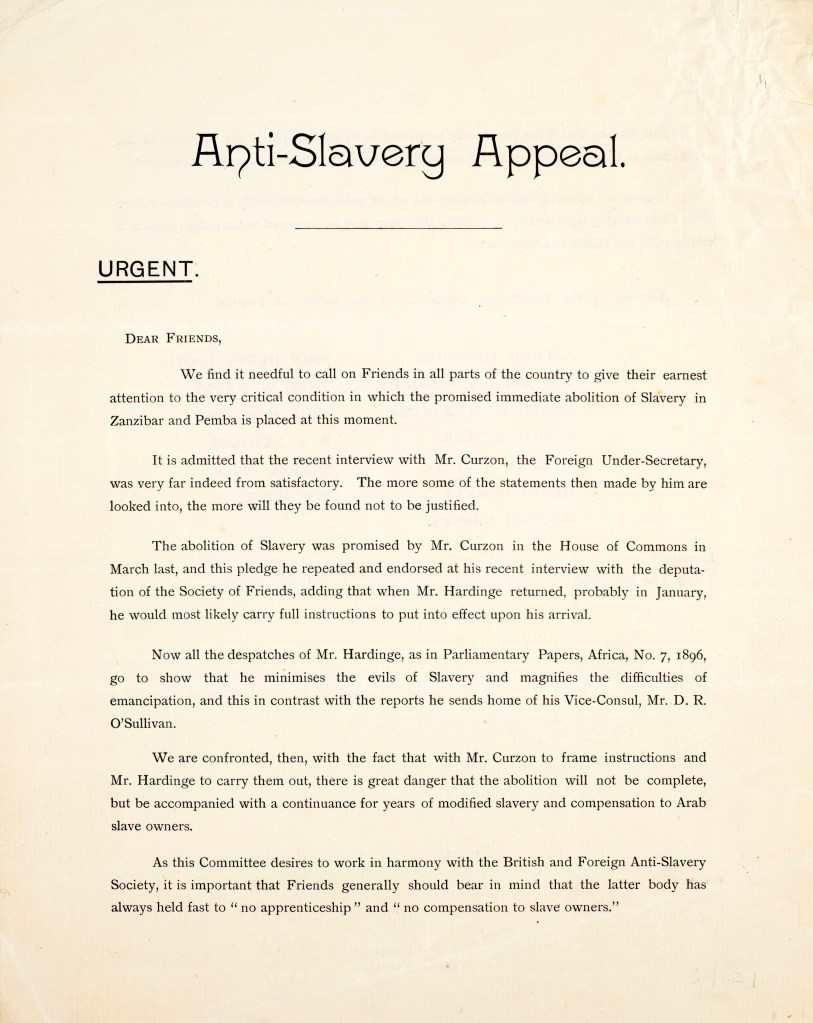

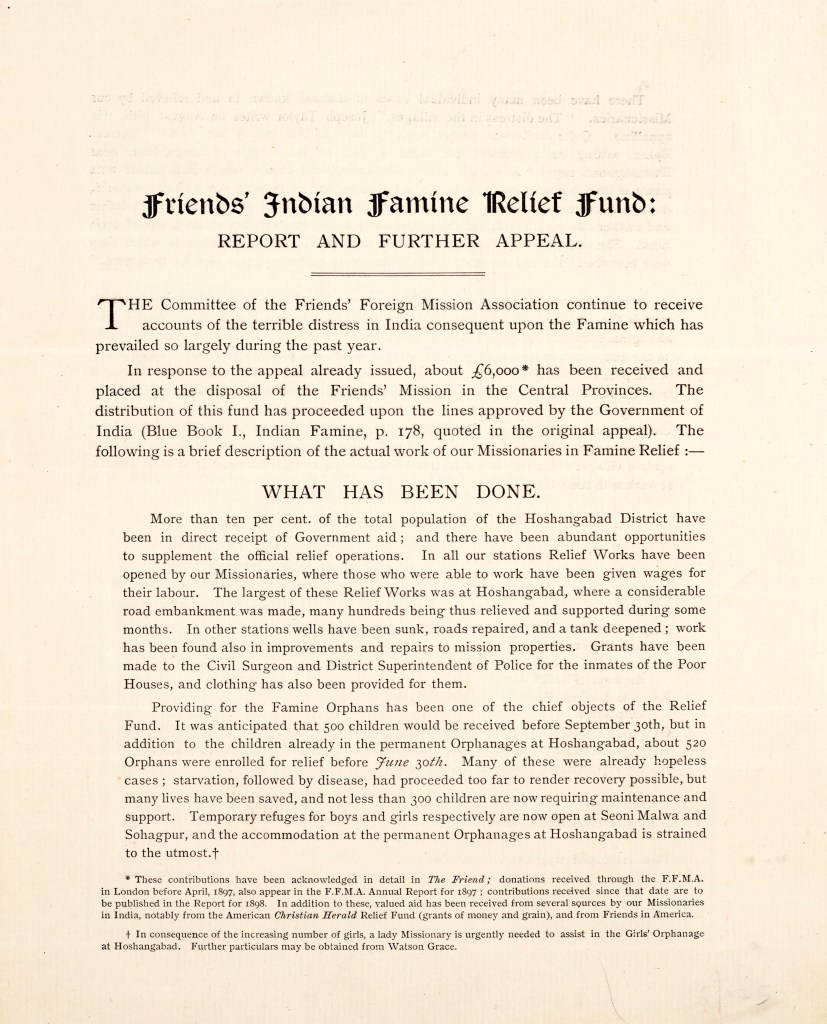

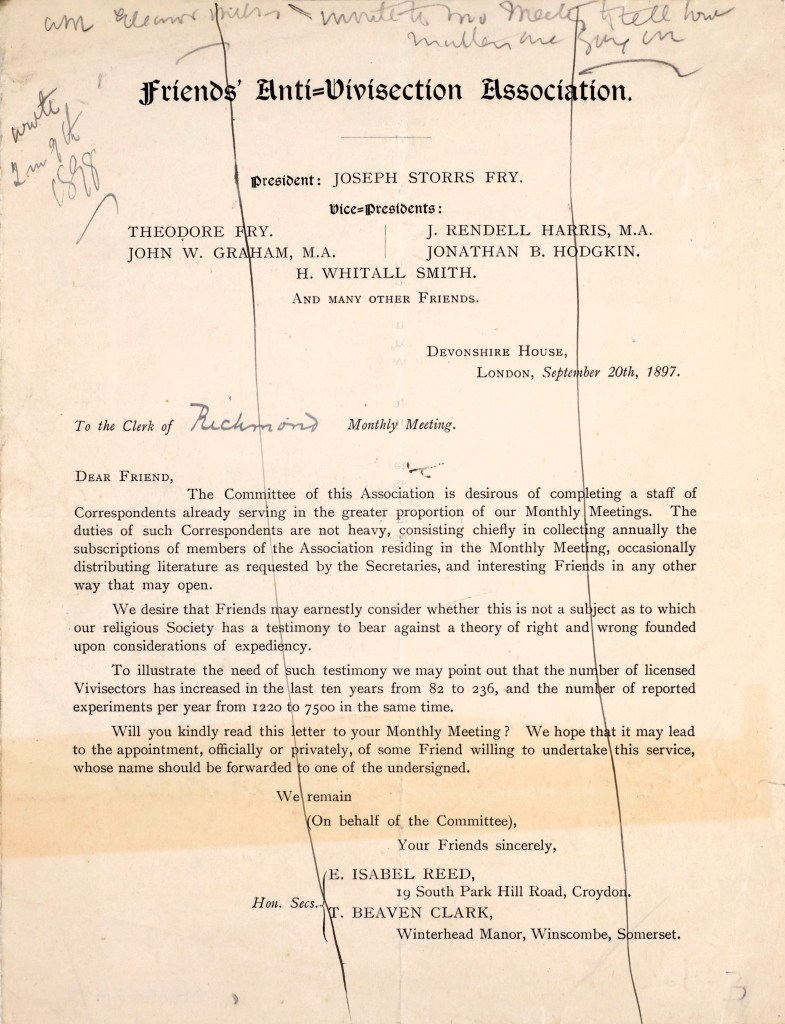
Slideshow of images from 1-6:
- Opium Traffic Declaration, 1895 [R/Q/R 7/231]
- Anti-Slavery Appeal, Zanzibar, 1896 [R/Q/R 7/278]
- Letter from Anti-Slavery Committee to Richmond Monthly Meeting, 1895 [R/Q/R 7/228]
- Friends’ Indian Famine Relief Fund: Report & Further Appeal, 1897, page 1 [R/Q/R 7/291]
- Note from Joseph Lee of Askrigg, accompanying a collection of £1 5s 6d from the Bainbridge Meeting to the Indian Famine Relief Fund, dated 5 March 1897 [R/Q/R 7/283]. The amount is roughly equivalent to £104.00 in today’s money (using The National Archives currency converter tool, 2017)
- Letter from the Friends’ Anti-Vivisection Association to Richmond Monthly Meeting, 1897 [R/Q/R 7/289]
Education and learning
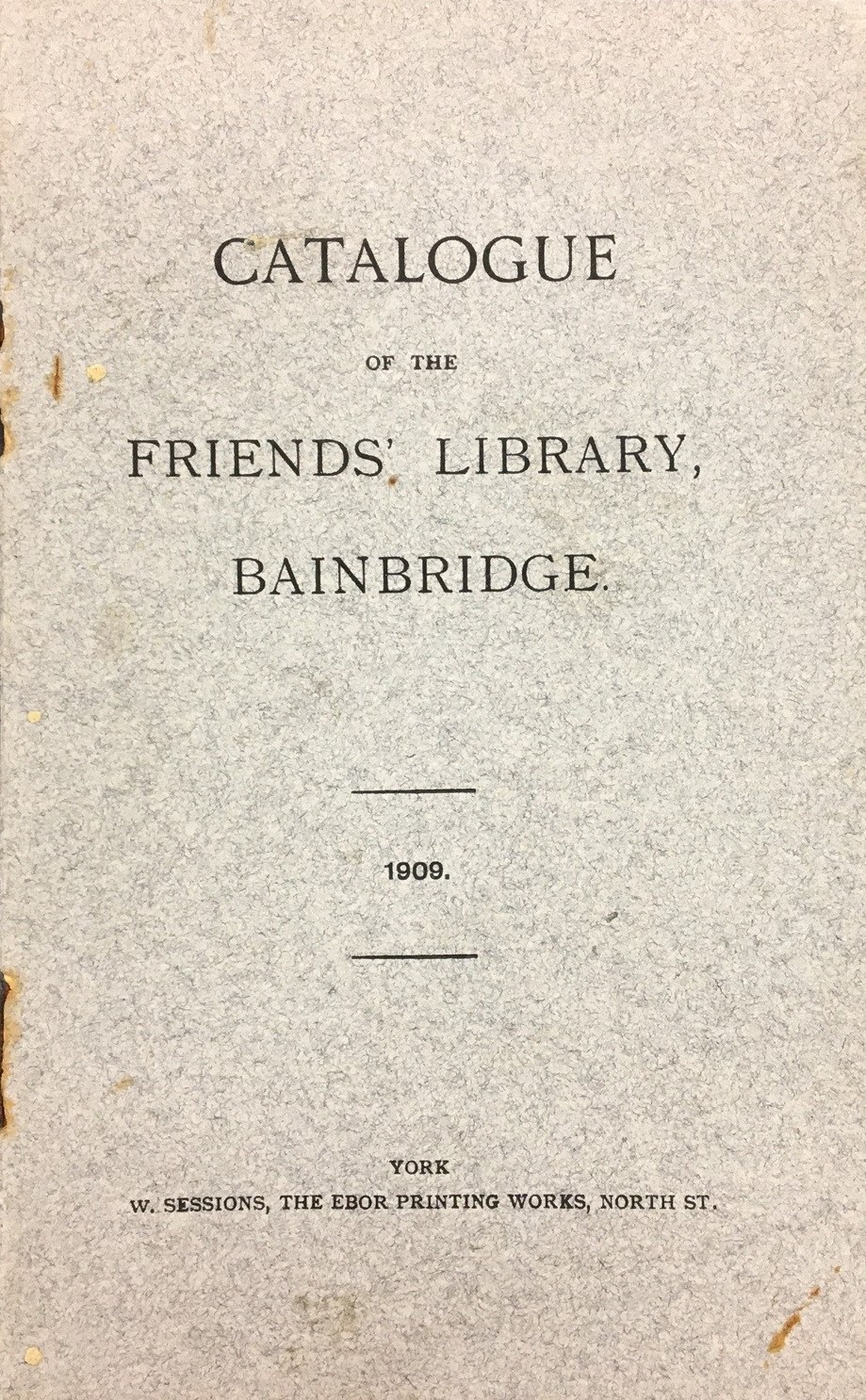
It was recognised early in the formation of the Society that the priorities of good record-keeping and connectivity with fellow Quakers, both at home and abroad, required members to have a sound education. Quaker schools for both girls and boys were established, with records surviving either in the Monthly Meeting collections, as in the case of the Friends’ School, Reeth [R/Q/R 13], or in private collections, as in the case of The Friends’ School at Great Ayton [ZFA, EF]. Libraries were established at Meeting Houses for use by Friends of Preparative and Monthly Meetings.

- Left: The Friends’ School, Great Ayton (photograph reproduced from a glass plate negative) [EF 486/015]
- Right: Bainbridge Preparatory Meeting Library catalogue (1909) [R/Q/R 14/2]
Peace
Quakers regard war and other violent action as unlawful. Printed circulars contained in the Richmond Monthly Meeting correspondence and papers show Friends at various times joined and organised campaigns in support of peace, and against army enlargement and military conscription.
“We believe that a nation which from the highest reasons of duty refused to fight would occupy the noblest of all positions.” [R/Q/R 7/294]

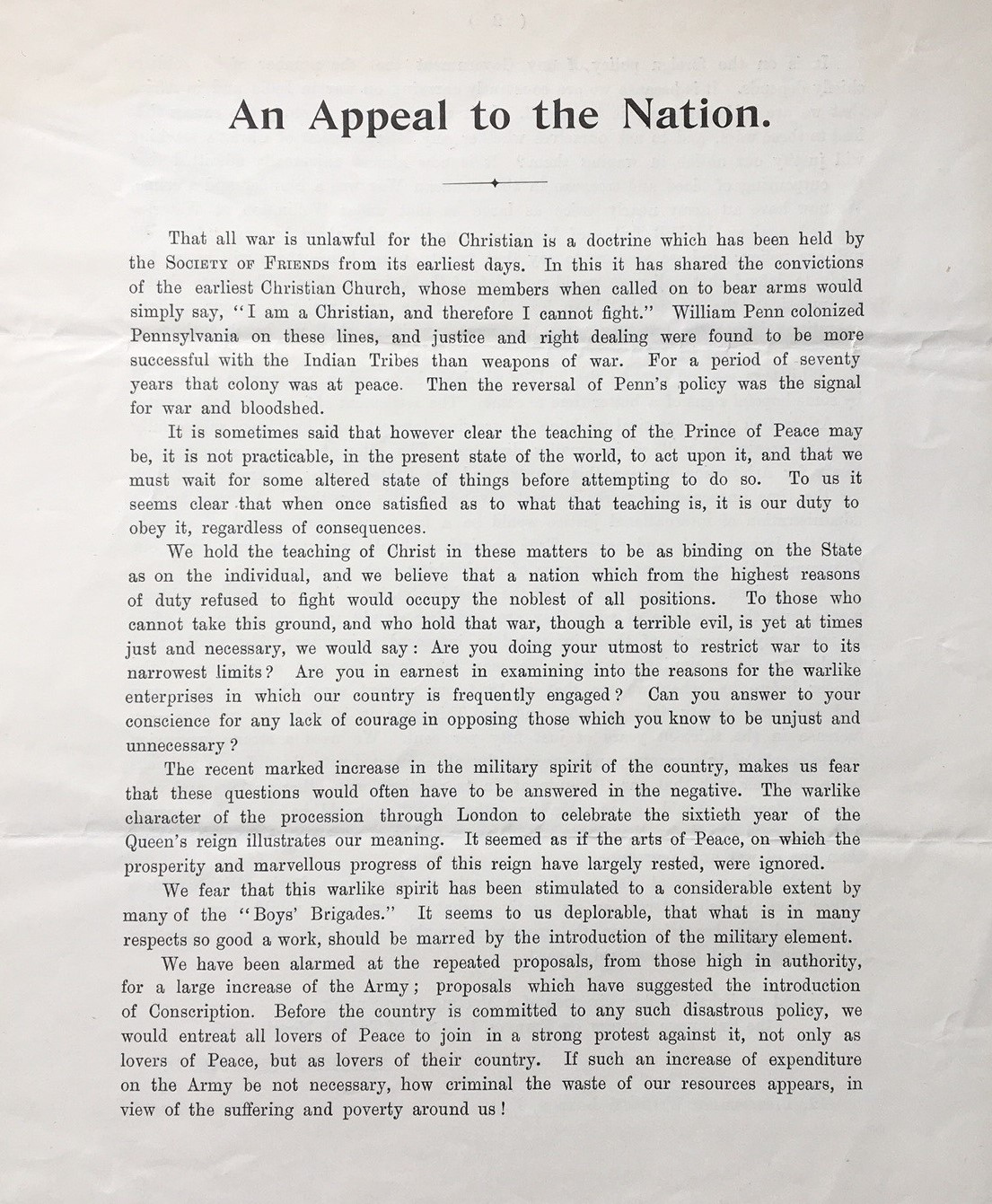
Peace and anti-war and anti-military circulars, 1897, from Richmond Monthly Meeting correspondence [R/Q/R 7/292 & 294]
Quaker records
As the Society of Friends grew, antagonism towards it increased, whereby George Fox encouraged Quaker groups to establish regular meetings for worship and Society business and to keep good records of their membership, their activities and business interests, and all instances of encountered persecution. Meetings were organised at local (Preparatory), district (Monthly), regional (Quarterly) and national (Yearly) level.
The Record Office holds the records of the Monthly Meetings for Richmond (from 1665, reference R/Q/R) and for Guisborough (from 1669, reference: R/Q/G). These collections are catalogued to item level, with detailed paper catalogues available in our research room. For the repositories of other Monthly Meetings within the York Quarterly Meeting area, see the online guide to Researching Yorkshire Quaker History (opens as pdf).
Membership records
These records include membership lists, acceptances and removals, notes of births, marriage forms, notes of deaths and burial registers (may also include General Register Office certificates of death after 1837).

Birth note of Alfred Stackhouse Dixon of Great Ayton, 6 December 1892 [R/Q/G 3/6]

Marriage certificate of John Hillary of Birchrigg and Mary Robinson of Countersett, Aysgarth, 1692 [R/Q/R 11/1]
Their son, William (1697-1763), was an outstanding physician of his day. He was one of the first to study the effects of climate upon prevalent diseases – especially Smallpox – and much of his work was undertaken during his time in Barbados from 1747-1757 [R/Q/R 11/2-4, not shown here]
Minutes of meetings and accounts
Minute books record the business of Women’s and Men’s Preparatory and Monthly Meetings. Minute books contain administrative and financial entries, together with notes on ministry, sufferings, notifications of intended marriages and any concerns relating to misconduct of members. Whilst accounts information can be recorded in the minutes, separate account books and files were also kept – and likewise separate registers of Sufferings. The Preparatory and Monthly Minutes may also include copies of some Quarterly and Yearly Minutes, as well as epistles, queries and advice, and other items of correspondence from regional, national, and international Meetings.
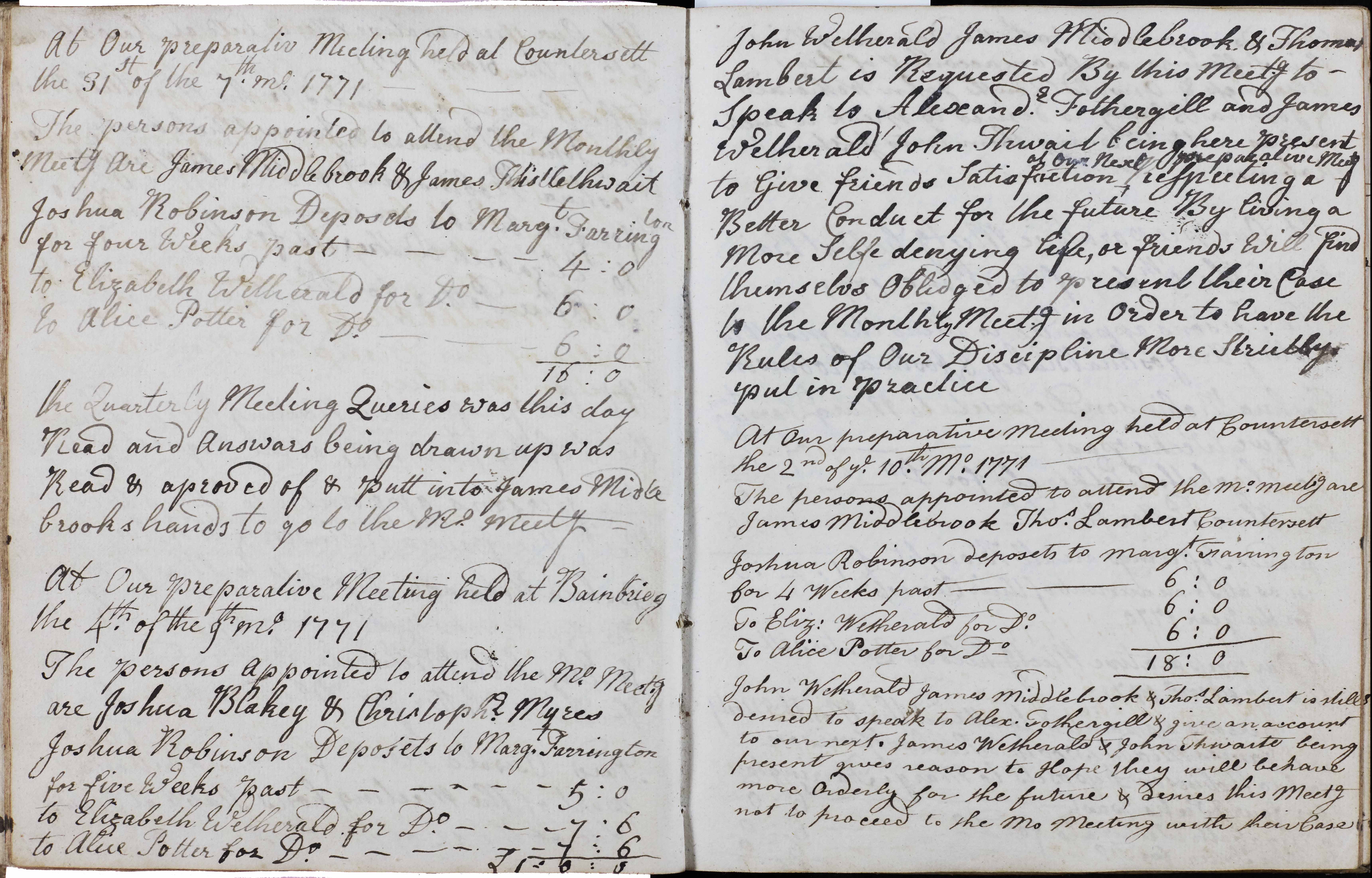
Minutes for the Preparative Meetings at Countersett and Bainbridge in September 1771 [R/Q/R 1/187]
The pages shown note that three Friends at the Bainbridge Meeting are appointed to speak with Alexander Fothergill, to encourage him in better conduct.

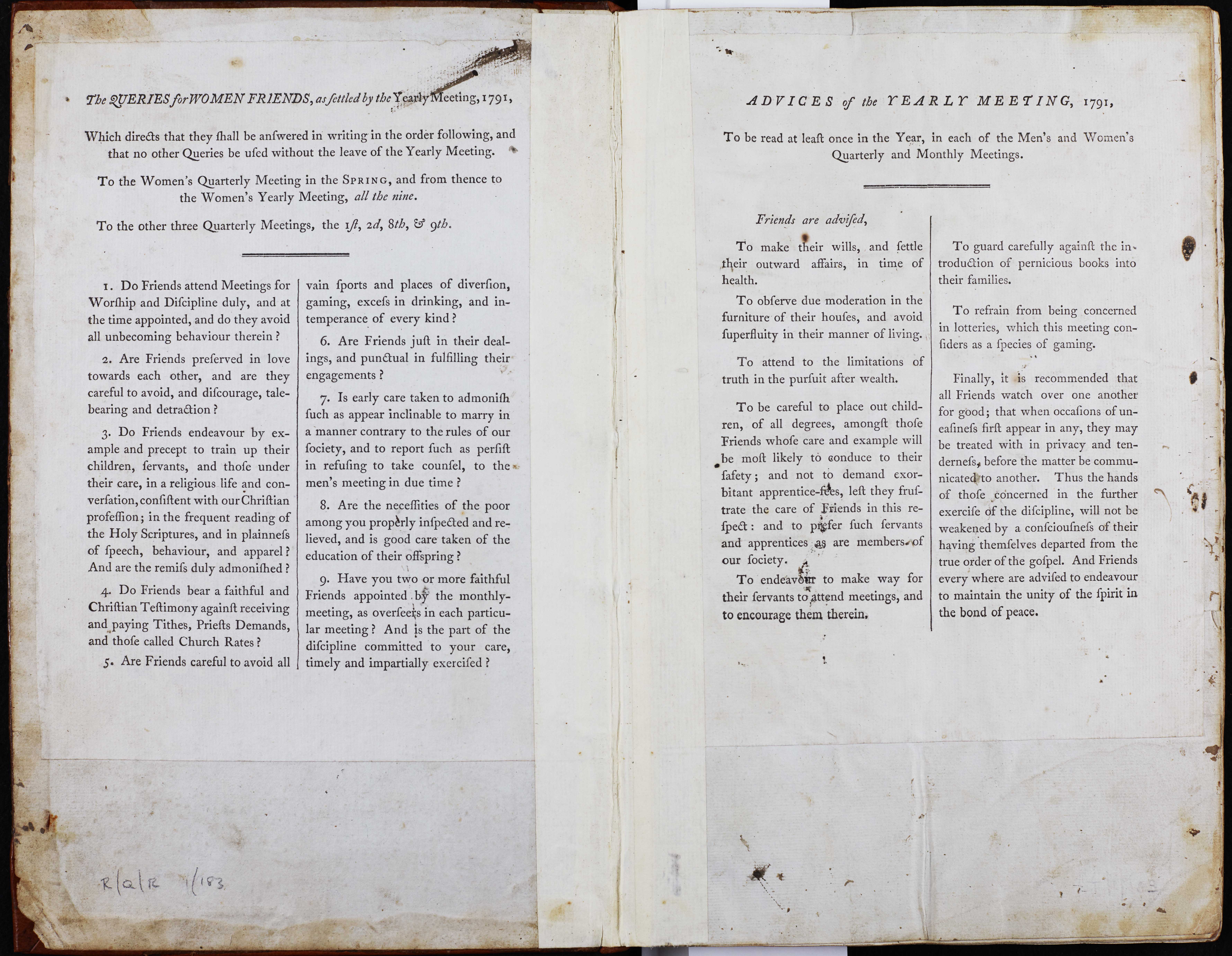
- Left: Epistle from the Yearly Meeting of Women Friends in Philadelphia to the Yearly Meeting of Women Friends in London, 1802 (pp137-138). Epistles were advisory or admonitory letters sent from one Yearly Meeting to others, with copies being disseminated among regional and local Meetings. This epistle is enclosed in the minutes of Swaledale Preparatory Women’s Meeting, 1786-1811 [R/Q/R 1/183]
- Right: ‘Queries and Advices from the Yearly Meeting, 1791’, saved in Richmond Monthly Meeting Minutes [R/Q/R 1/183]
Sufferings of Friends
Sufferings are records detailing wrongdoings and distraints against Friends by non-Quakers. Instances can appear in minutes of Meetings and in personal correspondence, but specific registers were also kept. Annual returns of sufferings were compiled by Quarterly Meetings and sent to the Yearly Meeting. The bulk of sufferings’ entries relate to punishments for non-payment of church rates and tithes, and further refusal to pay any subsequent fines imposed. Determined that Quakers would pay, the established church and court officials organised the seizing of non-payers’ goods in lieu of payment. Examples show anything and everything could be taken – usually amounting to more than the value of actual tithe amount due. Wider sufferings were also acknowledged, for example that of enslaved people.
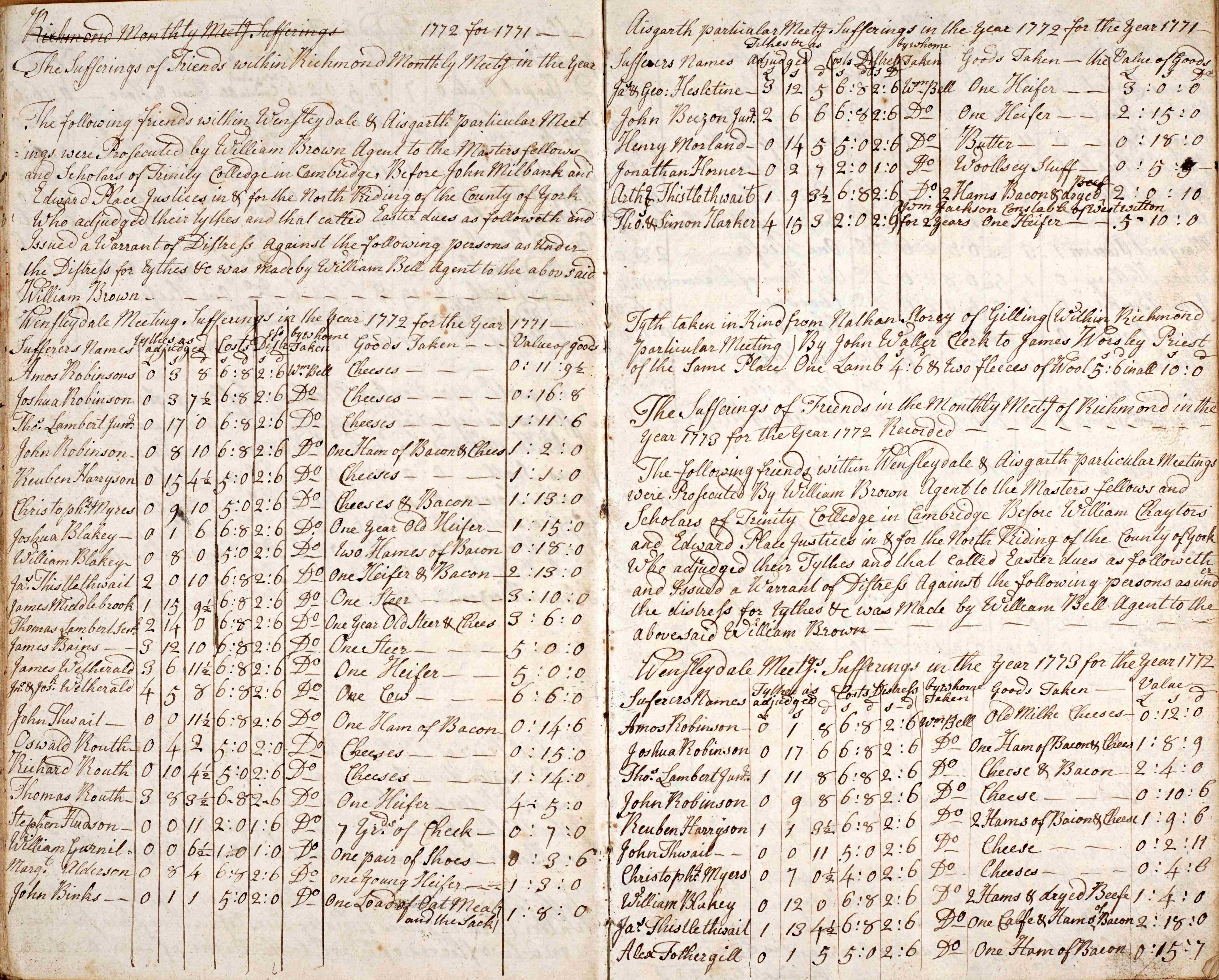
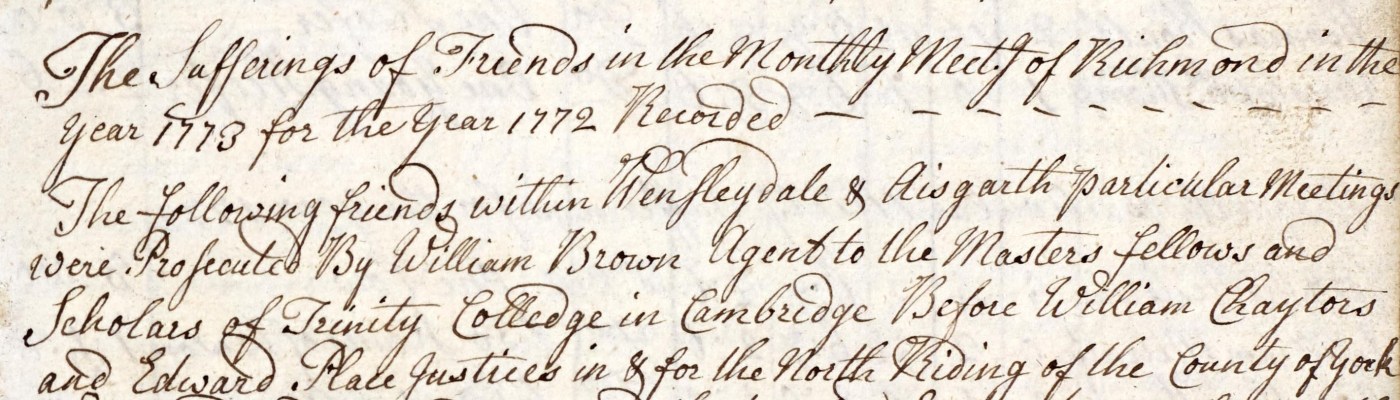
Register of Sufferings and Distraints, 1755-1781, showing pages for 1771-1772 [R/Q/R 5/28]

Register of Sufferings in Richmond Monthly Meeting, 1794-1816, showing pages for 1801 [R/Q/R 5/30]. Information recorded includes detailed lists of Sufferers, the nature of the demand, the amount paid, and claimants.
Testimonies and disownments
Cases detailed in the testimonies contained in Richmond Monthly Meeting records suggest that the behaviour of all members of a Quaker community was subject to internal supervision, regardless of individual or family prominence or degree of piety. For instance, even though the Fothergill family was well-respected, and their home at Carr End in Wensleydale was used as a Meeting House for many years until 1710, Alexander Fothergill nonetheless receives a testimony against him 1738 for marrying his second wife Margaret Thistlethwaite (also a Quaker) clandestinely. Some years later Alexander is under scrutiny again, for keeping bad company and other moral lapses – including financial negligence. Despite his high profile occupation as road surveyor and facilitator of the Richmond to Lancaster turnpike road, and his local charitable work, Friends at the Richmond Monthly Meeting in May 1774 agreed to issue a testimony against him, for persisting in an “intemperate course of life….the consequence of which hath brought forth evil fruits and disgraceful conduct”.

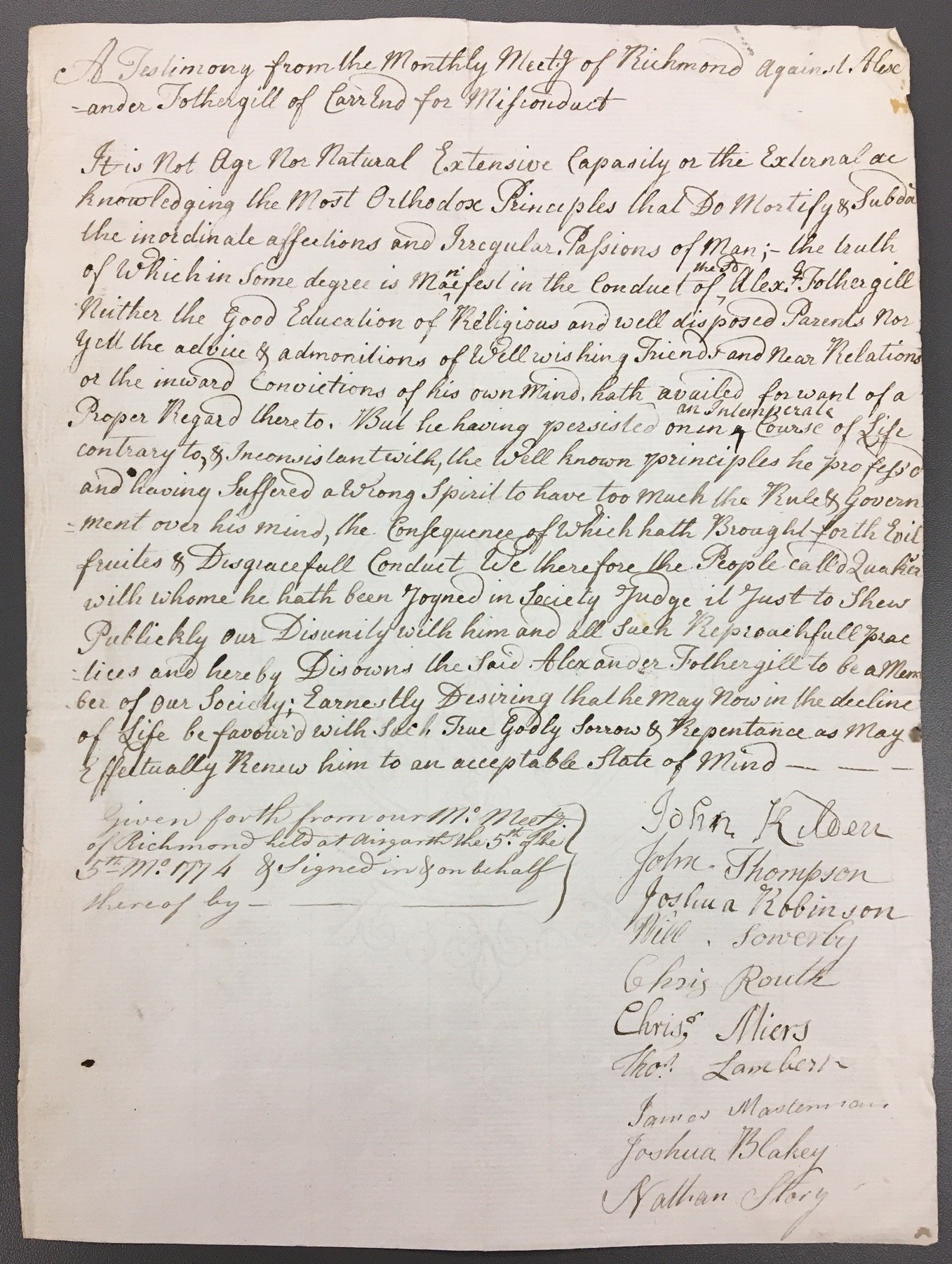
Testimonies against Alexander Fothergill, 1738 & 1774 [R/Q/R 15]
Good character and removal certificates
Quakers who were inspired to travel (often far) from home for ministering purposes were granted certificates of good character and introduction by their Monthly Meeting – as in the case of Alice Routh, a member of Richmond Monthly Meeting, who had “drawings in her mind” to pay other Quaker communities religious visits, including to Ireland in 1772.
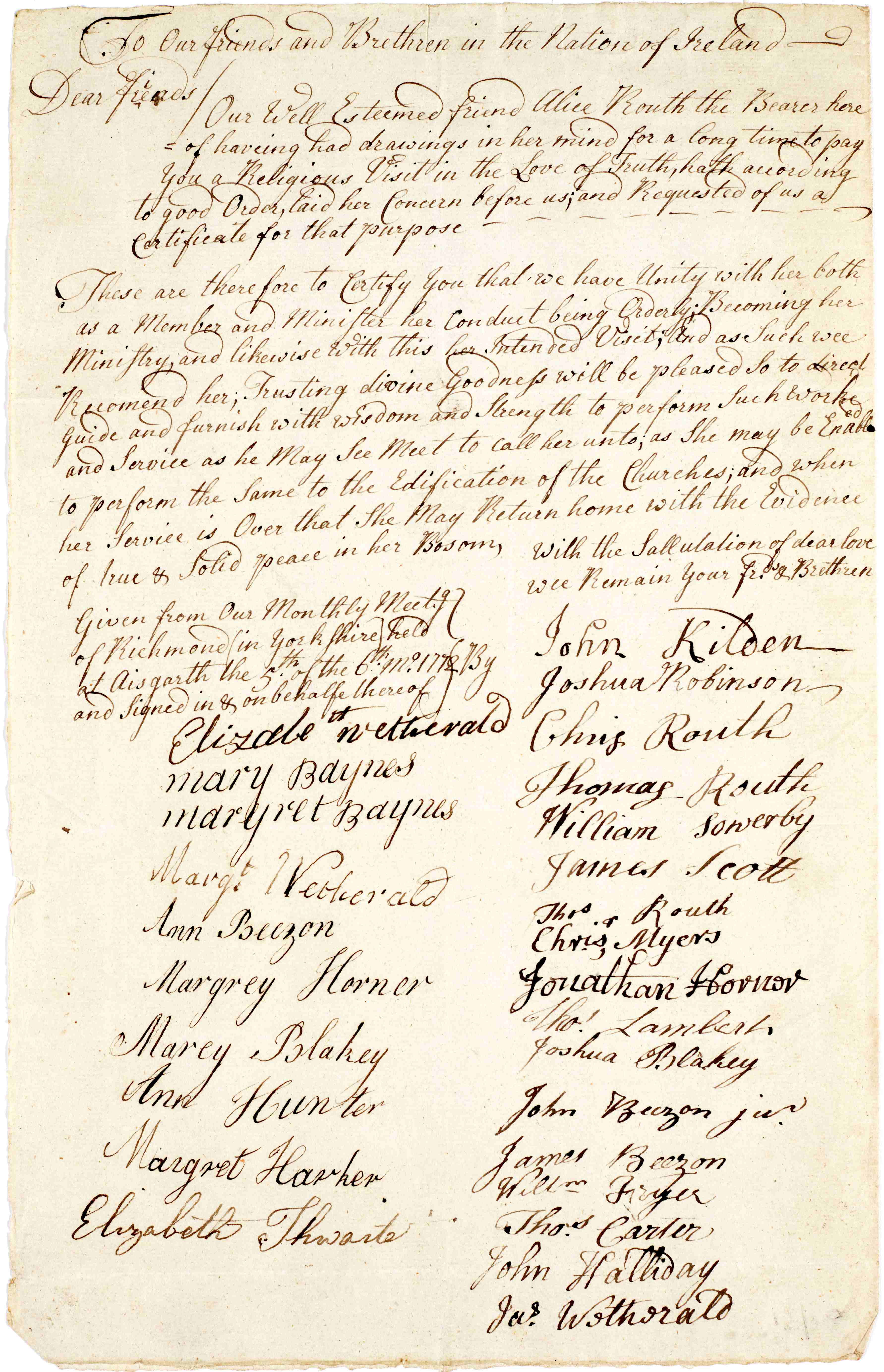
Certificate of good character for Alice Routh, to undertake ministry in Ireland, 1772 [R/Q/R 6/1]
Correspondence and papers
Monthly Meeting correspondence in the collections we hold is extensive and wide-ranging and includes everything from brief notes and formal letters to epistles from home and abroad and printed pamphlets and circulars on a variety of socio-political issues. A notable item in the Richmond Monthly Meeting correspondence is a supportive epistle from George Fox, written to Richmond Friends in 1664, during one of his incarcerations in Lancaster Castle. Before the passing of the Toleration Act in 1689, Fox was imprisoned several times in Lancaster Castle for preaching and holding meetings. In September 1664 he was remanded in custody until the next Assizes for refusing to take the oath, and during his incarceration he wrote this epistle to fellow Friends of Richmond Monthly Meeting. It bears his usual signature: “GFF”.
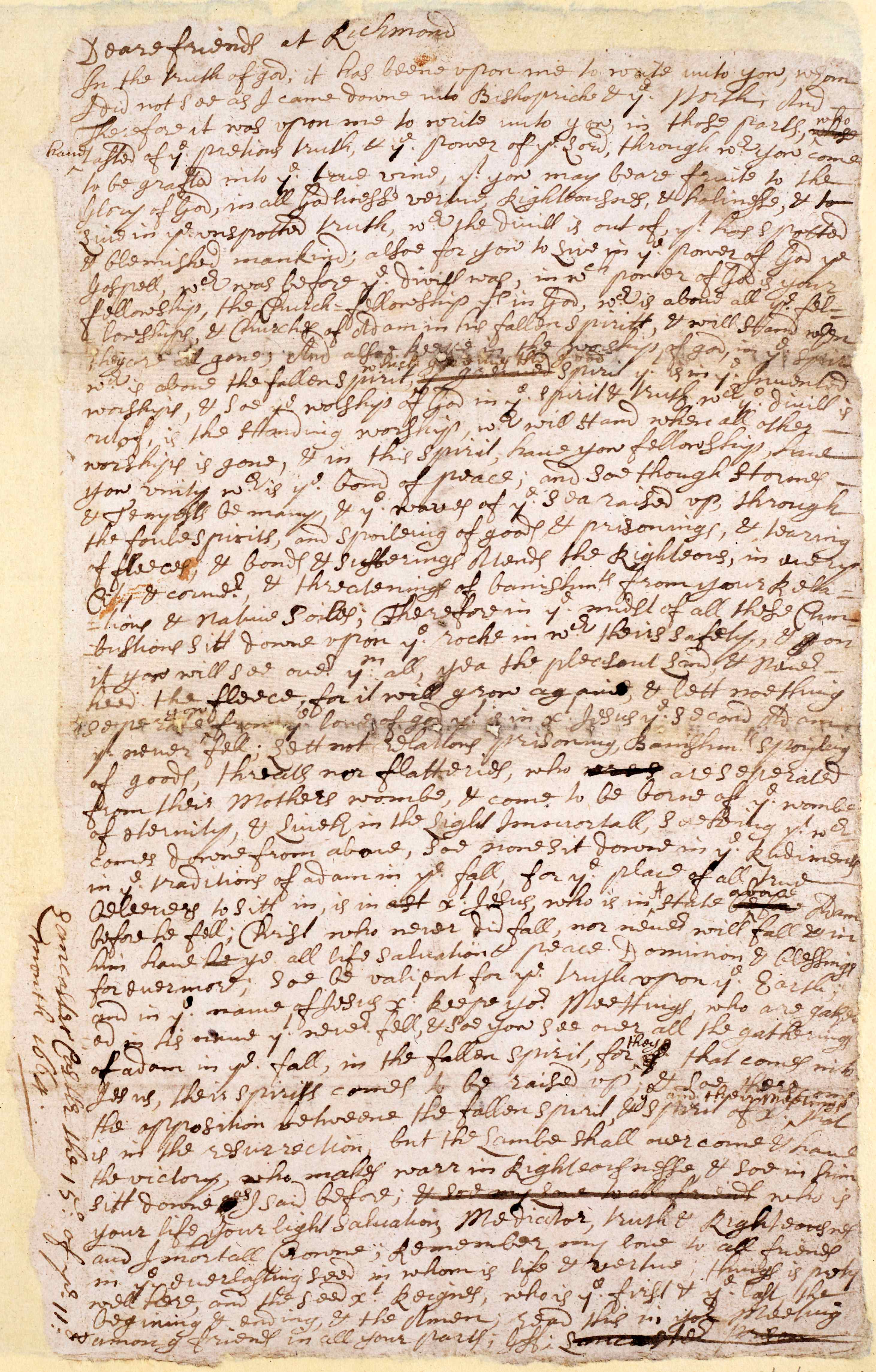
Epistle from George Fox to Friends of Richmond Monthly Meeting, Lancaster Castle, 15 January 1664 [R/Q/R 7/9]
Title deeds and rentals for Quaker land and property
Documentation relating to Meeting Houses and burial grounds can be found within the Preparatory and Monthly Meeting records. Records include title deeds, valuations, details of trustees, and drawings and plans.
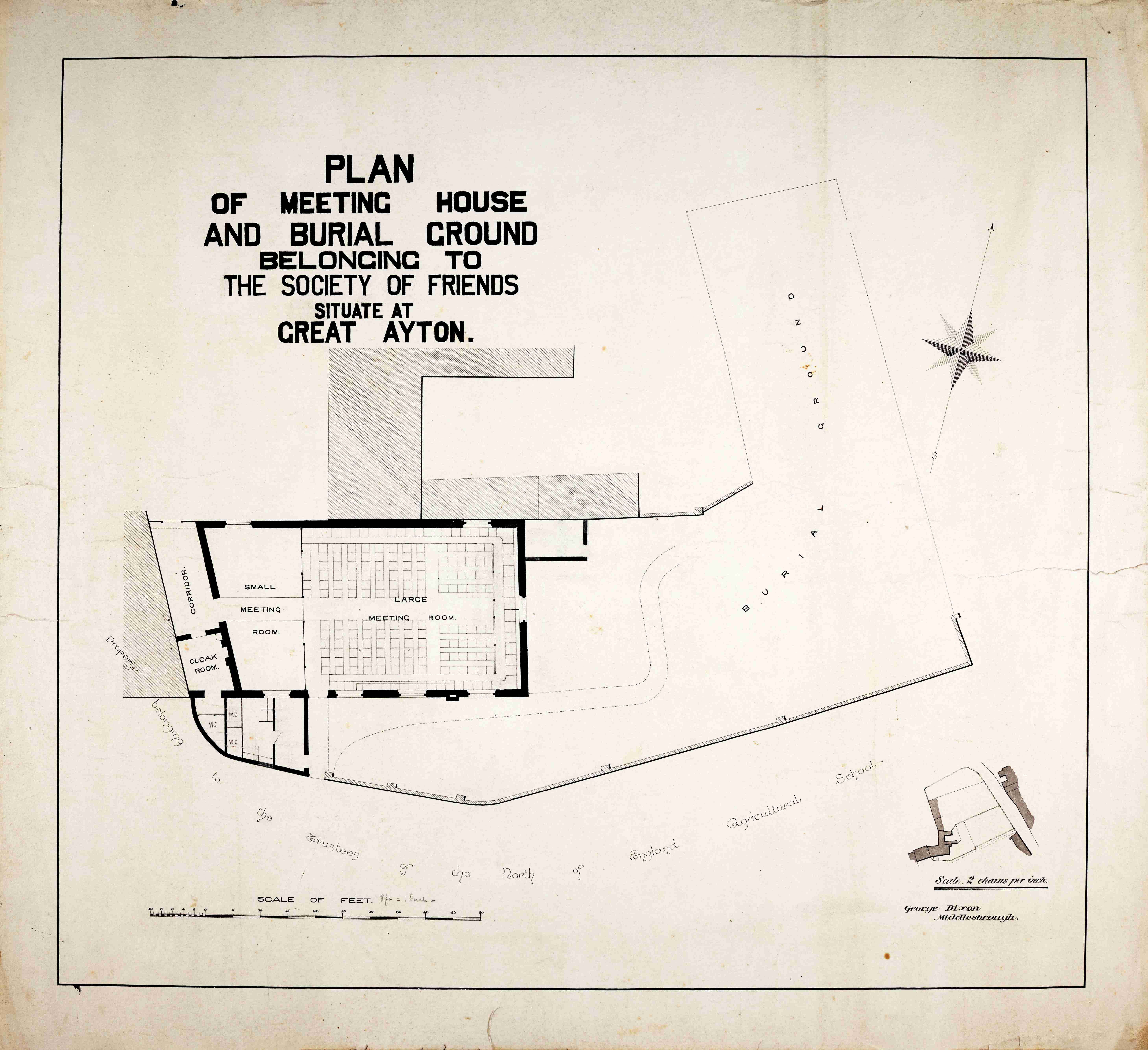

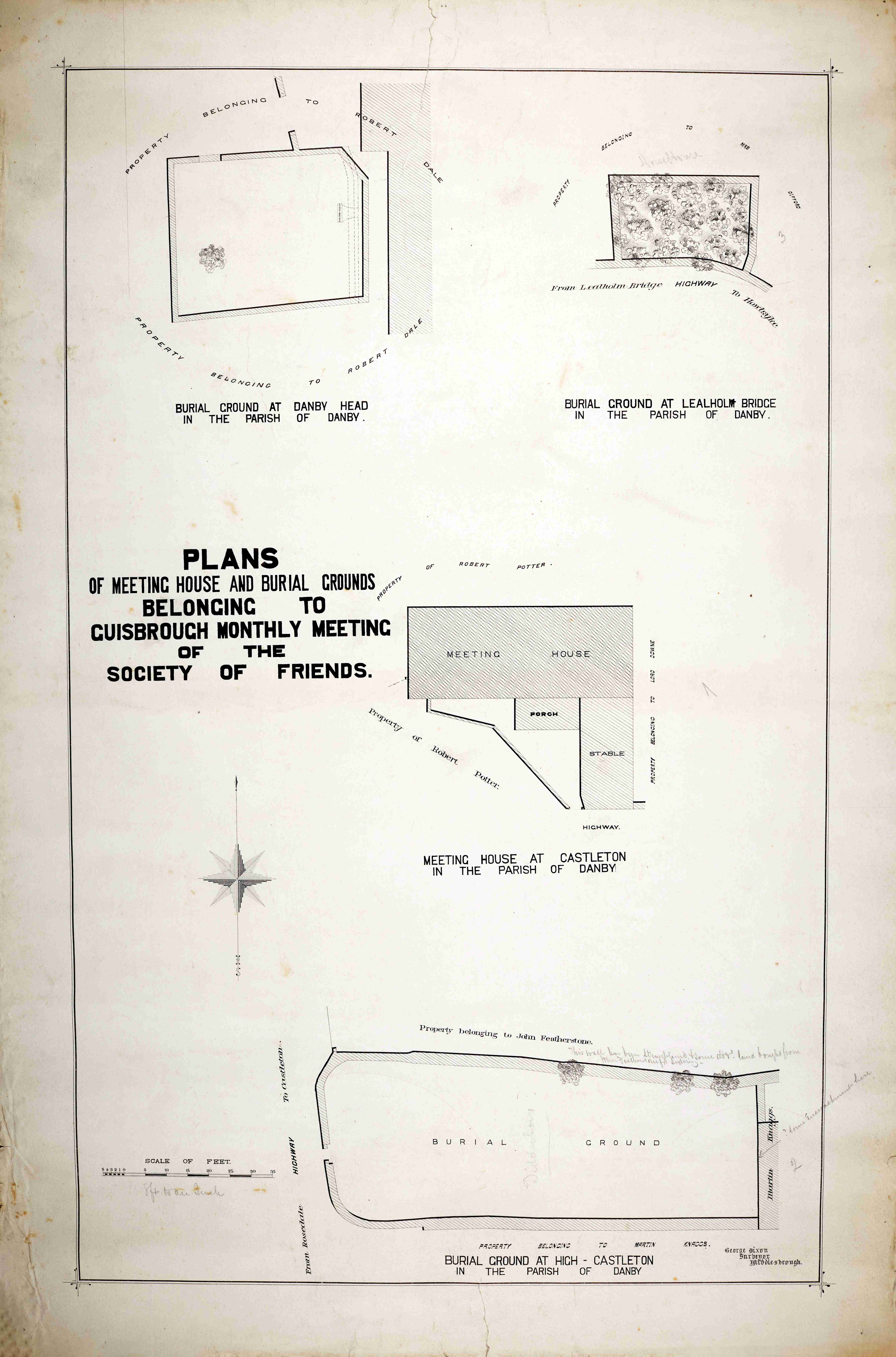
Top left, bottom left and right: Guisborough Monthly Meeting records include plans by George Dixon, showing Meeting Houses and burial grounds at Great Ayton, Danby Head, Lealholm Bridge and Castleton, 1868 [R/Q/G 7/1, 7/2 & 7/7]
Schools and libraries

The Richmond Monthly Meeting records include items relating to the Friends’ School at Reeth, including a school logbook covering years 1863-1889, and ground plans dated 1903.
Ground plan of the Friends’ School, Reeth, 1903 [R/Q/R 13]
The Quaker library at Bainbridge in Wensleydale was stocked with books and pamphlets by Wensleydale Preparative Meeting and Richmond Monthly Meeting. The range of items which were available include a copy of George Fox’s Journal, copies of relevant Acts of Parliament, Quaker histories, and copies of national and international Meeting minutes and epistles. Published works from this library are apparently held at University of York Library.
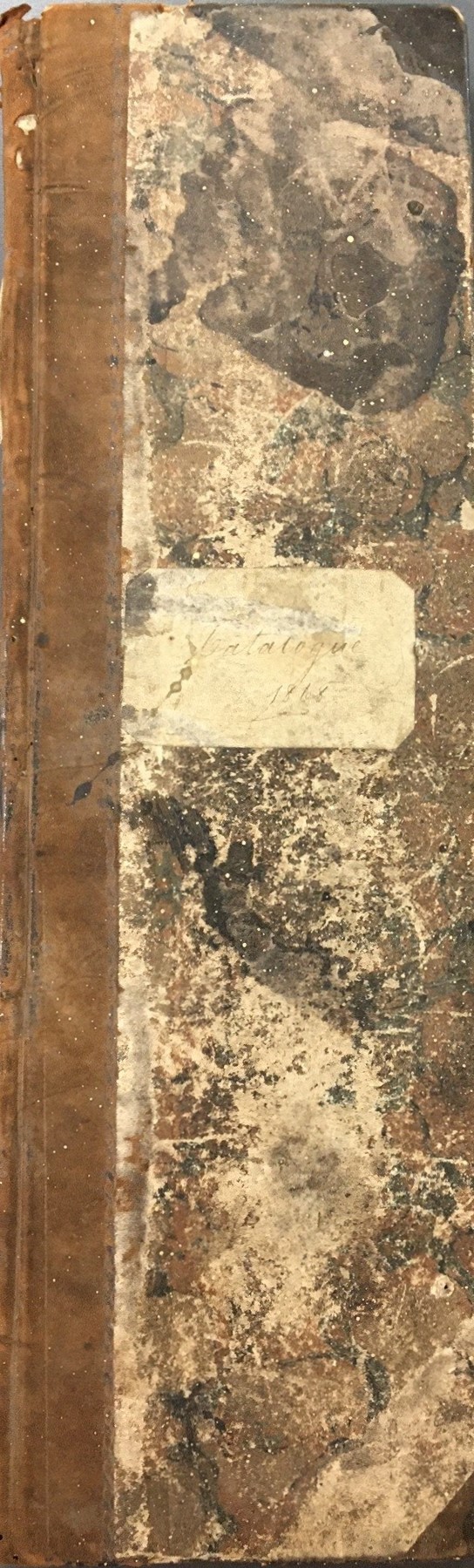


Bainbridge Preparatory Meeting Library catalogue and list of loans, 1862-1901, showing the outer cover, title page and catalogue contents [R/Q/R 14/1]
Quakers represented in wider collections at the Record Office
We hold the archives of some Quaker families and institutions amongst the private and estate collections.
For example, in the archive of the shipbuilding Tindall family of Scarborough, is a typescript memoir: “In the Days of Old: A Quaker Child, by ‘Granny’” interspersed with loose illustrations giving insight into Quaker everyday life during the early to mid-19th century. Isabella describes (page 4) her older sister’s hair being “cropped short, as was the Friends’ fashion, lest vanity should have any place in our hearts.” Later (page 28), she recollects her father refusing to pay the church rates and tithes, resulting in the parish beadle and bailiff being sent to collect their goods in lieu [ZYZ].
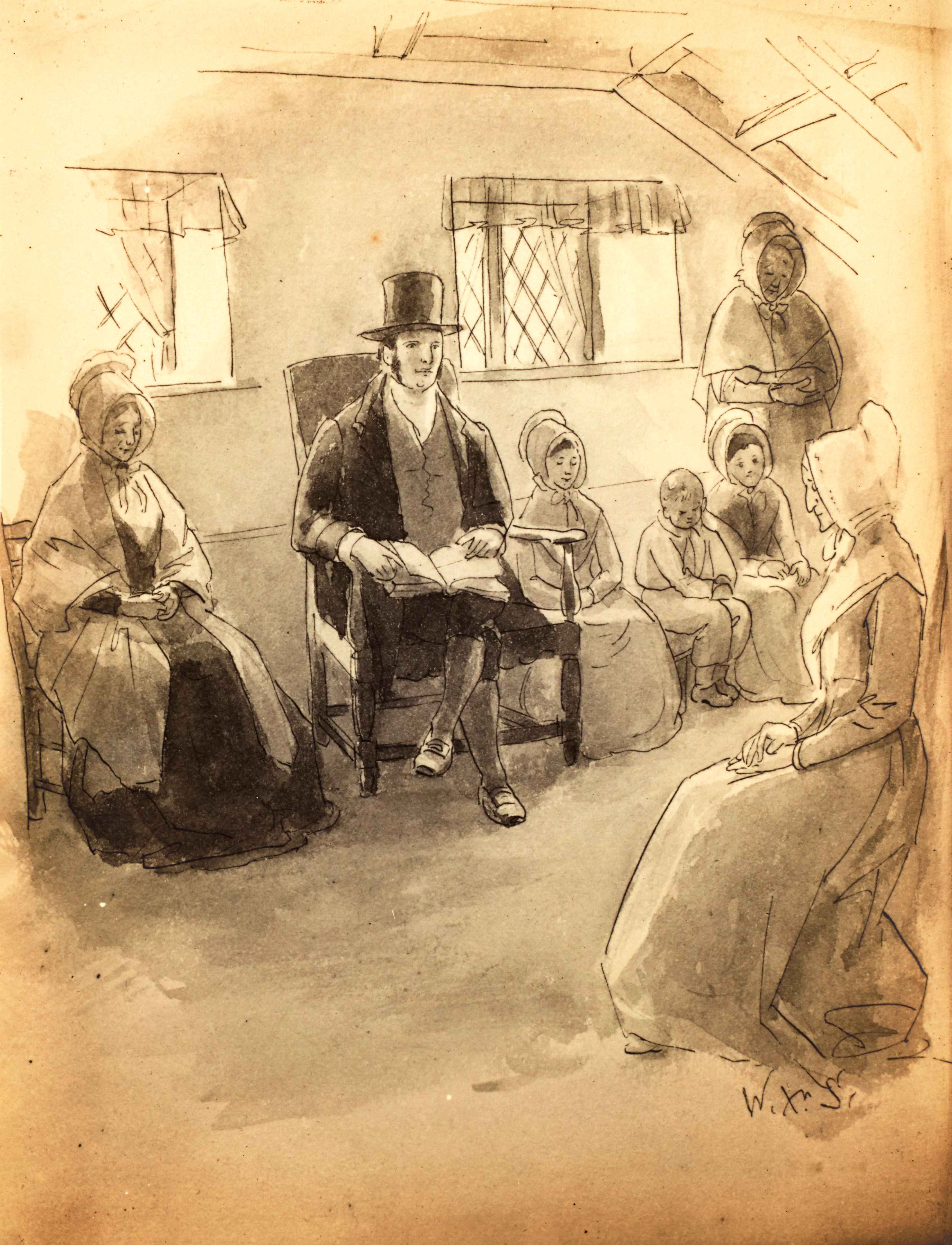
Illustration of Friends meeting, from “In the Days of Old: A Quaker Child, by ‘Granny’”, by Isabella Harris (née Tindall), not dated, c.19th century [ZYZ]
We hold the collection of records pertaining to The Friends’ School at Great Ayton (ZFA). In 1841, Thomas Richardson contributed £5,000 of the £6,500 needed to buy the land to establish what was then called the North of England Agricultural School. Richardson’s donation meant the school was able to purchase seventy-four acres of land backing onto High Green in Great Ayton. The school was later renamed The Friends’ School in 1854. Their motto ‘Magna est Veritas‘ translates as ‘truth is great and will prevail’.
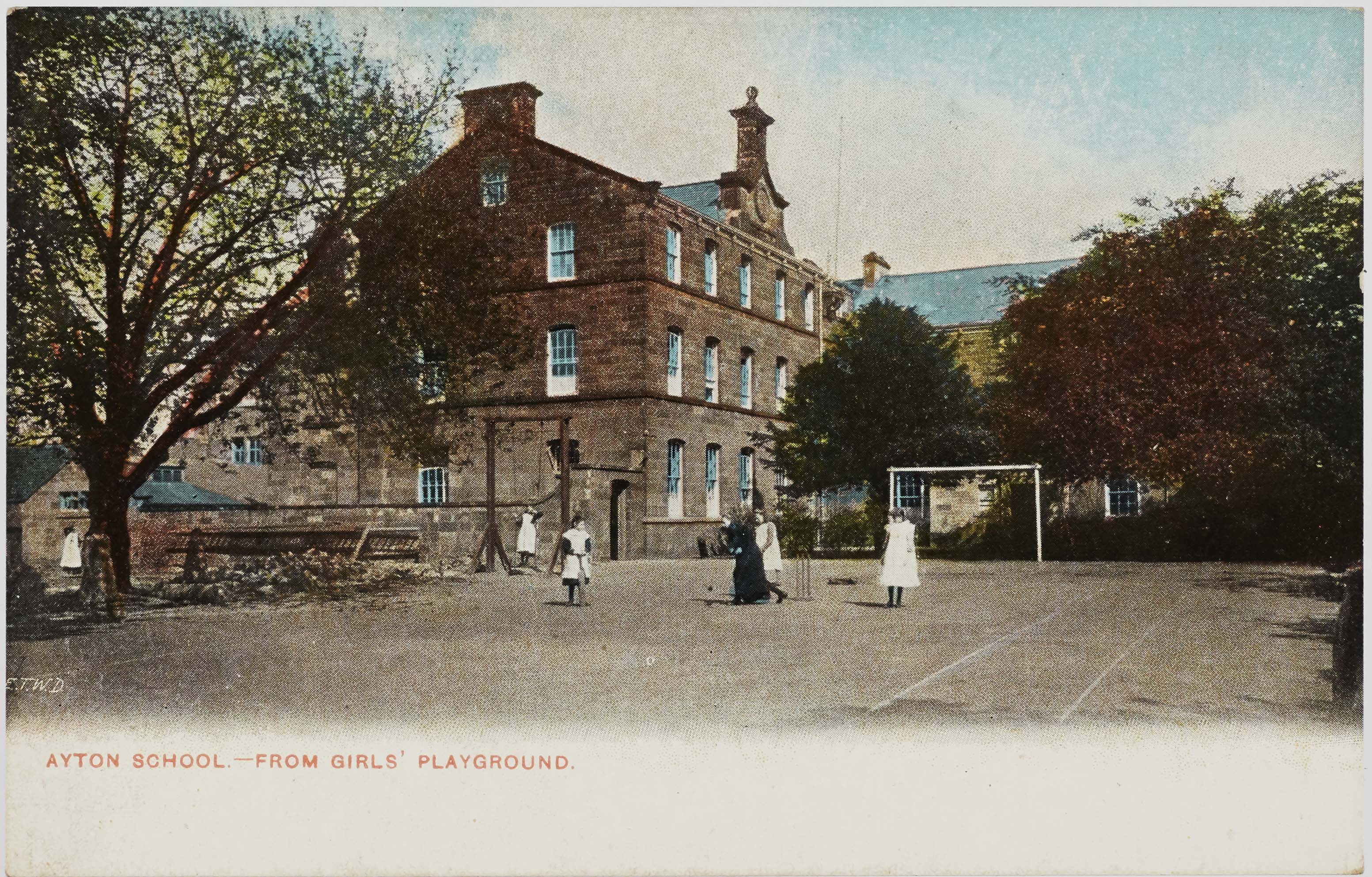

Promotional photograph from a school prospectus, and the 1911 edition of Beckside school magazine [ZFA]

Following Thomas Richardson’s death, a charitable trust was started by Friends at a meeting on 25 October 1853, in accordance with Richardson’s will. The trust’s purpose was to support existing Friends’ schools and establish new ones, as well as assisting the poor and aged, and to establish Meeting Houses, alms-houses and hospitals, and its records are held at the Record Office (ZAO).
Minute book of the Thomas Richardson Trust, 1853-1875, pages 2-3 [ZAO]
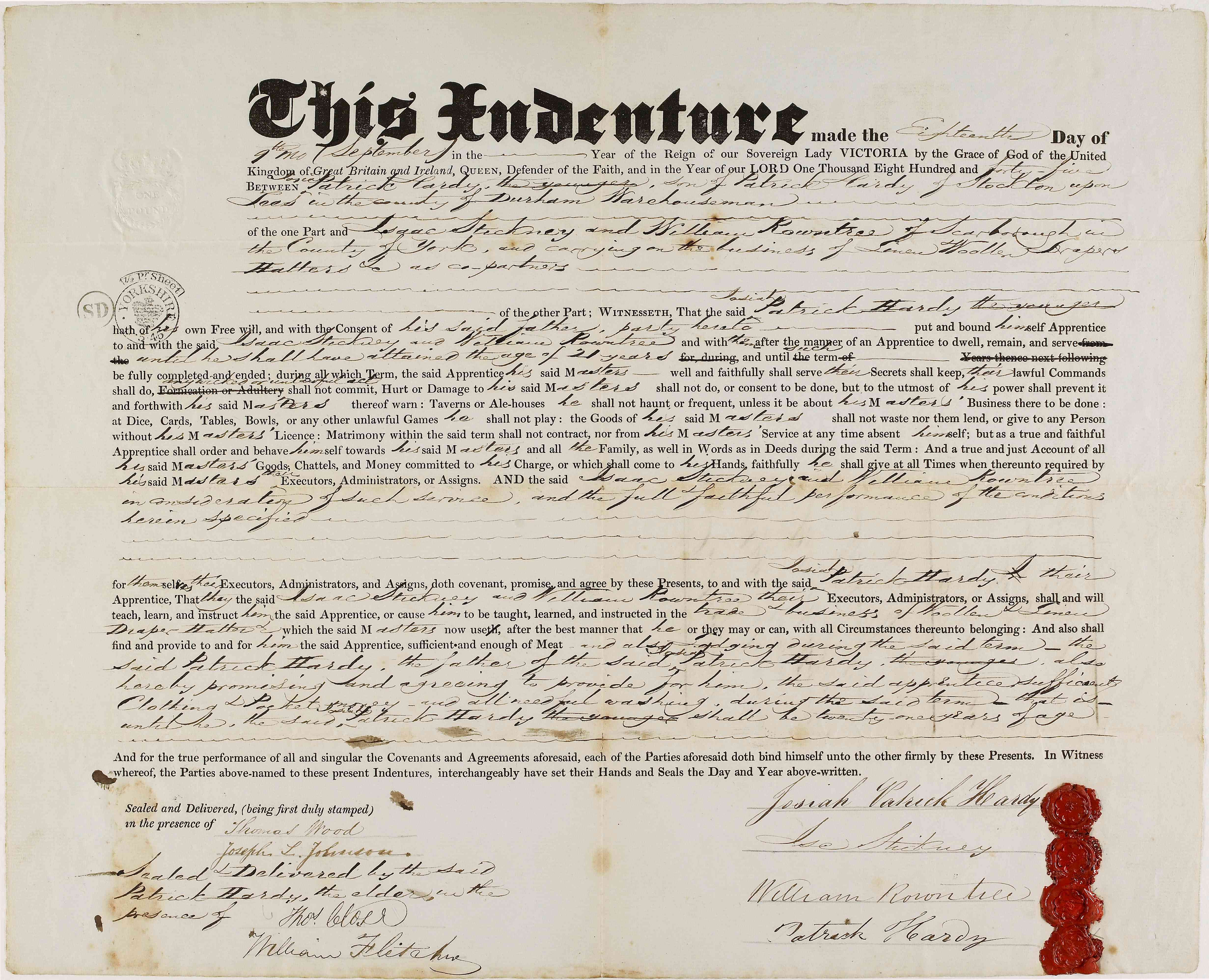
We hold a small collection of Quaker birth, marriage, and apprenticeship certificates, including the apprenticeship indenture of Josiah Patrick Hardy bound to Isaac Stickney and William Rowntree of Scarborough, linen woollen drapers & hatters, on 18 September 1845.
Apprenticeship indenture of Josiah Patrick Hardy, 1845 [Z.1351]
Isolated Quaker-related items, such as letters, deeds, certificates, and even sketch books, can be found within non-Quaker private and estate collections.

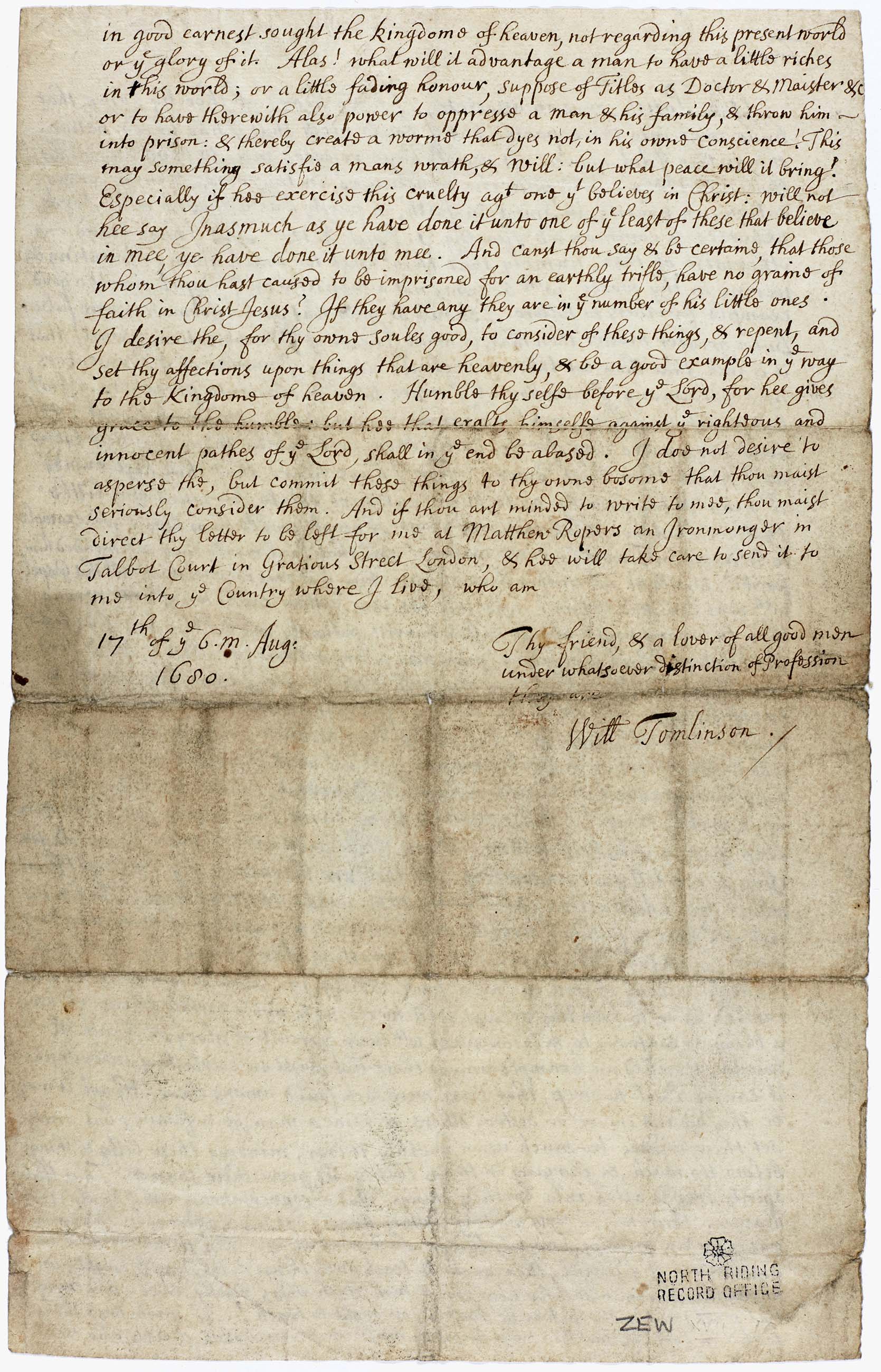
Admonishing letter from Quaker William Tomlinson to the Reverend George Parish, 17 August 1680, from a collection of miscellaneous papers in archive of the Feversham/Duncombe family of Duncombe Park, Helmsley [ZEW X]

Sketch book containing a pencil drawing of Preston Patrick Meeting House, Cumbria, no date, c. 1868 [ZXF 35].
From the Lord Manuscript collection, a variety of papers gathered by Thomas Lord of Settle, which also include records of the Society of Friends, Settle, 1928.
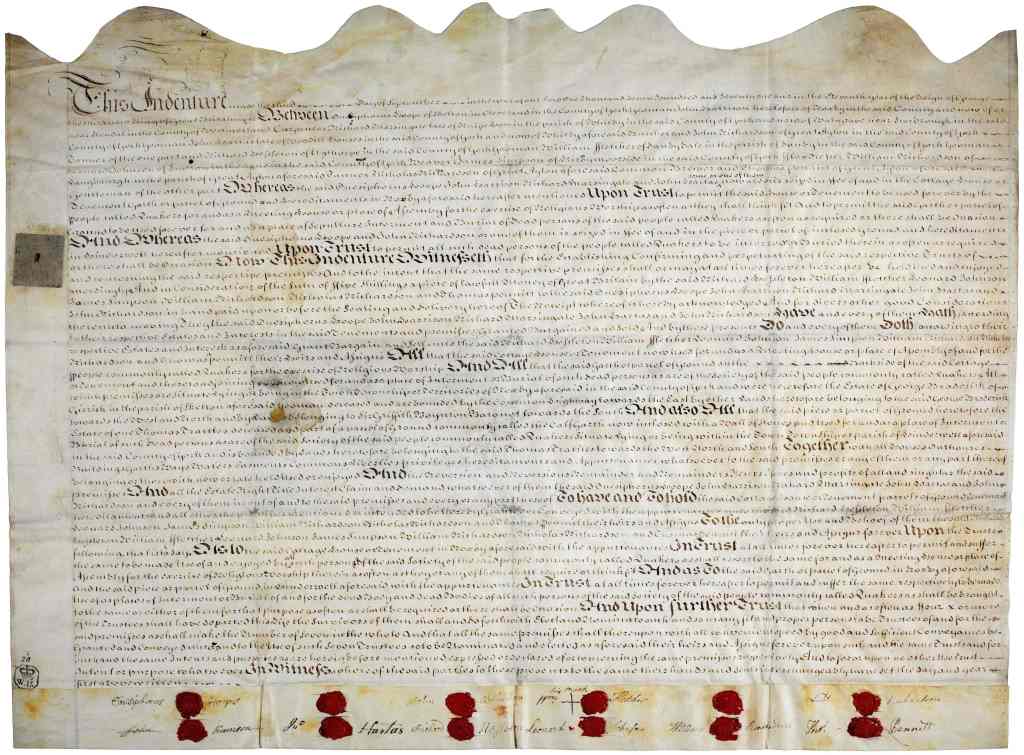
Quaker-related documents can sometimes be found amongst miscellaneous collections of deeds and papers, such as the appointment of Trustees for the Meeting House at Roxby, 1771, in collection ZRI.
Appointment of trustees for Meeting house at Roxby, 1771 [ZRI 20/1]
Until the Toleration Act of 1689, Quakers were obliged to be baptised, married, and buried in their parish church. They can therefore appear in the Anglican parish registers – though not necessarily in a complimentary manner! Sara Lonsdale was baptised when aged about fifty, at Grinton parish church in 1721, the clerk noting she’d been “brought up in the errors of Quaking”.
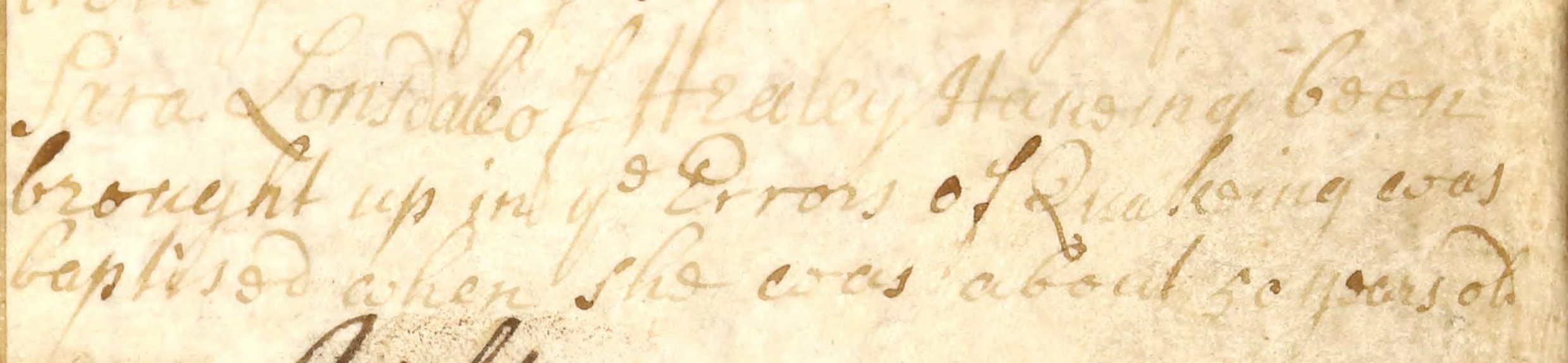
Detail from Grinton parish register showing the baptism entry for Sara Lonsdale, 25 June 1771 [PR/GR 1/4]
An early consolidated parish register of baptisms, marriages, and burials for Kirkbymoorside (1681-1702) contains occasional pages dedicated to recording entries of Quaker births (1695-1704) and marriages (1697 & 1701-1702) occurring in the parish.


Pages from Kirkbymoorside parish register of entries for Quaker births (left) and marriages (right) [PR/KMO 1/3]
The Quarter Sessions for the North Riding can include registrations of domestic dwellings as well as purpose-built Meeting Houses for licensed worship (QSB), as well as Returns of Licensed Dissenting Meeting Houses by parish constables (QDN(W)). In 1829, the House of Commons requested that all counties and dioceses supply “Returns of the Number of Places of Worship, not of the Church of England, in each parish, distinguishing as far as possible of what Sect or Persuasion and the total number of each Sect”. Copies were kept at local level within the Quarter Sessions papers.

Registration by John Petch and William Barker, at the Quarter Sessions held at Guisborough, of a Quaker Meeting House near Laskill Bridge in Bilsdale, 16 July 1734 [QSB 1734].
The registration describes the Meeting House “for the people called Quakers” as “now built”, suggesting it was erected specifically for the purpose. The Toleration Act of 1689 allowed non-conformist groups to legally worship, leading to an increase in designated licensed Meeting Houses.


- Left: Constable Robert Moore’s Return of licensed dissenting Meeting Houses in the parish of Helmsley, 1836 [QDN(W)]. Constable Robert Moore reports that of the five places noted in Helmsley parish, one is for Quakers and was erected in 1812 (other institutions include chapels used by Ranters, Wesleyan Methodists and Calvinists).
- Right: ‘A Return of the Number of Places of Worship not of the Church of England in each parish, in the following Divisions in the North Riding, 1829’ [QDN(W)]
The North Riding Military Tribunal Papers (1916-1918) contain some appeals against WWI conscription on conscientious grounds – including that of Sidney Kemp Brown, age 17, whose Quaker faith meant he was strongly anti-war and anti-combatant. Refusing even to join the Friends’ Ambulance Unit, it was eventually decided he could assist with the Friends’ War Victims’ Relief Committee work in France, helping civilian refugees of war.

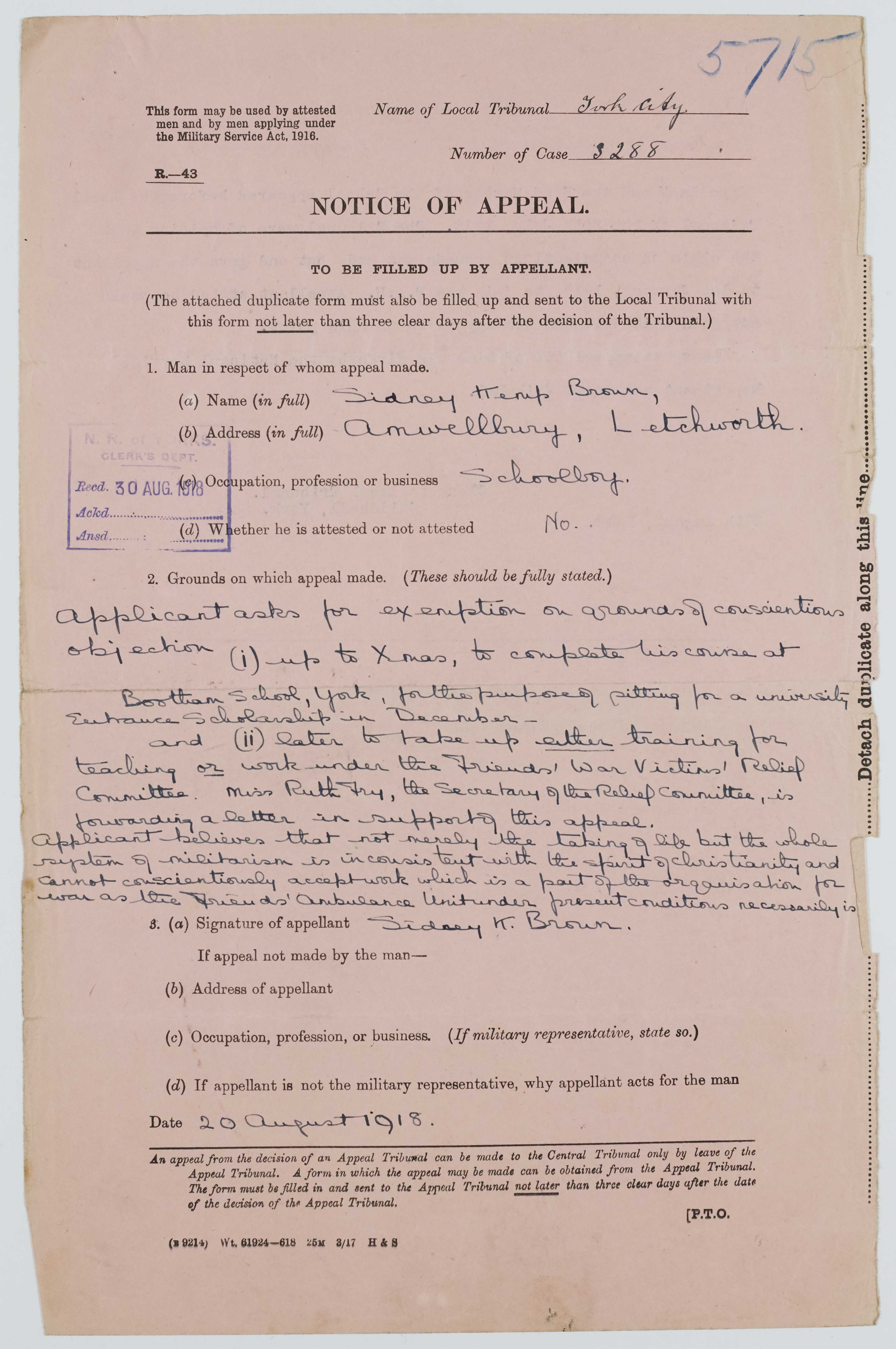
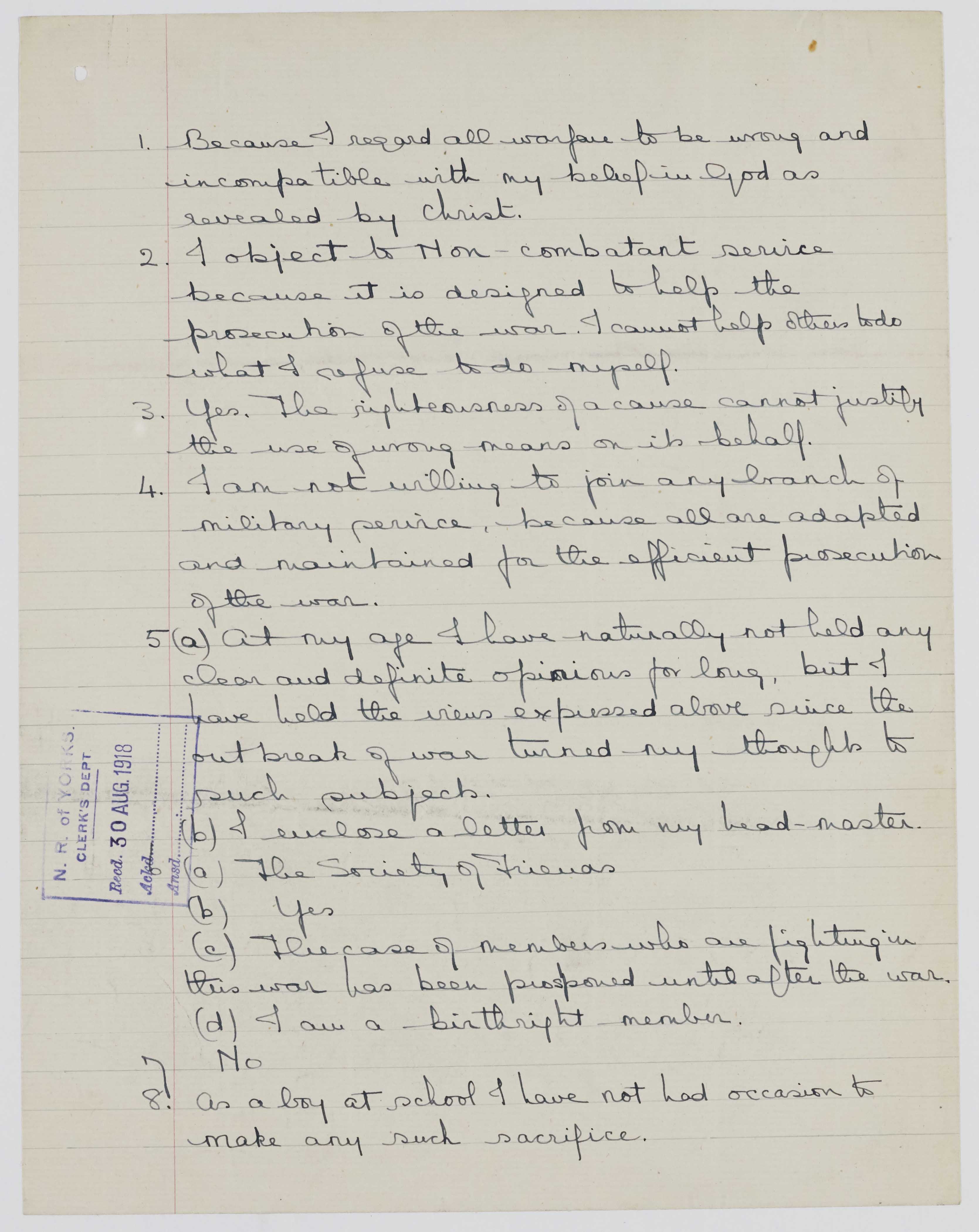

A selection of the WWI Appeal papers of Sidney Kemp Brown of York [NRCC/CL 9/1/5715]
Historic maps can feature locations of Meeting Houses and burial grounds within a wider landscape, over different points in time.
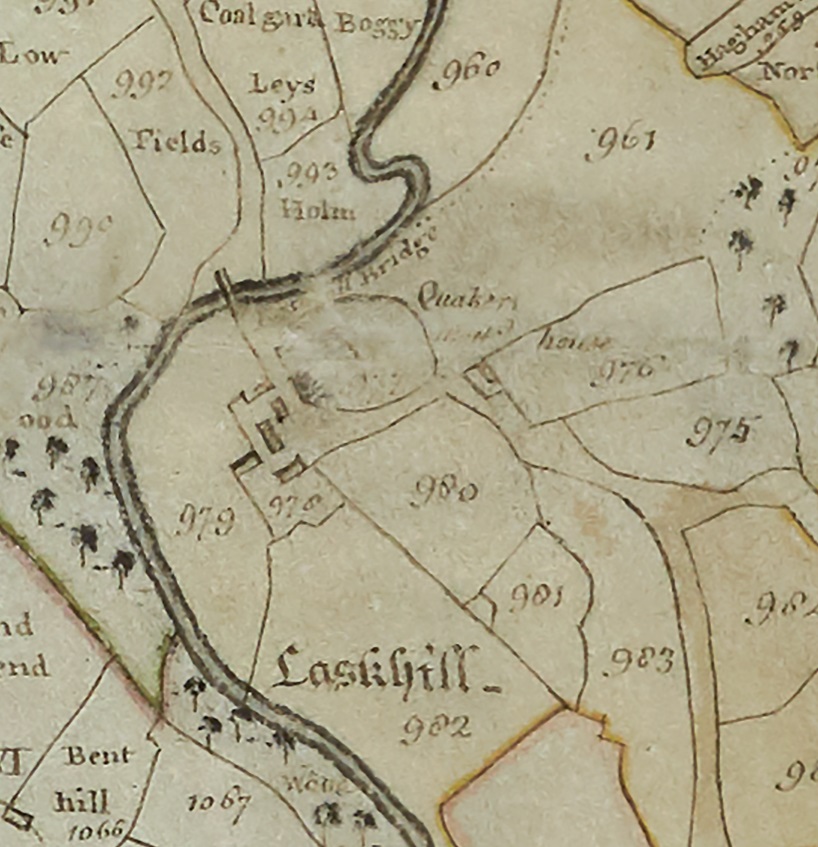

- Left: Quaker Meeting House at Laskill in Ryedale. Detail from a map in the archive of the Feversham/Duncombe family of Duncombe Park, Helmsley [ZEW(M)9]
- Right: Friends Meeting House at Laskill, Ryedale. Ordnance Survey, Yorkshire Sheet 73, Six-inch to the mile, surveyed 1854, published 1857
Further reading
Alexander Fothergill & The Richmond to Lancaster Turnpike Road (NYCROP 37), 1985, by Marie Hartley & Joan Ingleby, David S. Hall, and Leslie P. Wenham
Many items from the Swale family papers [R/Q/R 9] are featured in the NYCRO Publications Nos. 31 and 36:
- The Wharton Mines in Swaledale in the 17th Century (NYCROP 31), 1982, by Arthur Raistrick
- The Swaledale Estates of Lord Wharton in the 16th & 17th Centuries, including documents to illustrate the study of the Wharton mines in Swaledale in the 17th century by Arthur Raistrick, (NYCROP 36), 1984, edited by M.Y. Ashcroft
Yorkshire Quakers Heritage Project – University of Hull
Research guide to Quaker records in Yorkshire (opens as pdf)


What a fantastic page! Wonderful to see so many Quaker-related documents, with beautifully clear photographs.
Thank you!
Hi Ben, We’re pleased you enjoyed our Quaker records post, thanks for the feedback!