
Treasures from the Parish Chest: exploring North Yorkshire’s church history from archives to architecture
1753 Lord Hardwick’s Marriage Act
“An Act for the Better Preventing of Clandestine Marriage” was the first statutory legislation in England and Wales to require a formal ceremony of marriage and came into force in 1754. It introduced a specially printed paper register to record marriages, which had to be by published banns or by licence for a specific church. Registers of banns of marriage were also to be kept from 1754.
The Act was intended to prevent illegal, runaway marriages and irregular ceremonies as the wedding ceremony now had to take place in a church; only Quakers and Jews were exempt. Those of all other denominations, including Catholics, were forced to marry according to the rites of the Church of England. The age of consent was set at 21 years, although no minimum age was specified. The later, Age of Marriage Act, 1929 set the minimum age at 16.


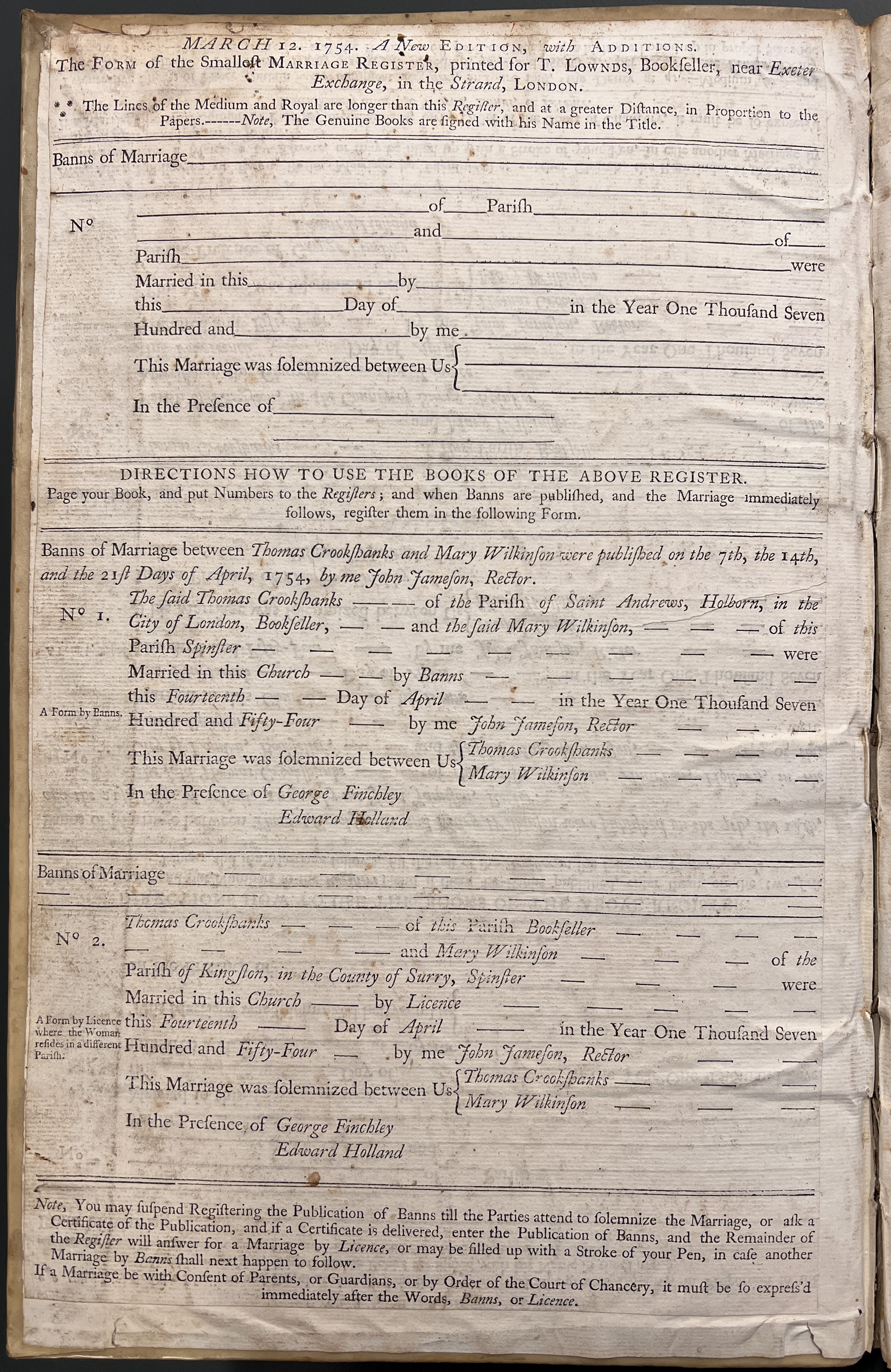

Page of entries for 1802 from the pre-printed register of marriages from Brompton by Sawdon, All Saints, 1754-1810 [PR/BRO 1/7]
From 1754, marriage registers usually record:
- Names of bride and groom
- Their marital status,
- Their parish of residence
- Date married.
- The way in which the ceremony was performed, by banns or licence
- The signatures or marks of the husband and wife
- Signatures or marks of at least two witnesses
- The name of the officiating minister
Information you don’t usually find:
- Age of bride and groom
- Detailed addresses
- Occupations
- Names of parents
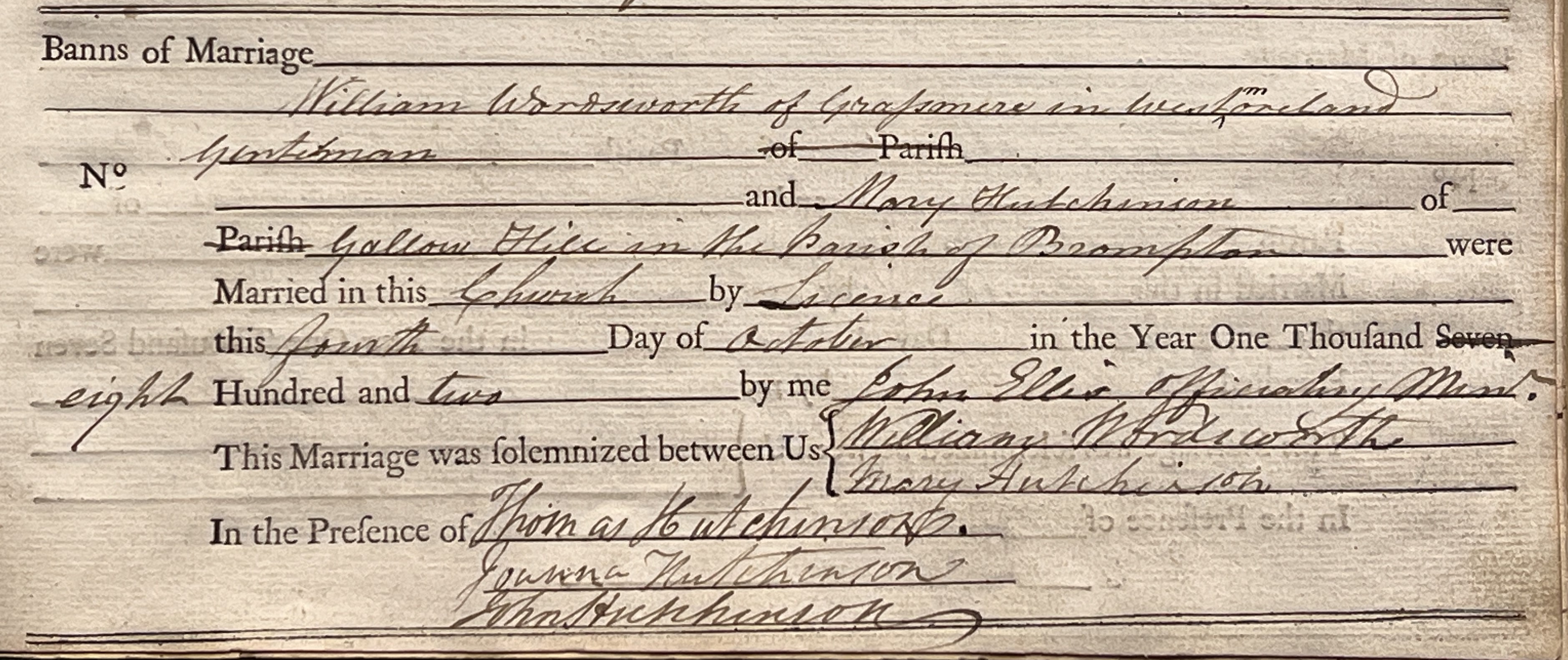
Detail of entry recording the marriage of William Wordsworth (the Lake District poet) of Grasmere in Westmoreland to Mary Hutchinson of Gallow Hill in the parish of Brompton, by license on 4 October 1802 in the Brompton by Sawdon, All Saints’ register of marriages, 1754-1810 [PR/BRO 1/7]
A note on Dade registers
In the 18th century, even after the 1753 Marriage Act required additional information to be recorded in the marriage register, the details recorded in the separate baptism and burial register remained very brief. As well as the date of the ceremony, records of baptism usually included only the child’s name and parent’s name(s), and for burials, the name of the deceased.
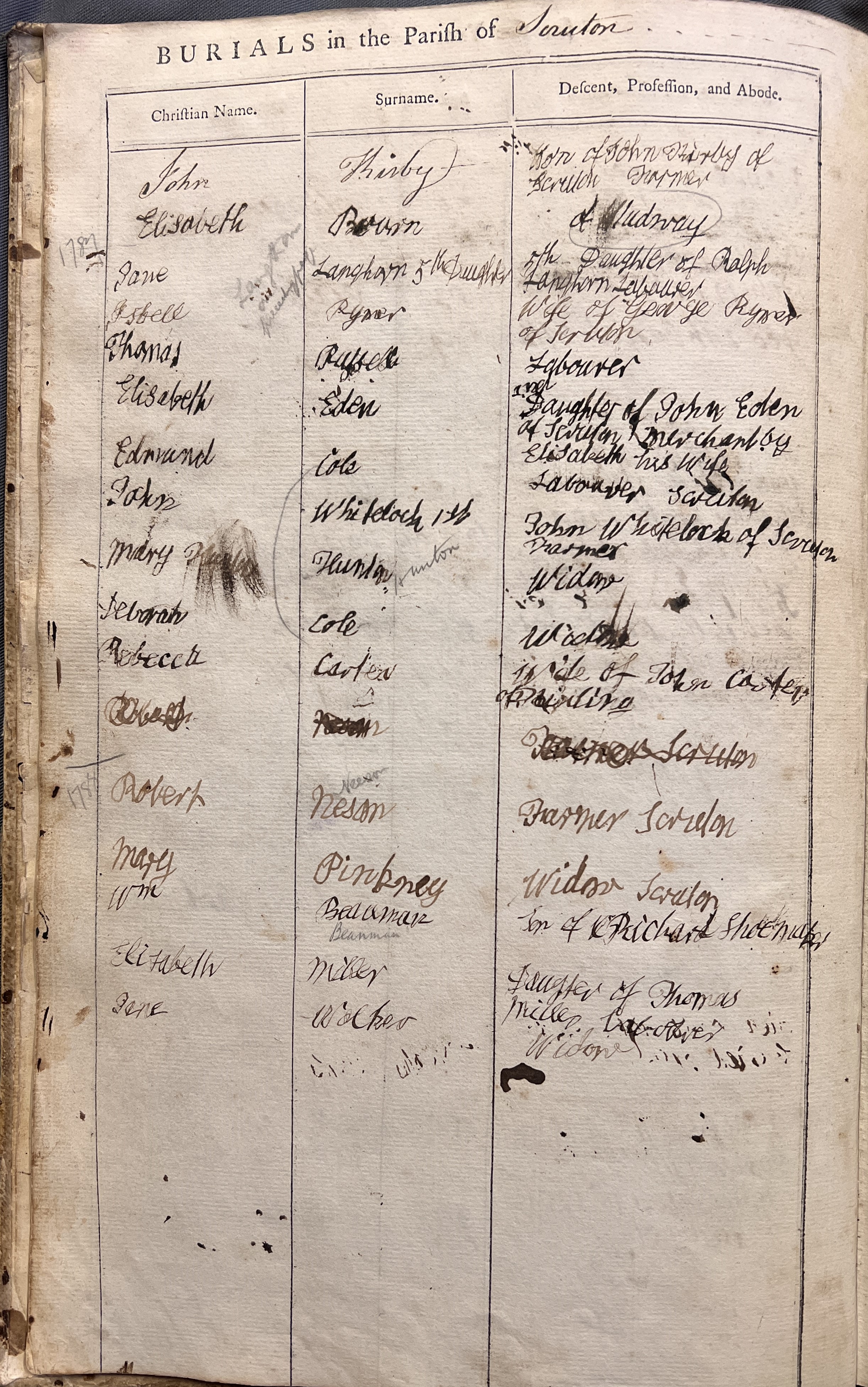
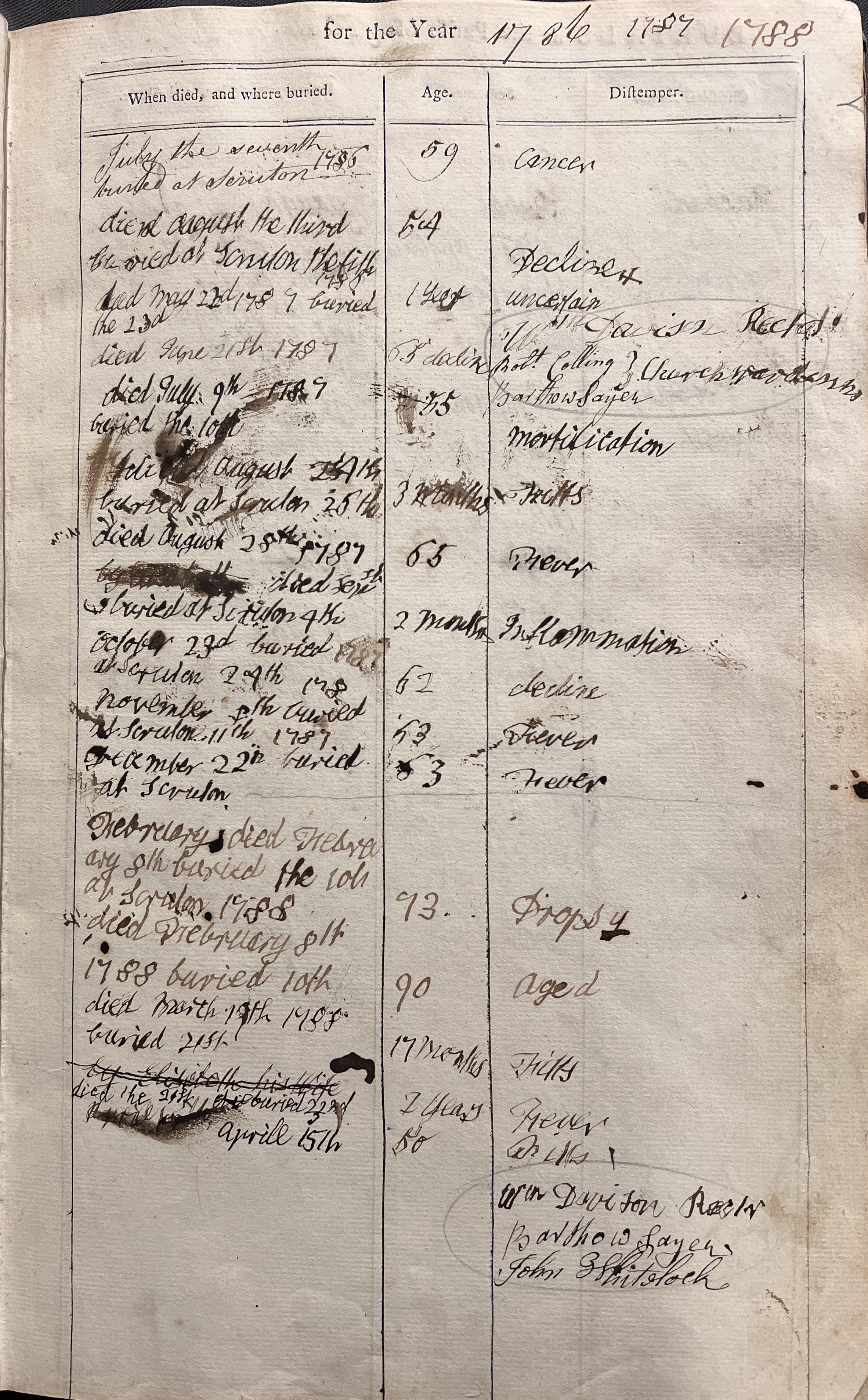
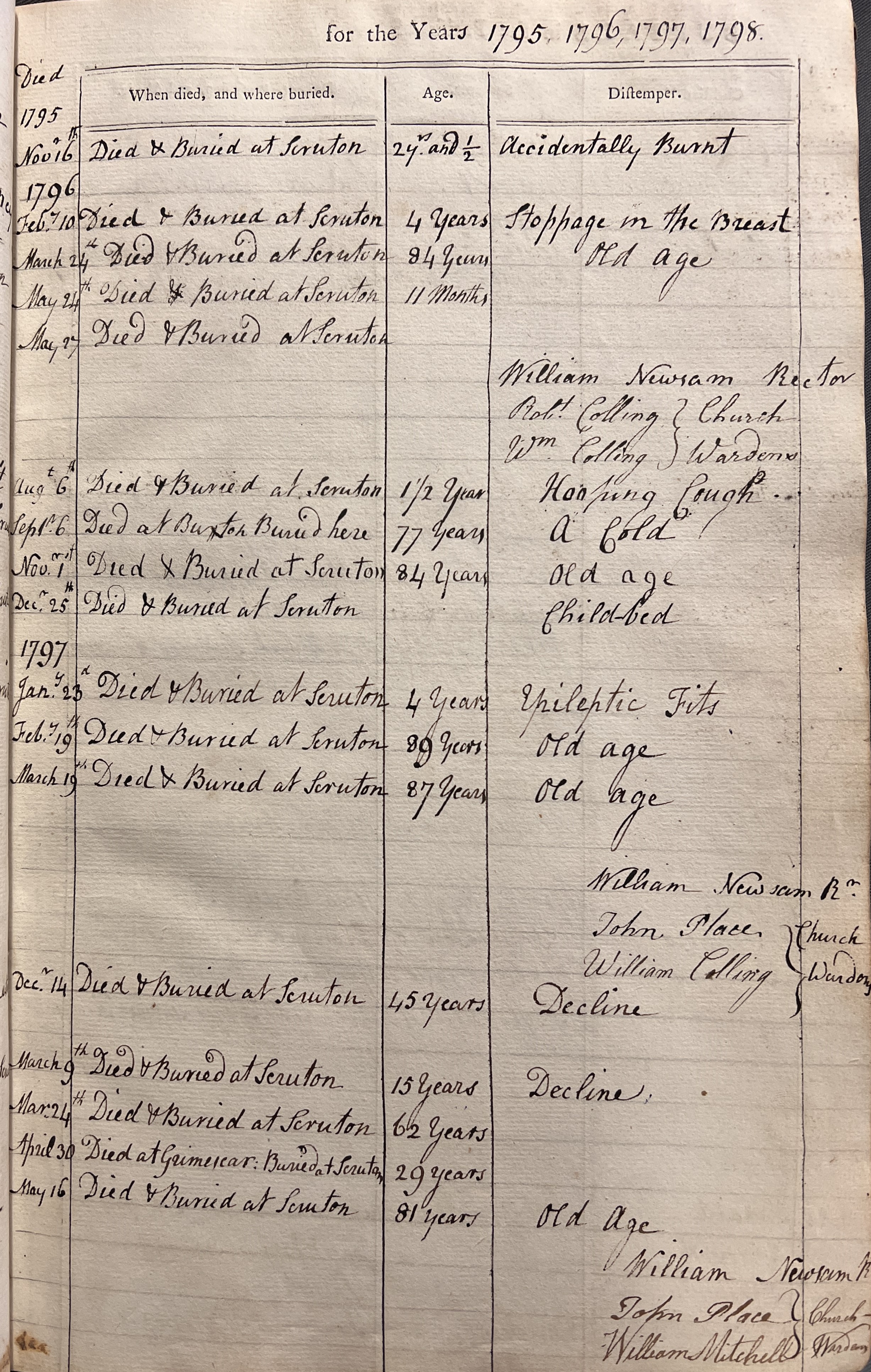
Between 1770 and 1812, however, a number of parishes in Yorkshire adopted what are known as Dade registers, and recorded a significant amount of additional detail. For baptisms, this information can include the child’s seniority in the family, date of birth, father’s occupation, and grandparent’s names, occupations and abodes. Likewise, for burials, registers can include date of death, occupation, parentage, age at death and cause of death.
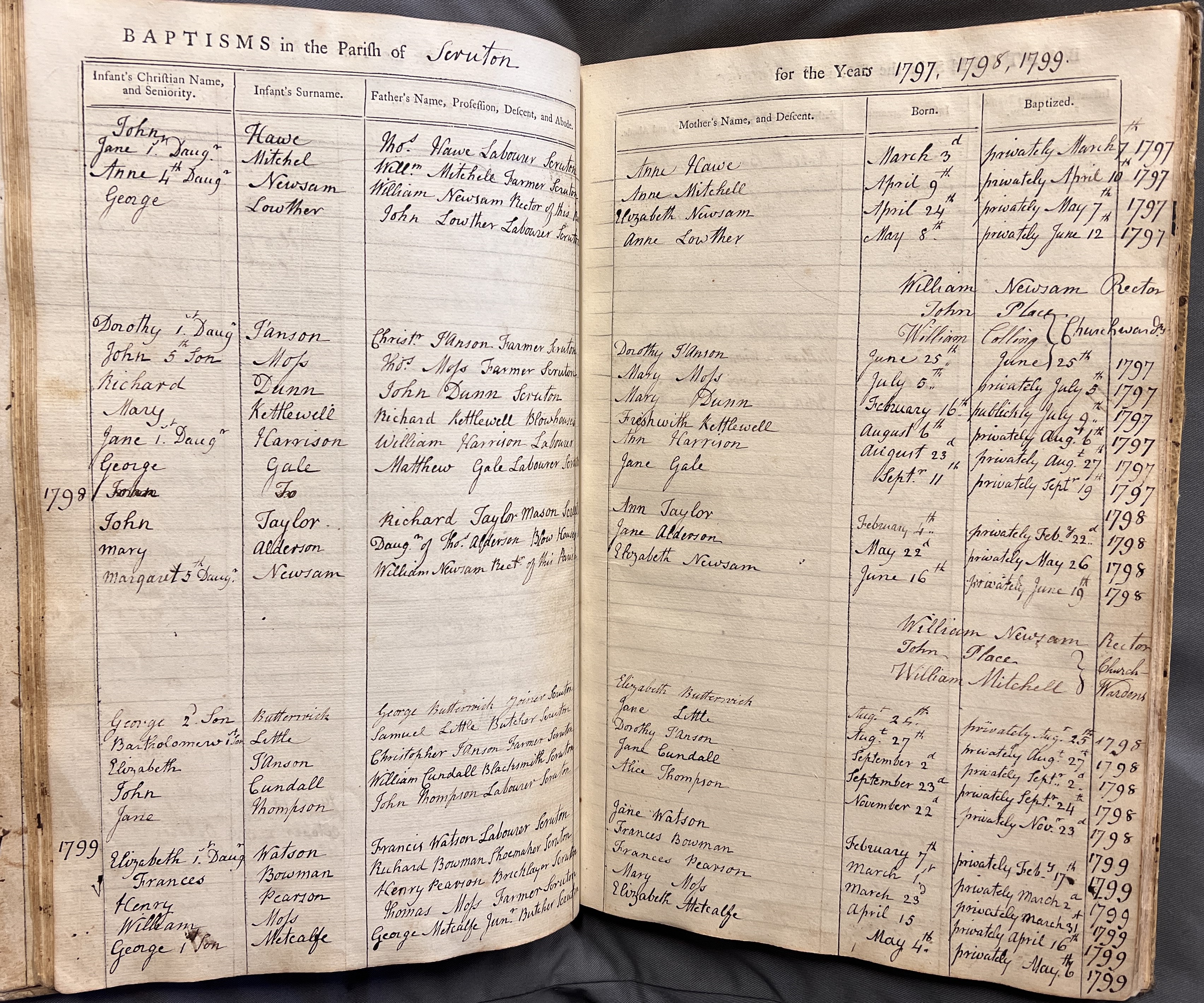
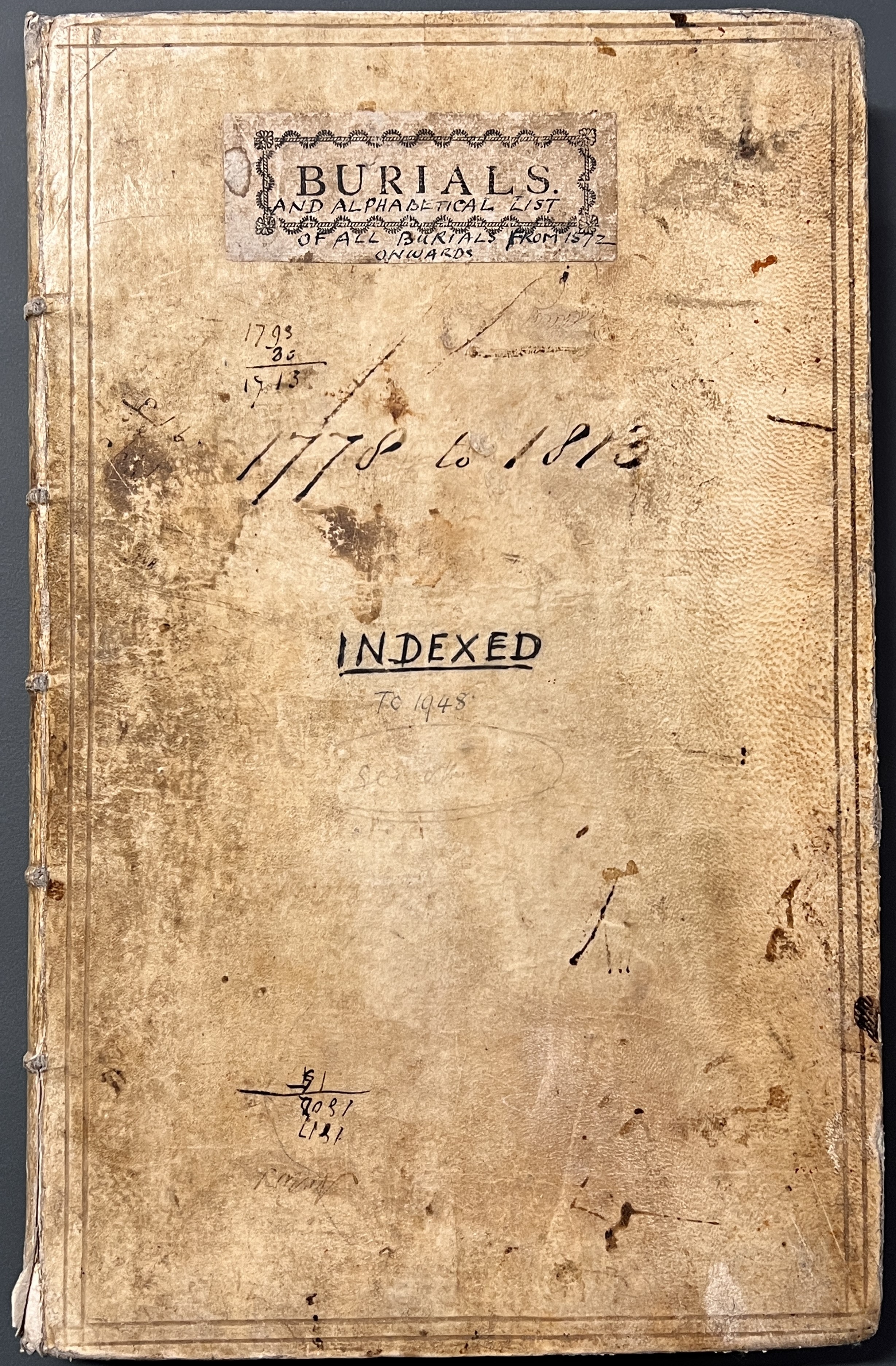
Scruton, St Radegund: Dade register of baptisms and burials, 1778-1813, open at pages recording baptisms in the years 1797-1799, the entries are to be read across both pages [PR/SCR 1/4]
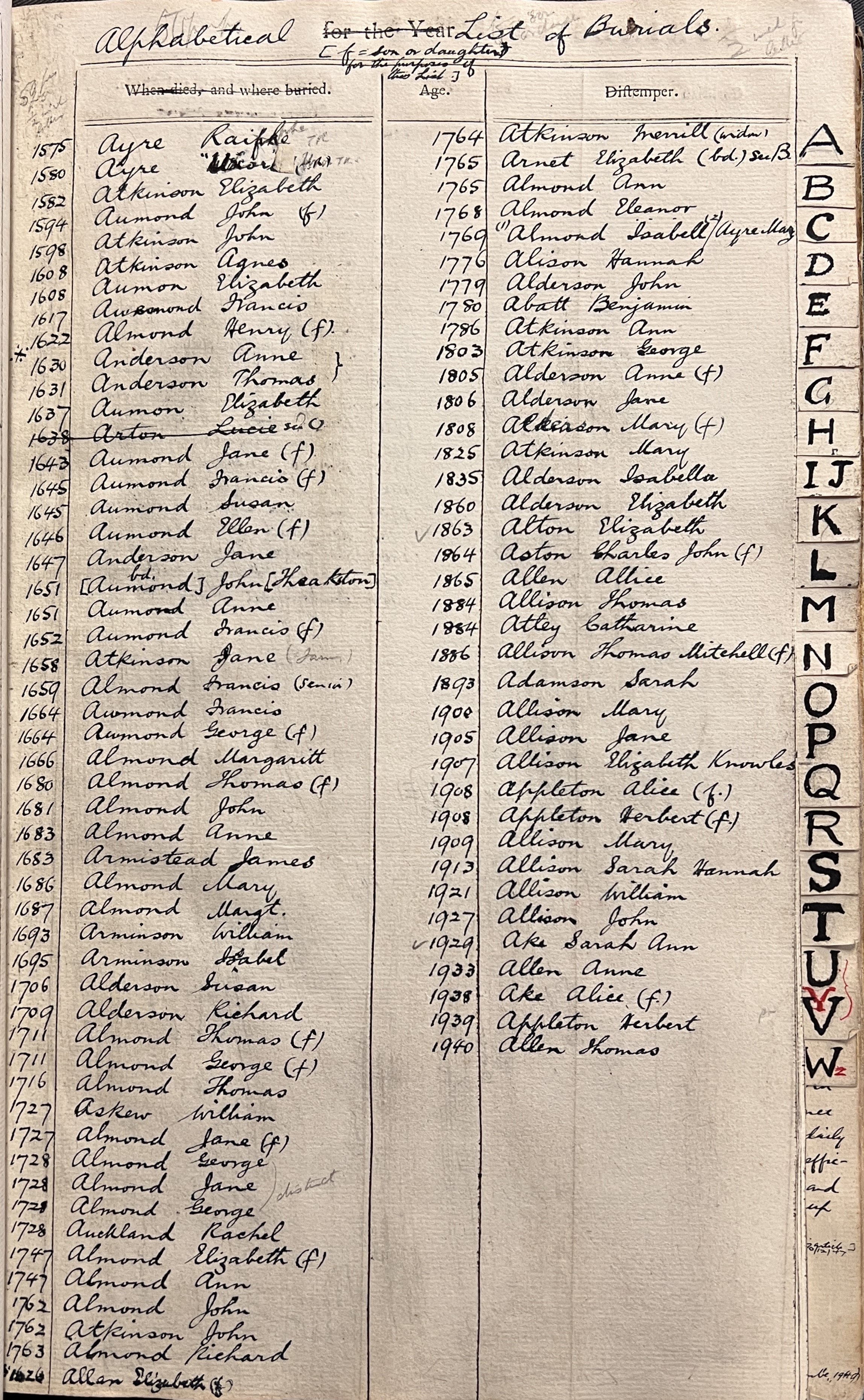
These registers were devised by the Reverend William Dade of the City of York. Their use was encouraged by William Markham, Archbishop of York, throughout his diocese, which included most of the West Riding and parts of the North Riding of Yorkshire. Their format varies from parish to parish, some were written freehand, and others had more formal headings. Their use was largely discontinued with the introduction of a new pre-printed register format from 1813 (see below). Some ministers’ handwriting was extremely neat, others less so!

Even in non-Dade registers, additional details may be recorded, for example in the case of members of the local gentry.
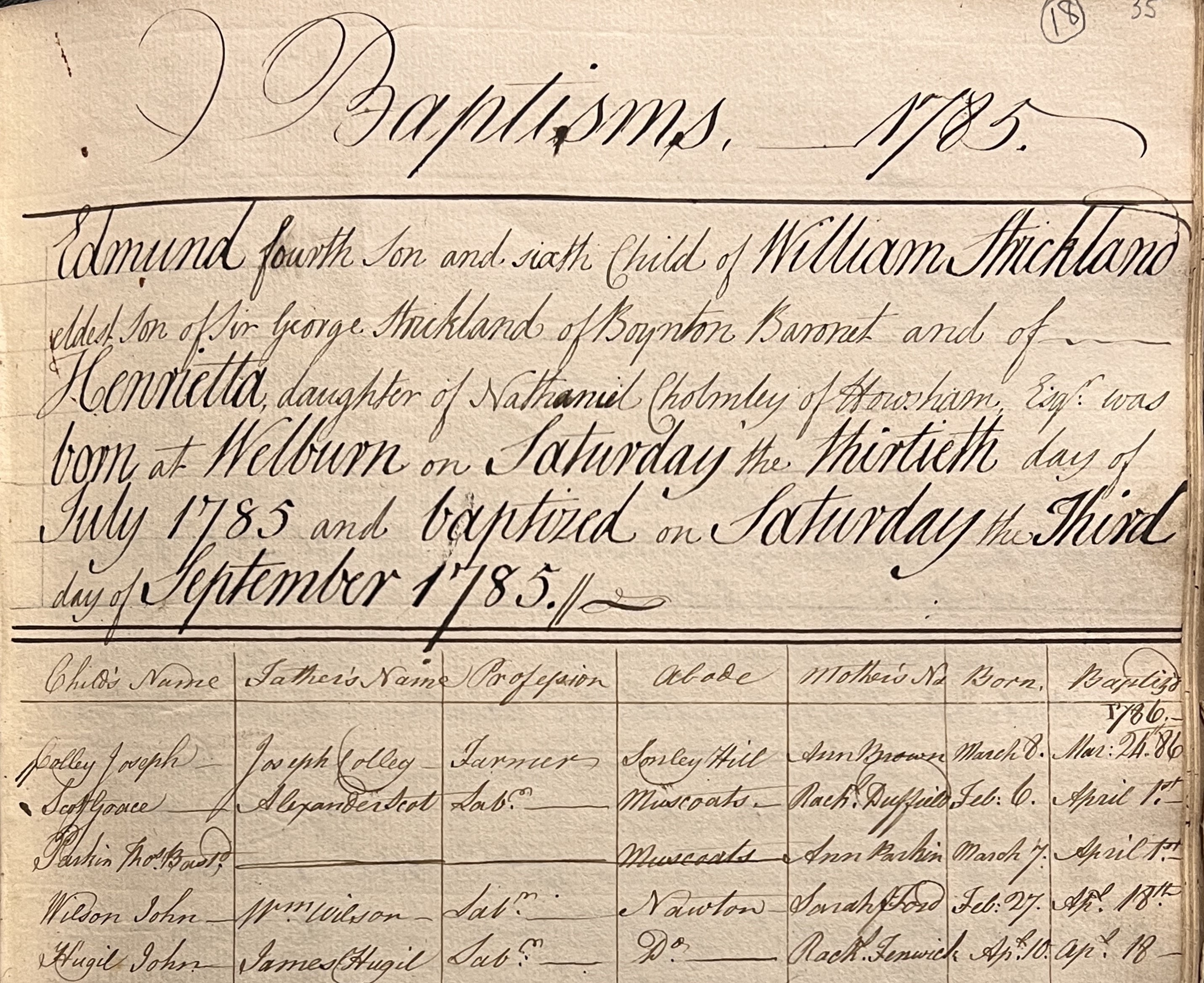

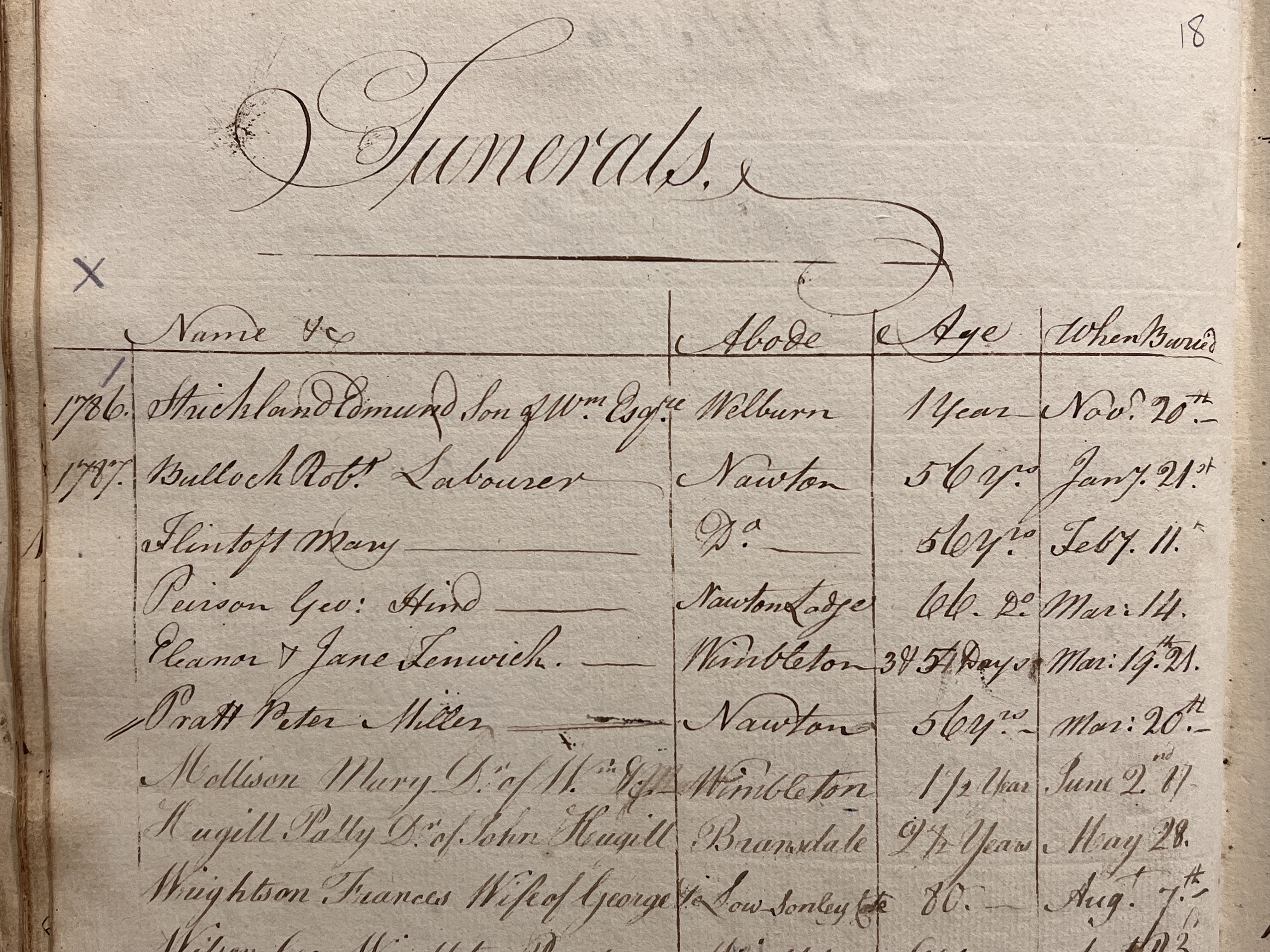
Kirkdale, St Gregory’s Minster: register of baptisms and burials, 1763-1812. Baptised on 3 September 1785, Edmund, the fourth son of William Strickland, son of George Strickland of Boynton, Baronet. Sadly, Edmund was not to live much beyond his first year and his burial is recorded later in the same register on 20 November 1786 [PR/KRD 1/4]
1783 The Stamp Duties Act
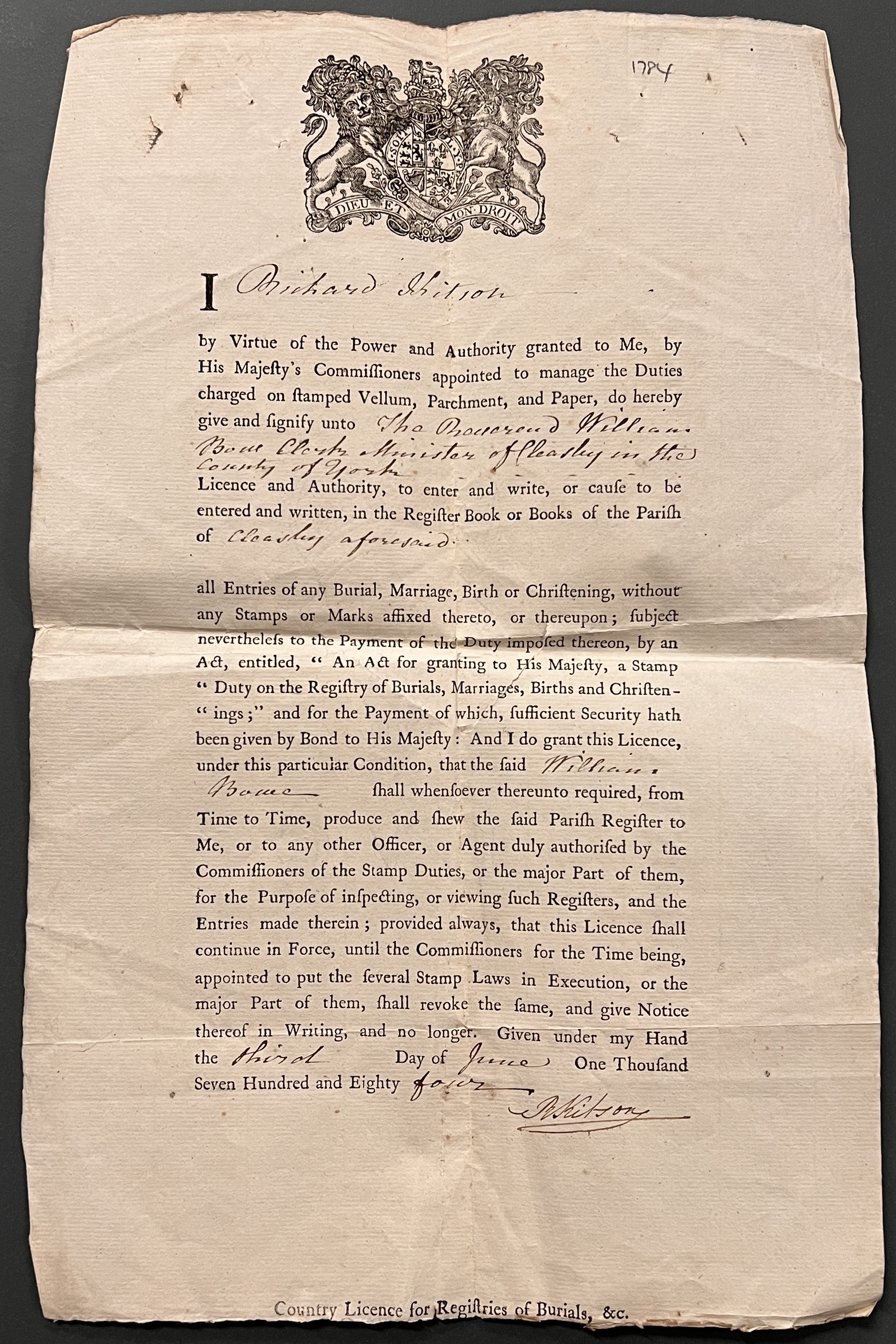
The Stamp Duties Act, 1783, imposed a tax of 3d (old pence) on all parish register entries for baptisms, marriages and burials; churches were entitled to ten percent of the revenue for collecting this tax. The Act was an extremely unpopular measure, and those who refused to pay were fined. It was repealed in 1794.
Licence to the Revd William Bone, minister of Cleasby, to enter in the register books, christenings, marriages & burials, subject to payment of stamp duty, 3 June 1784 [PR/CLE 1/5]
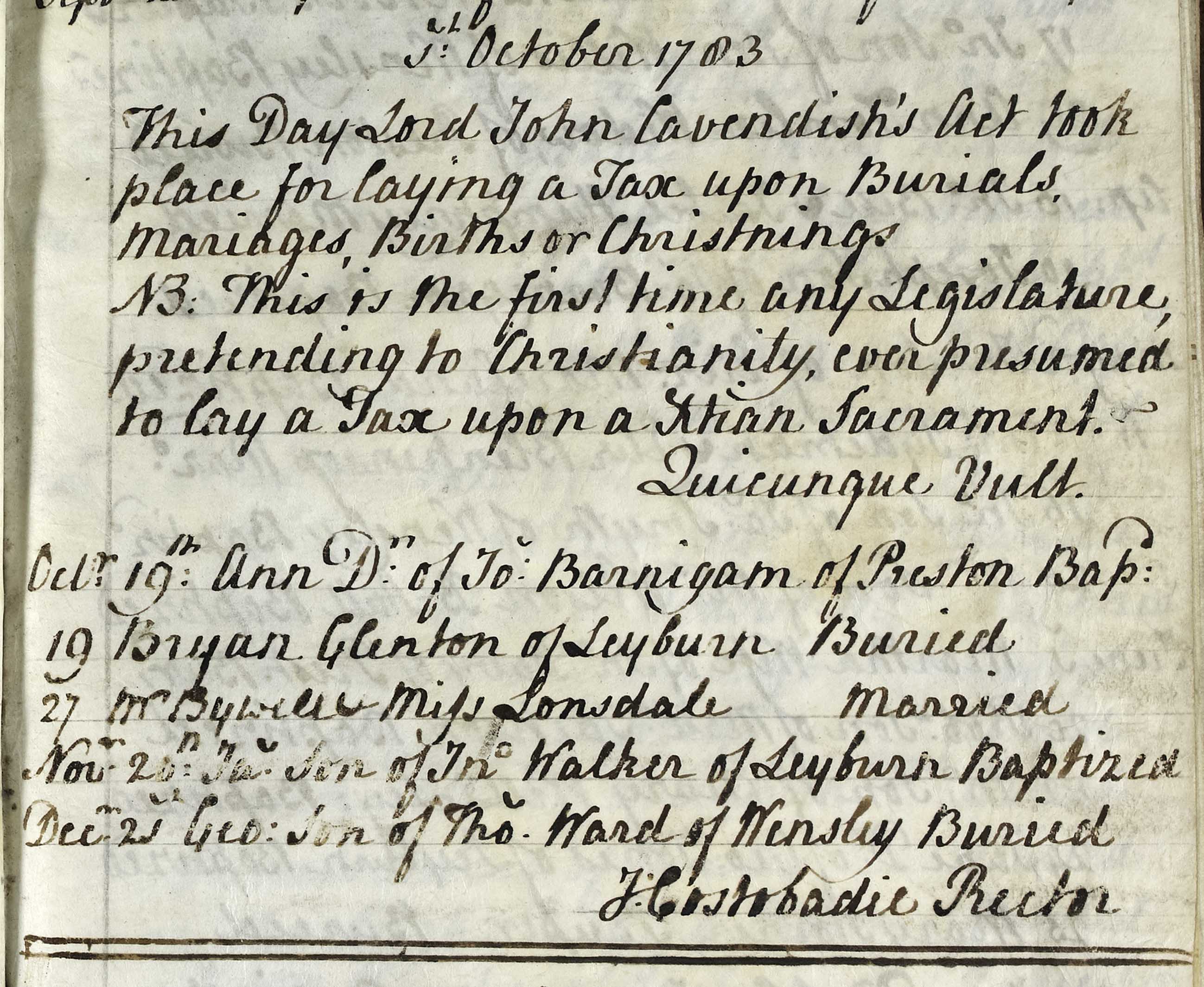
“This day Lord John Cavendish’s Act took place for laying a tax upon Burials, Marriages, Births or Christnings. NB This is the first time any Legislature pretending to Christianity ever presumed to lay a Tax upon a Christian Sacrament. Quicunque Vult.”
Wensley, Holy Trinity baptism, marriage and burial register, 1770-1812 comment on the Stamp Duties Act in October 1783 [PR/WEN 1/2]
1812 George Rose’s Act
The “Act for the better regulating, and preserving of Parish and Other Registers” came into effect in January 1813. Its stated aim was to ‘greatly facilitate the proof of pedigrees claiming to be entitled to real or personal property‘. This introduced separate, pre-printed baptism and burial registers, with headings for each piece of required information. Very occasionally, additional information was recorded in the margins of the pages.
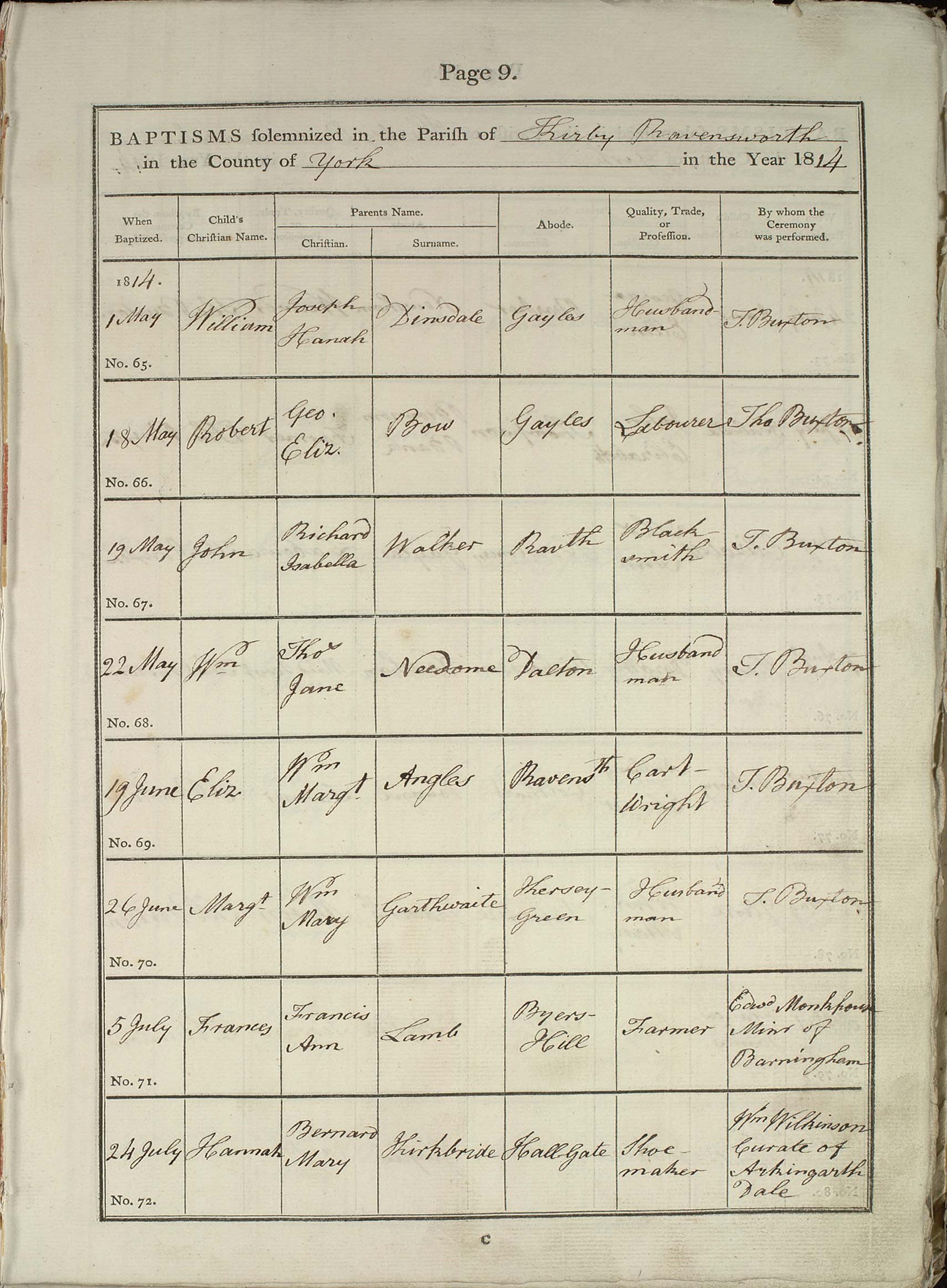
Page of entries for 1814 from the pre-printed register of baptisms from Kirby Ravensworth, St Peter & St Felix, 1813-1849 [PR/KRR 1/7]
From 1813, baptism registers usually record:
- When baptized
- Child’s Christian name
- Parents name: Christian and surname
- Abode
- Quality, trade or profession
- By whom the ceremony was performed
Information you don’t usually find:
- Date of birth or age
- Mother’s maiden name
- A detailed address
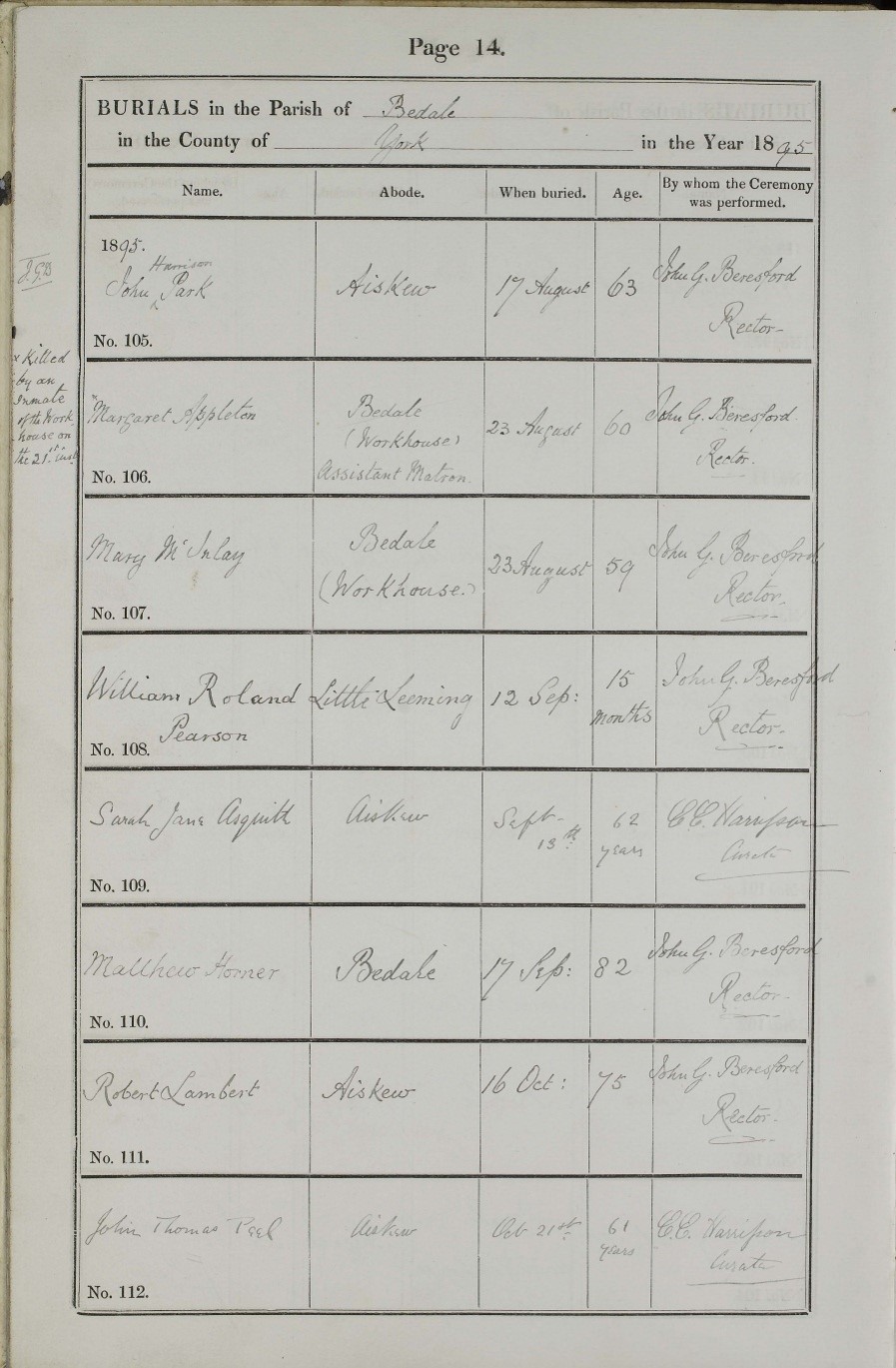
Page of entries for 1895 from the pre-printed register of burials from Bedale, St Gregory, 1892-1919 [PR/BED 1/29]
From 1813, burial registers usually record:
- Name
- Abode
- When buried
- Age
- By whom the ceremony was performed
Information you don’t usually find:
- Date of death
- Cause of death
- Occupation
- Details of relatives
- A detailed address
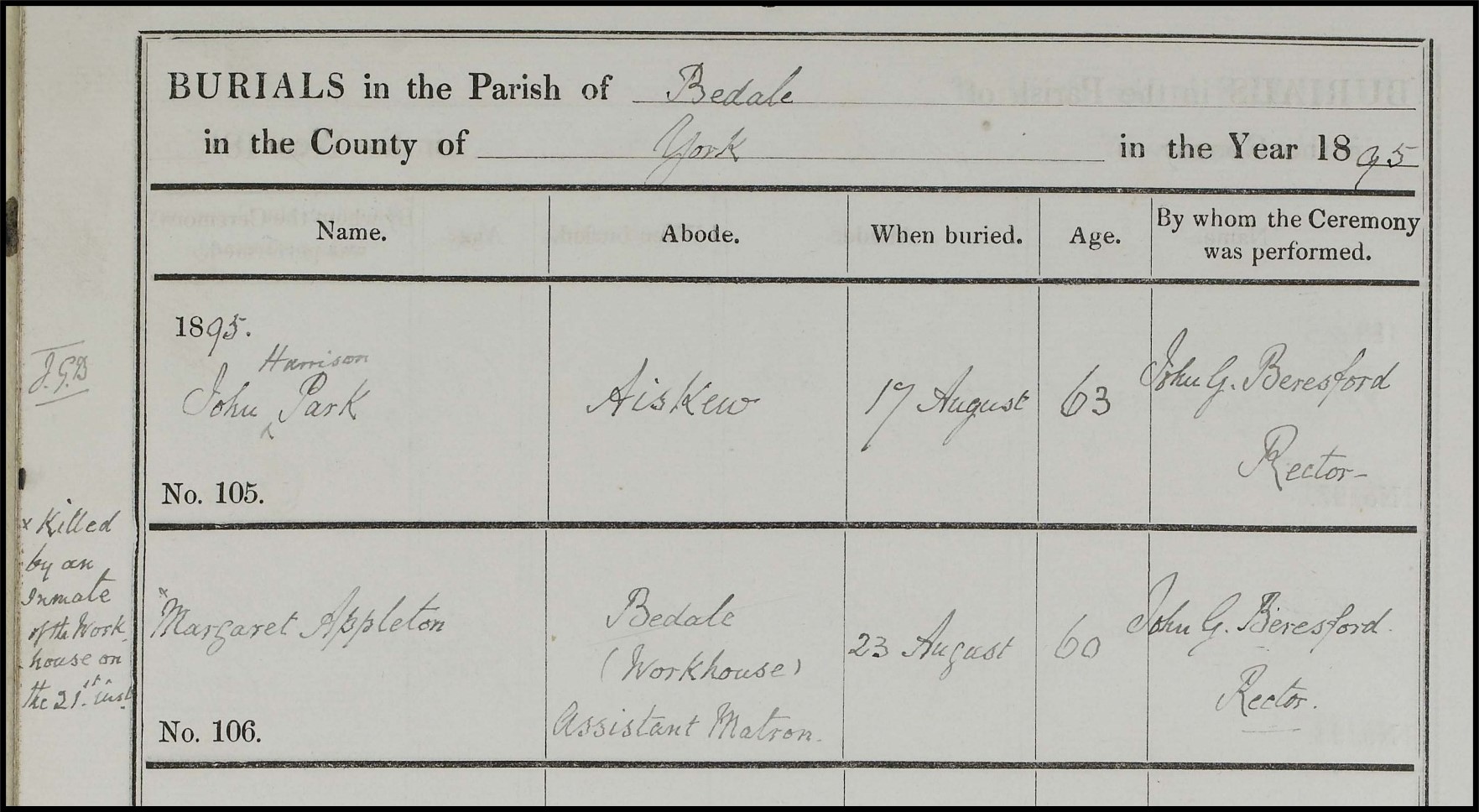

Detail of burial entry for Margaret Appleton, Assistant Matron of Bedale Workhouse, 23 August 1895, aged 60 showing marginal note recording that she was killed by an inmate of the Workhouse on 21 August, from the Bedale, St Gregory register of burials, 1892-1919 [PR/BED 1/29]
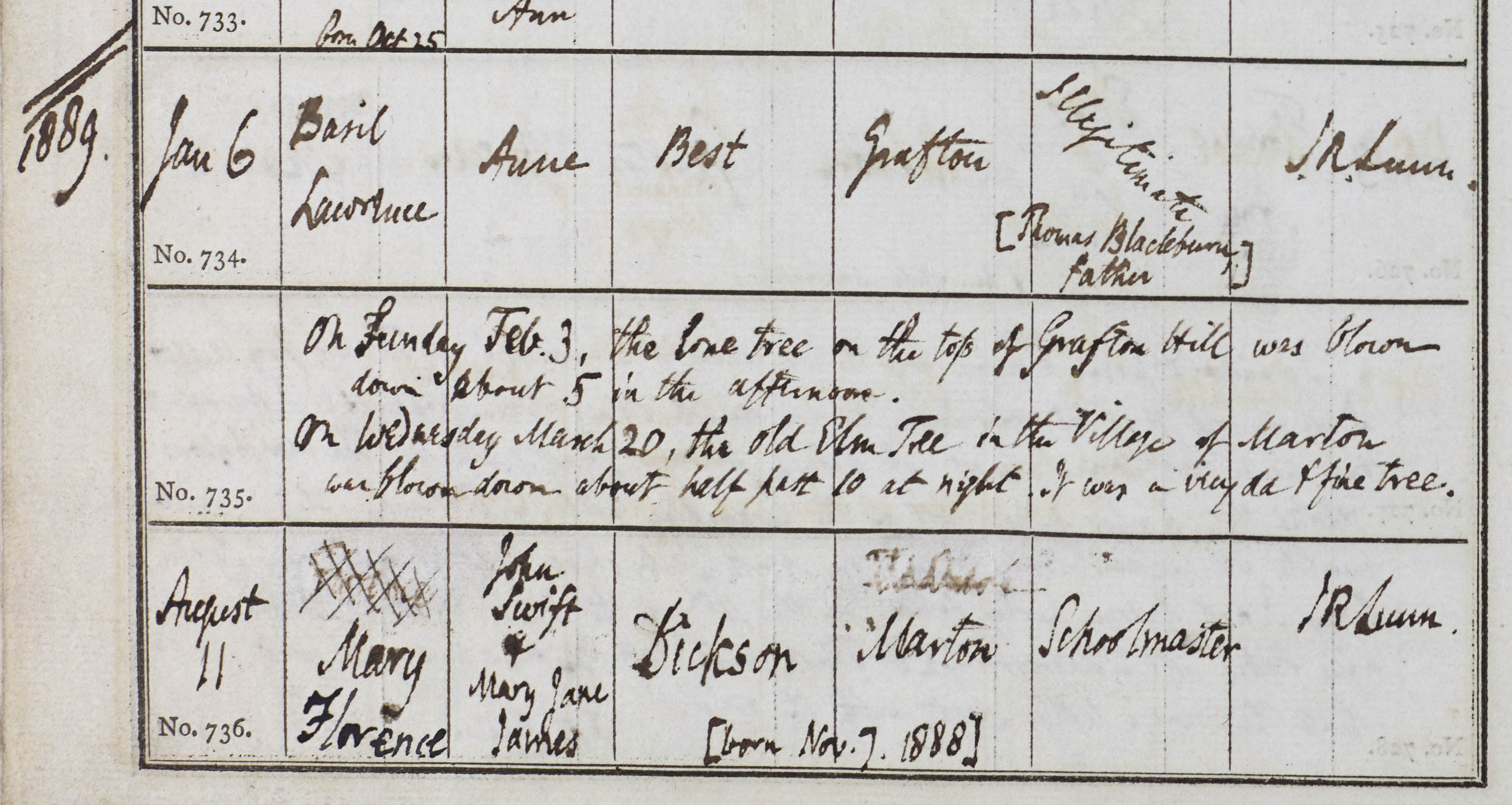
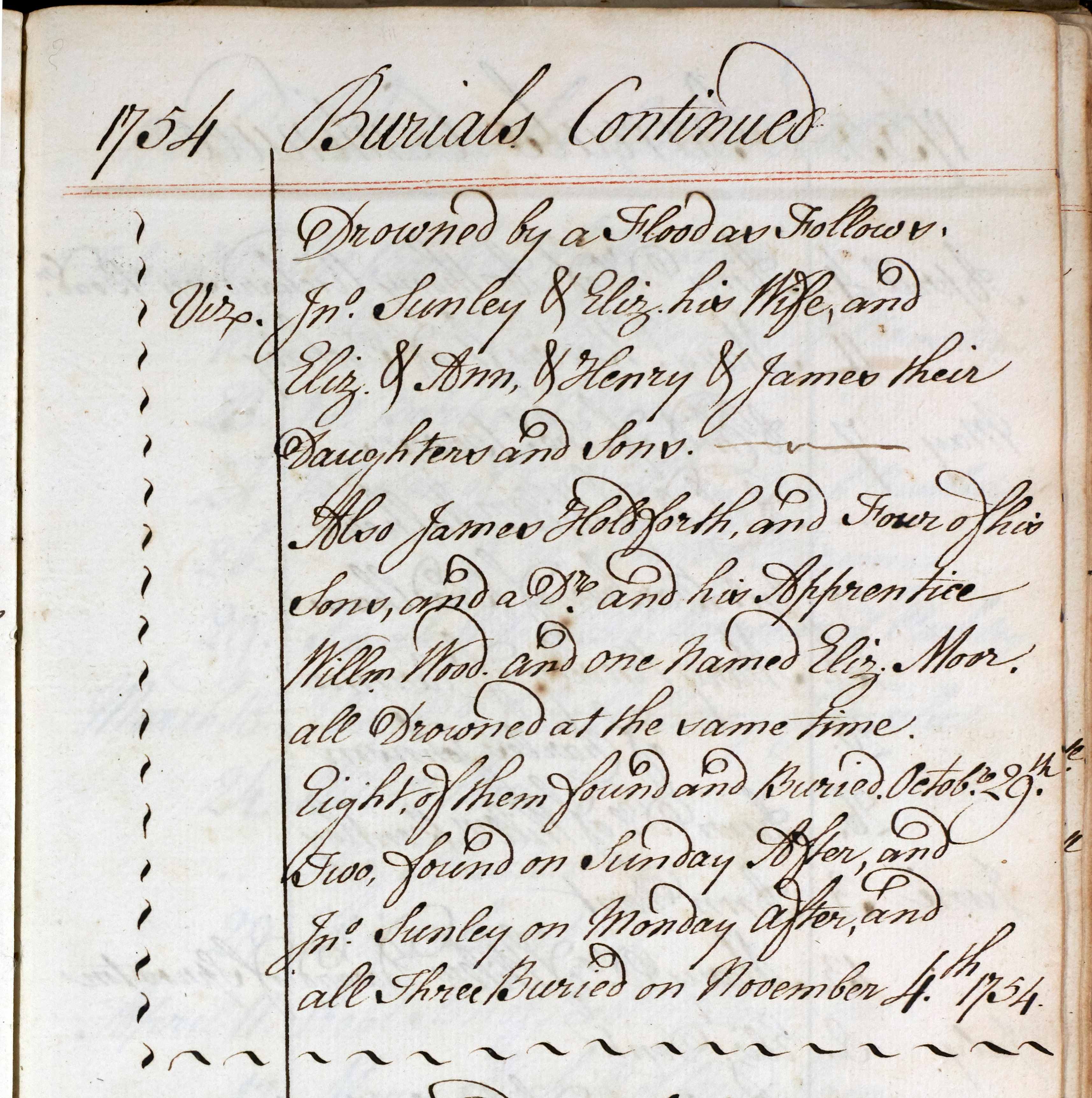

- L: Marton cum Grafton, Christ Church baptism register 1813-1902 containing notes on two trees which blew down in the village on 3 February & 20 March 1889, the latter an old elm, which was “a very fine and old tree” [PR/MAG 1/4]
- C: Helmsley, All Saints’ baptism, marriage and burial register, 1697-1780 recording burials in October and November 1754 due to drownings caused by a flood [PR/HEL 1/5]
- R: Ingleton, St Mary baptism register, 1849-1917 recording the death of Queen Victoria on 22 January 1901 [PR/INT 1/7]
1837 Civil Registration
In the early 1800s, Parliament recognised the need for accurate records for voting, planning, taxation, and defence purposes. Civil registration began in England and Wales on 1 July 1837 and covered births, marriages, divorces and deaths. However, in the early years, coverage was not universal and tougher laws were introduced in 1874.
Churches continued to record the ceremonies of baptism, marriage and burial in parish registers after 1837, and do so to the present day. Since 1837, marriage registers were the same as civil registration registers.
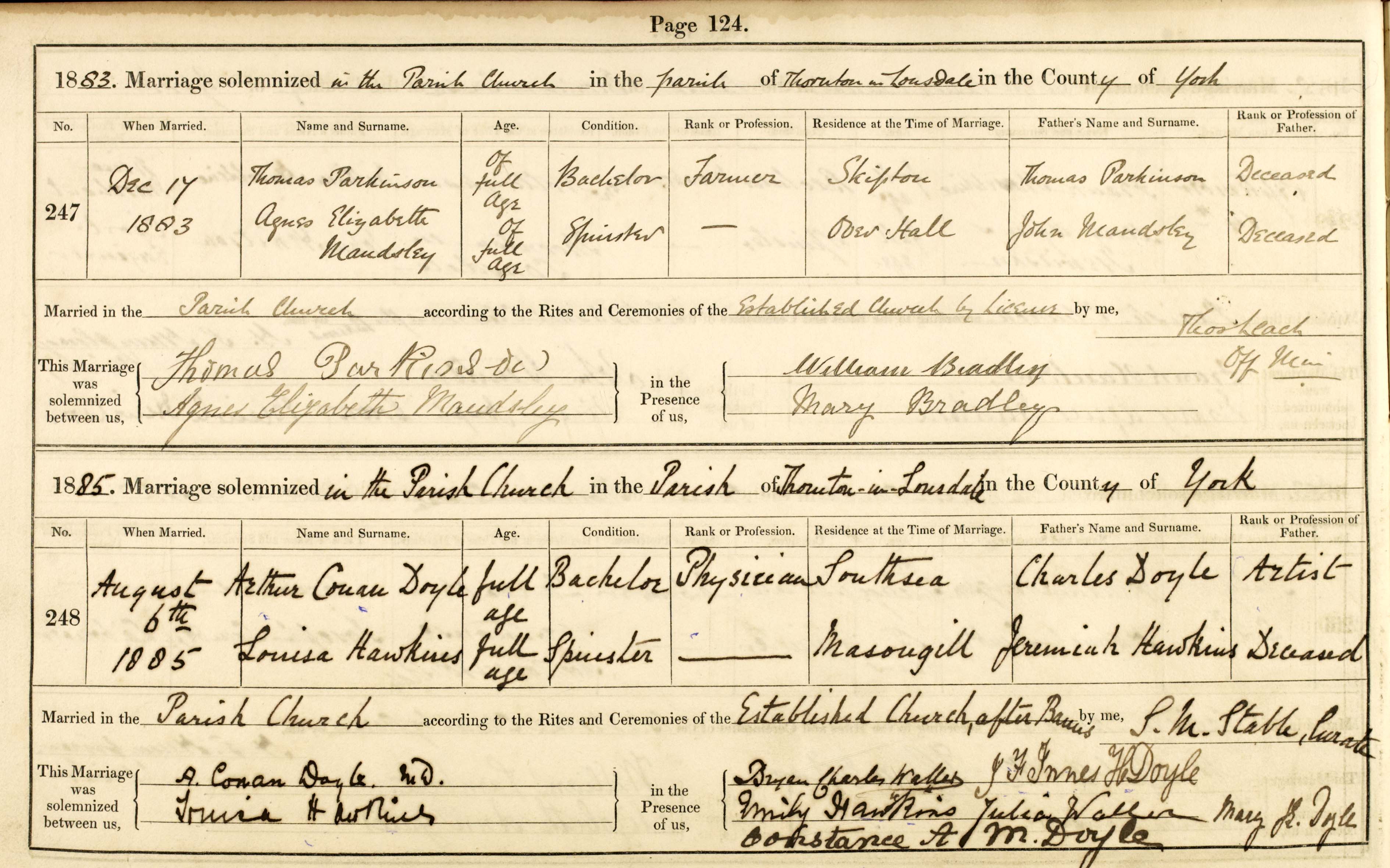
Page of entries from the pre-printed register of marriages from Thornton in Lonsdale, St Oswald, 1837-1992 showing the marriage of Arthur Conan Doyle, Physician of Southsea (and later the author of the Sherlock Holmes novels) to Louisa Hawkins of Masongill on 6 August 1885 [PR/TNL 1/10]
Copies of certificates of births, marriages and deaths after 1837 can be obtained via North Yorkshire Council’s Certificate Services.
Civil Registration indexes to births, marriages and deaths between 1837 and 1997 can be searched online as part of an ongoing transcription project via the FreeBMD website.
 North Yorkshire Archives Blog