
Treasures from the Parish Chest: exploring North Yorkshire’s church history from archives to architecture
All Saints’, Northallerton is one of the churches restored by Charles Hodgson Fowler of Durham in the 1880s. The Record Office collections include a series of 19th century engravings, drawings and architectural plans depicting both the interior and exterior of the church before and after the restoration. Some of these are within the parish collection [PR/NO], some in the Hodgson Fowler archive [ZRA 48] and some in historic image collections [ED & EE]. From these, the internal reordering and structural changes that were made to the building can be traced. Contemporary descriptions in The Building News and Engineering Journal provide further details of the works that were undertaken.


- Left: ‘Sketch of Northallerton Church Yorkshire. It is dedicated to All Saints & is a vicarage in the Patronage of the Dean & Chapter of Durham. Taken by Will Latham August 16th 1825’ [ED12/2]
- Right: South-west view of All Saints, Northallerton, undated [PR/NO]

Situated at the north end of the High Street, the church of All Saints, Northallerton is Perpendicular in style and was rebuilt in the 14th century between 1345-1381. Earlier features survive, including the 12th century north arcade. That there was an even earlier church on the site is evidenced by a quantity of Anglo-Saxon and Anglo-Danish sculptural fragments discovered during the Hodgson Fowler restoration work of 1883-1884. The parish registers date back to 1594, churchwardens’ accounts survive from 1687 and there are a wealth of parish records from the 18th and 19th centuries [PR/NO].
Extract from Northallerton tithe map, 1842 [T]
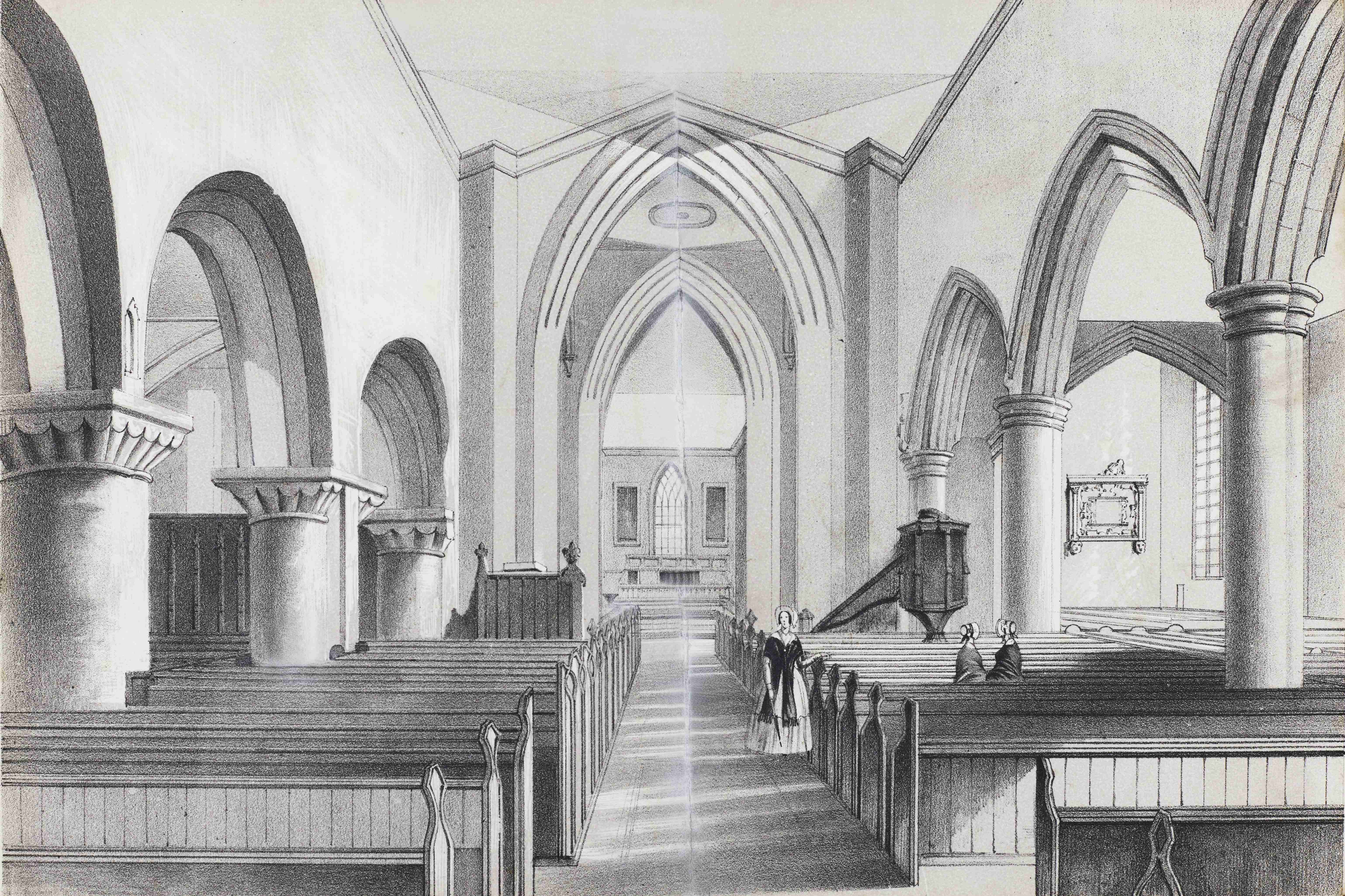
- Left: Engraving of interior view of All Saints, Northallerton prior to the 1884 restoration, looking east down the nave towards the altar and chancel [PR/NO]
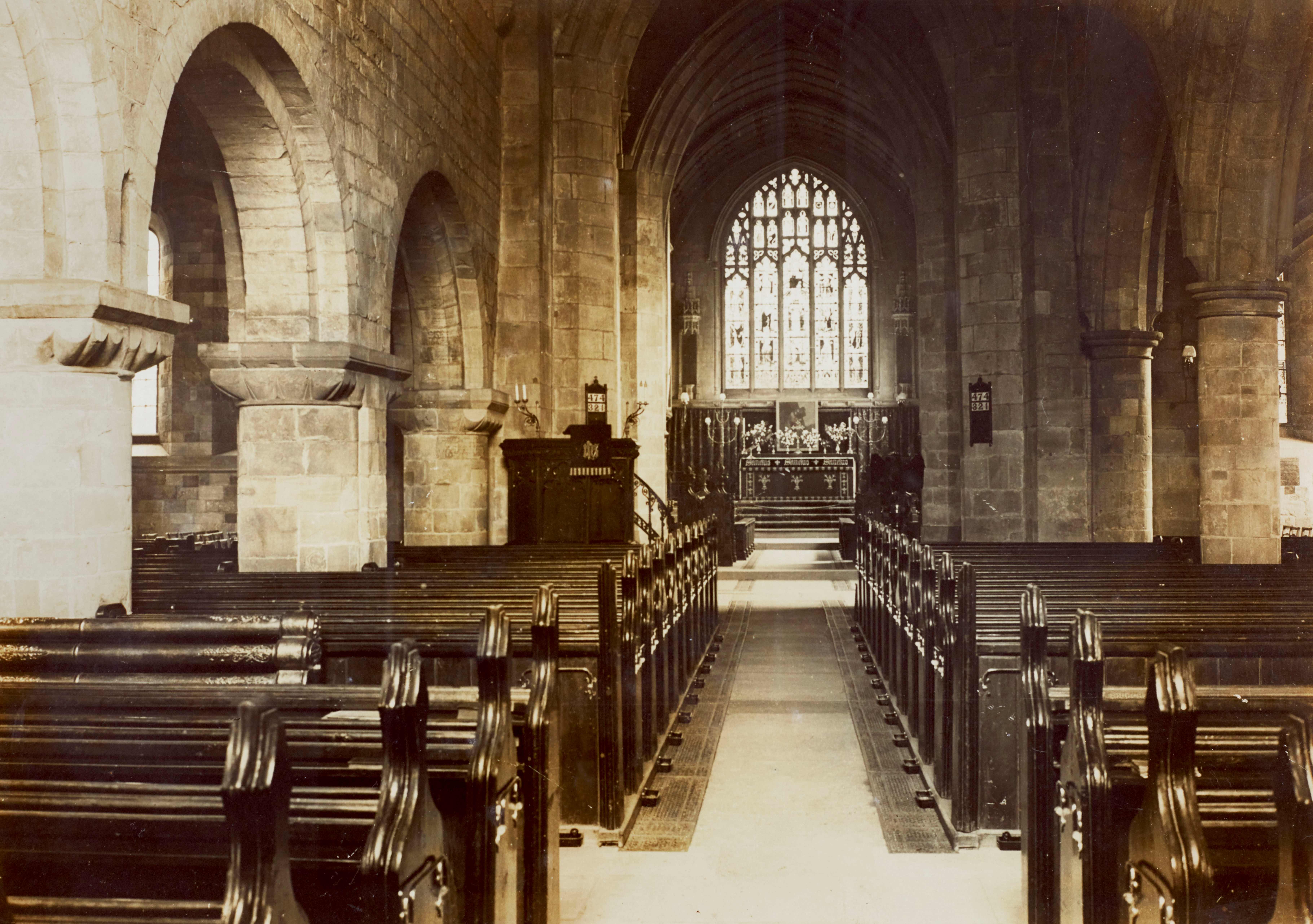
- Right: Undated photograph of interior view, post-restoration, showing pulpit in different position and enlarged chancel window at east end [PR/NO]
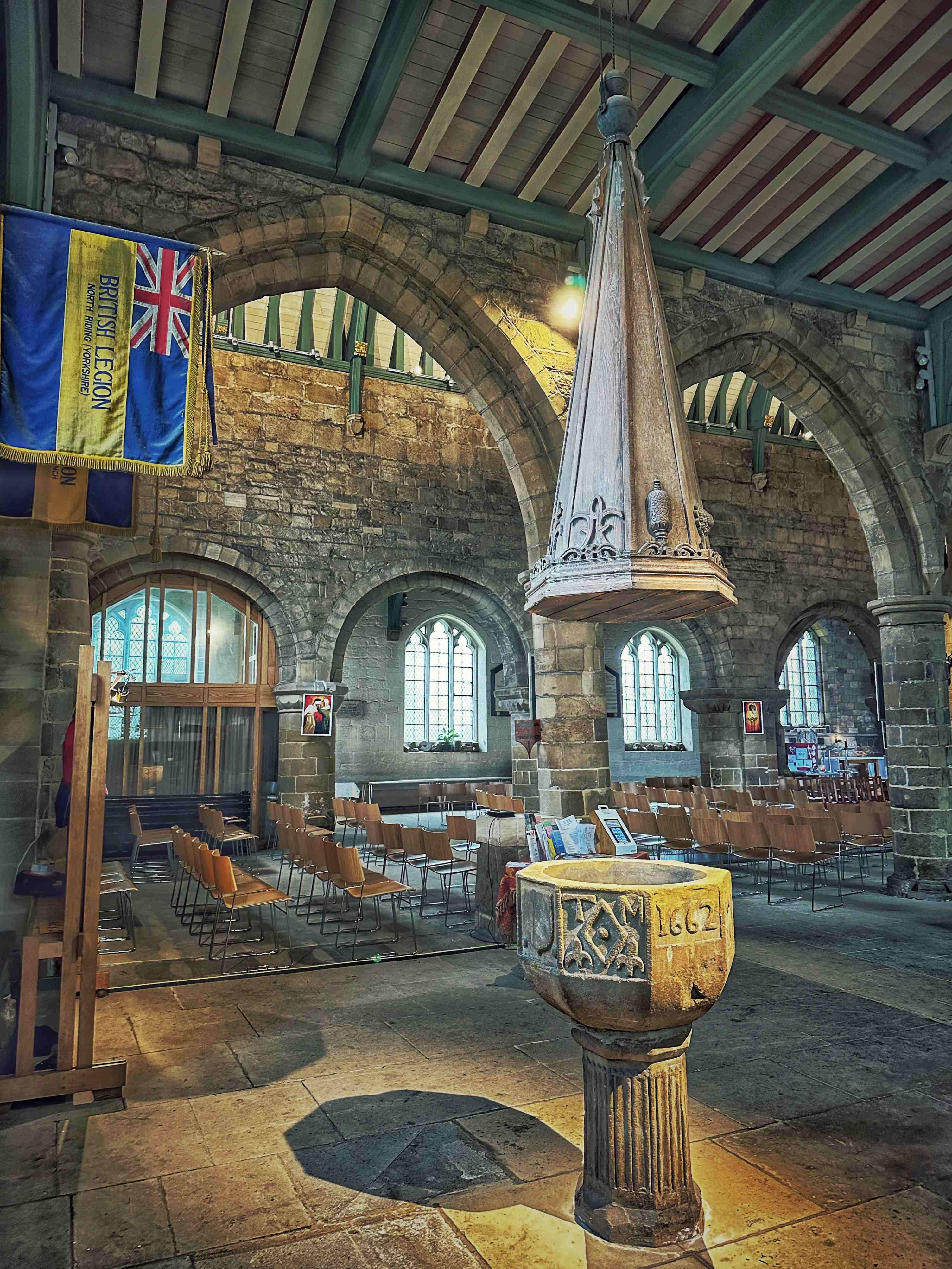
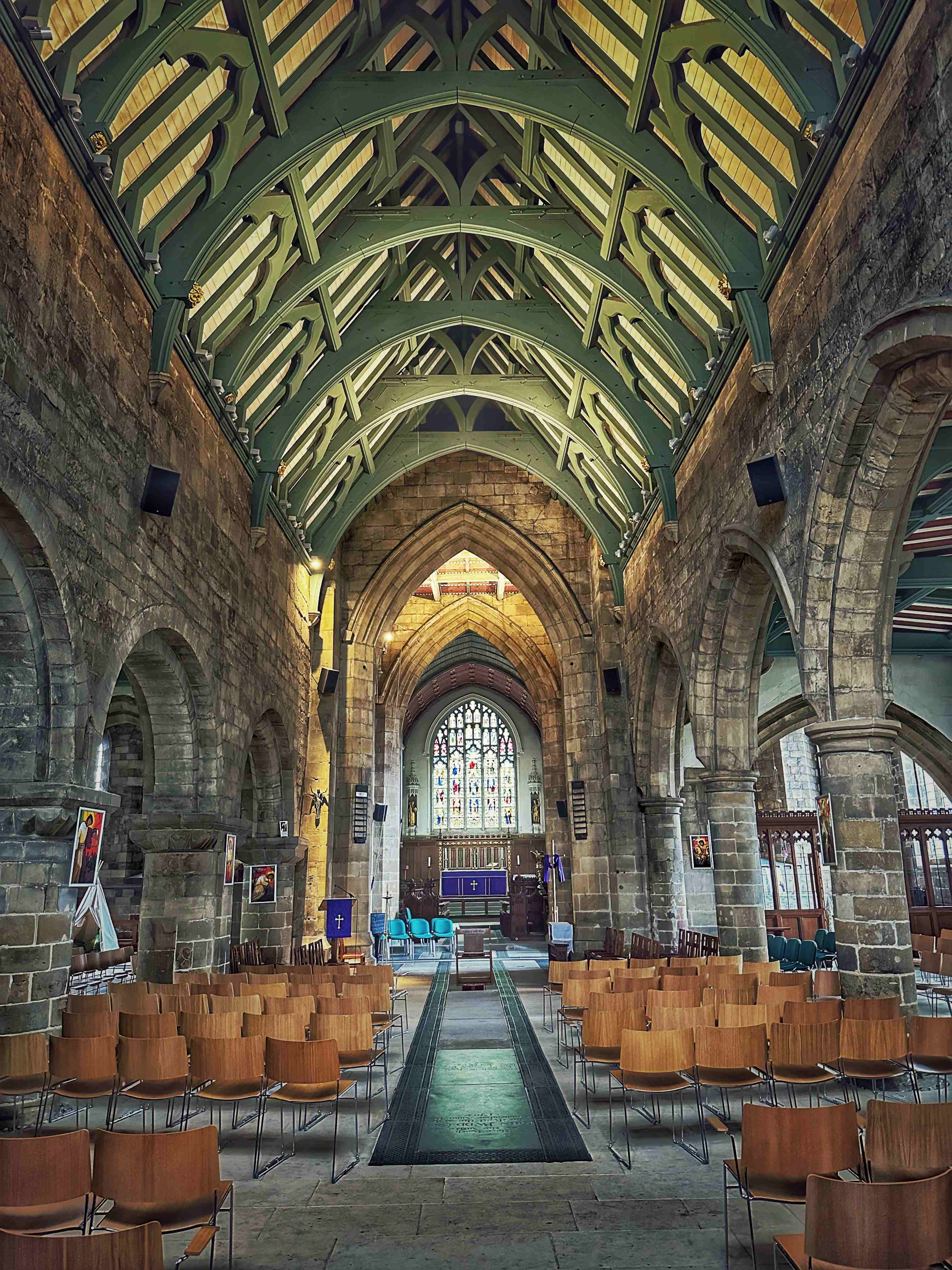

The Hodgson Fowler collection contains 43 architectural drawings for the restoration of Northallerton, All Saints between 1882 and 1884 [see the full list in our online catalogue: ZRA 48]. These include plans, sections and elevations ‘as at present’, and designs for proposed restoration.


The Building News and Engineering Journal, 14 September 1883 describes the first phase of restoration work at the church:
“NORTHALLERTON – On Thursday week the reopening of the nave and aisles of All SS. Church took place. The old roofs have been removed from the nave and aisles, and replaced by new ones. The nave has been covered with the old slates and the aisles with new lead. The walls of the interior have been cleared of colour wash, and the stonework re-dressed. The old gallery has been removed. Most of the west end has been pulled down and rebuilt. The west door has been repaired, and over it has been placed a window, and all the windows have been renovated and fitted with cathedral glass. The great window in the south transept has been brought down to its old level, and the tracery work repaired and filled with rough glass. The lancet windows on the east side of the south transept have been reopened, and the stonework dressed. The architect is Mr. Fowler, of Durham. The total cost of the restoration will be above £5,200.”


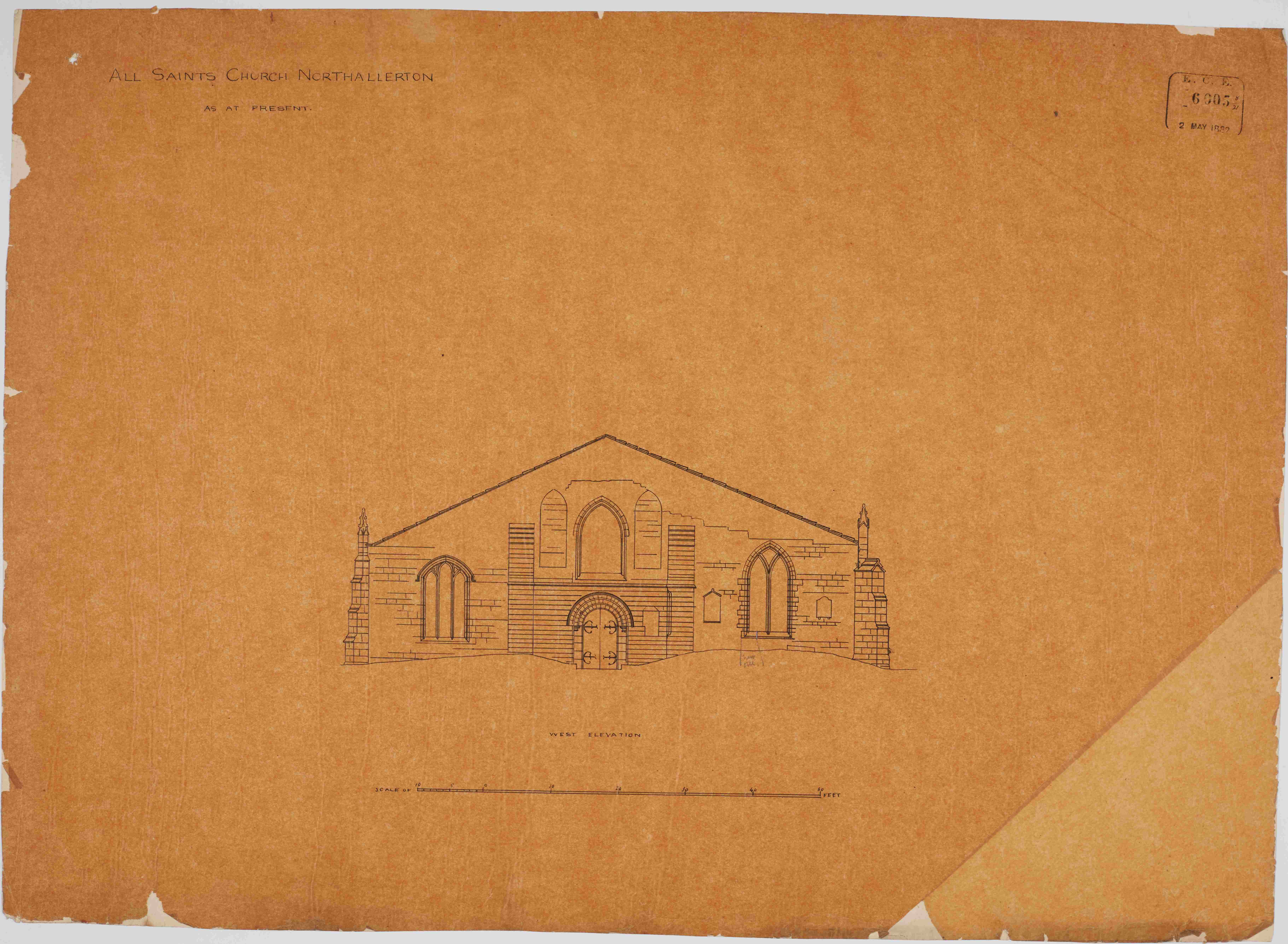

Existing and proposed plans can be compared below by moving the slider to the left and right to reveal both plans.


An article by C. Hodgson Fowler in The Building News and Engineering Journal, 30 November 1883 provides some background history of the church, as well as an illustration of the design for the proposed chancel restoration:
“All Saints’, Northallerton
This fine church, now in course of restoration, consists of nave and aisle 60ft. long, central tower and transepts, and chancel 64ft. long. The church was originally Norman, the north arcade being of about the year 1120. Some eighty or ninety years afterwards an extensive rebuilding and enlarging took place, the south aisle being added, and the whole church brought to its present cruciform plan. Of the work of this time the south arcade of the nave and the two fine transepts remain very little altered.
The church seems to have remained in this state until 1318, when it was burnt by the Scots, and according to an inscription formerly in it, was rebuilt by Bishop Hatfield in 1381; but though he probably reroofed and repainted the whole, he only seems to have rebuilt the tower, the present dignified one being all of that date. This known date of the tower is a very interesting fact in the architectural history of the North, the work being more advanced in style than might have been expected.
After this work of Bishop Hatfield minor alterations were made from time to time; the great south window of the southern transept being the work of Bishop Neville, whose arms are over it; and then, later on, the south aisle was somewhat altered and the north one enlarged. What was the state of the chancel at this time can only be gained by the aid of a very rough engraving, of the early part of the last century, which shows it of three bays and apparently of the same character as the aisles. But whatever it was, it was entirely with the exception of a few feet of plinth destroyed in 1779, when, being looked upon as dangerous, it was pulled down, and the present meeting-house looking building erected on its site.

View of All Saints prior to the 1884 restoration, showing the late-18th century chancel, described by C. Hodgson Fowler (see above & below) as ‘meeting-house looking‘ and a ‘hideous alteration’ [PR/NO]
“This hideous alteration appears to have so commended itself to the parishioners, that in 1786 the fine old roofs of nave, aisle, and transept were all removed and replaced by others of the poorest barn-like type, the nave and aisles being covered by a roof in one span. Such was the church two years ago. Now the nave, aisle, and transepts have been restored, and several very interesting features brought to light; and early in the spring it is intended to replace the present chancel with a new one, the first design for which is shown in the accompanying illustration.”


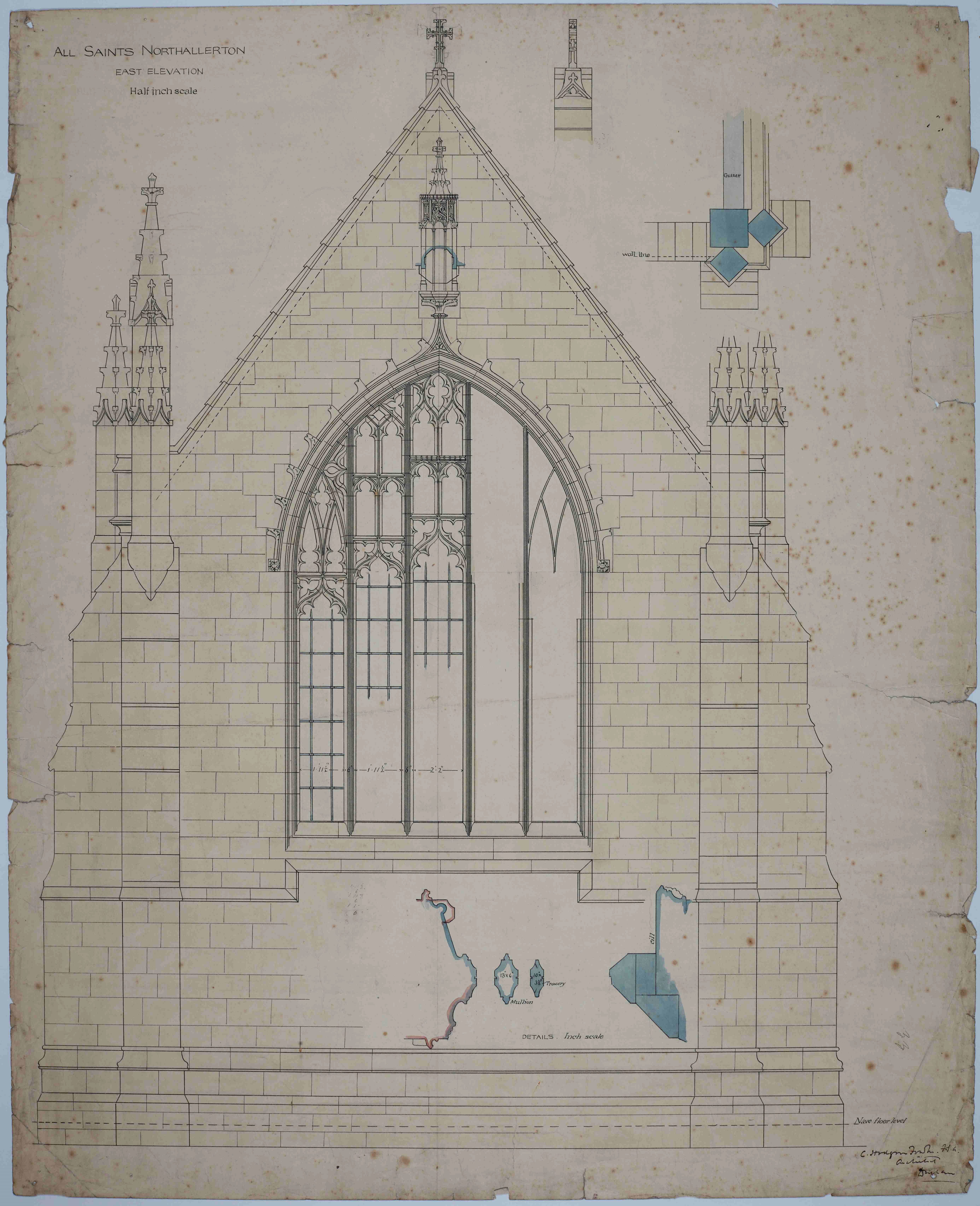
Lithographs of Northallerton, All Saints as featured in The Building News, 22 May 1883 [EE76/106] and ‘Design for new chancel and restoration of Northallerton Church, C. Hodgson Fowler. F.S.A Architect’ in The Building News, 30 November 1883 [EE76/105] plus east elevation drawing by Fowler, undated [ZRA 48 (viii)]
Over twenty years after the chancel restoration, Hodgson Fowler was commissioned to prepare designs for a new pulpit and screen door for the church, the drawings for which are part of the parish record collection. If you look closely at the blue wash in the plan for the new pulpit, can you see the silhouette of a face in profile?


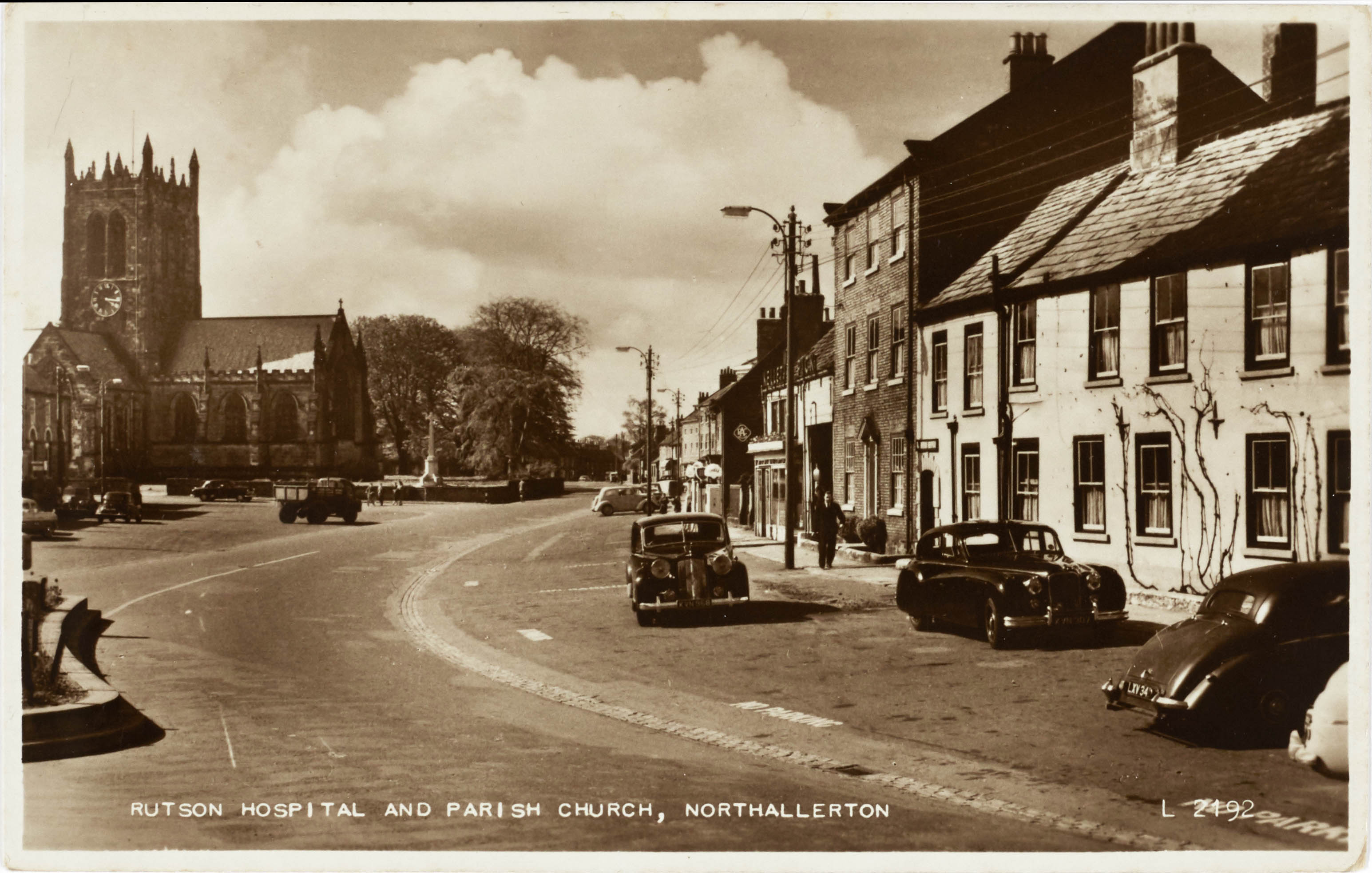

Views of All Saints’ at the northern end of the High Street in Northallerton after the restoration, undated (20th-century) [PR/NO 15/1/45]
Further information about Northallerton, All Saints
North Yorkshire County Record Office online catalogue listing of parish records for Northallerton, All Saints [PR/NO]
The Church of England in Northallerton: All Saints’ church
Northallerton, All Saints entry in A Church Near You
National Heritage List for England Northallerton, All Saints Grade I listed building description
Church of England Church Heritage Record for Northallerton, All Saints
Northallerton entries in the Corpus of Anglo Saxon Stone Sculpture
Ferrey and Mennim webpage with photographs of their recent work at Northallerton, All Saints
‘Parishes: Northallerton’, in A History of the County of York North Riding: Volume 1, (London, 1914) pp. 418-433 via British History Online
 North Yorkshire Archives Blog