
Treasures from the Parish Chest: exploring North Yorkshire’s church history from archives to architecture
The majority of architects’ drawings of churches in the Record Office collections date from the 19th and 20th centuries, although some survive from the 18th century.
Victorian church restoration and rebuilding
The 19th and early-20th centuries saw the extensive restoration and rebuilding of many Anglican churches across the country. This process can clearly be seen in parish record collections from a wealth of surviving correspondence and architectural drawings of this period. A number of architects were involved in these church restorations in North Yorkshire, including renowned names such as E.B Lamb, George Gilbert Scott Jnr, George Edmund Street, Richard Norman Shaw, Charles Hodgson Fowler and Temple Lushington Moore.
By the Victorian period, the fabric of many medieval churches was in need of repair. There were other influences such as the Oxford Movement, members of the Church of England whose views on the practices of worship led to changes in the internal arrangement of many churches. These changes included enlargement of the chancel for increased use of ceremony and ritual, moving the pulpit to one side of the church and the creation of a central aisle to provide a clear view of the altar, replacing box pews with open bench pews to accommodate a larger congregation, and the removal of galleries.
The mid-19th century was also a time when Gothic Revival was the pre-eminent architectural style. The Ecclesiological Society encouraged church architects to return to the medieval Gothic style of church architecture, in particular the ‘Decorated’ style of the 14th and 15th centuries. Internal church furnishing and decoration followed a similar trend. In some cases, alterations and additions were made to church buildings to match the style of their surviving medieval fabric. In others, where little early fabric remained, the whole church might be rebuilt.
The funding for such restoration and rebuilding work could come from a variety of sources. In some cases, money was raised by voluntary public subscription, and/or a wealthy patron might commission new designs and help to fund building works. Building grants were also available from the Incorporated Church Building Society (ICBS, formerly known as the Incorporated Society for promoting the Enlargement, Building, and Repairing of Churches and Chapels in England and Wales) and Ecclesiastical Commissioners (ECE), whose stamps can be found on a number of architectural drawings in our collections.
Edward Buckton Lamb (1809-1869)
Before becoming architectural assistant to John Claudius Louden in 1831, Edward Buckton Lamb was apprenticed to the architect Lewis Nockalls Cottingham. Until 1843, when Loudon died, Lamb worked largely on landscape architecture projects. From the mid-1840s to early-1860s, he built up a practice specialising in church building and restoration. Lamb’s first church commission was in Yorkshire; he designed Healey, St Paul for Admiral Vernon Harcourt of Swinton Park, near Masham, completed in 1848.
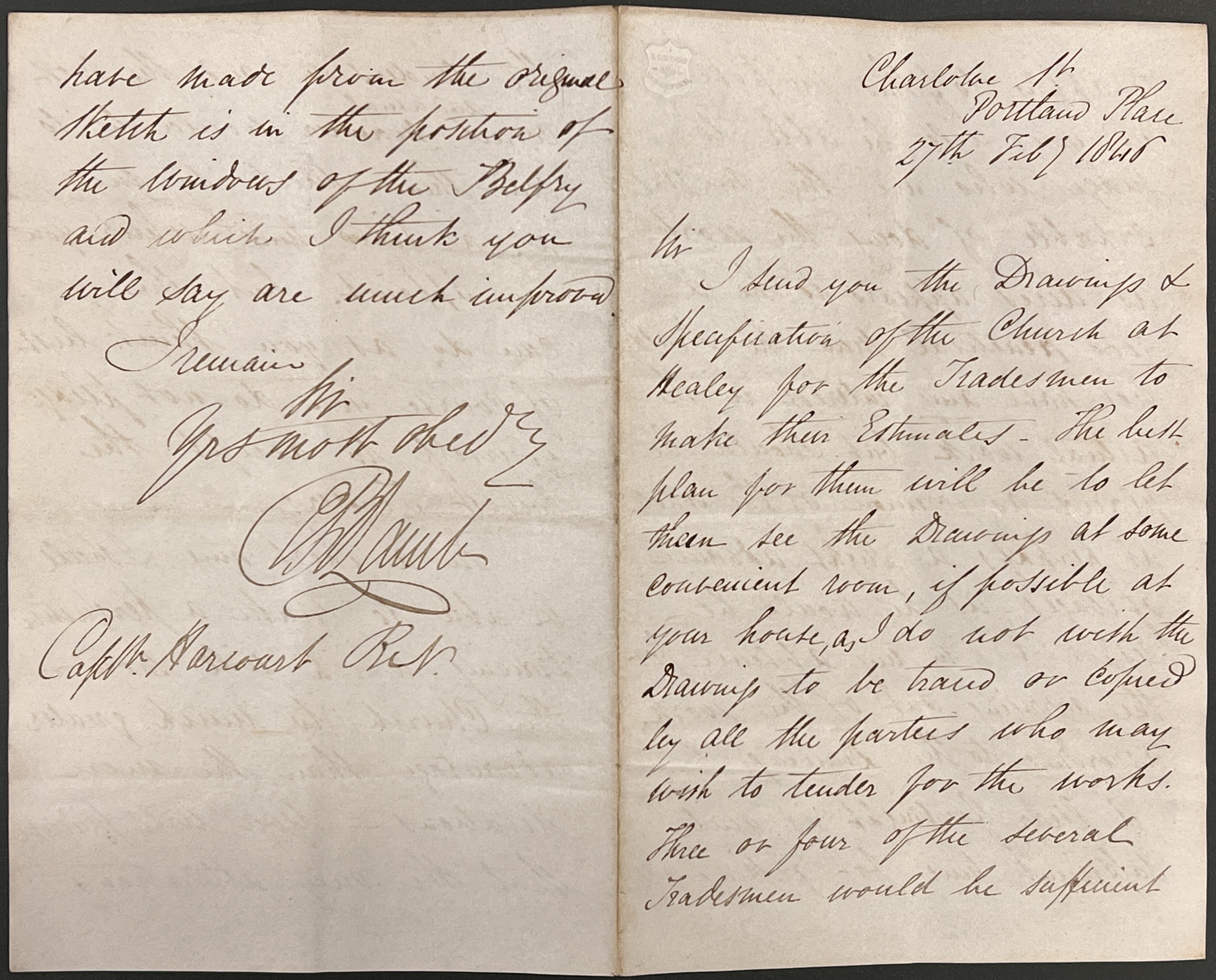
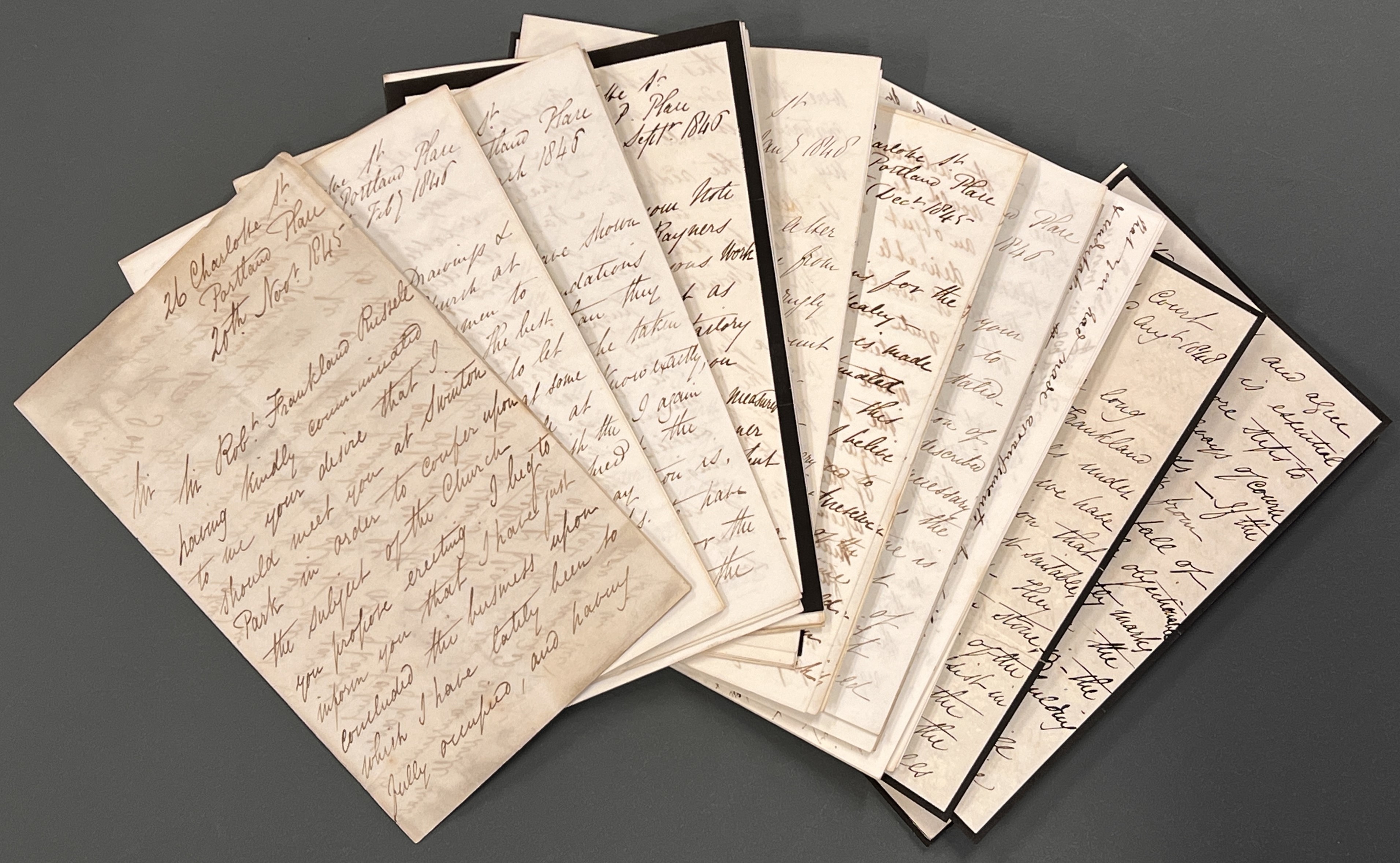

Selection of correspondence from E.B. Lamb to Captain Harcourt of Swinton Park about Lamb’s designs for Healey Church, near Masham, showing both pages of a letter dated 27 February 1846 [ZS Box 20]

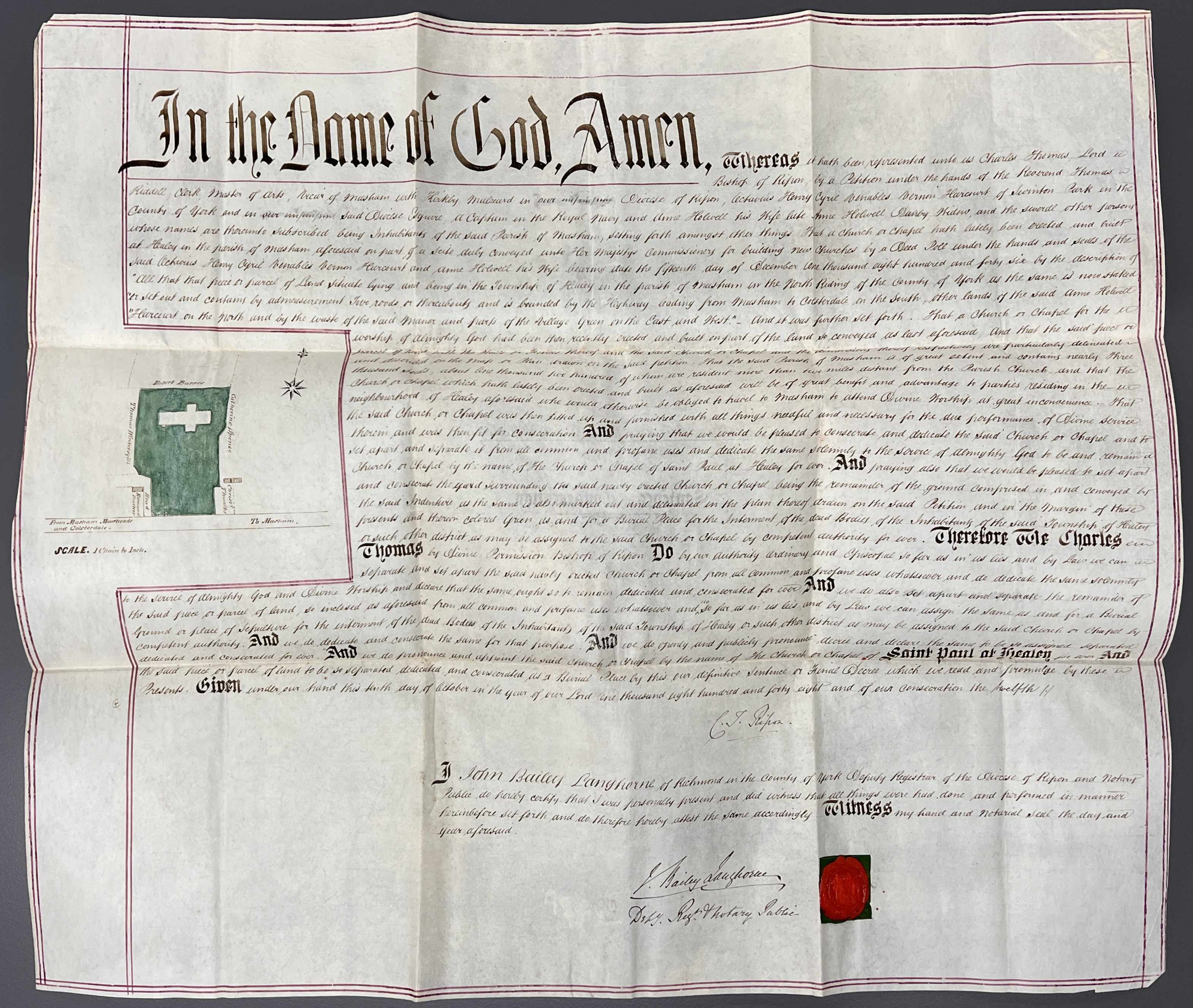
Ground plan of Healey church, signed by Lamb [PR/HEA 20/1] and sentence of consecration for the church, 10 October 1848 [PR/HEA 5/1]
George Fowler Jones (1818-1905)
Although born in Scotland, George Fowler Jones lived and worked for much of his life in Yorkshire, after initially studying architecture in London under William Wilkins and Sir Sydney Smirke. In 1846, he started a practice in York from where he ran his business for the rest of his career. In later life, he retired to the town of Malton, where he had been involved with St Michael’s church in New Malton in the 1880s. The Fitzwilliam family of Malton archive includes correspondence and plans relating to seating and the chancel in 1882-1883 [ZPB VII 3/7].


Letter from George Fowler Jones to the Hon. Admiral Douglas, agent to Earl Fitzwilliam, regarding plans (see above) for proposed works to the chancel arch at Malton, St Michael, 3rd January 1883
George Edmund Street (1824-1881)
A pupil of George Gilbert Scott Snr, George Edmund Street was an English architect and leading proponent of the Gothic Revival in ecclesiastical architecture. He is best known in Yorkshire for his late-19th century restoration and rebuilding of churches in the Yorkshire Wolds for the Tatton Sykes family of Sledmere in the East Riding. Amongst the Record Office parish record collections, is material including a design for the altar at Kirby Wiske, St John the Baptist, 1872 [PR/KRW 4], papers relating to his restoration of Pickhill, All Saints, 1875-1877 [PR/PIC 8/2/1], and the former priory church of St Mary at Bolton Abbey in 1866 [PR/BNA 10/2] (see below). You can see images of his work at Thirsk, St Mary in the 1870s on this page.


First and last pages of a letter from G.E. Street to Canon Robinson concerning the proposed restoration of Bolton Abbey, St Mary and estimated costs, 4 October 1866 [PR/BNA 10/2/1]
Richard Norman Shaw (1831-1912)
Richard Norman Shaw was born and raised in Edinburgh and, by 1849, was working in London at the architectural practice of William Burn. After travelling to the continent in the mid-1850s, he joined the practice of George Edmund Street in 1858. He opened a short-lived practice with William Eden Nesfield in 1863. As well as churches, he is known for designing a range of country houses, commercial, public and residential buildings.

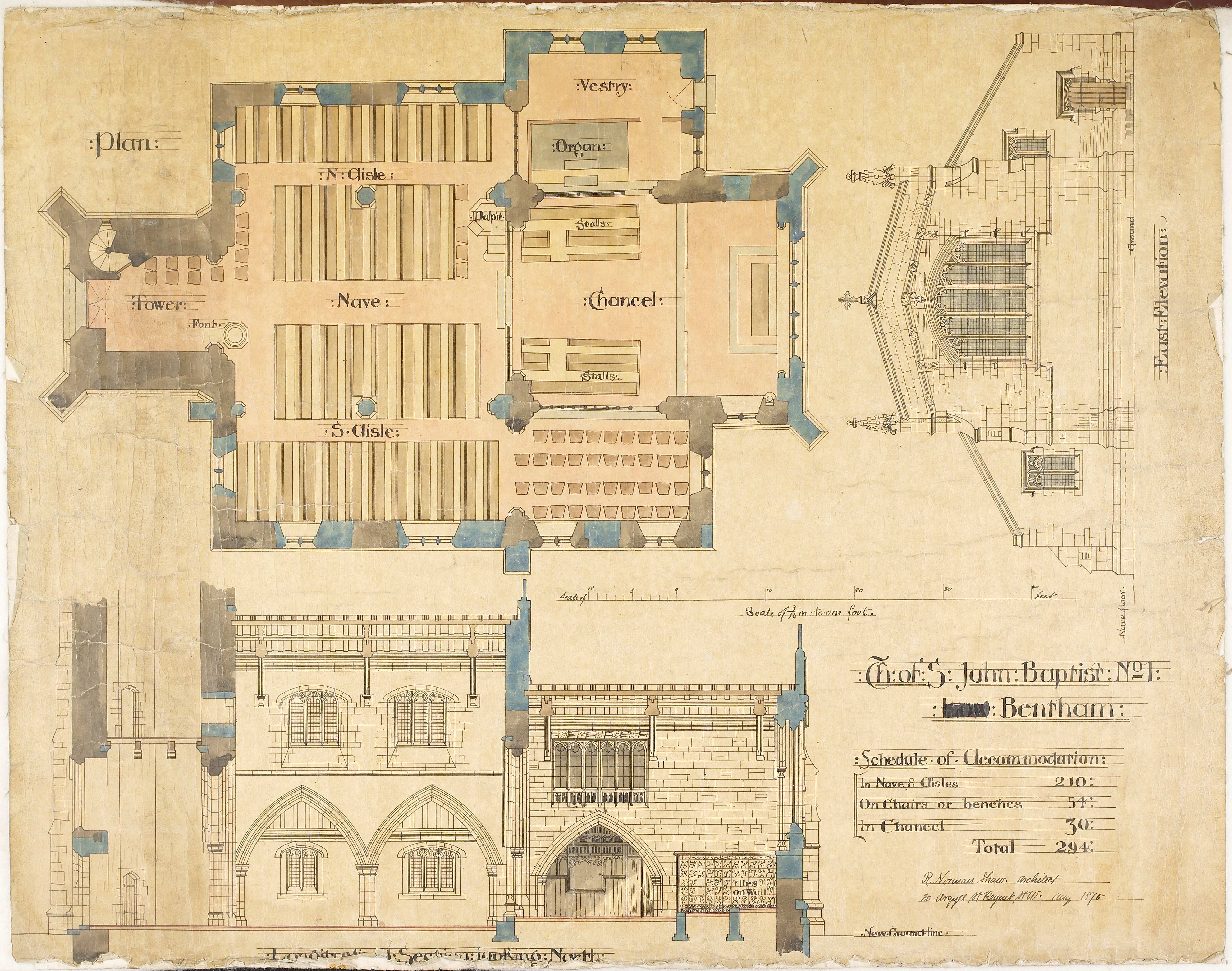
Low Bentham, St John the Baptist: Plan of the present seating (No.1), undated [PR-BNL 14-3] and Plan of the seating in the church, the east elevation, and a longitudinal section looking north (No. 1) by R. Norman Shaw, 30 Argyll Street, Regent St W, August 1875 [PR/BNL 14/2]

Low Bentham, St John the Baptist: South elevation and cross-sections through the nave, aisles and chancel (No. 2) by R. Norman Shaw, 30 Argyll Street, Regent St W, August 1875 [PR/BNL 14/2]
George Gilbert Scott Snr (1811-1878) and George Gilbert Scott Jnr (1839-1897)
From the famous Gilbert Scott family of English architects, George Gilbert Scott Jnr was the eldest son of architect Sir George Gilbert Scott (1811-1878), and father of Sir Giles Gilbert Scott (1880-1960). Trained in his father’s office in London, both he and his father were leading Gothic Revival architects of the Victorian period. Gilbert Scott Snr also trained a number of other well-known architects, including Charles Hodgson Fowler and George Edmund Street (see above and below).
Gilbert Scott Snr was responsible for designs for the restoration of Richmond, St Mary in the North Riding in 1858, his plans for which can be found in the parish records [PR/RM 9/1/9-14]. In 1874, Gilbert Scott Junior founded Watts & Co. with fellow architects Thomas Garner and George Frederick Bodley. This was a company specialising in interior design, supplying furnishings for their buildings.

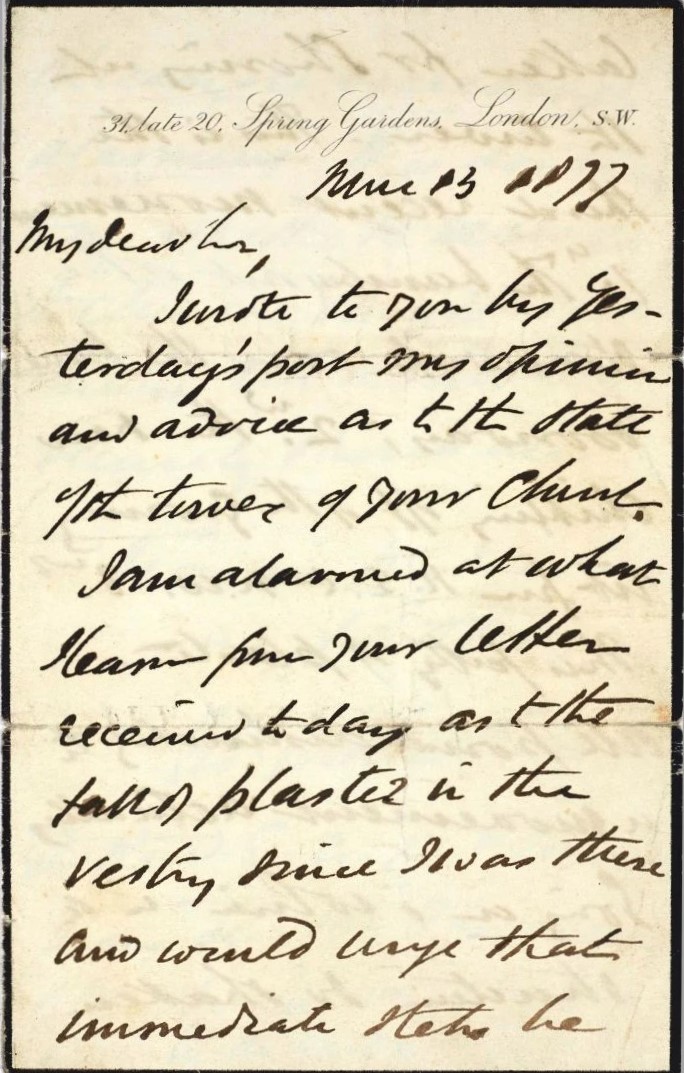

Correspondence from George Gilbert Scott Jnr to the Revd E.A.B. Pitman of Stonegrave relating to Malton, St Mary’s Church, 13 June 1877 from the Copperthwaite Papers [ZUN 7/4]
From the correspondence of George Gilbert Scott Jnr to the Reverend E.A.B Pitman of Stonegrave, we learn of the dangerous condition of the church tower at Old Malton, St Mary [ZUN 7/4]. On 11 June 1877, he writes: “My Dear Sir, Having very carefully examined the beautiful tower of your church, I regret to have to report that it seems to me to be in a very serious danger (the last four words underlined).” In a subsequent letter of 13 June, 2 days later (pictured), he writes “My Dear Sir, I wrote to you by yesterday’s post, my opinion and advice as to the state of the tower of your church. I am alarmed at what I hear from your letter received today as to the fall of plaster in the vestry since I was there and would urge that immediate steps be taken for shoring up the tower”.
It is presumably a direct result of this advice that the architect Temple Moore undertook renovation and restoration work at St Mary’s in the late 1870s. He had initially trained with Gilbert Scott Jnr, before setting up his own practice in 1878, after which they continued to work together (see below).
Charles Hodgson Fowler (1840-1910)
Charles Hodgson Fowler was a prolific architect, who specialised in church restoration and building. Originally from Nottinghamshire, he was apprenticed to Sir George Gilbert Scott Snr and, in 1864, moved north to Durham, where he established his architectural practice. He carried out a large amount of work in Yorkshire, also holding the position of Architect to the Diocese of York. After Fowler’s death in 1910, his practice was taken over by William H. Wood of Newcastle, who entered into partnership with Edmund Oakley to form Wood and Oakley in 1927. The Record Office holds an archive collection of drawings from Hodgson Fowler Architects, covering the period 1871-1931, which are listed in our online catalogue [ZRA].
Examples of his work at Northallerton, All Saints can be found on a subsequent page of this online exhibition, as can his designs for Husthwaite vicarage.
Temple Lushington Moore (1856-1920)

Originally from Ireland, Temple Moore trained under the architect George Gilbert Scott Jnr in London from 1875, and established his own practice in 1878, working on church restoration and building schemes around the country, particularly in the Gothic Revival style. In his late teens, from 1872, he had been privately educated at Londesborough in the East Riding of Yorkshire, where he met his wife Emma Wilton, and later designed large numbers of churches in Yorkshire in the late-19th century and into the Edwardian period. As Scott Jnr’s health deteriorated in his later years, Moore continued to work closely with him, helping to complete commissions, such as at East Moors, St Mary Magdalene.
Temple Moore’s signature on designs for Kirkdale, St Gregory, 1907 [PR-KRD 7/4/2]
One of their key patrons was the Reverend C.N. Gray (see undated photograph PR/HEL 31/1/8), vicar of Helmsley from 1870-1913. Responsible for one of the largest parishes in Yorkshire, he carried out an extensive programme of church restoration and building of churches in the area, funded by Lord Feversham of Duncombe Park. Scott Jnr and Moore’s architectural drawings for many of these church alterations and improvements, including Pockley, St John the Baptist (1876-1878), East Moors (1881-1882) and Sproxton, St Chad (1879) are held as part of the Helmsley parish record collection [PR/HEL 30], as are designs for Moore’s solo projects at Rievaulx, St Mary (1906) and Kirkdale (1907-1909). This collection also contains Moore’s designs for improvements to Helmsley, All Saints, and a new vicarage for Reverend Gray in Bondgate, Helmsley, which is a Grade II listed building and now used as the headquarters of the North York Moors National Park Authority.
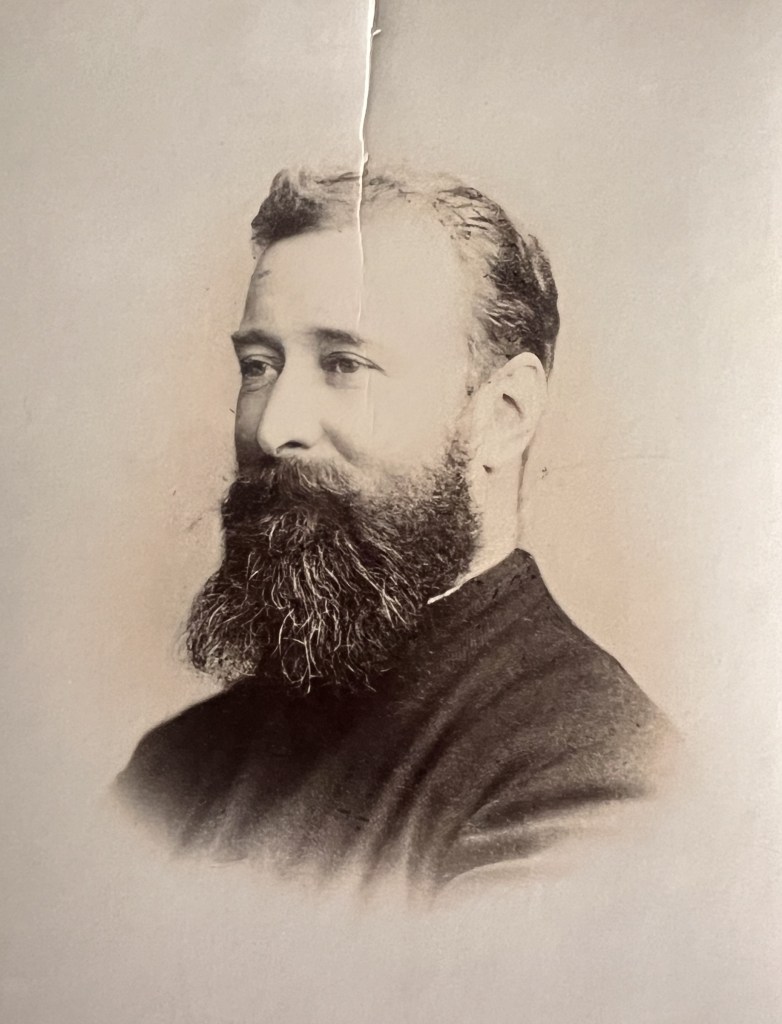


Section and elevations from sheet of designs for new vicarage, Helmsley for Revd C.N. Gray by Temple Moore, undated (c.1899) [PR/HEL 30/3/5]
Examples of Scott Jnr and Moore’s work at East Moors and at Kirkdale can be found on a subsequent page of this online exhibition, as can Moore’s restoration work at St Botolph’s church, Carlton-in-Cleveland in this related blog. Temple Moore’s pupils included Giles Gilbert Scott, son of George Gilbert Scott, Jnr. After Moore’s death in 1920, his son-in-law Leslie T. Moore continued the practice, undertaking projects in Yorkshire, such as at Richmond, St Mary [PR/RM 9/1/15-16] .
Henry Wyatt (d.1899)

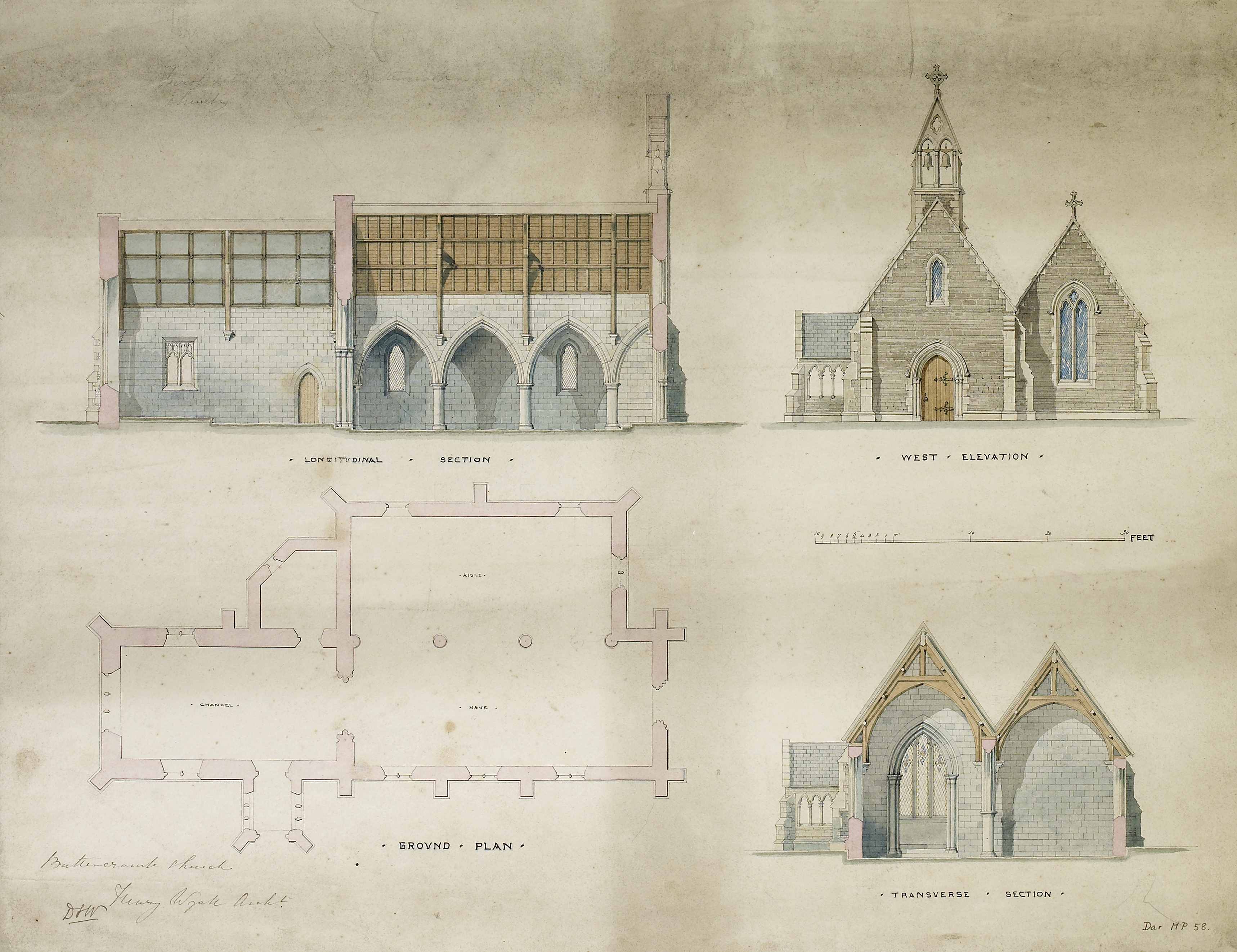
Ground plans, sections and elevation drawing proposals for Buttercrambe, St John the Evangelist by architect Henry Wyatt, undated from the Darley of Aldby Park archive collections [ZDA MP/58-59]
These images of Buttercrambe Church are signed by Henry Wyatt, Architect: ‘Design for alteration and restoration of Buttercrambe Church for H.B. Darley Esq‘, from the Darley of Aldby family archive [ZDA MP/58-59]. Wyatt was based in London, but had a successful practice in Yorkshire centred on Scarborough. He was also engaged by the Darley family to alter and extend their home at nearby Aldby Park in the late 1840s. It is not clear whether these Wyatt plans for church restoration were ever implemented, as the church today does not have a side aisle, central bell-cote or porch, as shown in these drawings. This Grade II* listed church was much restored in 1878, although the architect is unknown.
Coe and Goodwin, London (1849-1856)
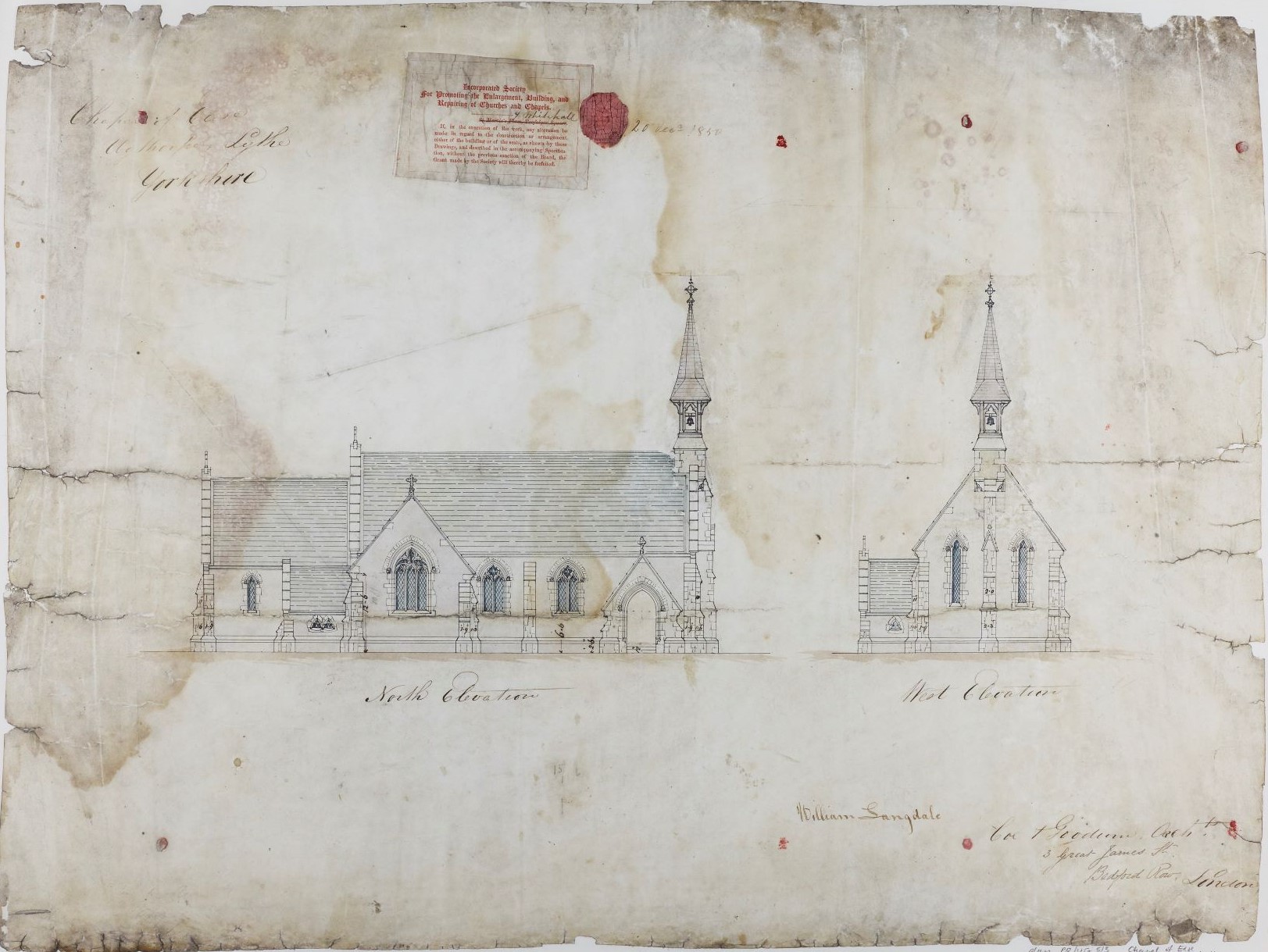

Sitting plan and elevations of Ugthorpe Chapel (Christ Church), near Lythe, Whitby by Coe and Goodwin architects, 1850 [PR/UG 5/3-7]
The relatively short-lived partnership of Coe and Goodwin was established in 1849 by Edwin Morton Goodwin and Henry Edward Coe, the latter of whom had been a pupil of George Gilbert Scott. Designs for Ugthorpe chapel, dated 20 December 1850 are signed Coe & Goodwin architects, 3 Great James Street, Bedford Row, London. The church was built 1855-1857. A calculation written on the sitting plan shows that there were 282 seats in total. Written beneath, the Vicar, William Long, has written:
“The Incorporated Society for promoting the Enlargement, Building, and Repairing of Churches and Chapels in England and Wales granted £115 towards building this Church upon condition that all the seats be reserved free and unapp[rop]riated for the use of the poor and other inhabitants of this parish.”
By the 19th century, the letting of pews was almost universal practice in England. The renting and private ownership of seats in churches originated in the post-Reformation period and reached its height in the Victorian era. A seat on a bench or pew cost between one and thirty shillings, or more, per year, per person. If someone could not afford a seat, they might be allowed to stand at the back, or in a gallery. A person’s seating position in church reflected their social status, the best quality and most comfortable seating was at the front, and there were often seating disputes between parishioners!
This practice of pew renting was suppressed in the mid-19th century and many of the old pews were replaced during Victorian church restoration projects.
Further information
This page provides only a very brief summary on the subject of Victorian church restoration and rebuilding, a detailed exploration of the subject can be found in James Stevens Curl’s recent book on English Victorian Churches: Architecture, Faith , & Revival, 2022, John Hudson Publishing.
Chronological overviews of church building can be found in the introductions to the respective volumes of the revised Pevsner: The Buildings of England series for the North, West and East Ridings of Yorkshire, which also provide alphabetical gazetteers of churches and other buildings throughout the county (bibliographic details are listed on the further information page).
A listing of some of the architectural plans held at the Record Office can be found in Guide no.10 (opens as pdf); others can be found in the catalogues for their related parish churches (under ‘PR’ in the ‘Document Ref’ field of the advanced search of our online catalogue).
Article on the Incorporated Church Building Society
East Yorkshire Historic Churches Trust, 2012 Sykes Churches Trail leaflet: Northern Route (opens as pdf)
East Yorkshire Historic Churches Trust, 2008 Sykes Churches Trail leaflet: Southern Route (opens as pdf)
Temple Moore Trail website
 North Yorkshire Archives Blog