
by Gwyneth Endersby, Archives Assistant
Introduction
This blog explores 17th-century records within the Scarborough Borough collection, which relate to the official trial of a woman accused of witchcraft.
Background
The 17th-century records which survive for Scarborough Borough include those for its courts [DC/SCB VI 4]. They comprise several bound volumes, together with a large quantity of loose papers, and the coverage of years is at times patchy. Most papers relate to the quarter sessions, which dealt with offences against the Crown and disturbances of the peace (e.g. theft, assault), and to the sheriff’s tourn – or court leet – which was concerned with any flouting of the borough’s byelaws covering matters like highways and weights and measures. It appears less was recorded concerning the court of pleas, which heard private cases relating to issues like debt and trespass, and only a few coroners’ inquest papers survive.
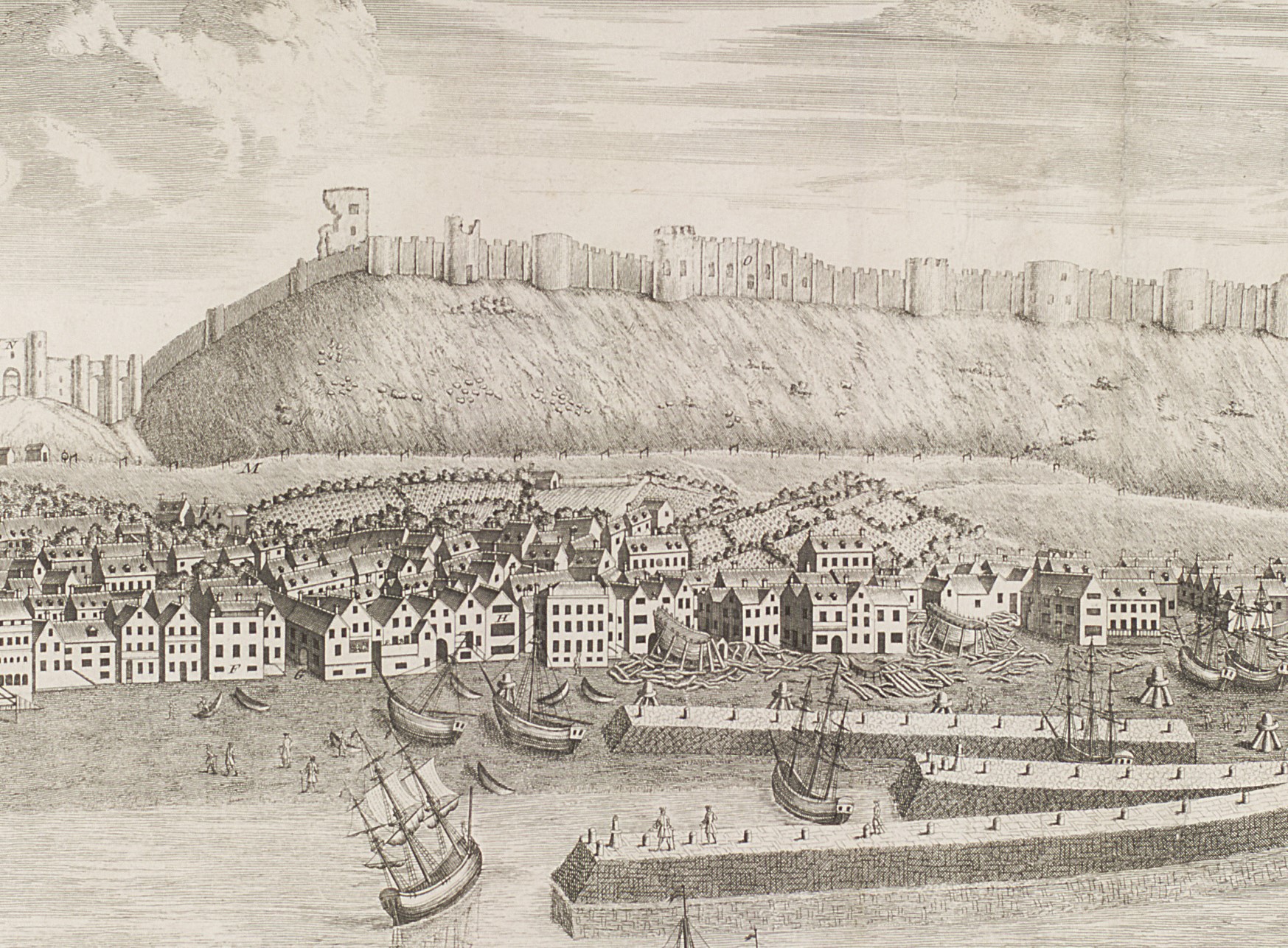

Right: Detail showing the Town Hall on Sandside (marked ‘H’), where the town’s court sessions were held, from ‘The Antient Town of Scarborough, Castle, Harbour & Spaw’ by John Setterington, 1735
The level of detail in these records varies greatly, but they nevertheless allow us a valuable insight into the regulation of this prominent coastal town and its people during the first half of the 17th century.
At this time, the borough council was comprised of members elected each year after Michaelmas, with two senior members being chosen to act as bailiffs and as joint mayors for a year. Their roles included presiding over the various courts of the borough.
Records of accusation and trial
Accusations of witchcraft are characteristic of 17th-century Britain, though the level and extent of persecution varies greatly from area to area – as does the level of representation in the courts. Yorkshire generally does not appear to have suffered the high level of persecution experienced in Essex, for instance. Shifts towards an increase in formal accusations of witchcraft during the 17th century appear to correspond with times of serious socio-economic upheaval – such as during the English Civil War or plague episodes.
Discovering two instances of witchcraft accusation in the quarter sessions papers of Scarborough (1600-1660) is therefore fascinating!
The first case in 1652 involves Anne Hunnam (also known as Anne Marchant/Merchant), who stands accused of bewitching four-year-old Frances, daughter of John and Anne Allen. Witnesses Margery Fish and Mary Westow gave verbal statements to Bailiff Luke Robinson in March 1652, describing the child’s alarming fits and how the parents were encouraged to engage Elizabeth Hodgson to diagnose the problem and employ counter measures. Charging the afflicted child’s parents a fee of two pence, Hodgson confidently pronounced that the child would now heal and claimed that the malefic actions of another townswoman, Anne Hunnam, were to blame for the affliction.
With Anne Hunnam arrested on suspicion of witchcraft, the bailiff duly ordered three local women – Margery Fish, Elizabeth Jackson and Elizabeth Dale – to search Anne’s body for any witch’s marks. It was believed that those having a pact with the Devil were physically marked by him in some way – usually an area or mark on the body, which usually proved unresponsive to pain or bleeding when tested by pricking with a sharp object. Witch-pricking became a commonly used method of detection during witch trials.
The informations (witness statements under oath) of the three Scarborough women describe finding a “blew spott” on Anne Hunnam’s left buttock, which they claimed grew “…out of hir flesh or skin as a wart of greate bigness”. Then when Margery Fish pricked this spot with a pin, she observed Anne “never moved nor seemed to feele itt”. For transcriptions of these records please click here.


Informations of Margery Fish, Mary Westow and Elizabeth Dale relating to the bewitching of Frances Allen by Anne Hunnam, and Anne Hunnam’s witch-pricking examination, taken by Luke Robinson, 19 March 1652 [DC/SCB VI 4]
Anne was then required to appear at the next quarter sessions, to answer the charges against her. Two men of the town: Christopher Porret, a baker, and Thomas Fiddy, a fisherman, were bound by the court on 1 May 1652 to ensure her appearance.

Recognizance (bond) of Christopher Porret and Thomas Fiddy, for the appearance at court of Anne Hunnam, 1 May 1652 [DC/SCB VI 4]
At the quarter sessions held in August 1652, Anne Hunnam firmly denied the accusations against her during her examination.

Examination of Anne Marchant, otherwise Hunnam, 1 August 1652 [DC/SCB VI 4]
There then follows a remarkable turn of events, as a formal indictment is prepared by the bailiff against Anne’s accuser, Elizabeth Hodgson, for her part in conjuring “evill & wicked spirits” against the child whilst blaming Anne Hunnam – “all of which is contrary to the publique peace & the lawes of this land.”

Indictment of Elizabeth Hodgson, otherwise Stitchill, undated (c.1652) [DC/SCB VI 4]
The second case relating to witchcraft accusation is only very briefly recorded in the Scarborough court papers of June 1659, when Widow Mary Farthing lodges a formal complaint against William Sheffeild for violently beating her and publicly accusing her of bewitching his ailing mother.
Disappointingly, the Scarborough court papers do not record any sentences relating to either Anne or Elizabeth, nor any details of the outcome of Mary’s complaint. Whilst we shall never know the full story of these cases, it’s perhaps significant that they occur during the difficult period post-civil war and plague occurrences, in addition to coinciding with Luke Robinson’s tenure as bailiff – a strict and pious man notable for his over-eager enforcement of drinking laws in alehouses.
Further reading:
Ashcroft, M. Y. (ed.) (1991) Scarborough Records 1641-1660: A Calendar, North Yorkshire County Record Office Publications No. 49
Gaskill, Malcolm (2013), Witchcraft and Neighbourliness in Early Modern England. in S. Hindle (ed.), Remaking English Society: Social Relations and Social Change in Early Modern England Boydell Press, Woodbridge, pp. 211-232.
Sharpe, J.A. (1992) Witchcraft in Seventeenth-Century Yorkshire: Accusations and Counter Measures, University of York Borthwick Paper No. 81
 North Yorkshire Archives Blog