by Gail Falkingham, Record Assistant
In addition to the official records of the North Riding Quarter Sessions, as covered in a previous post, North Yorkshire Archives holds the bundles of working papers of the Quarter Sessions’ court back to the 17th century [QSB]. This post provides an overview of these working papers and features examples of the varied range of documents that can be found within the bundles.
North Riding Quarter Sessions’ bundles
The working papers are known as bundles because, as the court travelled from town to town throughout the county, the loose documents in use were literally tied together in bundles at the end of each Session. They are also sometimes referred to as the Sessions’ rolls, and contain most of the papers received or created during Quarter Sessions and subsequently considered worthy of preservation. The working papers relate to both the judicial and the administrative functions of the Justices of the Peace. For many years, these bundles were left largely unopened until they became part of the collections of the North Riding Record Office (the forerunner of today’s Archives) upon its establishment in 1949.
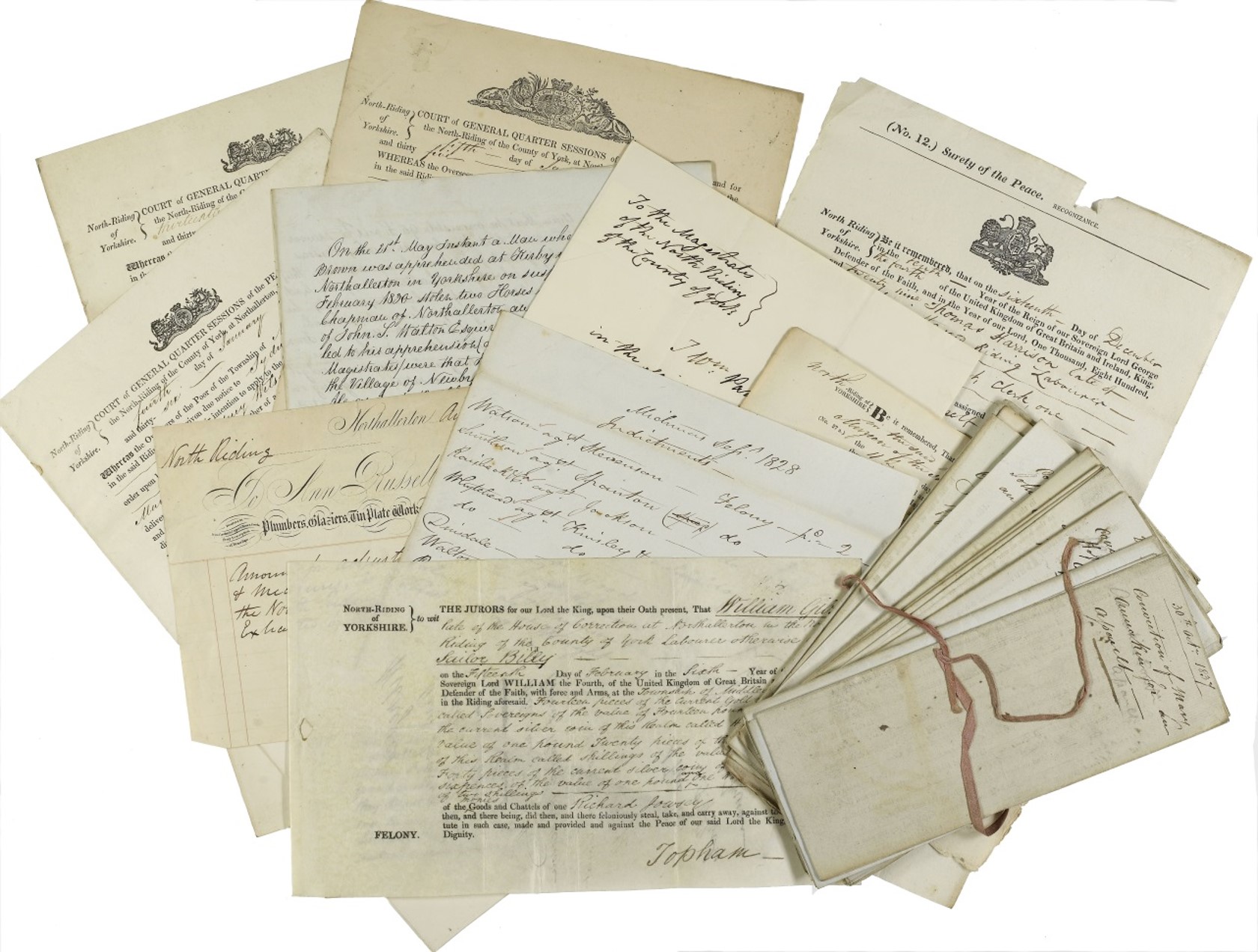
A selection of documents from the Quarter Sessions’ bundles of working papers
North Riding Quarter Sessions were held four times a year at Christmas/Epiphany, Easter, Midsummer and Michaelmas. At first, the Court met in various towns throughout the North Riding including Northallerton, Stokesley, Richmond, Thirsk and Malton; by the early-nineteenth century, it had settled in Northallerton.
The working papers are documents that were needed by the court to carry out its countywide administrative and judicial functions. They survive from the late-17th century onwards and contain a wealth of information. The Archives’ collections contain over 400 boxes of Quarter Sessions’ bundles, which include evidence as it was presented to the court. These give detailed, and often graphic, information that can be used to paint a vivid picture of everyday life, and the circumstances of individual criminal cases.
The cases dealt with by the North Riding Quarter Sessions were relatively minor offences. Examples of such offences include theft – for example of livestock, money, food or clothes; trespass and receiving stolen goods. More serious crimes, including murder, highway robbery and forgery, were dealt with at the Assize Courts. Records for the Assize Courts are held at The National Archives; further information can be found in their online guide: How to look for records of criminal court cases: assize courts 1559-1971.
Additional examples of cases heard at the North Riding Quarter Sessions, including that of Sophia Constable, feature in other blog posts. A number of stories of criminal women featured in Quarter Sessions’ records, have been explored in previous posts.
The types of documents within the bundles
North Riding Quarter Sessions’ working papers can include jury lists, writs to summon jurors, presentments and indictments (accusations/complaints and charges in judicial proceedings), depositions (examinations of defendants and witnesses), recognizances (bonds to secure appearance at Court, be of good behaviour etc.), calendars (lists) of prisoners, petitions, licences, highway diversions, poor law papers, sacrament certificates and much more. They can be on sheets of parchment or paper; handwritten, pre-printed, or a mixture of the two. Examples of a range of document types are featured below.
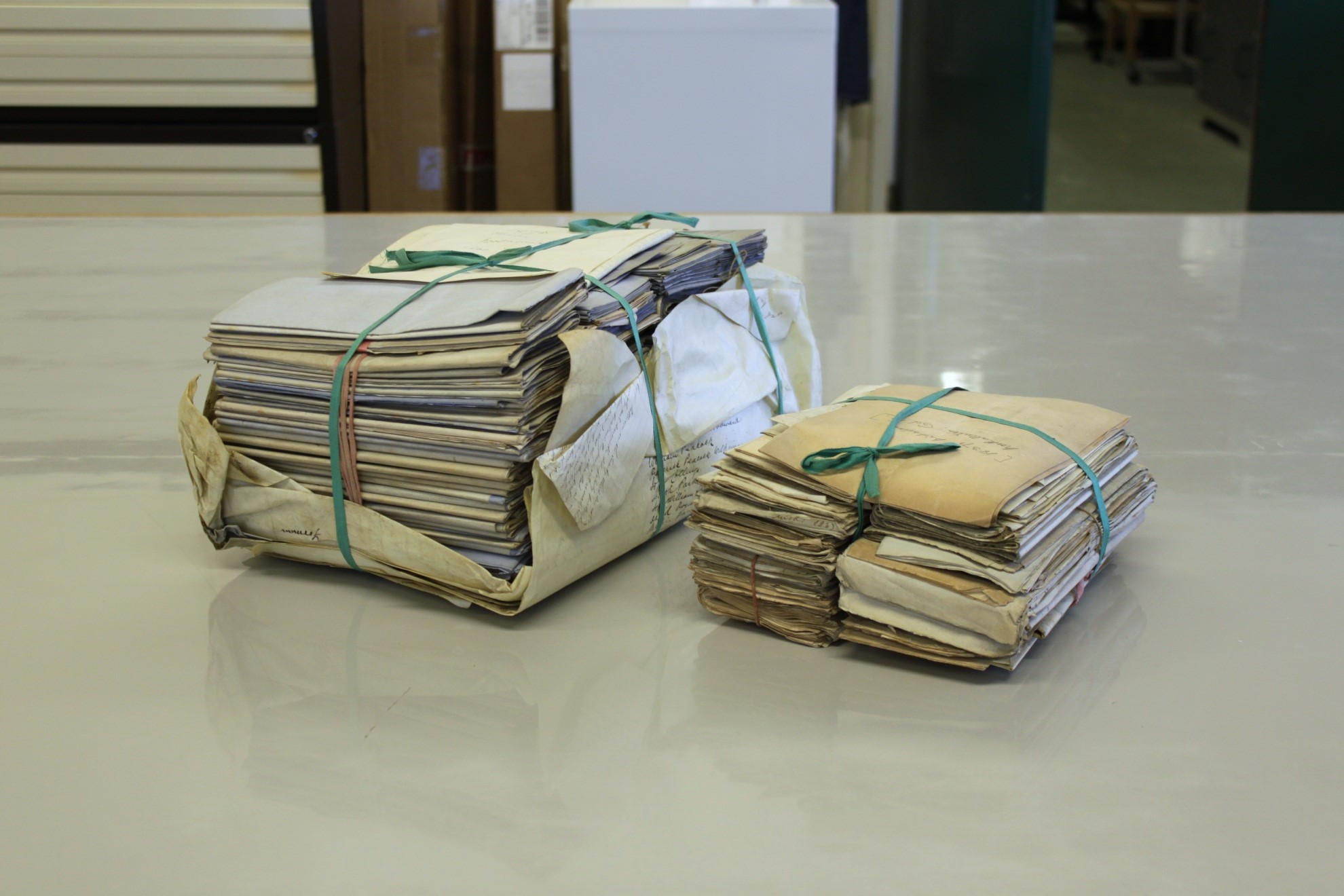
Unopened bundles of Quarter Sessions’ records [QSB]
The smaller bundle shown above (on the right) contains the papers collected at the Michaelmas Sessions in 1831, and the larger one (on the left) is from the Easter Sessions 1874. It is probable that the increase in size reflects the growing responsibilities of the Justices over time.
The bundles contain more than just information relating to the criminal cases heard at the Quarter Sessions’ courts. They also contain documents that reflect the Justices’ administrative and judicial duties including those carried out between Sessions, either by Justices individually or in Petty Sessions, such as records of summary convictions and inspections of roads and bridges.
The working papers greatly amplify the contents of the court minute books, and include much material that is not reflected in the minutes in any way. Further information about the court minute books [QSM] can be found in our previous post on Records of the North Riding Quarter Sessions. The bundles are of great significance as they are an extensive source of evidence for the history of almost every aspect of life in the former North Riding of Yorkshire.
Cataloguing the working papers of the North Riding Quarter Sessions
In 2009, North Yorkshire County Record Office (now known as North Yorkshire Archives) was awarded a grant by the National Cataloguing Grants Scheme administered by The National Archives, in order to kick-start the cataloguing of the North Riding Quarter Sessions’ bundles [QSB]. Since then, through the ongoing work of a dedicated team of volunteers, as well as Archives’ staff, a freely-accessible, searchable, detailed online catalogue of these remarkable records is being built up.

To date, 59,682 new QSB records have been added to our collections database, bringing the total to just over 96,000. More are being added every month as cataloguing continues. These records are searchable via our online catalogue.
Screenshot of our online catalogue showing search results for QSB records (catalogue powered by Axiell CalmView © 2008-2025)
During the project, we have also worked to conserve these documents. We have flattened, wrapped and re-boxed many of these records in conservation-grade materials, helping us to preserve the documents into the future.
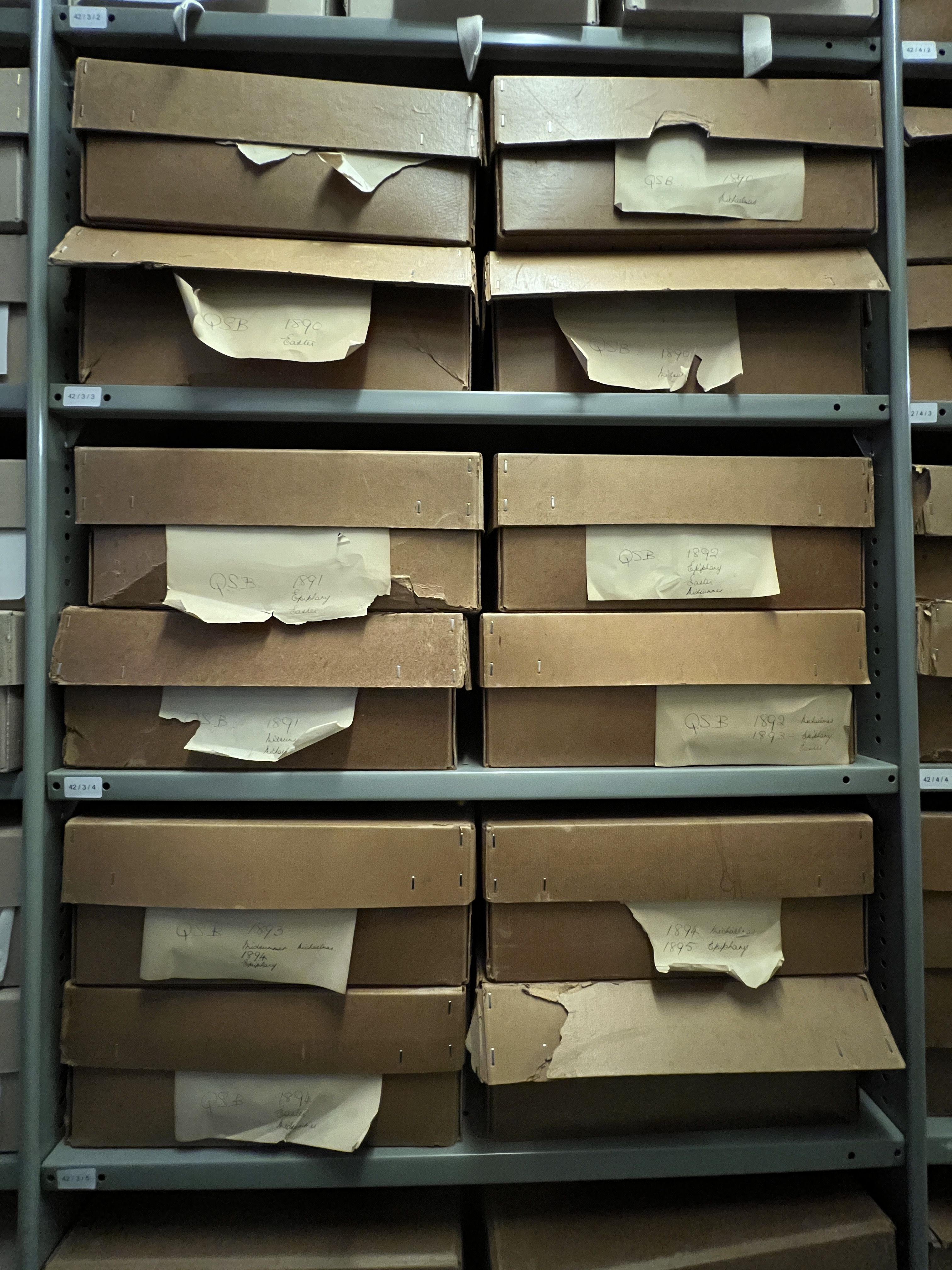
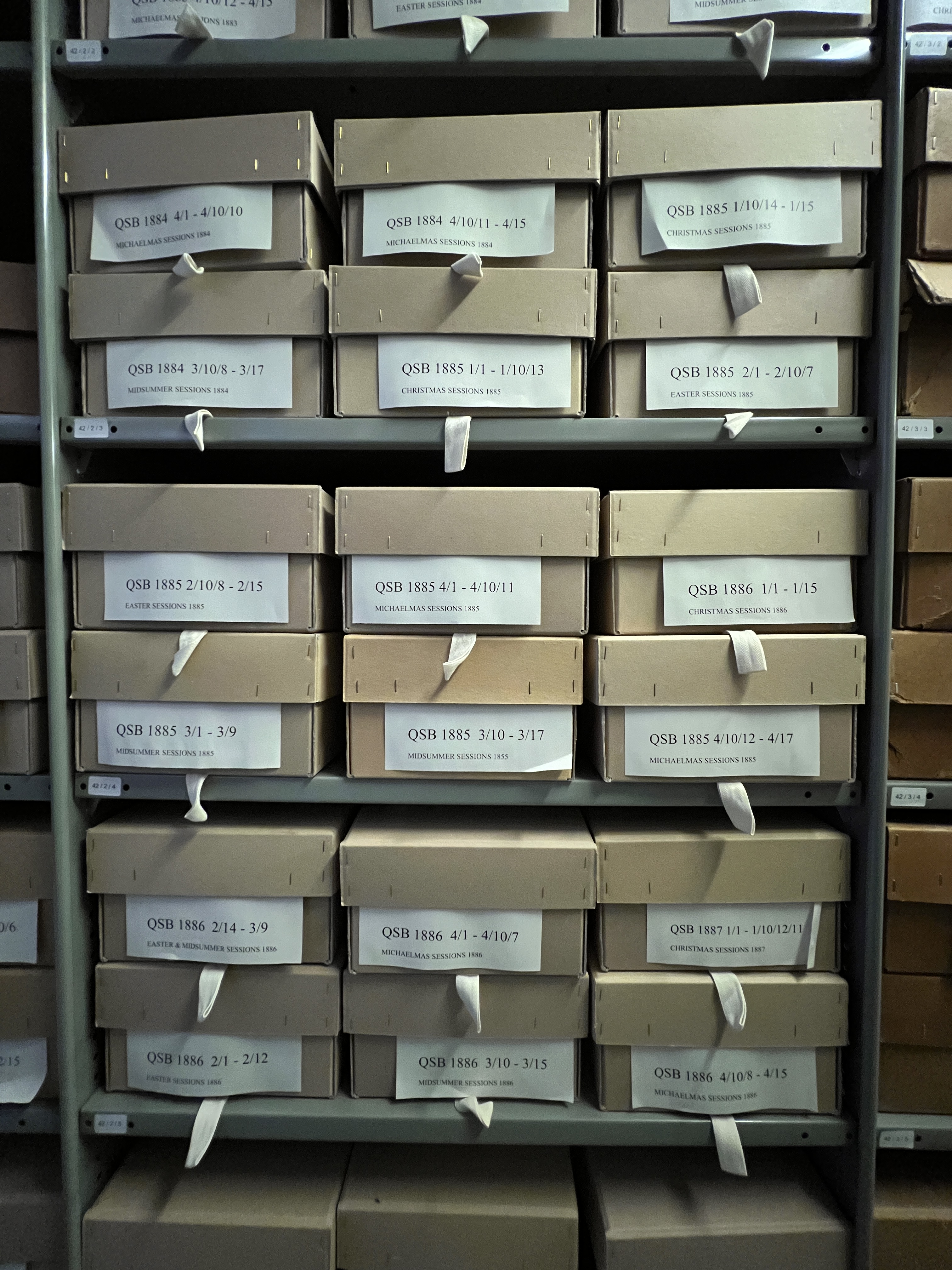
Quarter Sessions’ records in boxes on shelves in our strong rooms, showing before re-housing (left) and after re-boxing in conservation-grade materials (right) [QSB]
Examples of the varied range of documents from within the bundles
To provide a framework for cataloguing the North Riding Quarter Sessions’ bundles, the working papers have been organised chronologically, and by subject. Within each year, the working papers are arranged according to their respective quarter:
- Epiphany/Christmas
- Easter
- Midsummer
- Michaelmas
Within each quarter, papers are grouped into the following sub-sections:
- Papers relating to attendance, including call rolls, lists of jurors, exemptions and summonses to sessions.
- Papers relating to oaths of office and appointments, including sacrament certificates, other oaths (such as those of returning officers) and declarations by officials (such as corn inspectors).
- Calendars (lists) of prisoners
- Presentments and bills of indictment (charges in judicial proceedings)
- Recognizances (bonds to secure appearance at court, be of good behaviour etc.)
- Informations, depositions and examinations (of defendants and witnesses)
- Summary convictions and related papers
- Bastardy, settlement and removal
- Returns to Quarter Sessions
- Highways and bridges
- General administrative papers
- Bills and vouchers (including payments for prosecution costs)
- Coroner
Examples of these different types of records are featured below [when viewing online, clicking on the images will open full-screen versions]:
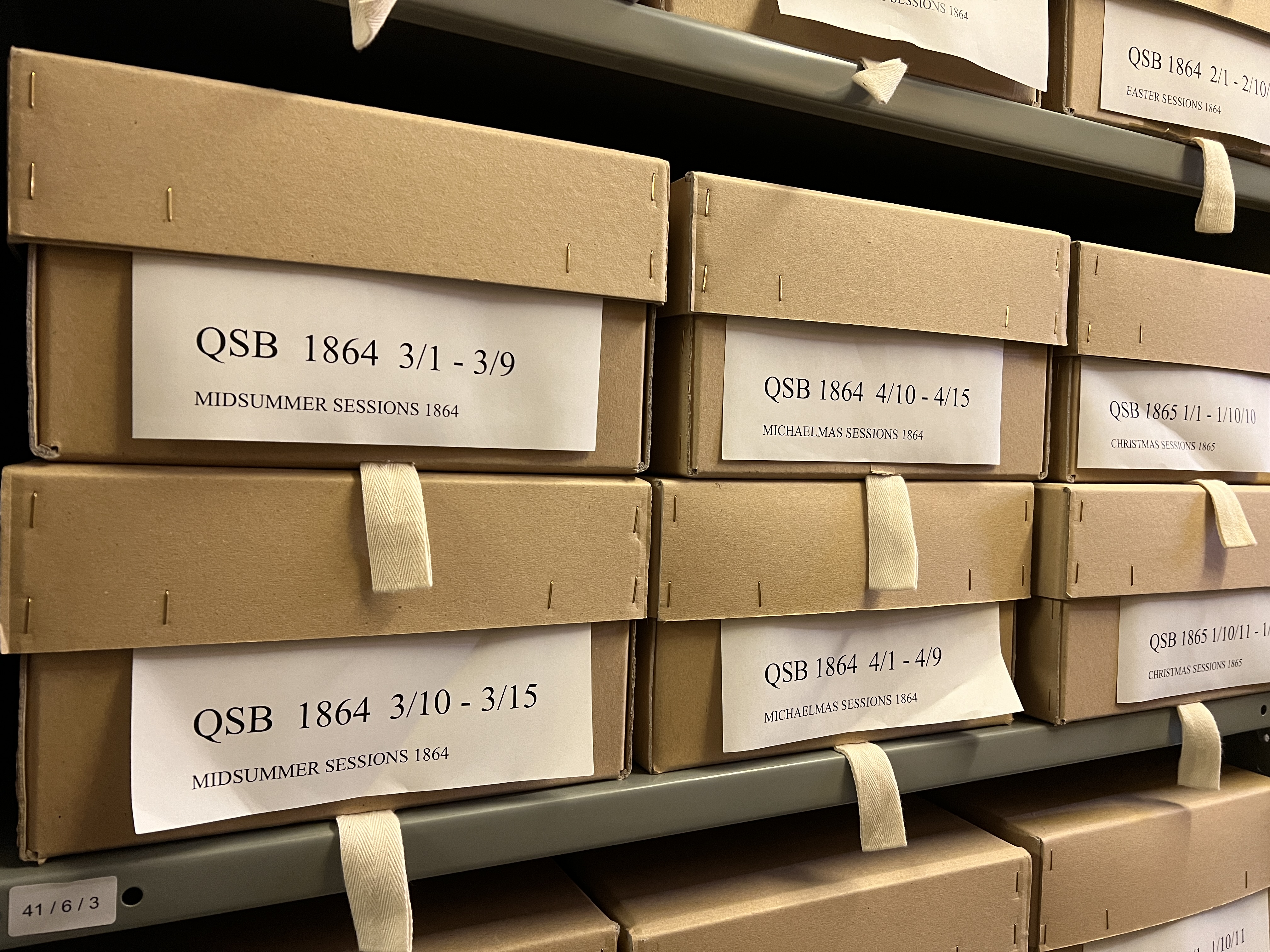
North Riding Quarter Sessions’ working papers boxed and labelled in our strong room according to their respective year, quarter and sub-section reference number [QSB 1864/3 Midsummer and QSB 1864/4 Michaelmas]
Papers relating to attendance
The North Riding Quarter Sessions were presided over by the Justices of the Peace. Other attendees included virtually all of those who held positions of importance in the county, for example the High Sheriff, Deputy Sheriff, the Clerk of the Peace, the County Coroners, Keepers of Houses of Correction or Gaols, Attorneys, Chief Constables, Stewards and Bailiffs. The names of these people were recorded in the call roll for each Sessions, as in the example below (bottom left).
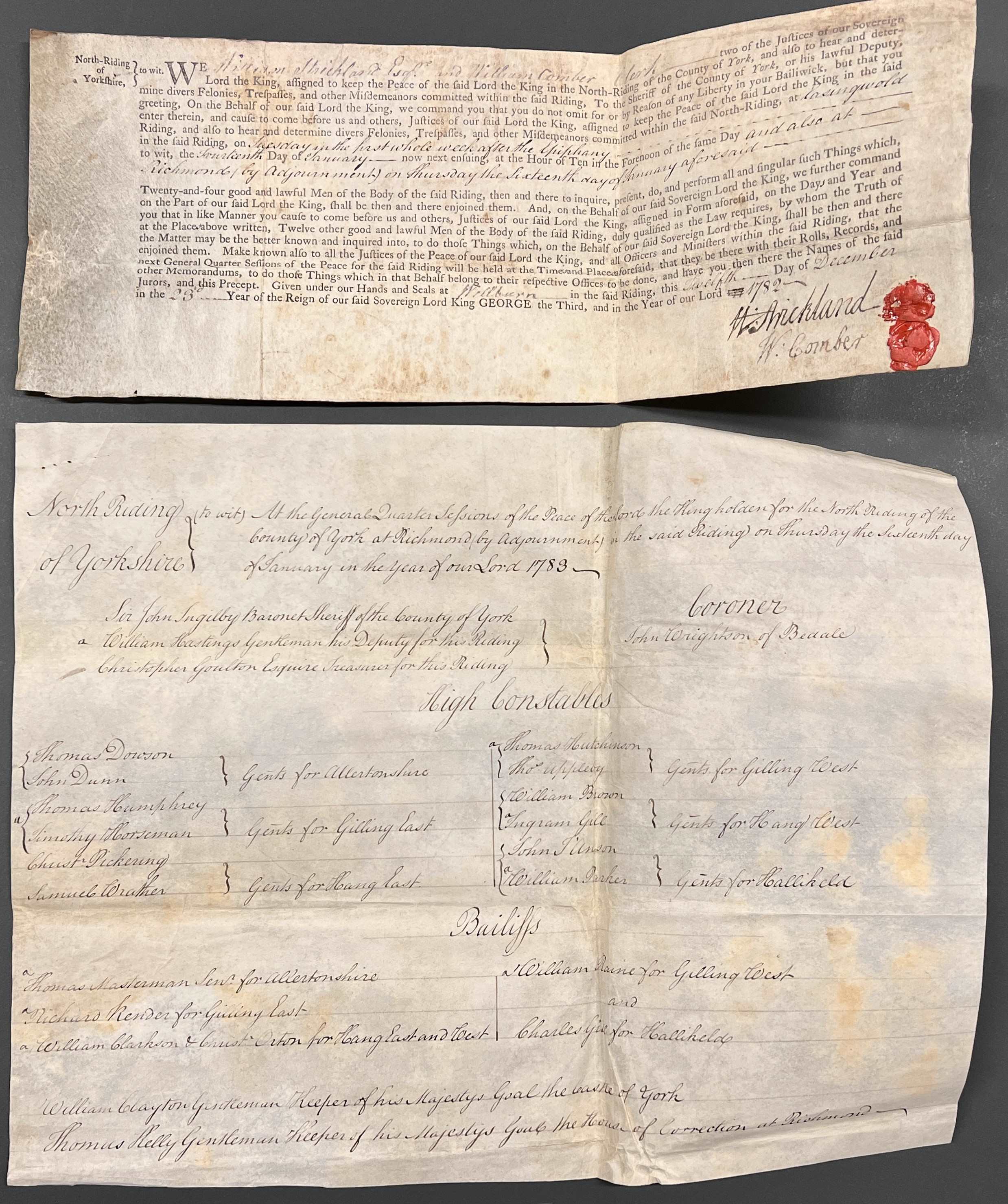
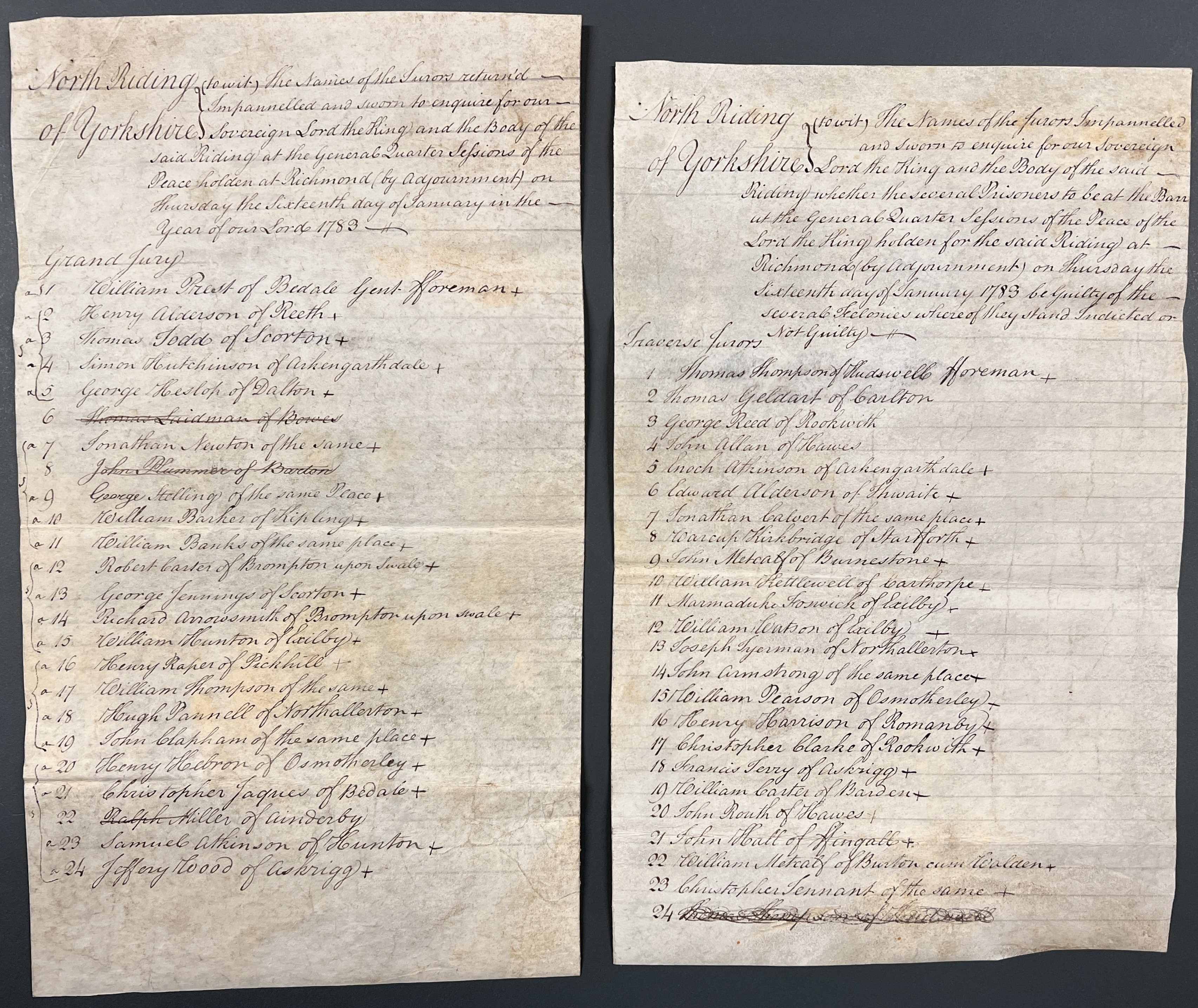
Precept to summon jurors (top left), call roll of those in attendance (bottom left) and jury lists for the Grand and Traverse Juries (right) from the Epiphany Sessions, 1783 [QSB 1783 1/1]
In addition, there would also be juries of local residents. These jurors would be summoned to attend the Quarter Sessions by the sheriff, who was instructed to do so by the Justices of the Peace, who would issue a precept (see above example top left).
Initially, a Grand Jury would hear evidence for the prosecution. They could only send the accused for trial if they felt that there was a case to be answered. In that instance, a Traverse Jury of 12 men was sworn in, and it was this smaller jury that would try the accused. The names of these jurors are recorded in the Quarter Sessions records as in the lists pictured above.
Further information about those who attended the Quarter Sessions can be found in our previous post: All Human Life: North Riding Quarter Sessions.
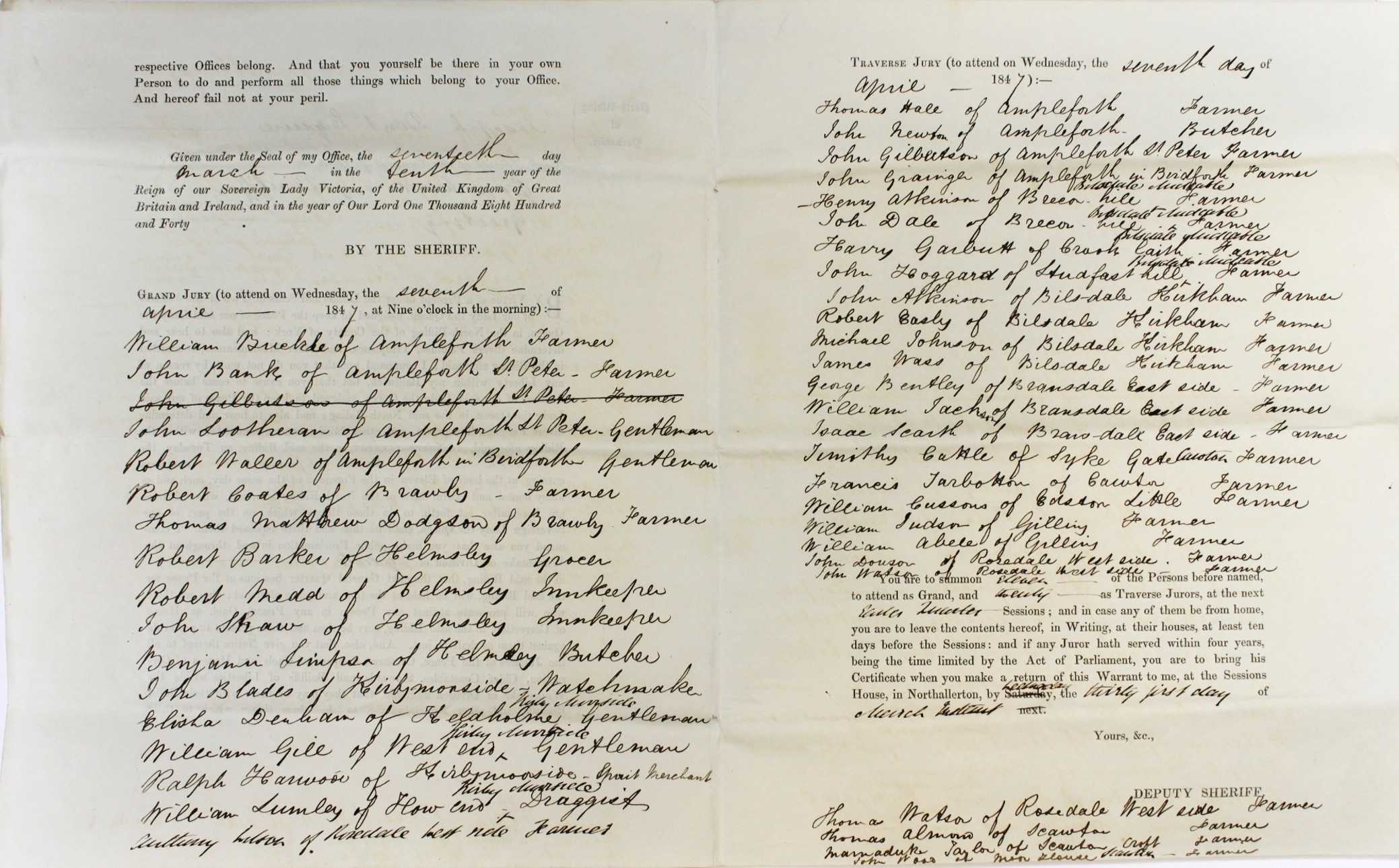
Jury List, Christmas, 1847 [QSB]
This example from 1847 tells us about the occupations of the people who were called up as Jurors. There are a mixture of farmers, gentlemen, and innkeepers, as well as a watchmaker, a spirit merchant, and a butcher.
At the bottom right, there is a note which shows that if a juror had previously served within four years, they could be exempt from serving on the jury again.
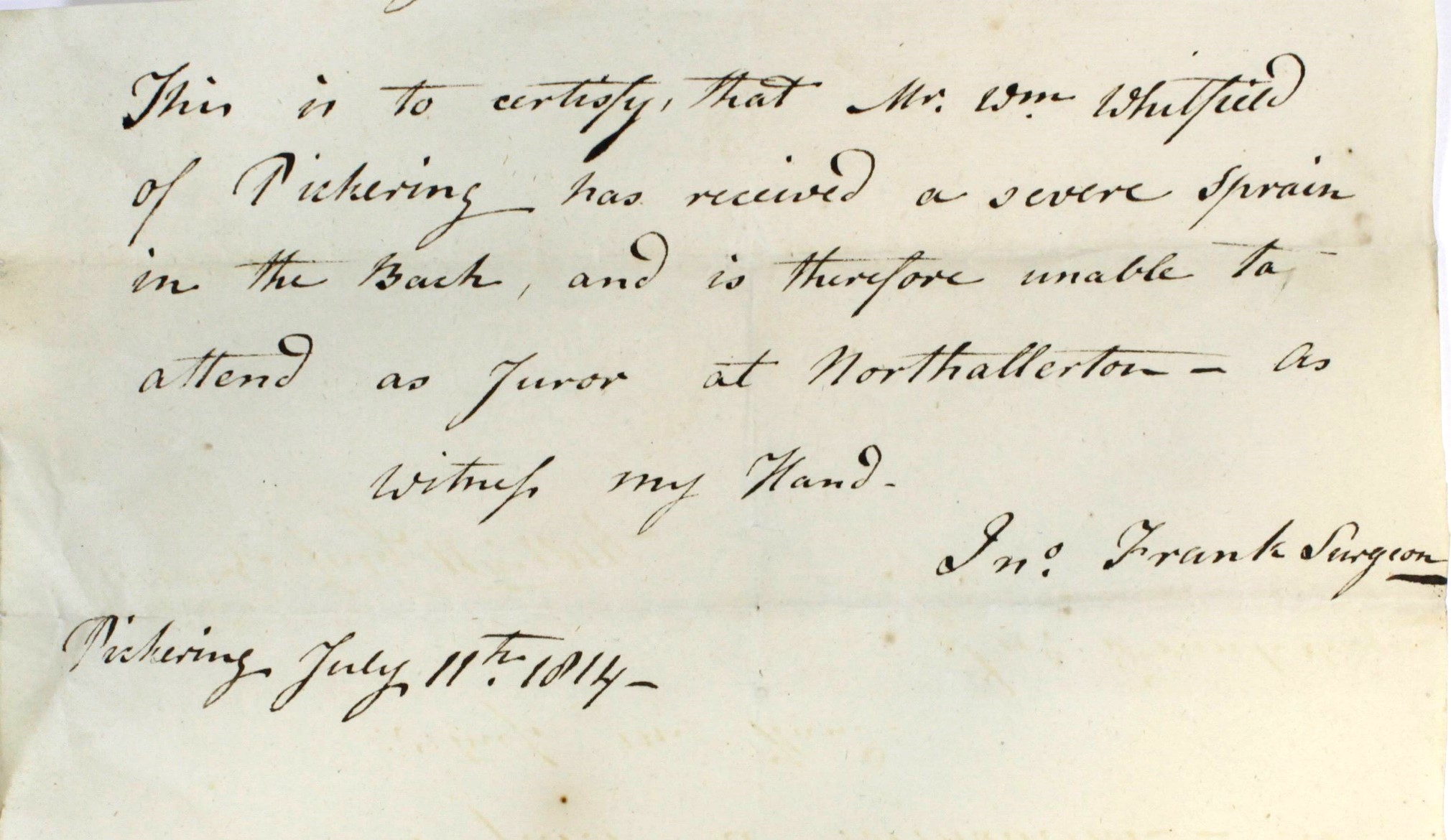
Exemption from Jury Service, 1814 [QSB]
This is a 200 year old sick note, which survives in the Quarter Sessions records!
If a potential juror was ill, a certificate could be issued by a surgeon in order to excuse him from service. This certificate, signed by John Frank, surgeon, tells us that William Whitfield of Pickering has received a severe sprain in the back and, as such, is unable to act as juror.
Papers relating to oaths of office and appointments
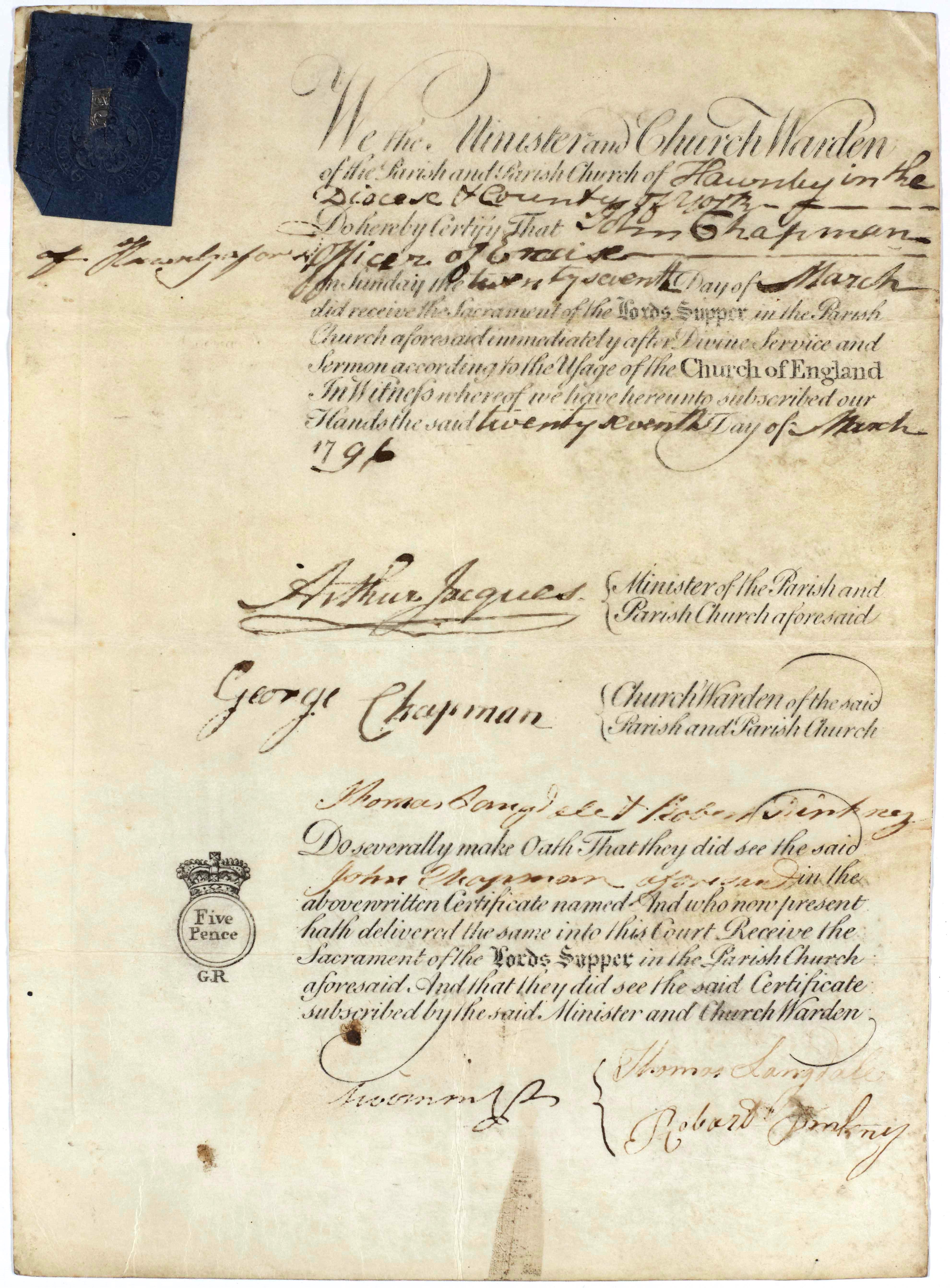
Sacrament certificate for John Chapman, Officer of Excise, 27 March 1796 [QSB 1796 2/2/1]
Holders of public office were required to present a certificate confirming that they had received communion in the Church of England. Under the terms of the Test Act 1673, those who were not members of the Church of England were excluded from civil or military office.
This sacrament certificate was signed by Arthur Jacques, minister of Hawnby parish; George Chapman, churchwarden, and two witnesses.
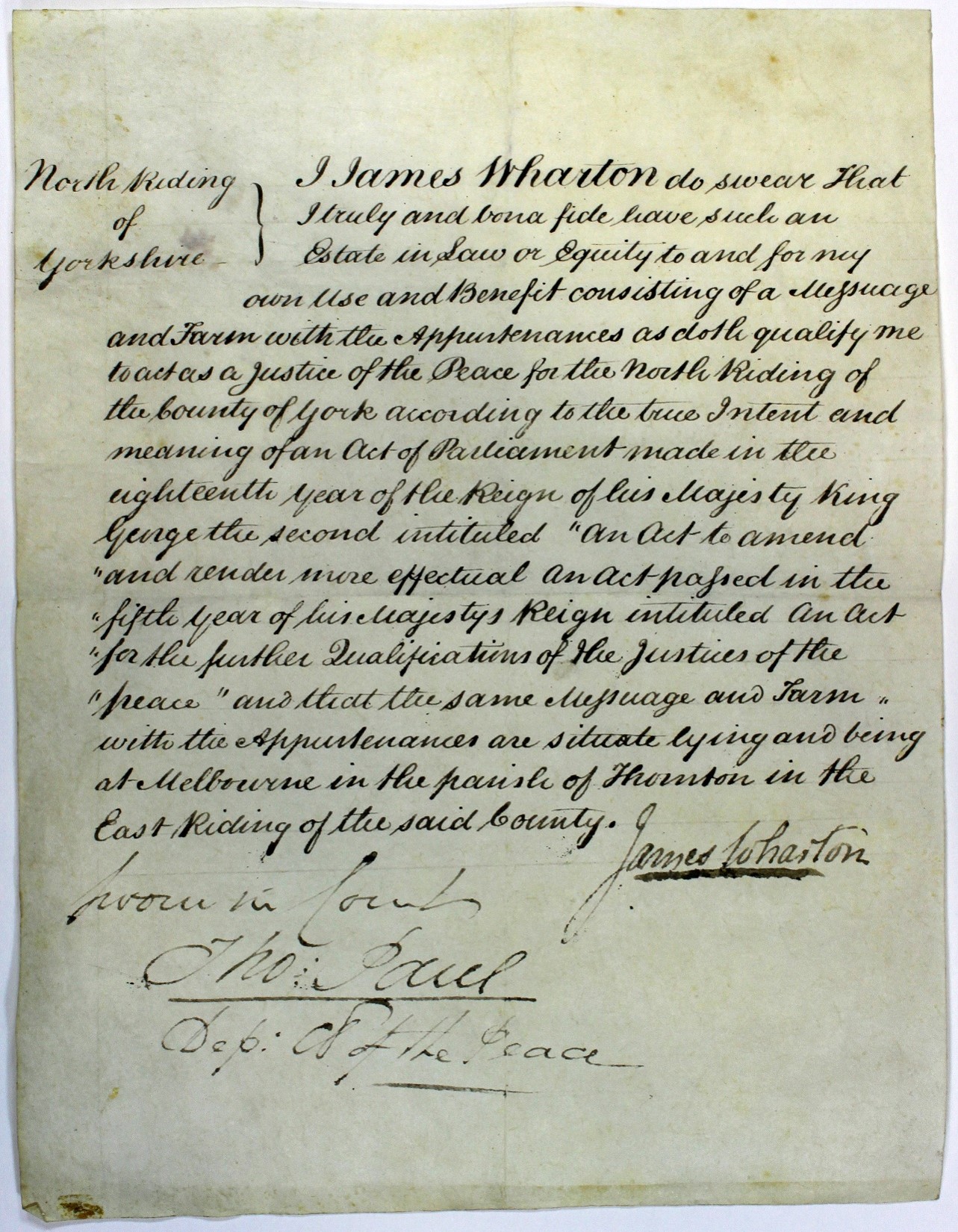
Justice’s Qualification Oath, Easter 1815 [QSB]
In order to qualify as a Justice of the Peace, a man needed to be a resident of the country and had to own an estate worth at least £20 per annum, increasing to £100 per annum as time went on.
In this Oath, James Wharton swears that he is the owner of an estate, consisting of a messuage and a farm, which makes him eligible to be a Justice. This property was situated at Melbourne in the parish of Thornton in the East Riding of the County of York.
Calendars of prisoners
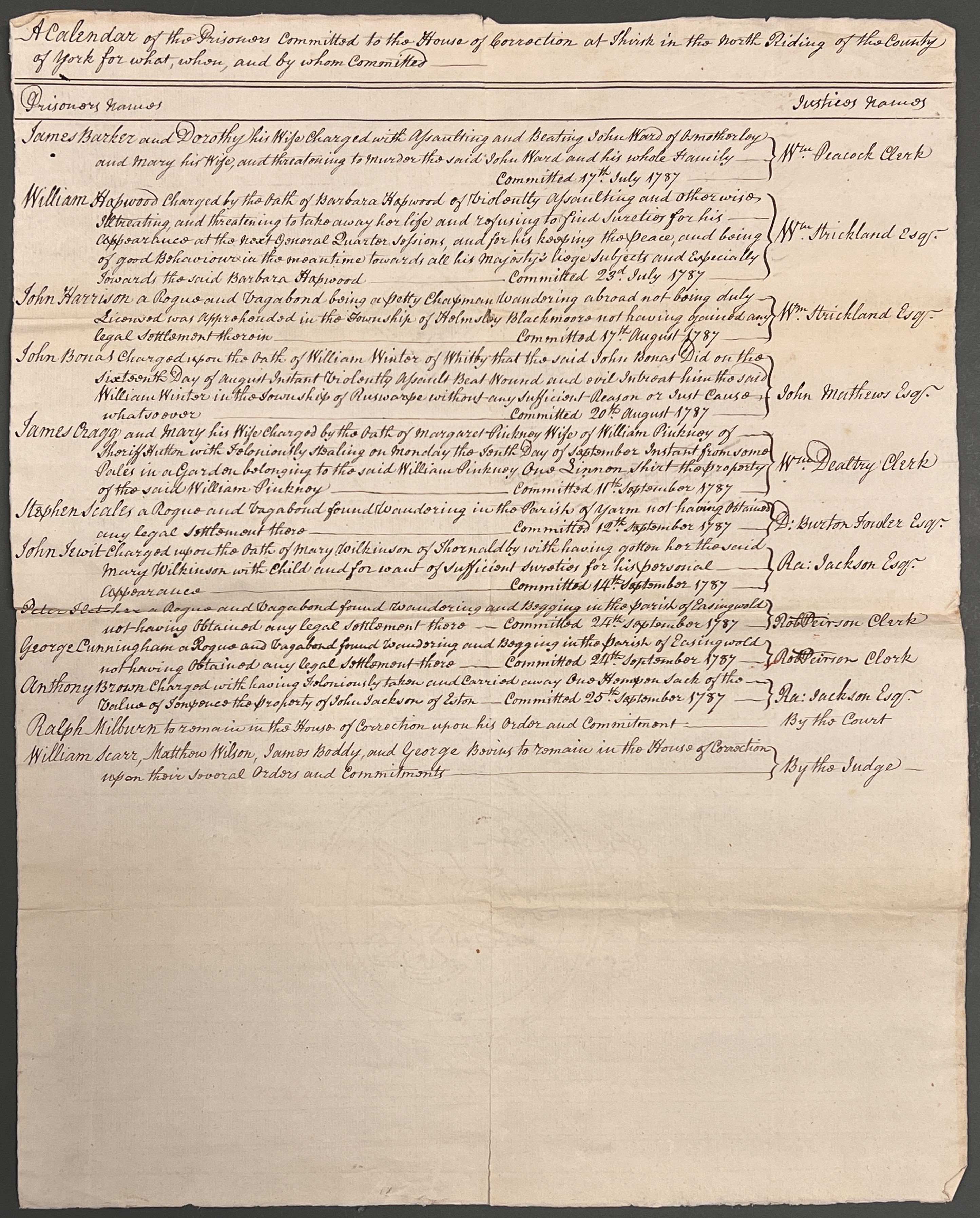
The bundles often include calendars (lists) of prisoners awaiting trial or sentencing. These lists were to be supplied by the Keepers of the House of Correction. In the 18th century, the lists were usually handwritten, but by the 19th century, they were printed in the form of posters, and published so that the public knew which prisoners were being held in custody awaiting trial, and for what offences.
A Calendar of the Prisoners committed to the House of Correction at Thirsk, Michaelmas 1787 [QSB 1787 4/5]
This list contains the names of prisoners, the offence(s) for which they were committed, and on what date.
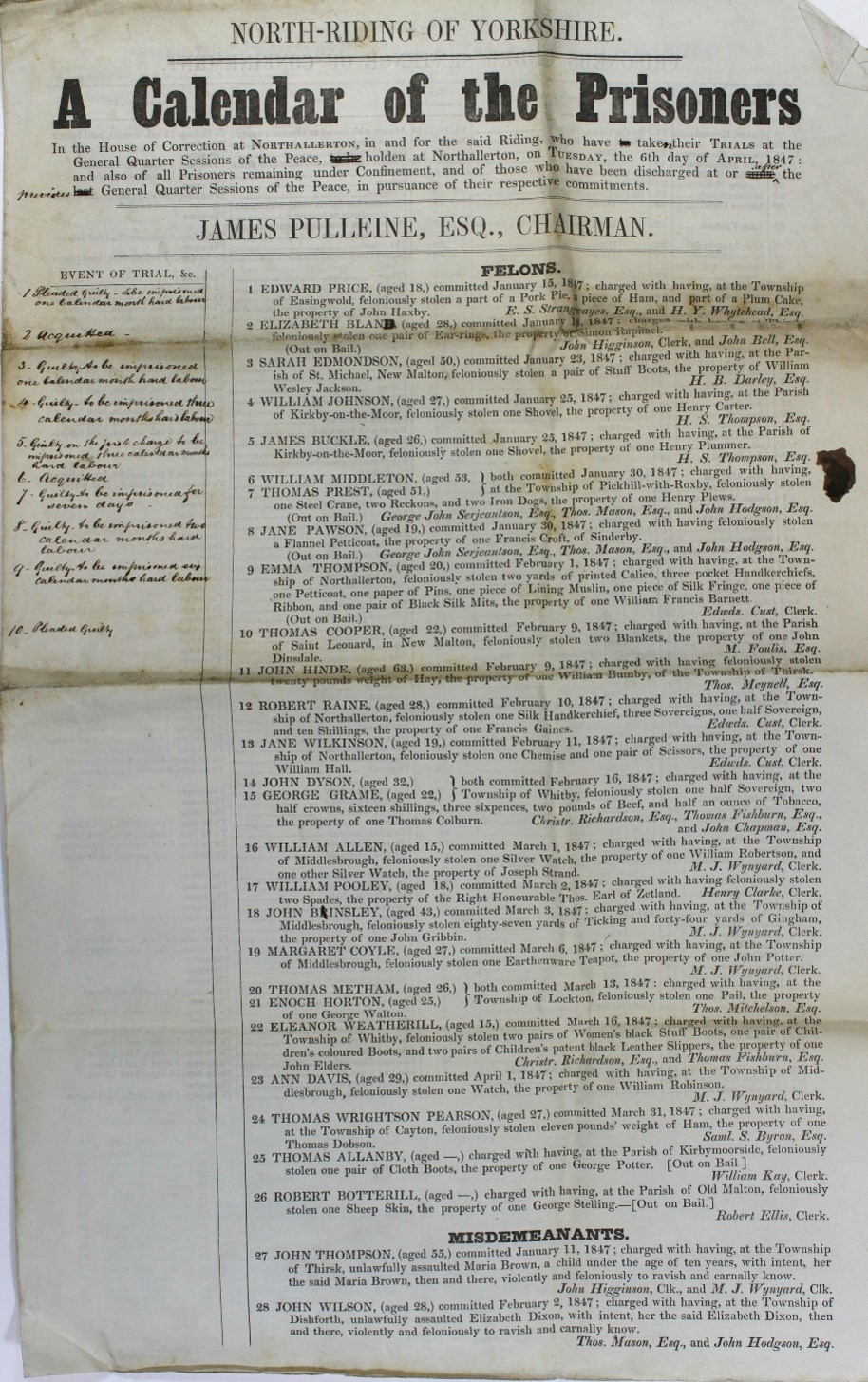
A Calendar of the Prisoners in the House of Correction at Northallerton, Easter 1847 [QSB]
This is a list of:
- those who were imprisoned awaiting trial at the Sessions, for both felonies and misdemeanours,
- those who were under sentence of confinement,
- prisoners who had been committed, but afterwards discharged.
The above list has been annotated, possibly as the trial was proceeding. The annotation allows us to see the fate of some of those who were tried on 6th April 1847.
For example, Edward Price aged 18, was committed in January, charged with stealing a piece of a pork pie, a piece of ham, and part of a plum cake, all of which had belonged to John Haxby. Edward pleaded guilty and was imprisoned for one calendar month with hard labour.
Also, William Middleton aged 53, and Thomas Prest aged 51, were both charged with stealing one steel crane, two reckons (cooking utensils), and two iron dogs (used for supporting burning wood in a fire). William was acquitted, whilst Thomas was found guilty and was to be imprisoned for seven days.
Presentments and bills of indictment
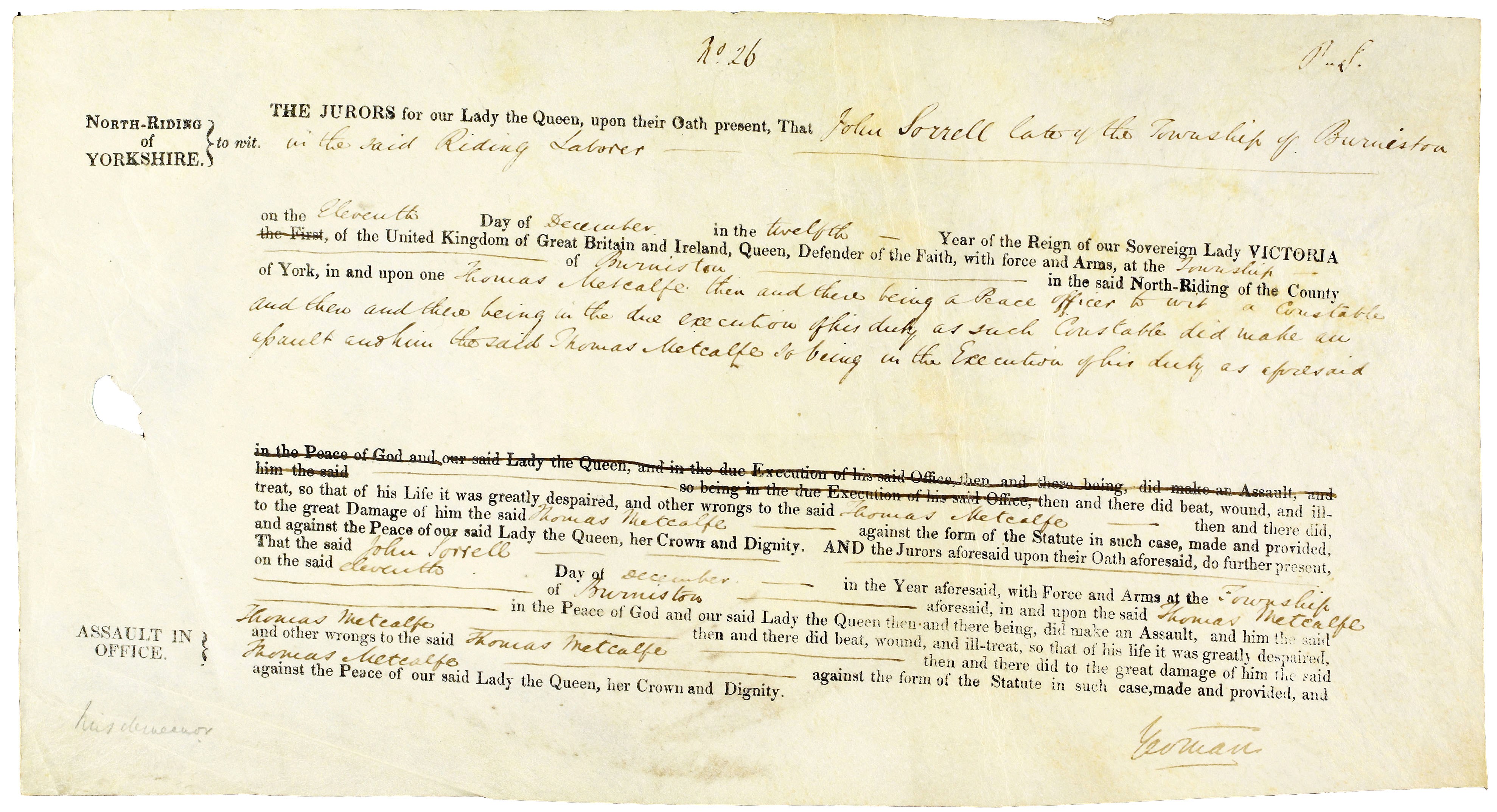
Presentments and bills of indictment are documents which outline an offence alleged to have been committed by a person or group of people. They were written on strips of parchment and endorsed on the back with the names of the witnesses who were to be examined before the Grand Jury. The Grand Jury would hear evidence for the prosecution only, and would decide whether the case was sufficiently well founded to send the accused for trial (known as a ‘true bill’). The examples below are endorsed (written on the back) with the words “True bill” or “Not found” (sometimes “Not true bill”), according to whether or not they were passed on to the Traverse Jury for a full hearing.
These bills of indictment are useful documents for both family and local historians. Not only can they tell us about our criminal ancestors, but also whether an ancestor was a victim of crime. Sometimes, the records reveal that whole villages and towns were indicted, for example for not repairing a local bridge or highway (see below).
There are other Quarter Sessions’ records that may provide more information about the accused or the victim. These include calendars of prisoners; informations, depositions and examinations (statements of the accused and of witnesses) and recognizances (bonds entered into by both the accused and witnesses, which try and ensure a person’s appearance at the Sessions).
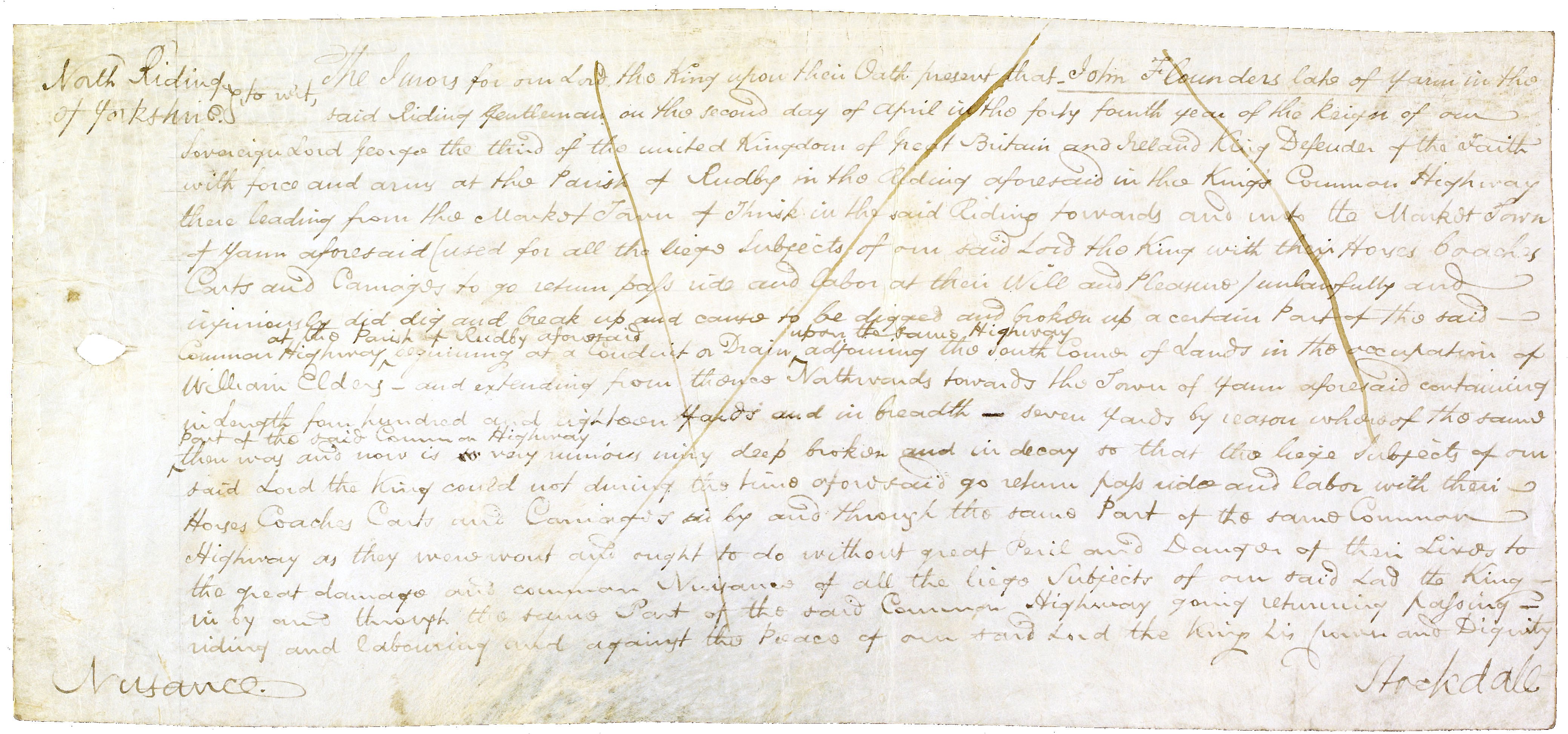
Bill of indictment of John Flounders late of Yarm, gentleman, for digging up part of the highway from Thirsk to Yarm in the parish of Rudby, from a conduit or drain on the highway adjoining the south corner of lands occupied by William Elders and extending northward towards the town of Yarm, being 418 yards in length and 7 yards in breadth. Offence committed at the parish of Rudby on 2 April 1804. Endorsed (written on the back) with names of witnesses and “not found“ [QSB 1804 4/6/3].
Bill of indictment of John Sorrell late of the township of Burniston labourer for assaulting Thomas Metcalfe a constable in the execution of his duty. Offence committed at the township of Burniston on 11 December 1848. Endorsed with names of witnesses and “true bill“ [QSB 1849 3/6/24].

Bill of indictment of Elizabeth Boyes for stealing one cap, four pairs of stockings, two smocks, two handkerchiefs, one dozen buttons, two yards of calico, four yards of shirting, two and a half yards of cotton cord, two yards of calico, and three quarters of a yard of canvas, the property of William Gaines. Offence committed on 25 November 1868. Endorsed with names of witnesses and “true bill“ [QSB 1869 1/6/9].
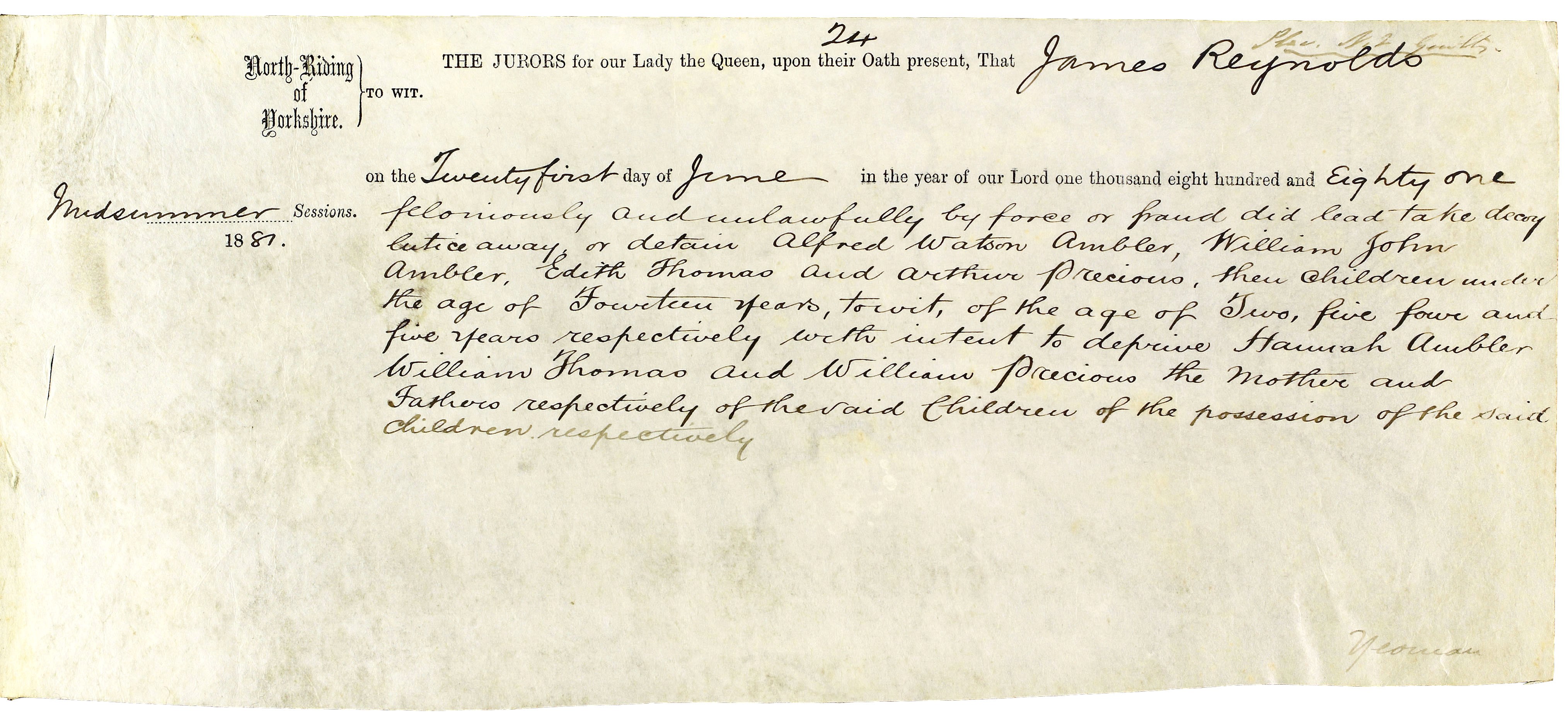
Bill of indictment of James Reynolds for enticing away Alfred Watson Ambler aged two, William John Ambler aged five, Edith Thomas aged four, and Arthur Precious aged five, with intent to deprive Hannah Ambler, William Thomas and William Precious, their respective parents, of the possession of the children. Offence committed on 21 June 1881. Endorsed with names of witnesses and “true bill“ [QSB 1881 3/6/18].
See also the bill of indictment from the case of William Pindar below.
Recognizances
In cases where an offence was to be tried at Quarter Sessions, the accused would have to enter into a recognizance (a bond or obligation) to appear and answer. By entering into this bond, the accused must appear at Quarter Sessions and answer the charges against them, or otherwise risk the loss of a specified sum of money.
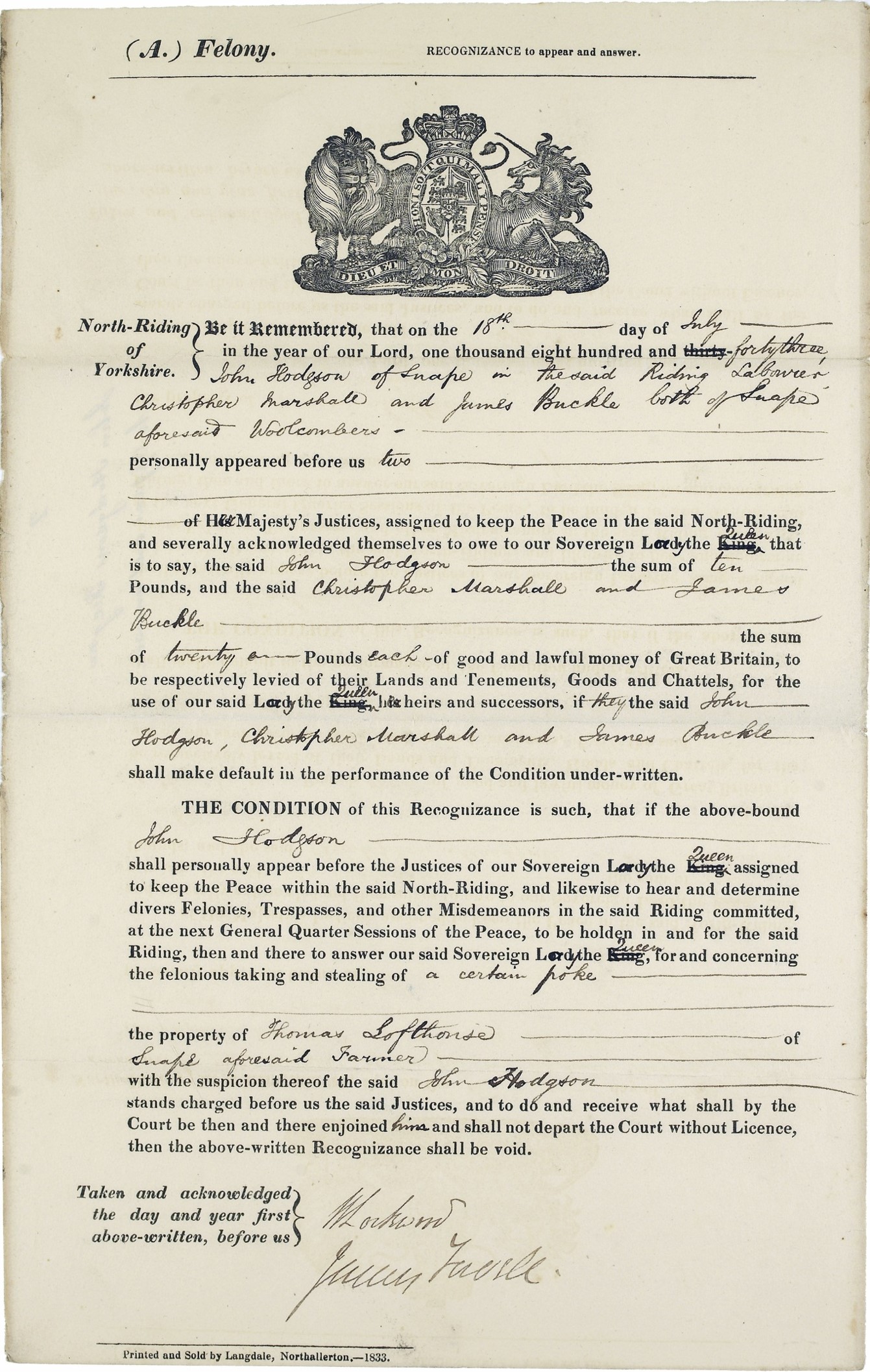
Recognizance to appear and answer, QSB 1843
This recognizance was entered into by John Hodgson, a labourer, and Christopher Marshall and James Buckle, both woolcombers, all of Snape. John Hodgson is accused of stealing a poke (bag) from Thomas Lofthouse. The total sum at stake is £50.
If a Justice of the Peace received a complaint against a person, he could issue that person with a recognizance (a bond or obligation) to keep the peace.
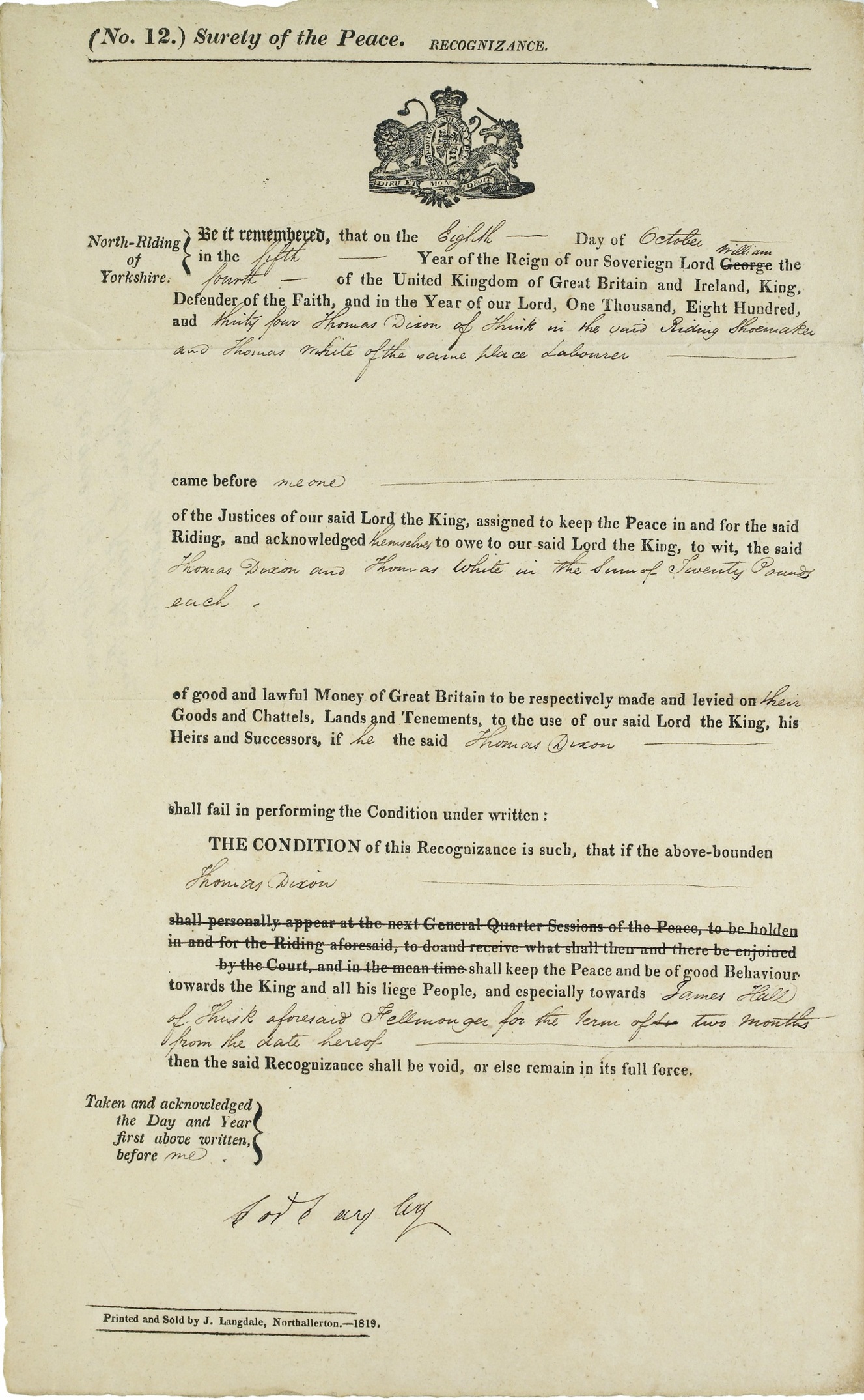
Recognizance to keep the peace, QSB 1834
This particular recognizance was entered into by Thomas Dixon, a shoemaker, and Thomas White, a labourer, both of Thirsk, who pledged the sum of £20 each that Dixon would keep the peace and be of good behaviour for a term of two months. This applied especially to his behaviour towards James Hall, a fellmonger of Thirsk. If Thomas failed to keep the peace, then £20 each would be forfeit.
In cases where an offence was to be tried at Quarter Sessions and witnesses were required to provide a testimony, these witnesses were to enter into a recognizance to give evidence. A witness who did not appear would forfeit a specified sum of money.
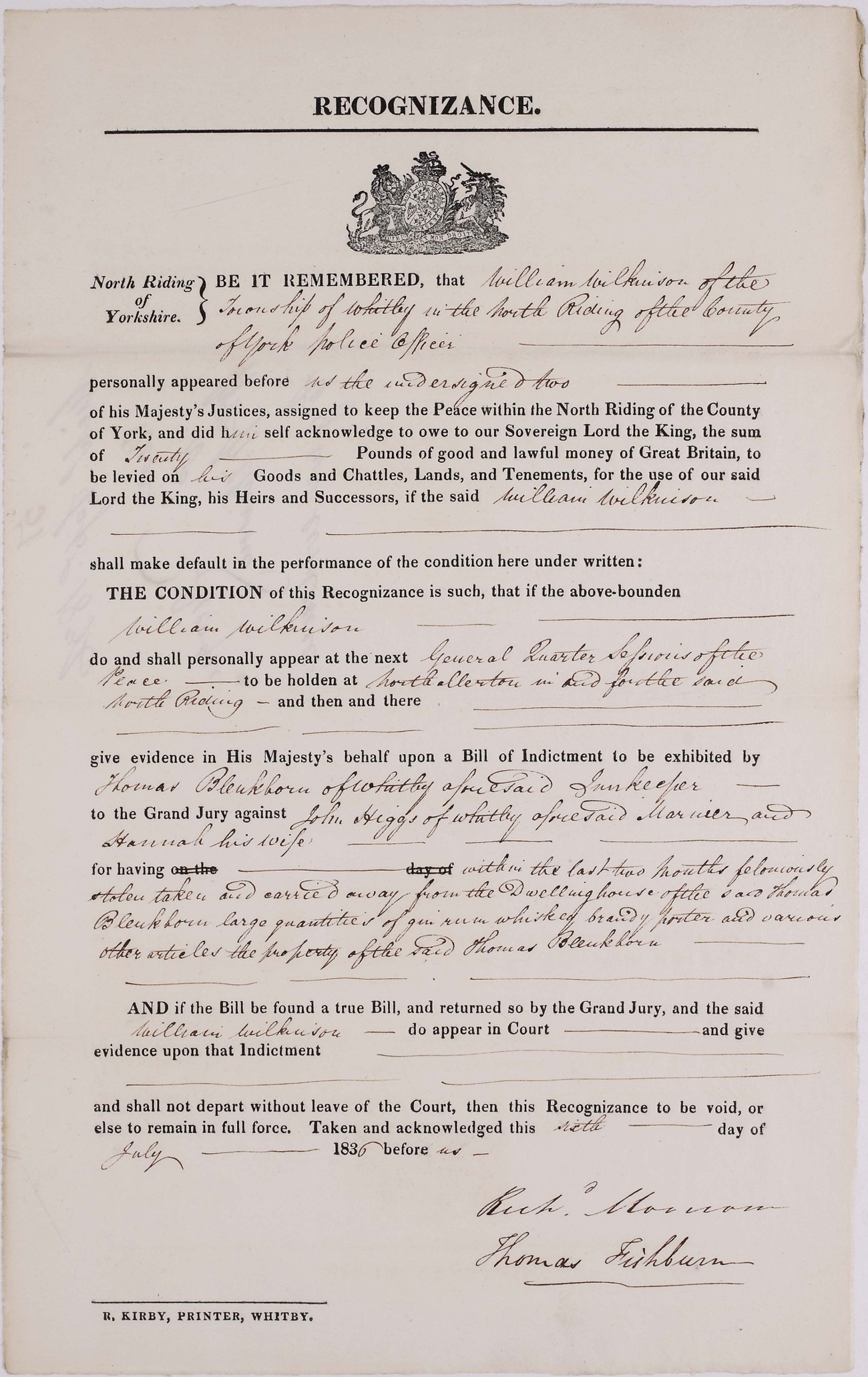
Recognizance to give evidence, QSB 1836
William Wilkinson, a police officer of Whitby, has entered into this recognizance to give evidence against John Higgs, a mariner, and Hannah Higgs his wife, both of Whitby, who will stand trial accused of stealing a large quantity of alcohol from Thomas Blenkhorn an innkeeper. William would lose £20 if he failed to appear.
Informations, depositions and examinations
Informations, depositions and examinations are documents which record the evidence gathered about a criminal case:
- Informations are written statements accusing someone of a particular crime.
- Depositions are sworn statements given under oath, typically by witnesses before the Quarter Sessions court hearing, and later used in the proceedings.
- An examination is a statement, usually made by the accused before the Quarter Sessions court hearing, and later used in the proceedings.
These types of documents typically contain the most detailed information about a case. The examples below are evidence in the case against William Pindar of New Malton, and are dated 6-7 November 1782 [QSB 1783 1/8/3]. The depositions and statement are both endorsed ‘Easingwold Sessions 14th January 1783’, when the case was heard.
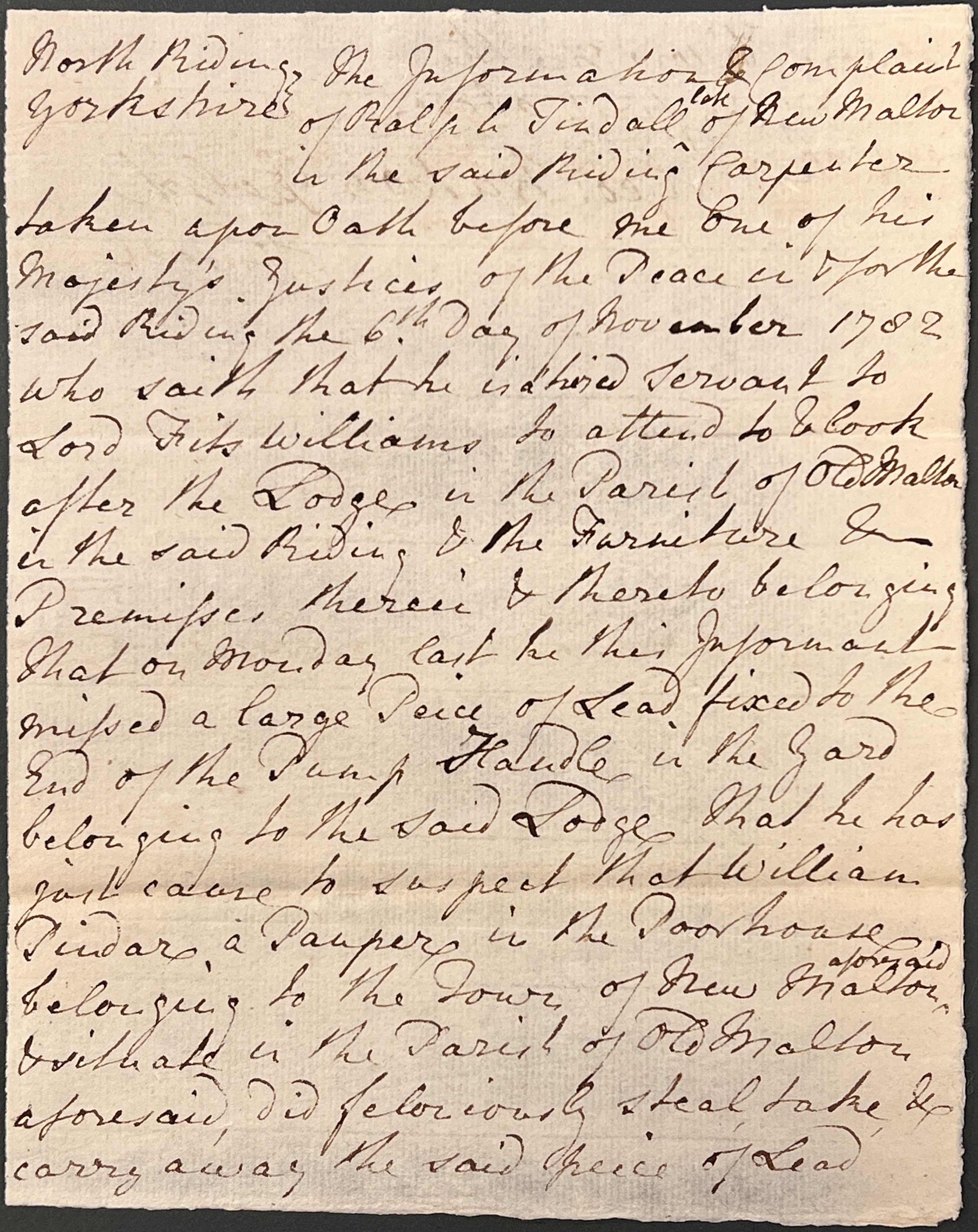
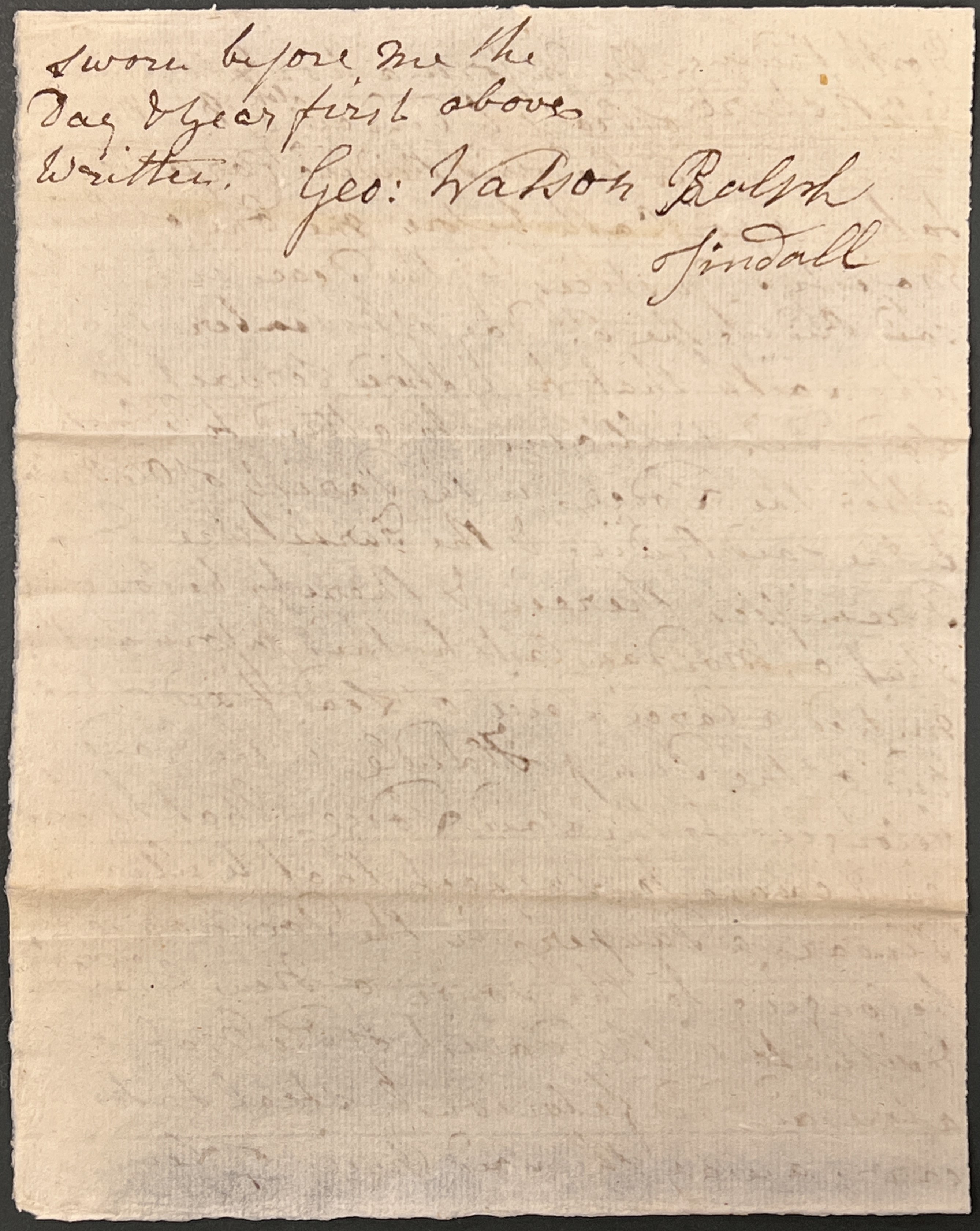
Information and complaint of Ralph Tindall, late of New Malton, carpenter, against William Pindar, a pauper in the poorhouse belonging to the town of New Malton, 6 November 1782 [QSB 1783 1/8/3]
The above document records the accusation – in the information and complaint of 6 November 1782, Ralph Tindall, a carpenter, upon oath before the Justice of the Peace, says that he is a hired servant to Lord Fitzwilliam, to look after the Lodge in Old Malton and its associated furniture and premises. He noticed a large piece of lead was missing that had been fixed to the end of the pump handle in the yard of the Lodge. He has just cause to suspect that William Pindar, a pauper in the poorhouse belonging to the town of New Malton, ‘did feloniously steal, take, & carry away the said piece of lead’.
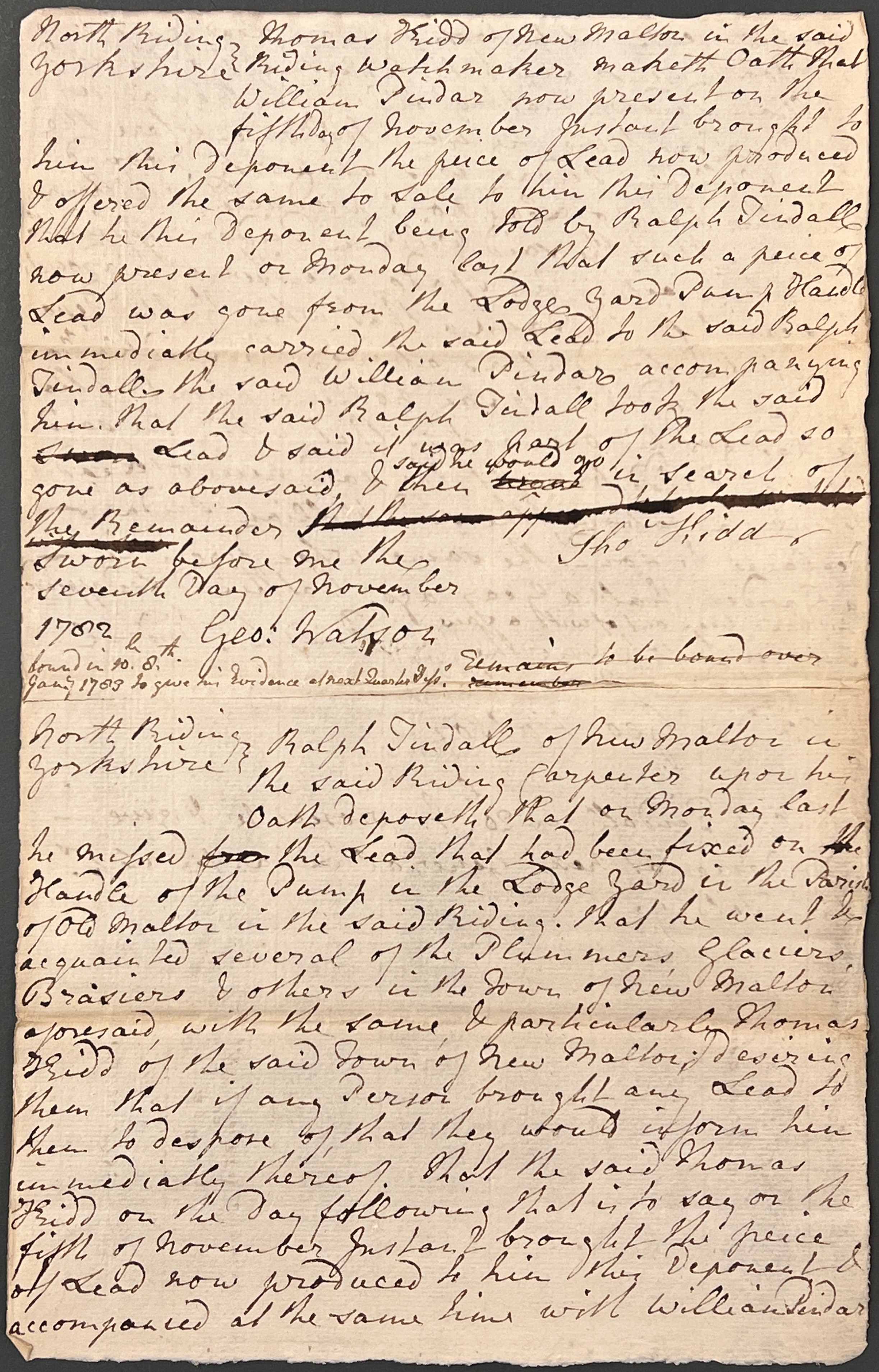
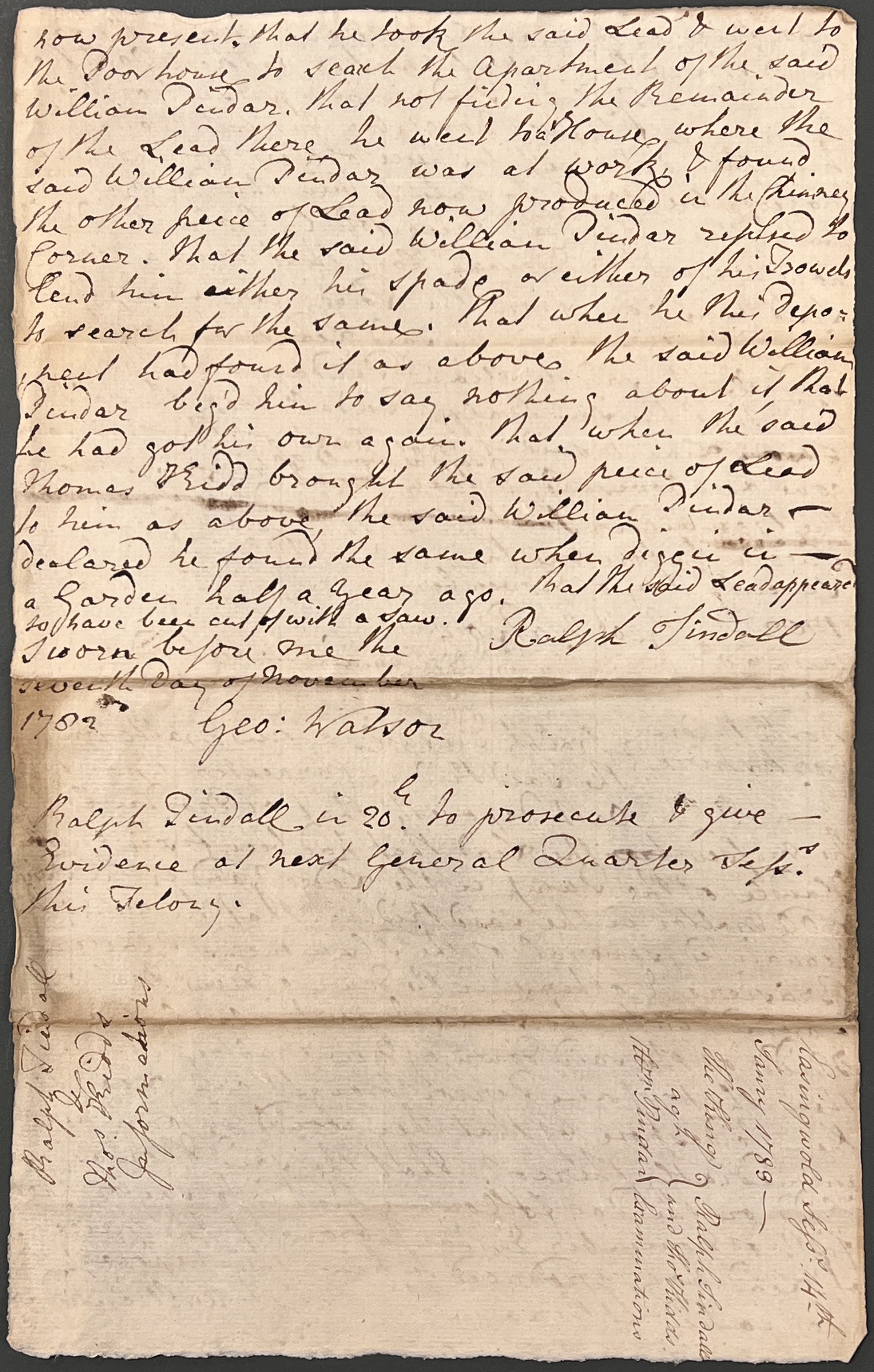
Depositions of Thomas Kidd of New Malton, watchmaker, and Ralph Tindall of New Malton, carpenter, witnesses in the case against William Pindar, 7 November 1782 [QSB 1783 1/8/3]
The above document records the sworn statements of both Thomas Kidd and Ralph Tindall – in the first part of the deposition of 7 November 1782, Thomas Kidd, a watchmaker of New Malton, makes the oath that on 5 November, William Pindar offered to sell a piece of lead to him. Having been told by Ralph Tindall that such a piece of lead was missing from the Lodge yard pump handle, Thomas Kidd immediately took the lead to Ralph Tindall, accompanied by William Pindar. Ralph Tindall said that it was part of the lead that was missing and that he would go in search of the remainder.
In the second part of the deposition, Ralph Tindall says under oath that after he noticed the lead that had been fixed on the handle of the pump in the Lodge yard was missing, he notified the plumbers, glaziers, brasiers and others in the town, and particularly Thomas Kidd. He asked them that they notify him immediately if anyone brought them any lead to dispose of. On 5 November, Thomas Kidd brought the piece of lead to him, accompanied by William Pindar. Ralph Tindall took the lead, and went to the poorhouse to search the apartment of William Pindar, but not finding the remainder of the lead there, he went to a house where William Pindar was at work and found the other piece of lead in the chimney corner. William Pindar had refused to lend Ralph Tindall his spade or either of his trowels to search for the lead, and begged him to say nothing about it. When Thomas Kidd brought the piece of lead to Ralph Tindall, William Pindar declared that he had found it when digging in a garden half a year ago. The lead appeared to have been cut off with a saw.
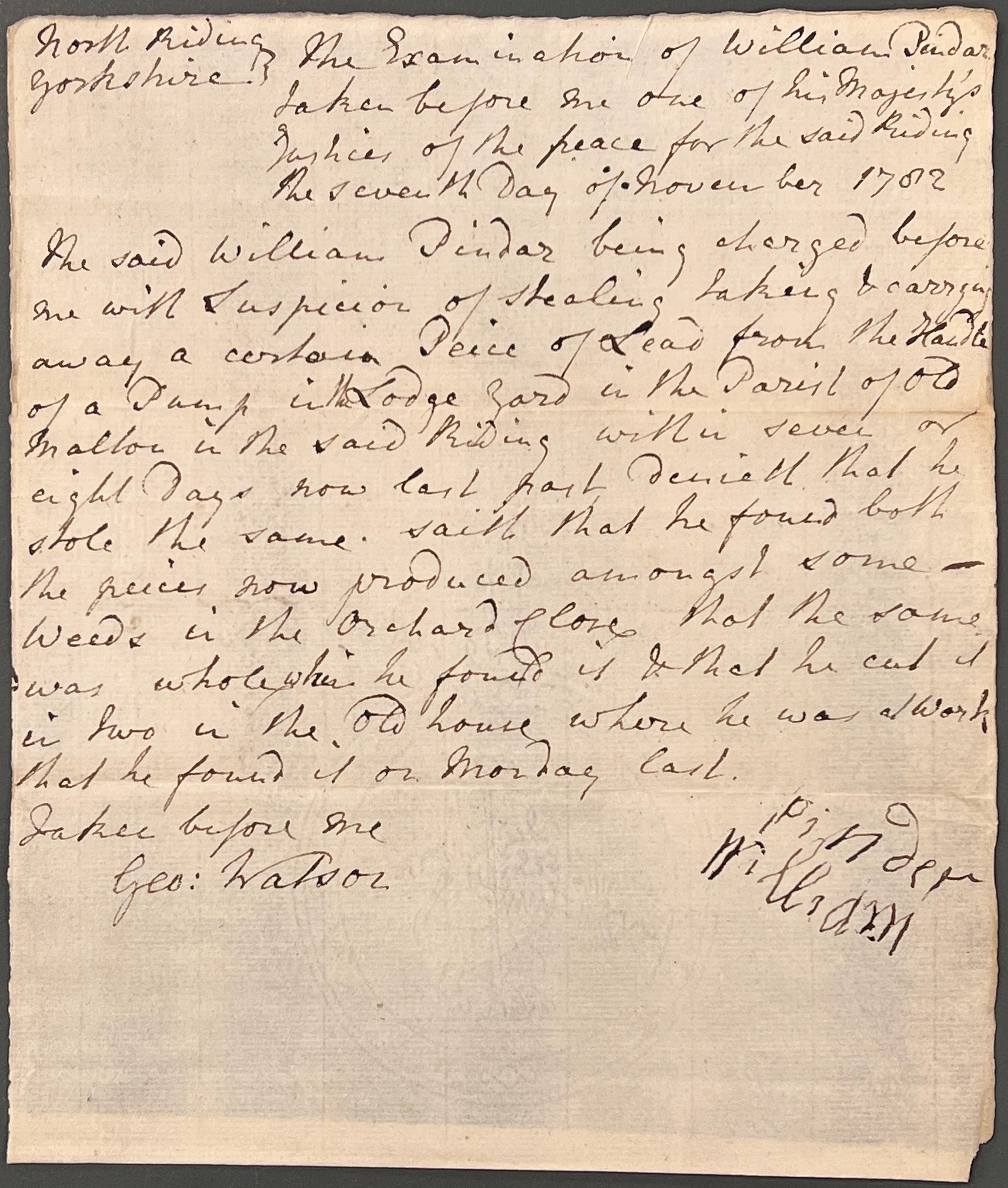
Statement of William Pindar, the accused, 7 November 1782 [QSB 1783 1/8/3]
In William Pindar’s statement under oath dated 7 November, as shown above, he denies that he stole the lead. He says that he found both the pieces amongst some weeds in the Orchard Close and that it was a whole piece when found. He cut it in two in the old house when he was at work, that he found it on Monday last.
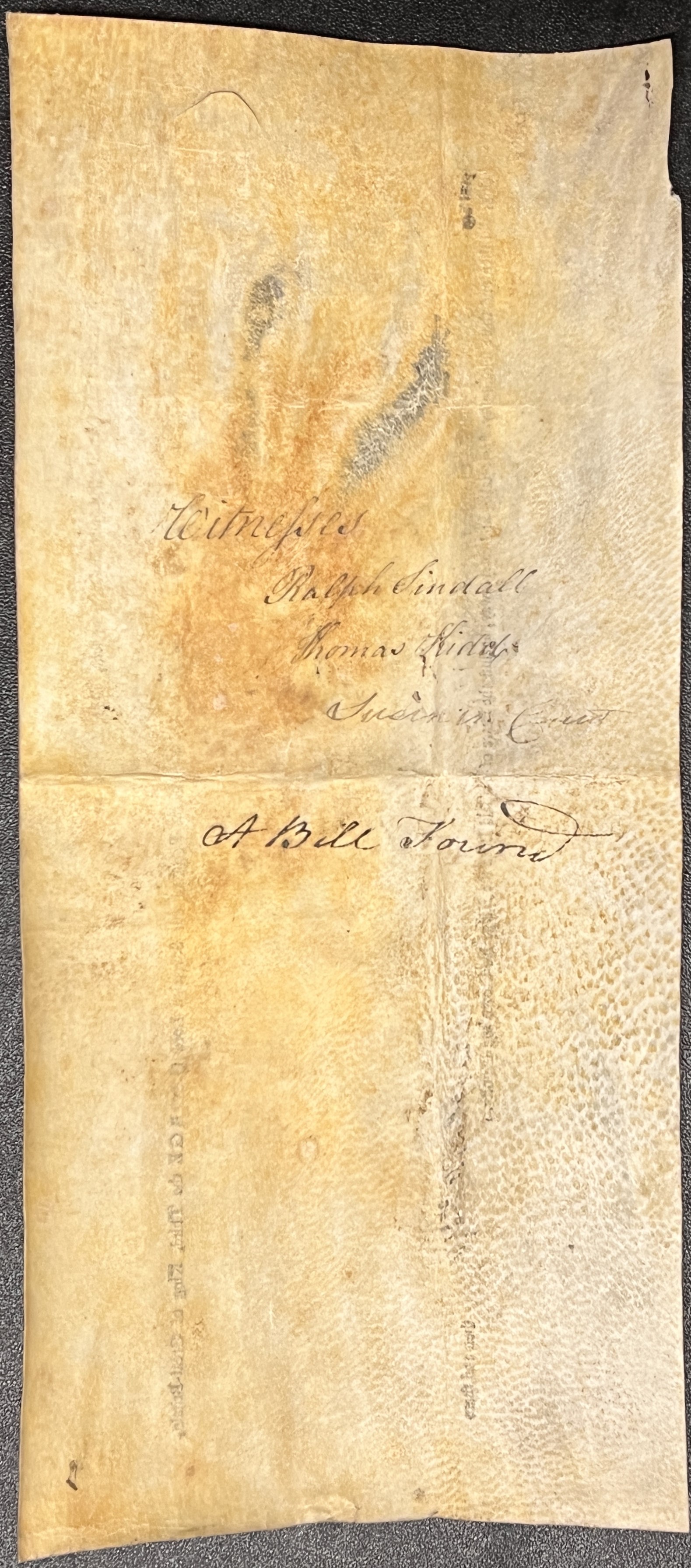
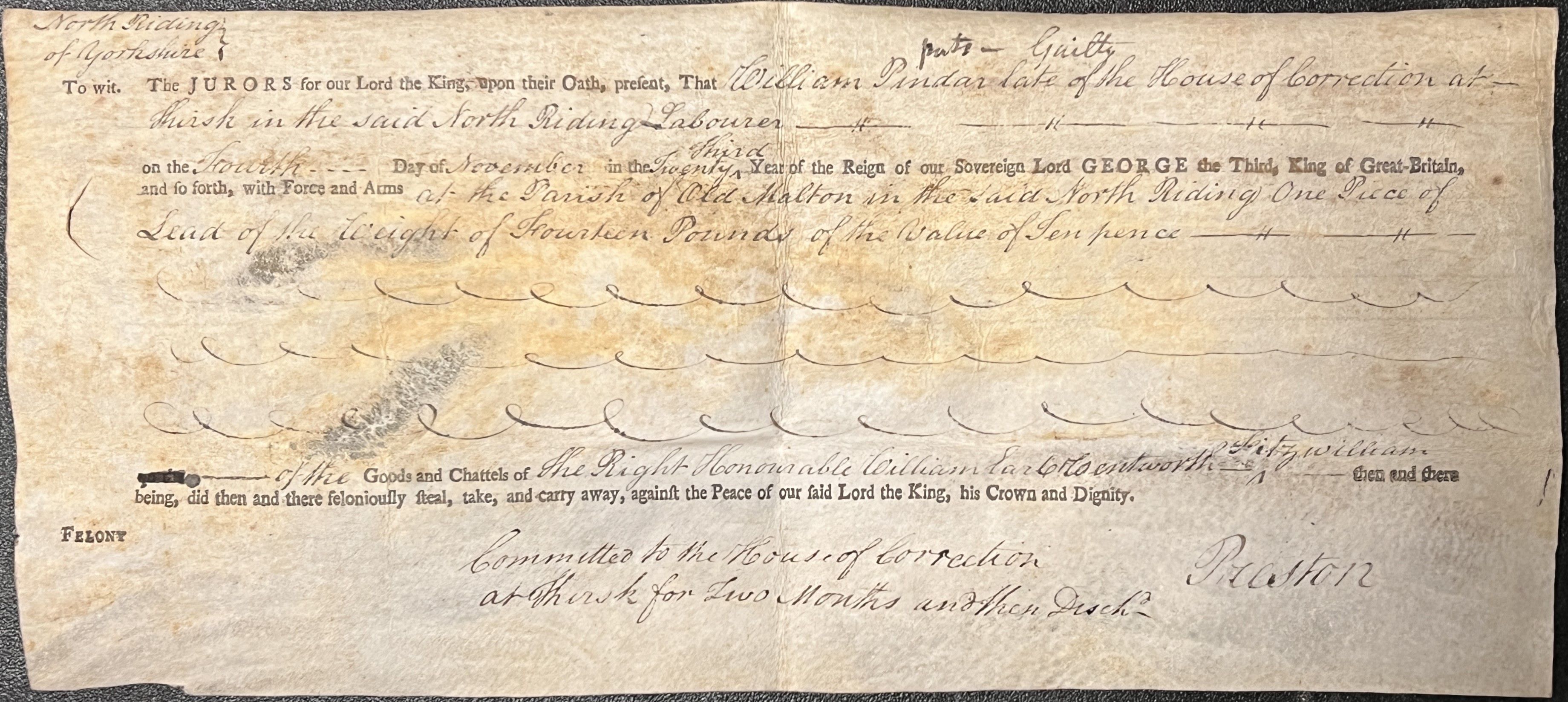
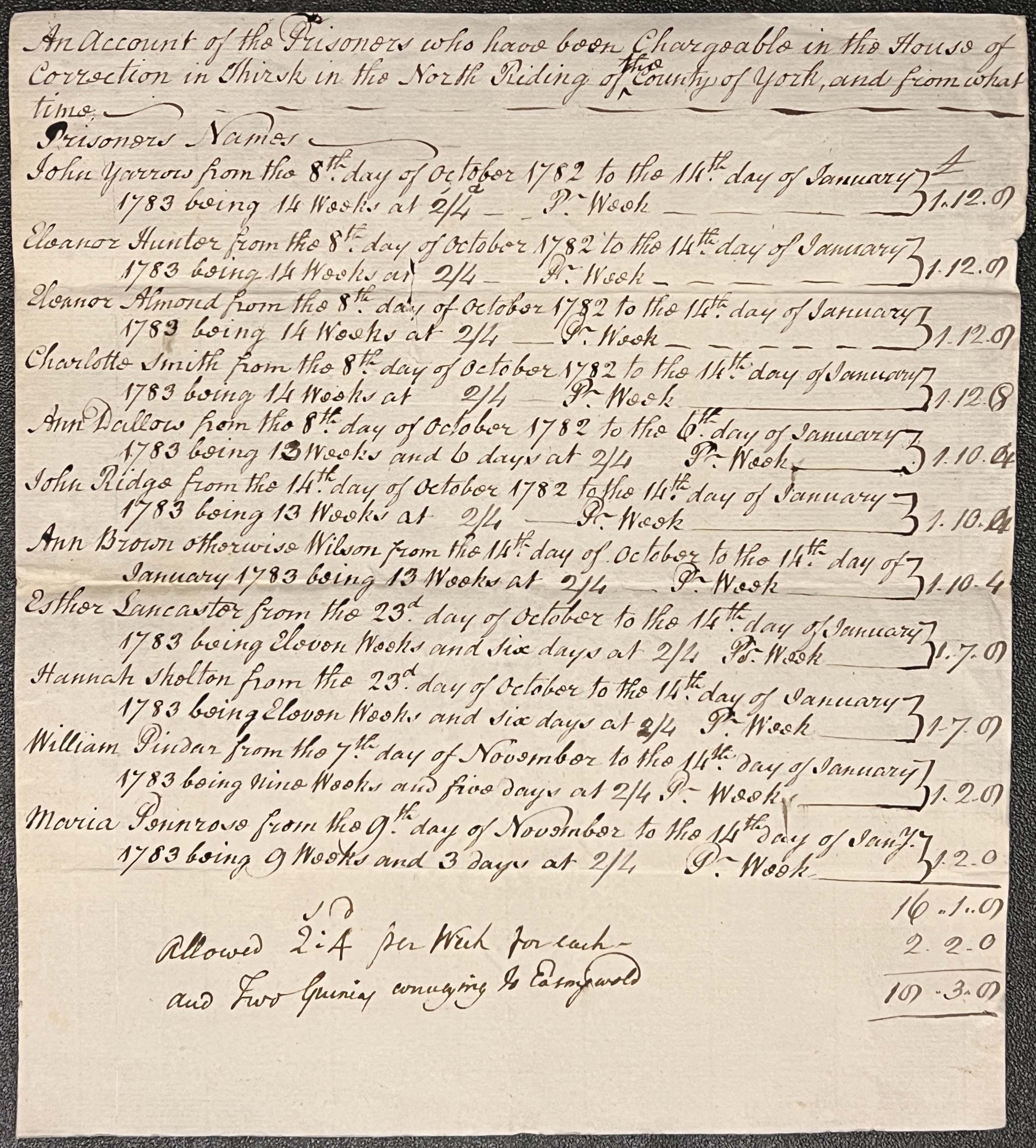
Back and front of a bill of indictment of William Pindar, late of the House of Correction at Thirsk, labourer, for stealing one piece of lead weighing 14 pounds value 10d, the property of Earl Fitzwilliam [QSB 1783 1/6/3] & Account for maintaining prisoners in the House of Correction at Thirsk including details of William Pindar [QSB 1783 1/15/44]
Other documents surviving from the same Quarter Sessions’ bundle, as shown above, record that William Pindar was found guilty, and shed light on what happened to him. ‘Committed to the House of Correction at Thirsk for two months and then disch[arge]d’ is written on the bottom of his bill of indictment, which is endorsed (written on the back) with the names of witnesses Ralph Tindall and Thomas Kidd and ‘A Bill Found’ [QSB 1783 1/6/3]. An account for maintaining prisoners in the House of Correction at Thirsk records that William Pindar was held there from 7 November 1782 to 14 January 1783, a period of nine weeks and five days, at a cost of 2s 4d per week [QSB 1783 1/15/44].
Summary convictions and related papers
Summary convictions record when a person was found guilty of a minor offence, usually by the Justices in the Petty Sessions and include information about the person and their crime, as well as the punishment that was given, usually either a fine or a period of imprisonment. They can either be fully handwritten, or the details written onto a pre-printed form, as can be seen in the examples featured below.
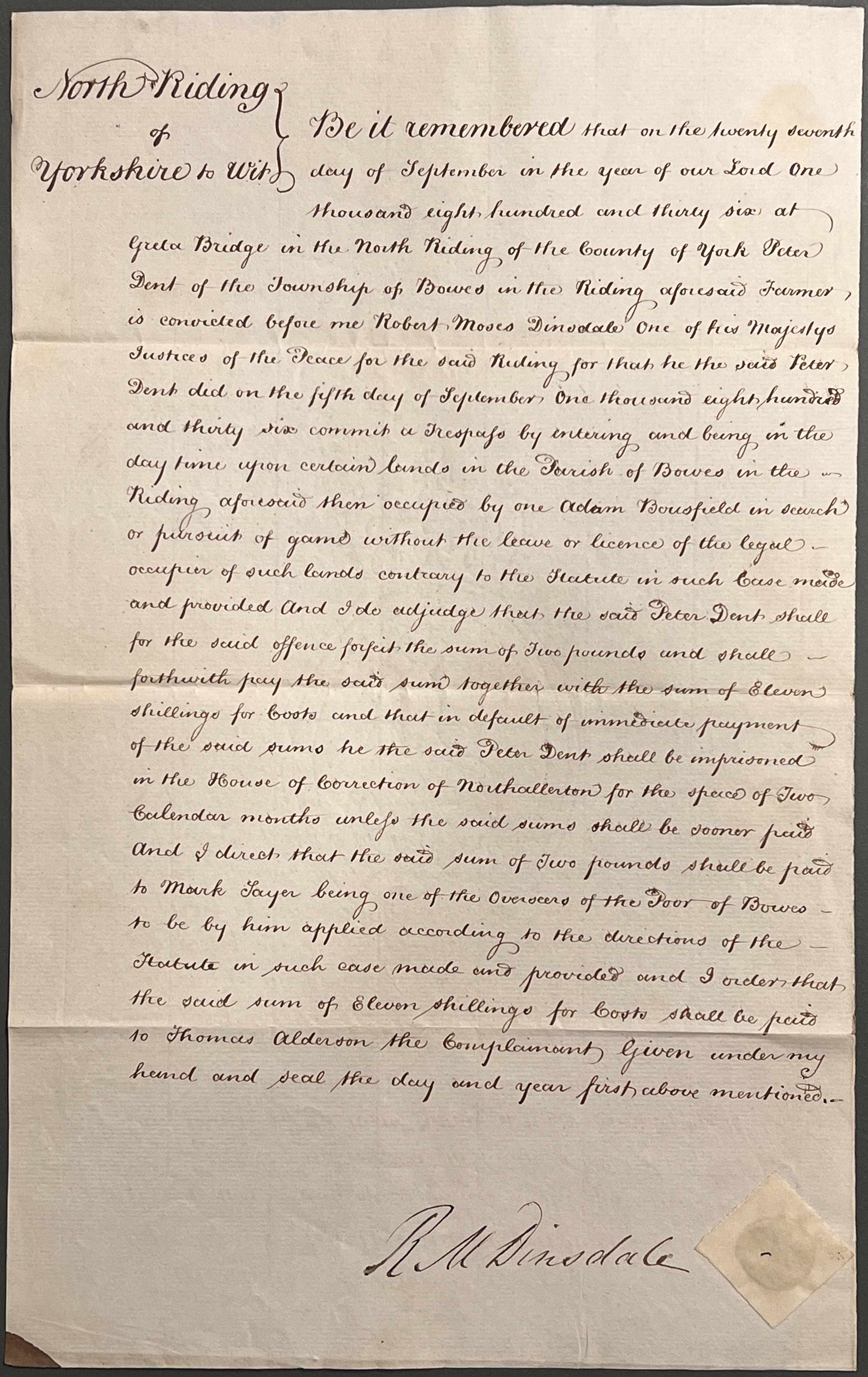
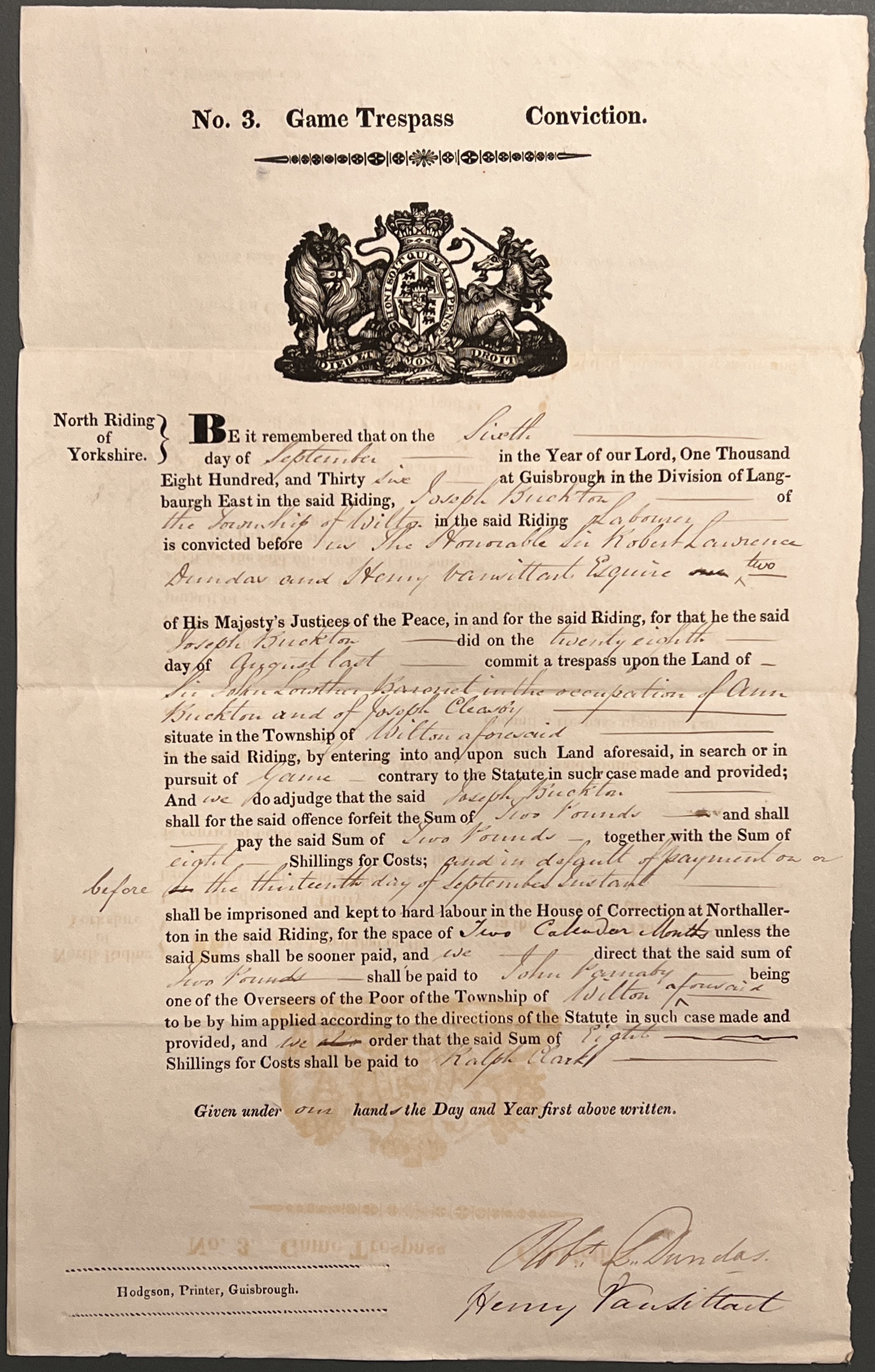
Summary convictions of Peter Dent (left) & Joseph Buckton (right) for game trespass [QSB 1836 4/10]
In one of the above examples, Peter Dent, a farmer from Bowes, is convicted for trespassing upon lands occupied by Adam Bousfield on 5 September 1836 in search of game without permission. He is ordered by Robert Dinsdale, J.P. to forfeit the sum of £2 to be paid to the Overseer of the Poor of Bowes, and 11 shillings in costs to be paid to the complainant, Thomas Alderson, or be imprisoned in the House of Correction at Northallerton for two months.
In the other example, Joseph Buckton, a labourer from Wilton, is also convicted of trespass in search of game, and similarly ordered to pay £2 to the Overseer of the Poor of Wilton, and 8 shillings in costs. In default of payment on or before 13 September, he is to be imprisoned and kept to hard labour at the House of Correction at Northallerton for two months.
Bastardy, settlement and removal
From the late-16th century until 1834, when Poor Law Unions were established, Quarter Sessions dealt with offences against the Poor Law. The Poor Laws of 1597 and 1601 made each parish responsible for its own poor. Accordingly, a Poor Rate was collected from parishioners by the Churchwardens and Overseers of the Poor to support those in need in the parish. To reduce the financial burden on the parish, the parish officers regularly attended the Quarter Sessions to obtain bastardy orders, and removal orders.
Bastardy
Bastardy refers to the status of a child born out of wedlock. Single mothers and their children were often viewed as a financial burden on the parish, and so the parish would try to identify the father and make him responsible for maintaining the child. The Quarter Sessions bundles can be a rich source of evidence for records relating to bastardy cases. Bastardy examinations were often used to determine paternity, sometimes in conjunction with settlement examinations. Overseers of the Poor would attend Quarter Sessions to obtain bastardy orders, to require the presumed father to pay maintenance for a child that might otherwise become chargeable to their parish.
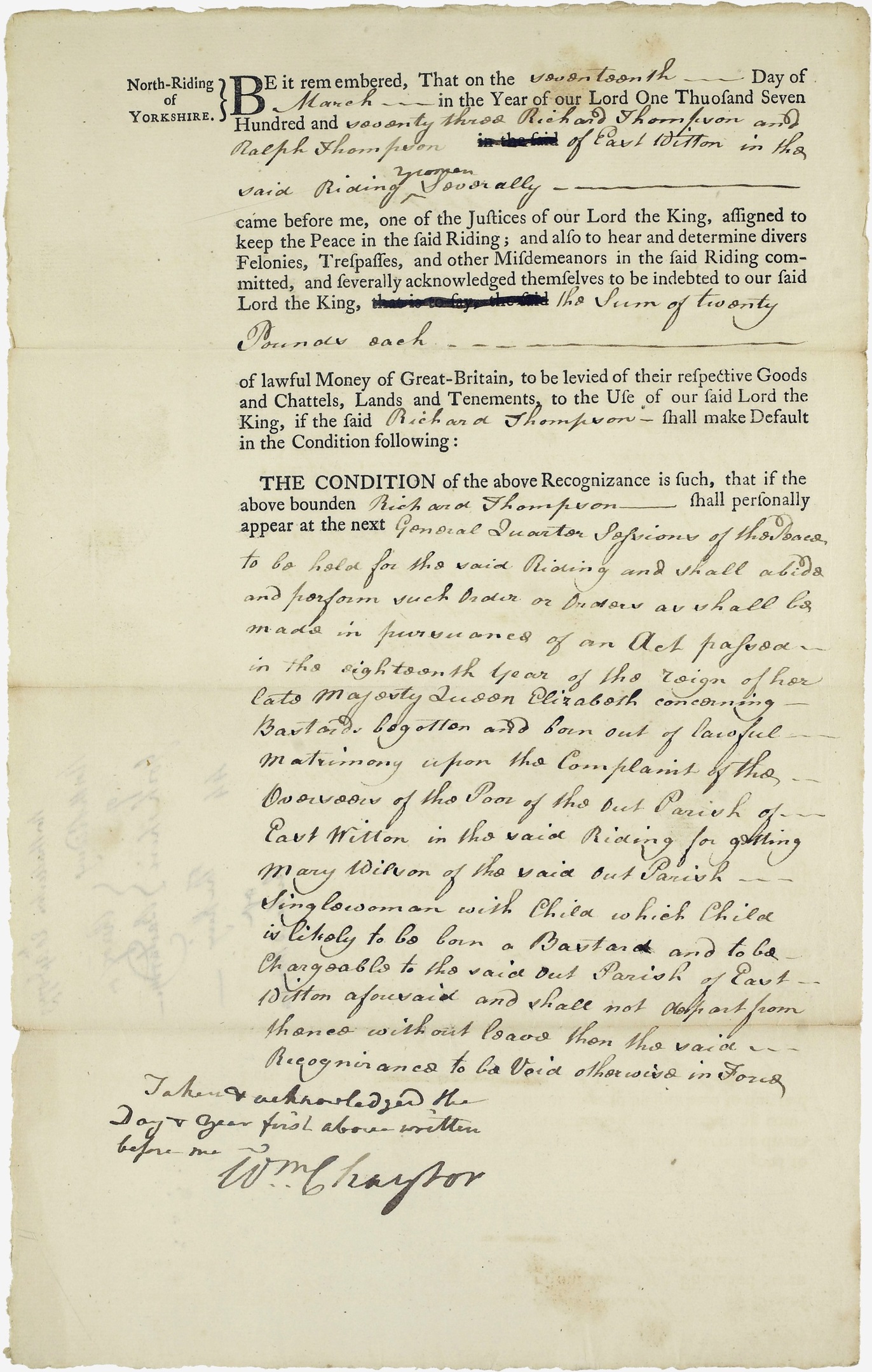
Recognizance in bastardy, QSB 1773
This recognizance (a bond or obligation) relating to bastardy was entered into by Richard Thompson and Ralph Thompson, yeomen of East Witton. Richard Thompson had to appear at Quarter Sessions to answer in relation to a child of Mary Wilson. If Richard failed to appear at Quarter Sessions he and his surety would forfeit £20 each.
Settlement and removal
Settlement refers to the right of a person to ‘belong’ to a particular parish, which was responsible for providing them with poor relief, if needed. Settlement certificates were issued by the parish as evidence of this. A person gained the right of settlement under several conditions, including birth, marriage, apprenticeship, and employment. A person’s place of settlement could change over time.
The Quarter Sessions dealt with disputed settlement cases, and settlement examinations determined which parish was legally responsible for someone. If a person became chargeable (likely to need poor relief) and did not have legal settlement in the parish they were living in, a removal order could be issued. This removal order directed that the person be sent back to their parish of legal settlement.
Removal orders were often issued to vagrants, rogues, vagabonds, paupers, unlicensed pedlars, and single mothers and their children, to avoid them becoming financially reliant upon a parish. It required two Justices to order the removal of an individual or family to the parish where they were last settled. A person who refused to comply with the removal order could be sent to the House of Correction as punishment.
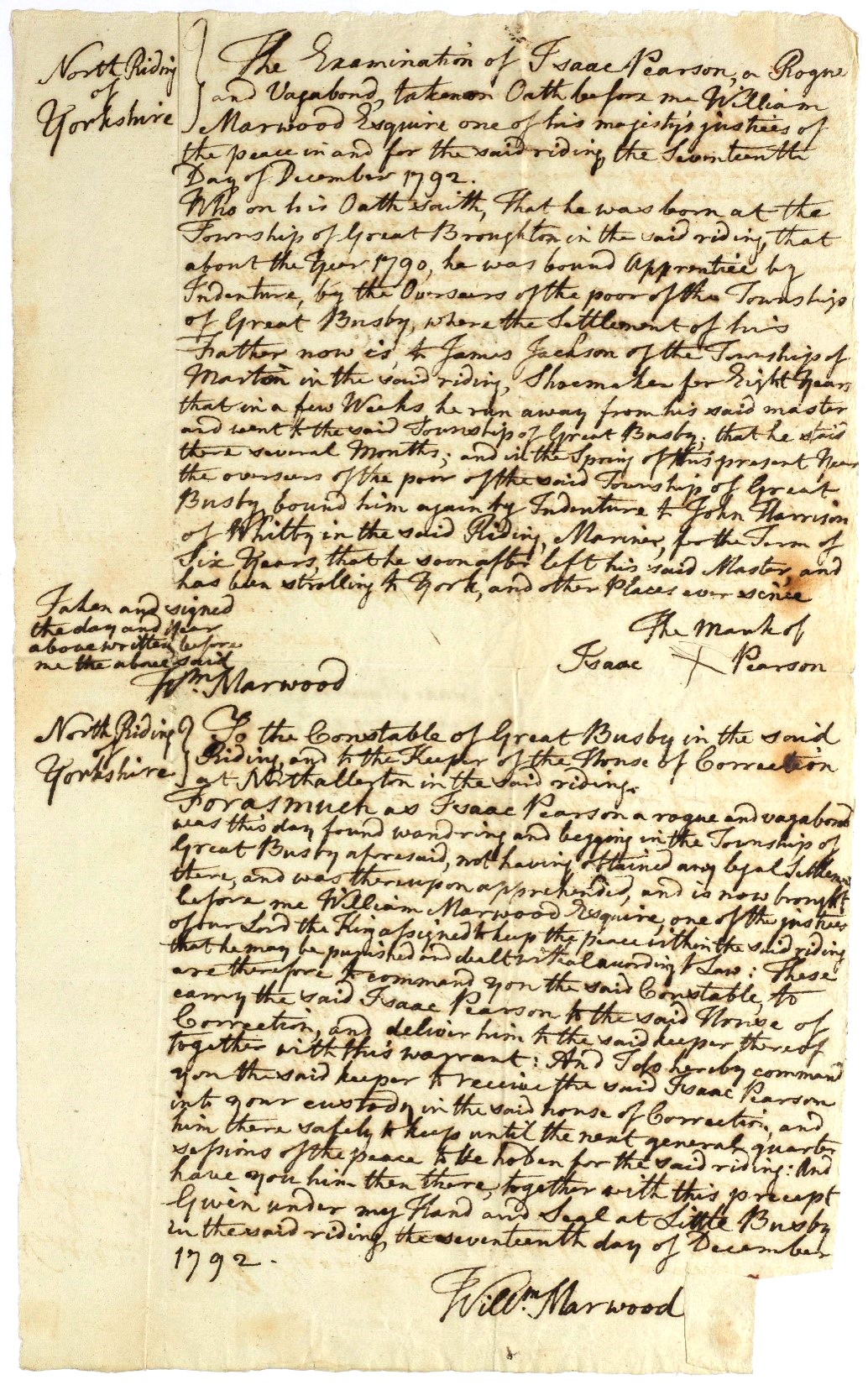
Settlement examination of Isaac Pearson, 1792 [QSB 1793 1/11/6]
Isaac Pearson was born in Great Broughton. He was bound as an apprentice by the Overseers of the Poor, but ran away to Great Busby. A few months later, the Overseers of the Poor of Great Busby bound him as an apprentice to a mariner in Whitby, but he again left and has been strolling to York and other places, before being apprehended as a rogue and vagabond for wandering and begging in Great Busby. This order requires the Constable of Great Busby to take Isaac to the Northallerton House of Correction to appear at the next Quarter Sessions.
The name Isaac Pearson appears in the Quarter Sessions bundles a number of times between 1793 and 1798 for a number of felonies, and for being a deserter from the 35th Regiment of Foot.
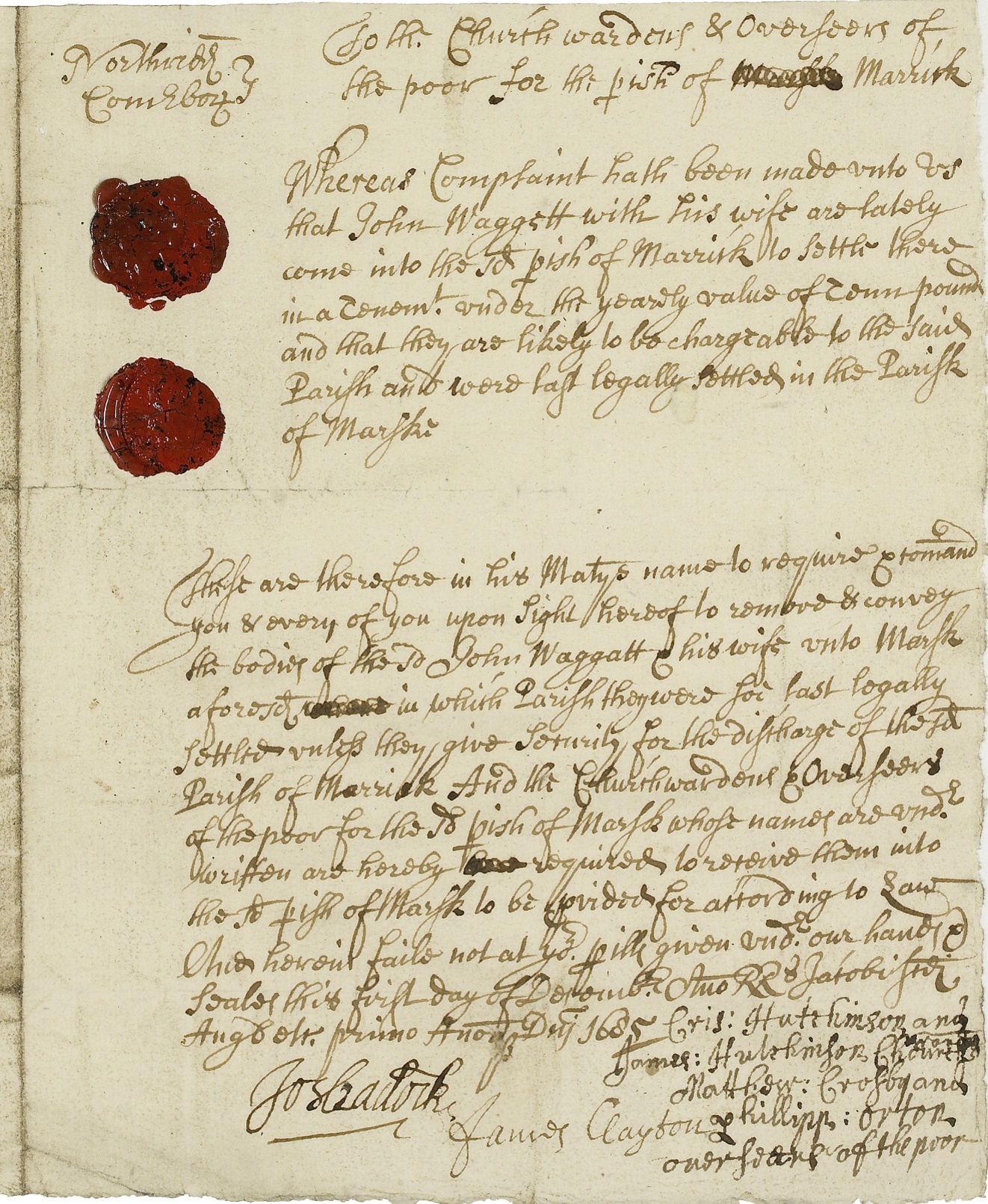
Removal order, QSB 1686/129
The Justices issued this order to remove John Waggett and his wife from the parish of Marrick to the parish of Marske, where they were last legally settled.
Returns to Quarter Sessions
Returns refer to the official reports, records, and other documents that were submitted to the Quarter Sessions by local officials, often detailing various administrative matters. These returns cover a wide range of subjects. They can include, for example, returns listing the names and rank of officers and men of the North Riding Militia in the late-18th century; returns of alehouse recognizances (guarantees that the innkeeper will operate according to local laws, including controlling the sale of alcohol and maintaining order); examinations of weights and balances, and fines for defective measures; statistical returns of crimes and sentences in a particular year; the number of vagrants committed to gaol; and the numbers of prisoners in a particular gaol.
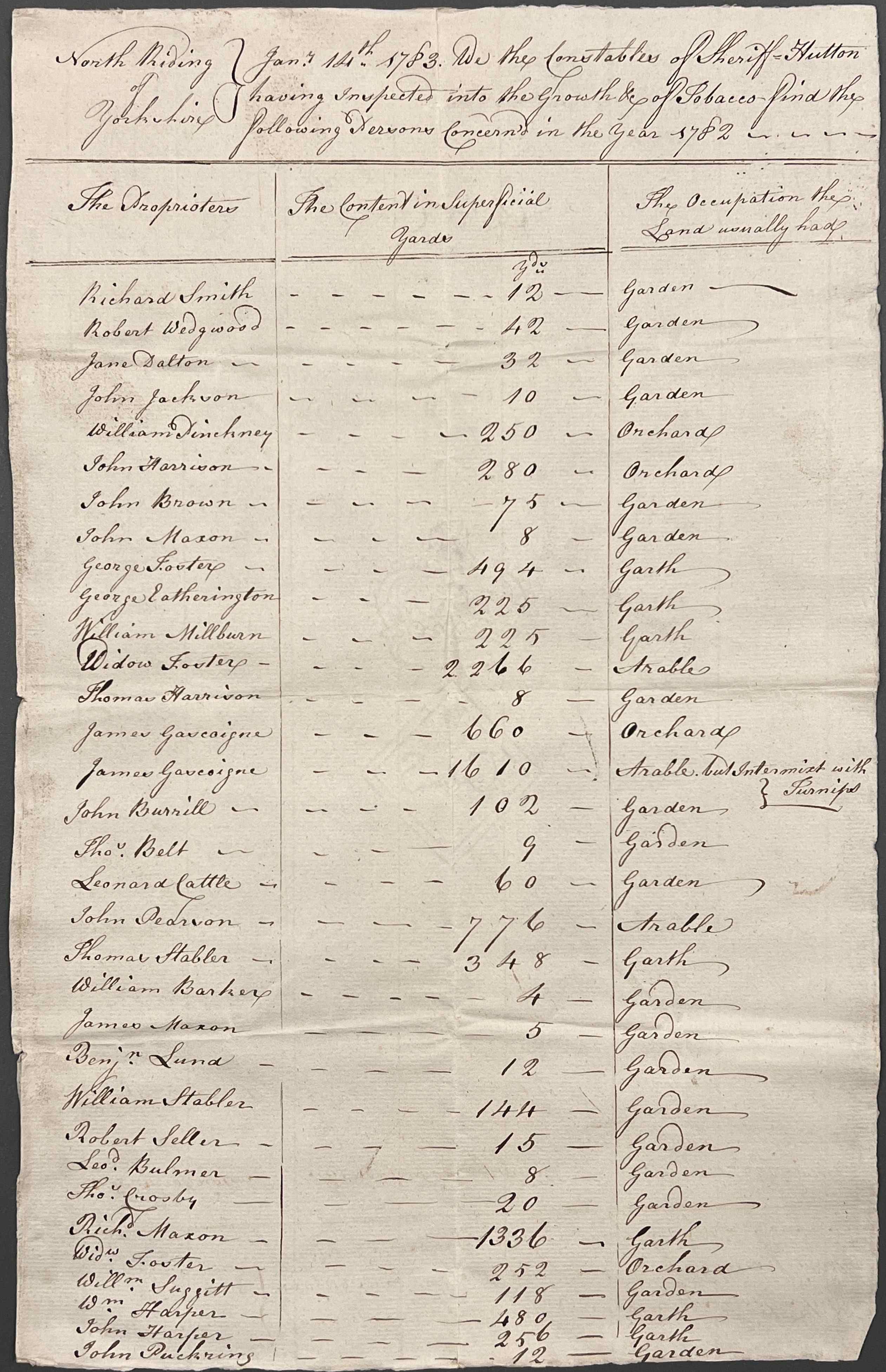
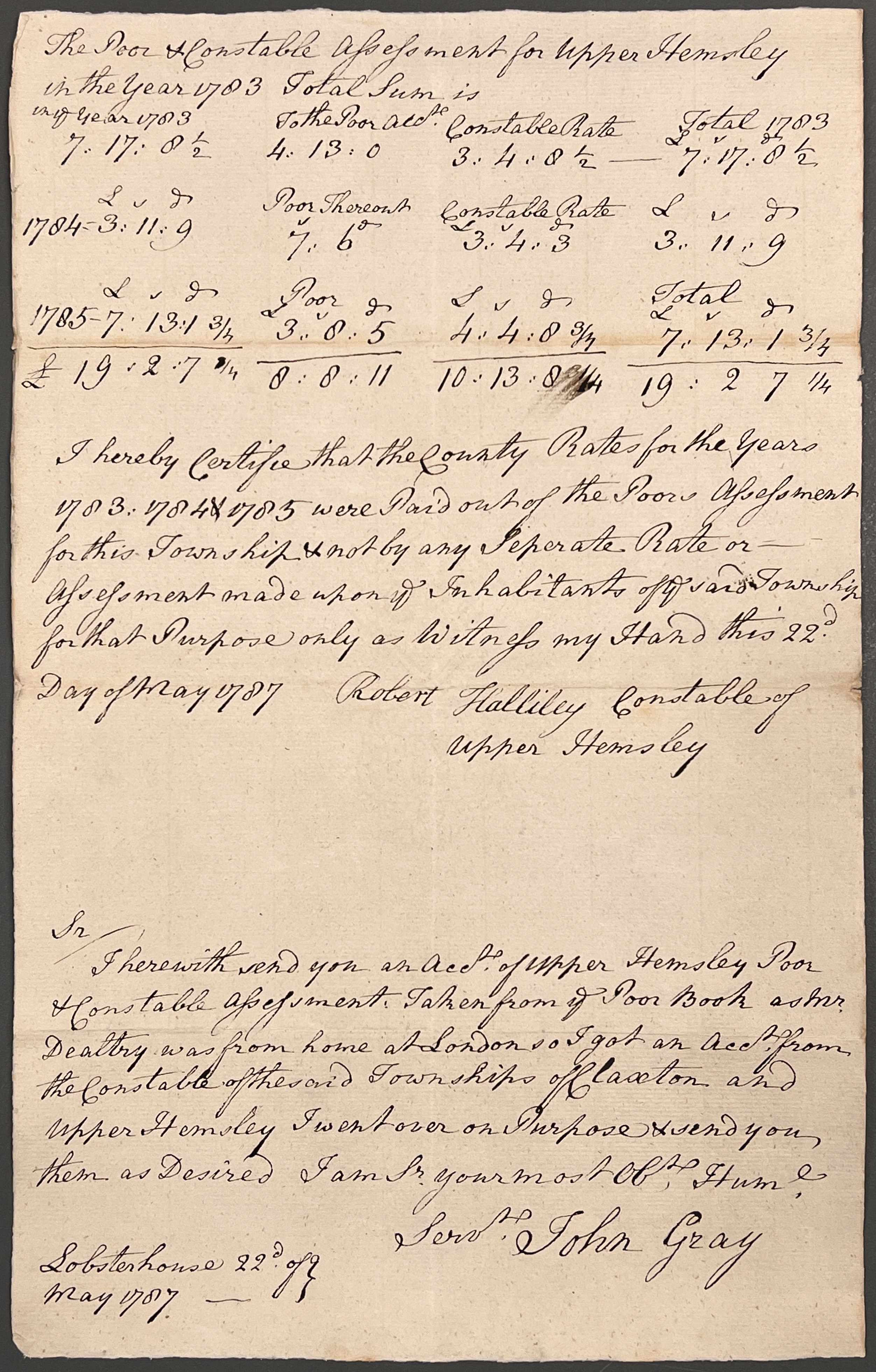
Left: Return of the Constables of Sheriff Hutton for the year 1782 following their inspection of the growing of tobacco, 14 January 1783 [QSB 1783 1/12] & Right: The Poor and Constable Assessment for Upper Helmsley, 1783-1787, recorded by Robert Halliley, Constable of Upper Helmsley, & submitted by John Gray, 22 May 1787 [QSB 1787 4/12]
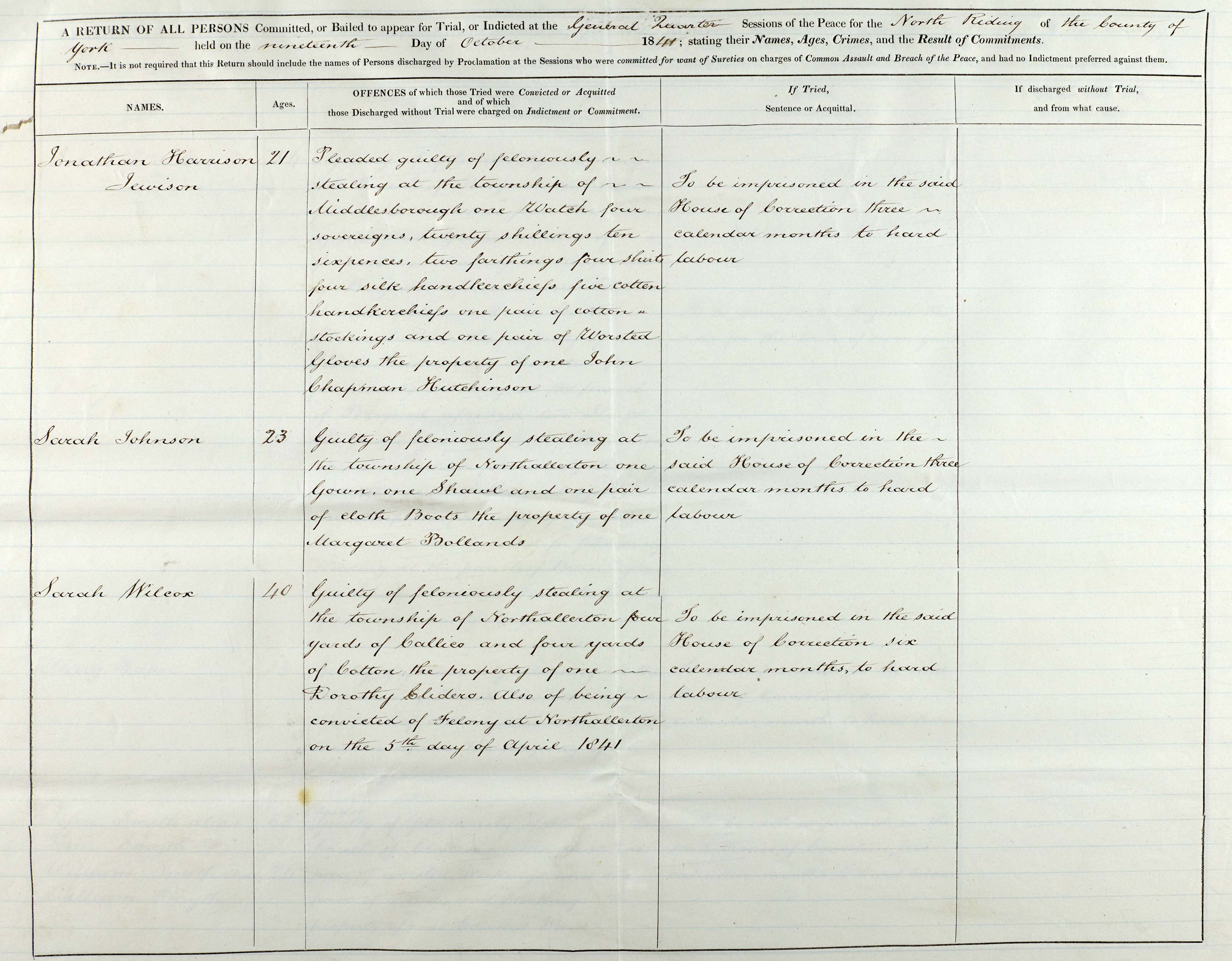
A return of all persons committed, or bailed, to appear for trial, or indicted, at the general Quarter Sessions of the North Riding on 19 October 1841 [QSB 1841 4/9]
The above return records the person’s name, age, offence for which they were convicted and their sentence. All three were found guilty of theft and were sentenced to either three or six months of hard labour at the House of Correction in Northallerton.
Highways and bridges
Until the early 19th century, Justices of the Peace enforced legislation that required local communities to keep their highways in a good state of repair, overseen by the parish Surveyor of the Highways. If a road fell into disrepair, and caused inconvenience or danger, the inhabitants of the parish through which it ran could be held collectively responsible for fixing it. The Quarter Sessions could raise a presentment (complaint), and an indictment could be issued against the inhabitants of the particular parish to order that repairs be carried out, sometimes specifying how much labour or what materials must be provided. Fines could be imposed for non-compliance.

Confirmation that the highway between Romaldkirk and Barnard Castle is in sufficient repair following indictment of the local community to carry out repairs, 27 July 1703 [QSB 1703 13/186]
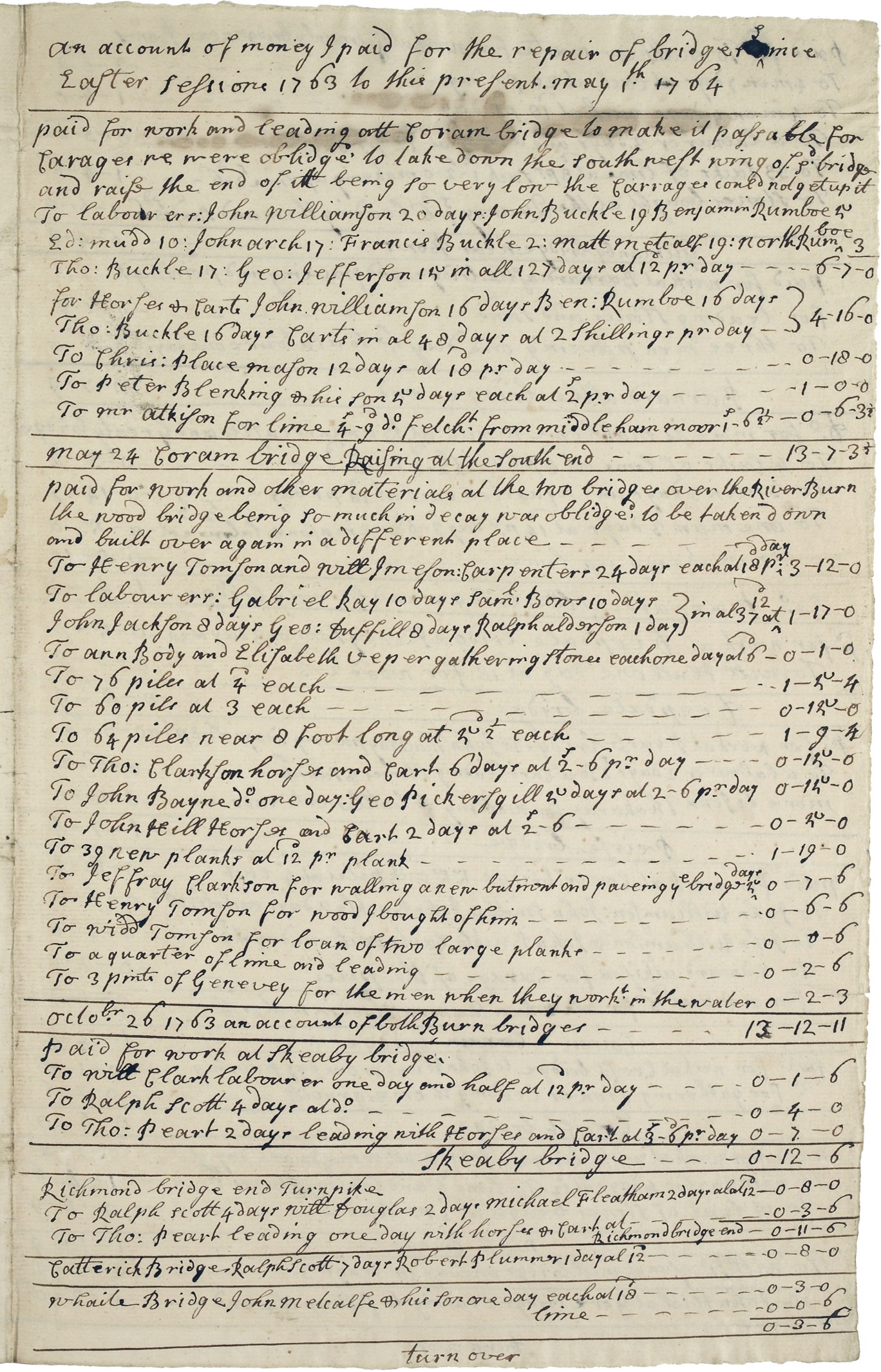
An account of money paid for the repair of bridges, QSB 1764
In a similar way to highways, the repair of bridges was a recognised public duty. The Justices of the Peace were given the power to enquire, hear and determine all annoyances of bridges and to raise a rate for their repair. They were also authorised to appoint Bridgemasters, whose duty it was to oversee the building of, or repairs to, particular bridges.
This document is an account of money paid by the Justices of the Peace towards the repair of various bridges throughout the county.
General administrative papers
The Quarter Sessions dealt with a range of other administrative matters, a few examples of which are pictured below.
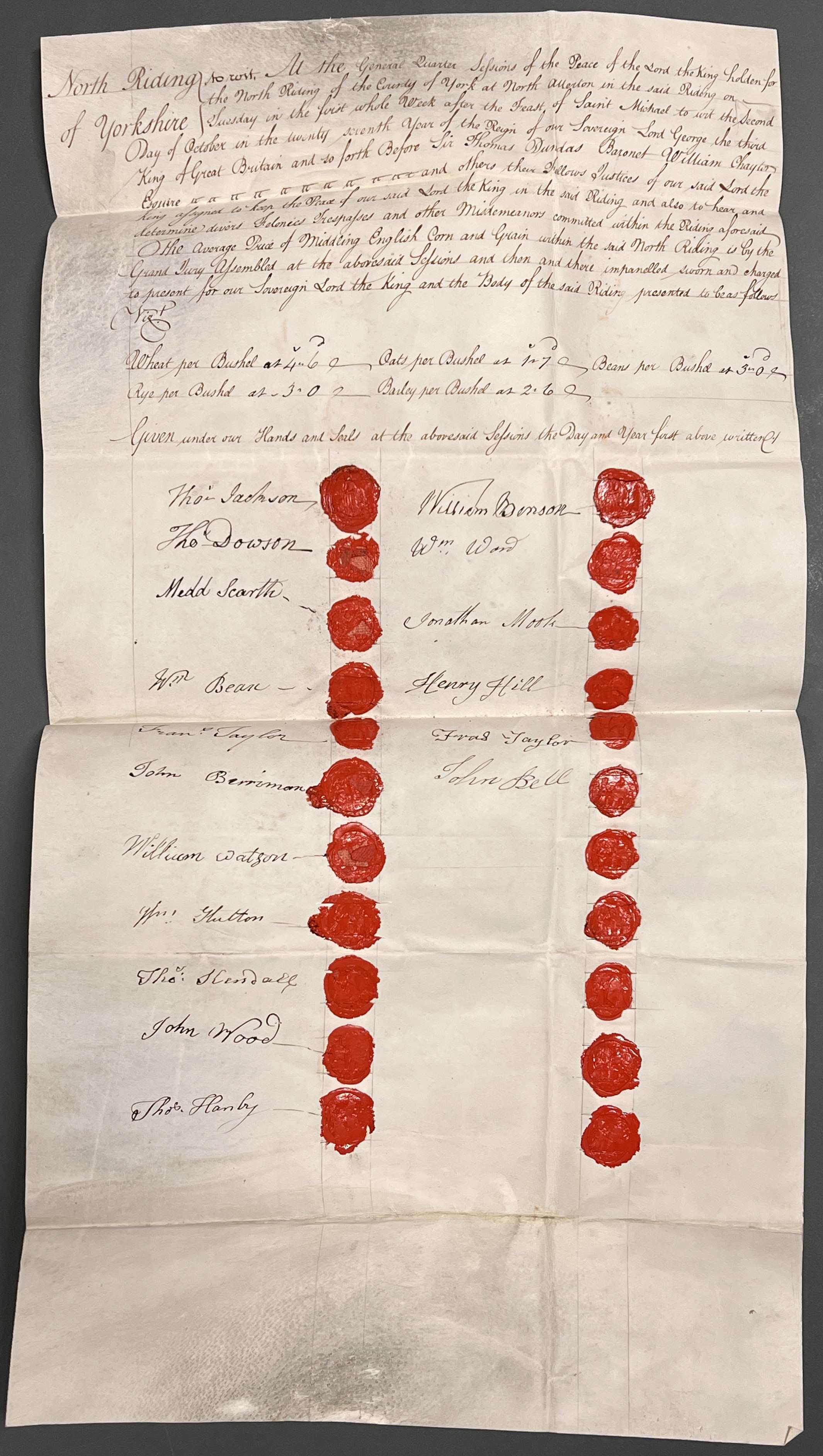

A corn presentment recording ‘the average price of middling English corn and grain’, 2 October 1787 [QSB 1787 4/14]
The above document records the price of various, staple agricultural crops per bushel: wheat, rye, oats, barley and beans. The Quarter Sessions had a role in overseeing the fair pricing and supply of corn and grain.
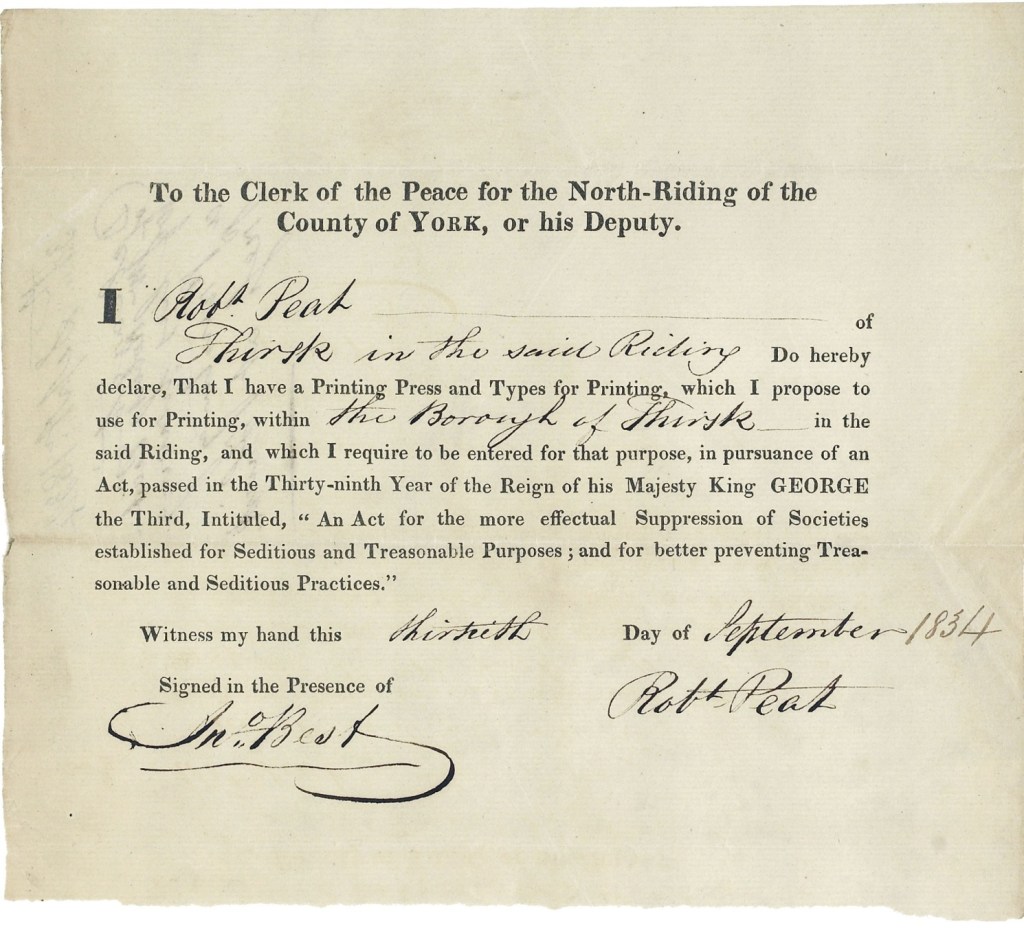
A declaration relating to a printing press, QSB 1834
Justices of the Peace wanted to avoid any literature or posters being printed that could cause public disturbances. In order to do this, all printing presses had to be licensed and Justices would regularly visit and inspect such printing presses.
In this document, Robert Peat of Thirsk declares that he has a printing press in the borough of Thirsk.
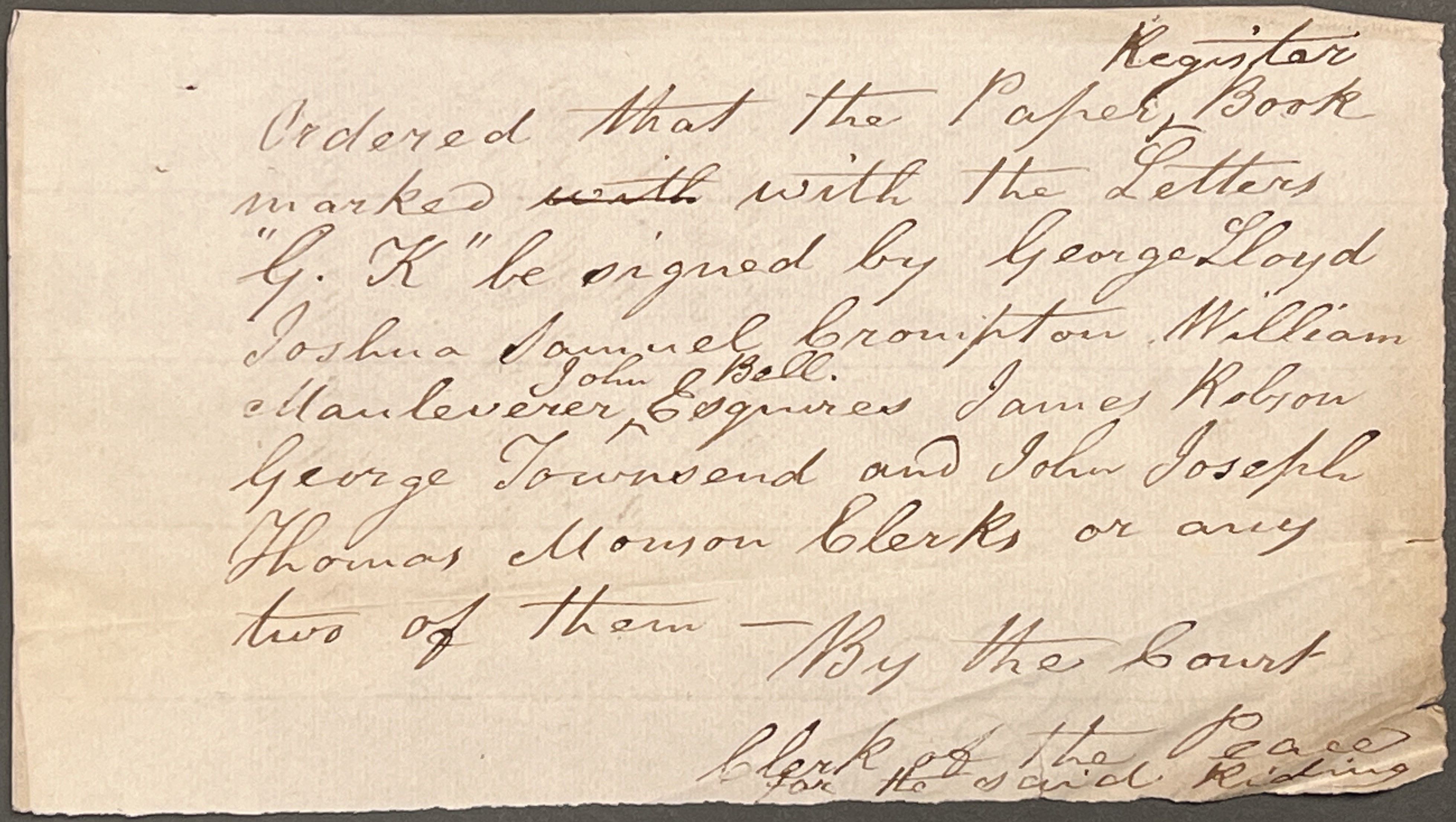
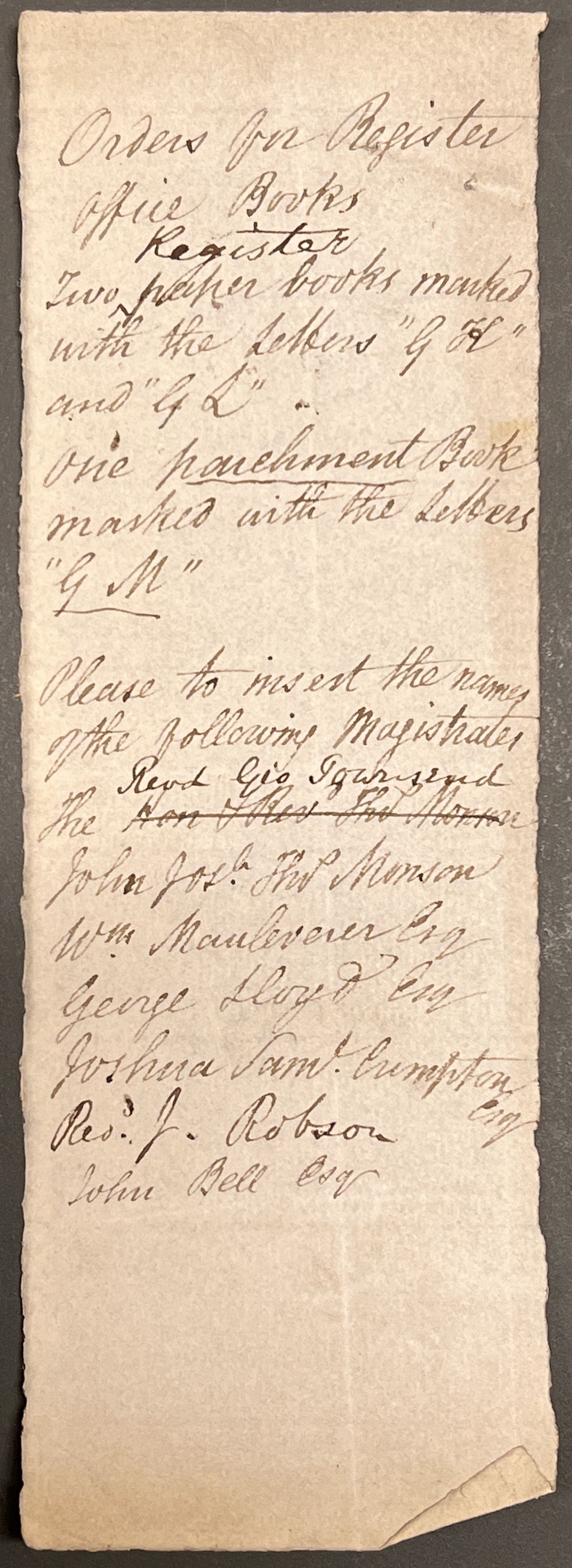
Order for books for the North Riding Registry of Deeds: two paper books to be marked with the letters ‘GK’ and ‘GL’, and one parchment book to be marked ‘GM’ [QSB 1836 4/14]
Further information about the North Riding Registry of Deeds can be found in our online house history guide.
Bills and vouchers (including payments for prosecution costs)
In each Quarter Sessions’ bundle, there are usually large numbers of vouchers, i.e. bills and receipts. These may, for example, relate to work completed on roads and highways; repair work at the House of Correction, Register House and Court House; provisions for the House of Correction; payments to parish constables for escorting various persons; payments for stationery and much more.
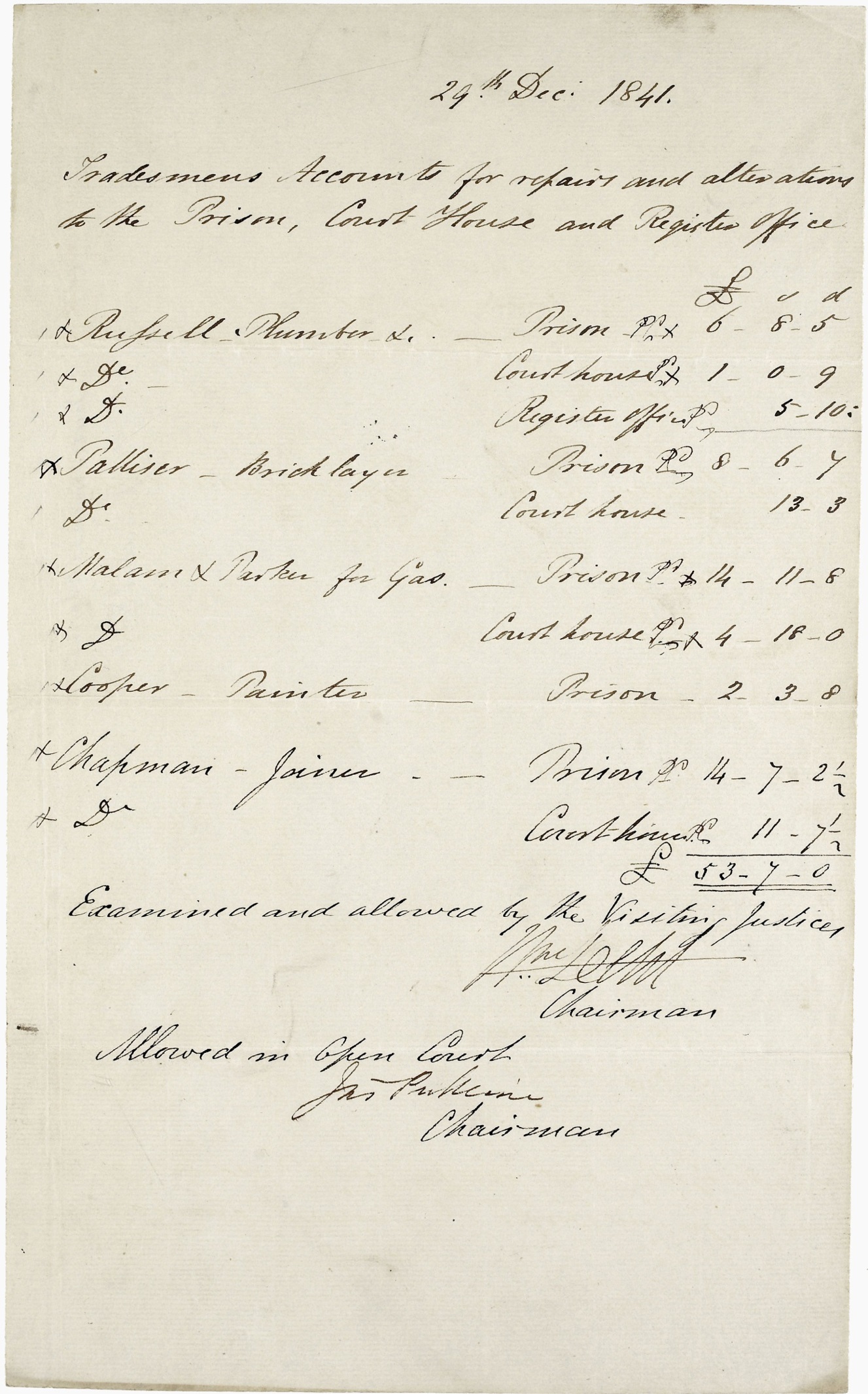
Tradesmen’s accounts for repairs and alterations to the Prison, Court House and Register Office, QSB 1842
In addition to the maintenance of roads and bridges, Justices of the Peace were also charged with maintaining the County Prison, Court House and other county buildings.
This tradesmen’s account shows payment for repairs and alterations made to the Prison, Court House and the Register Office, with money being spent employing a plumber, bricklayer, painter, and joiner, and for the supply of gas.
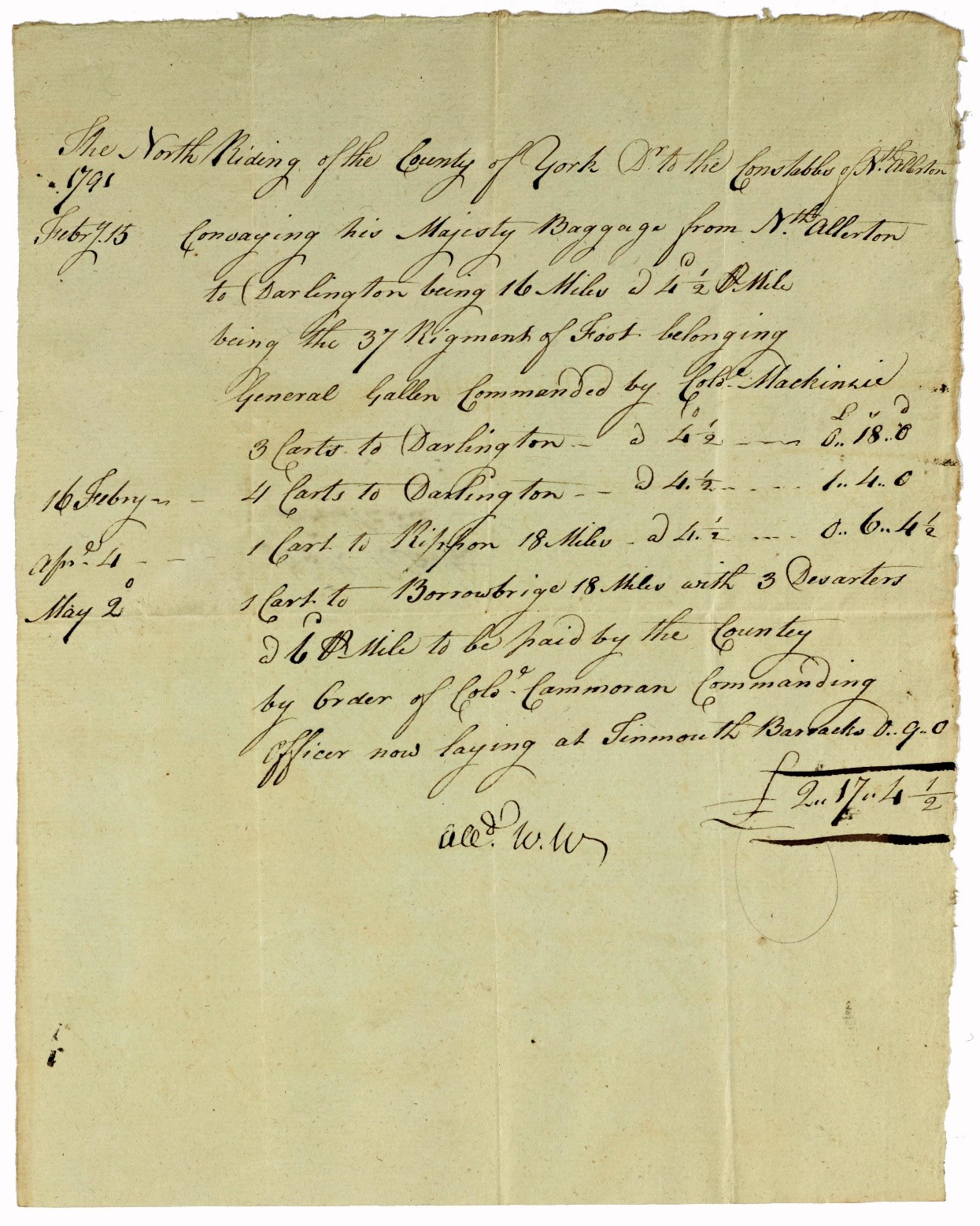
Bill of expenses for conveying soldiers’ baggage [QSB 1791 4/15/25]
Bill of expenses of the constables of Northallerton for conveying the baggage of the 37th Regiment of Foot, belonging to General Gallen and commanded by Colonel Mackinzie, from Northallerton to Darlington on 15 and 16 February, and from Northallerton to Ripon on 4 April at a rate of 4½ pence per mile; and for taking three deserters from Northallerton to Boroughbridge on 2 May 1791, to be paid by the County by order of Colonel Cammoran commanding officer, now at Tinmouth barracks.
A total bill of £2. 17s 4½d.
Coroner
In the 18th and 19th centuries, the main role of the coroner was to investigate sudden, unexpected, or unnatural deaths within their jurisdiction. This involved determining the identity of the deceased, the cause of death, and the circumstances surrounding the death. The coroner was appointed by the Crown and operated independently of the Quarter Sessions court. The Quarter Sessions’ bundles contain abstracts of the inquests submitted to the Assizes.
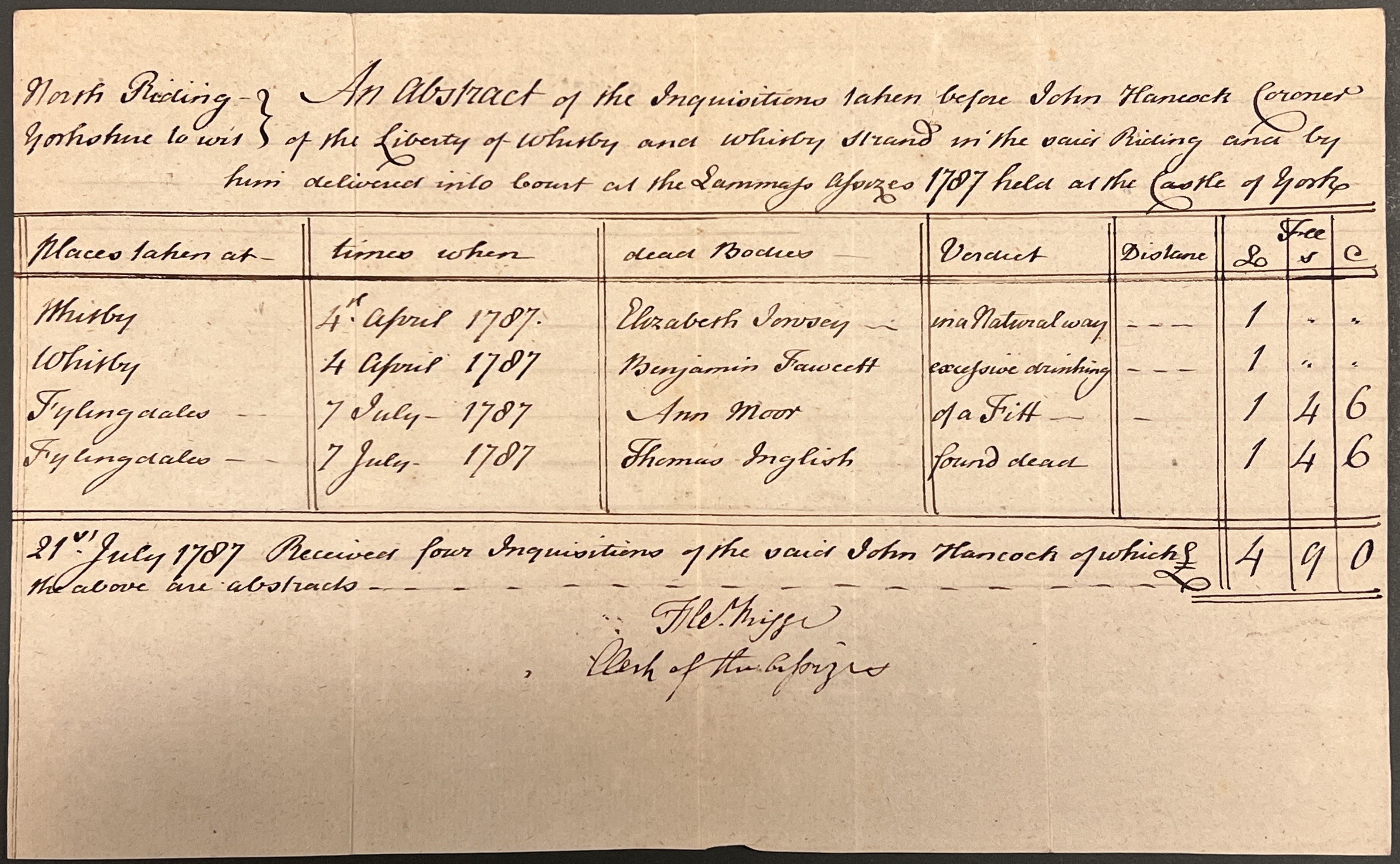
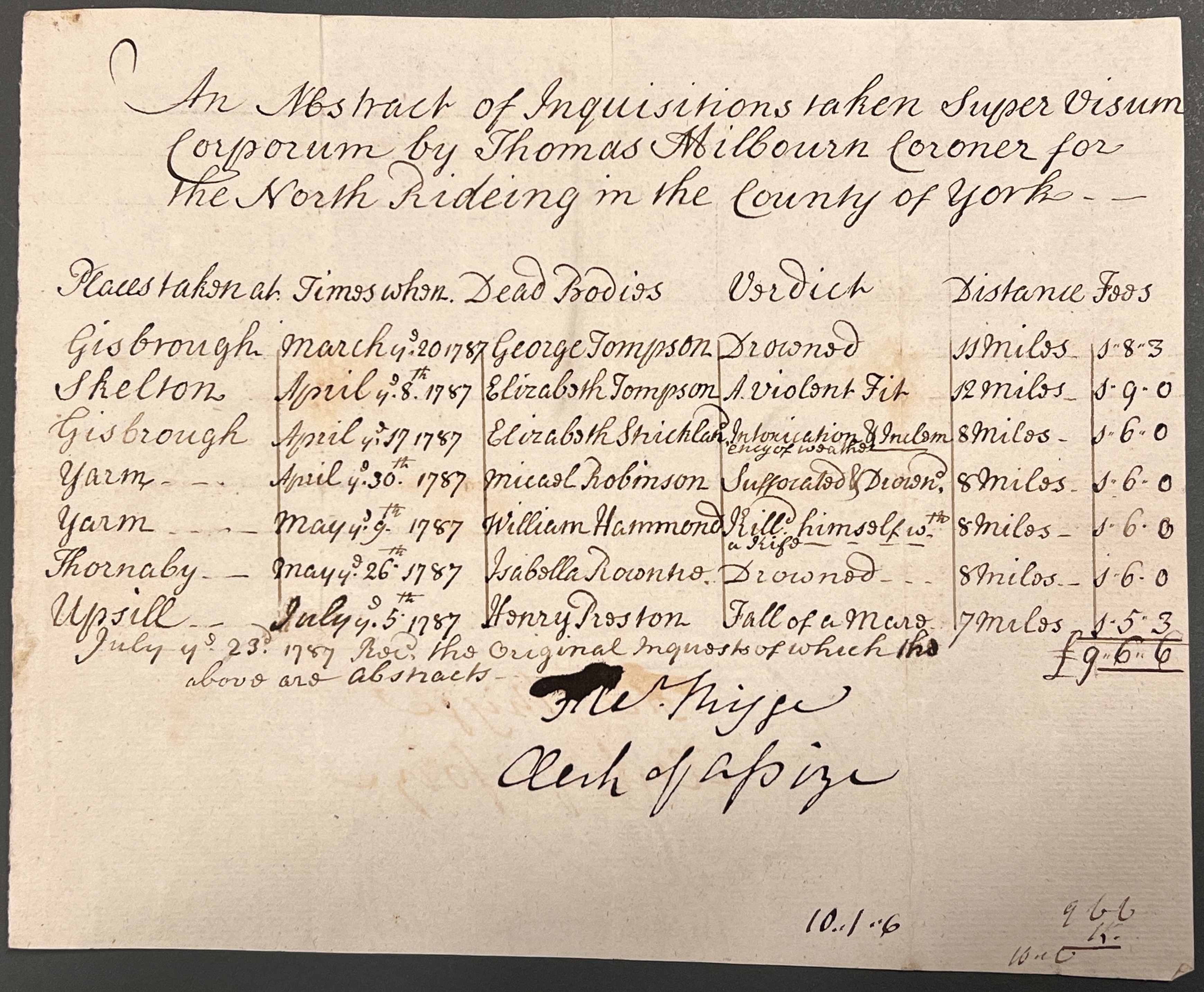
Abstracts of the inquisitions taken before coroners of the North Riding: John Hancock and Thomas Milbourn, recording the locations and dates of the inquests held, names of the deceased and their causes of death, distances travelled by the coroner and his fees, the former delivered into court at the Midsummer Assizes held at the Castle of York, 1787 [QSB 1787 4/16]
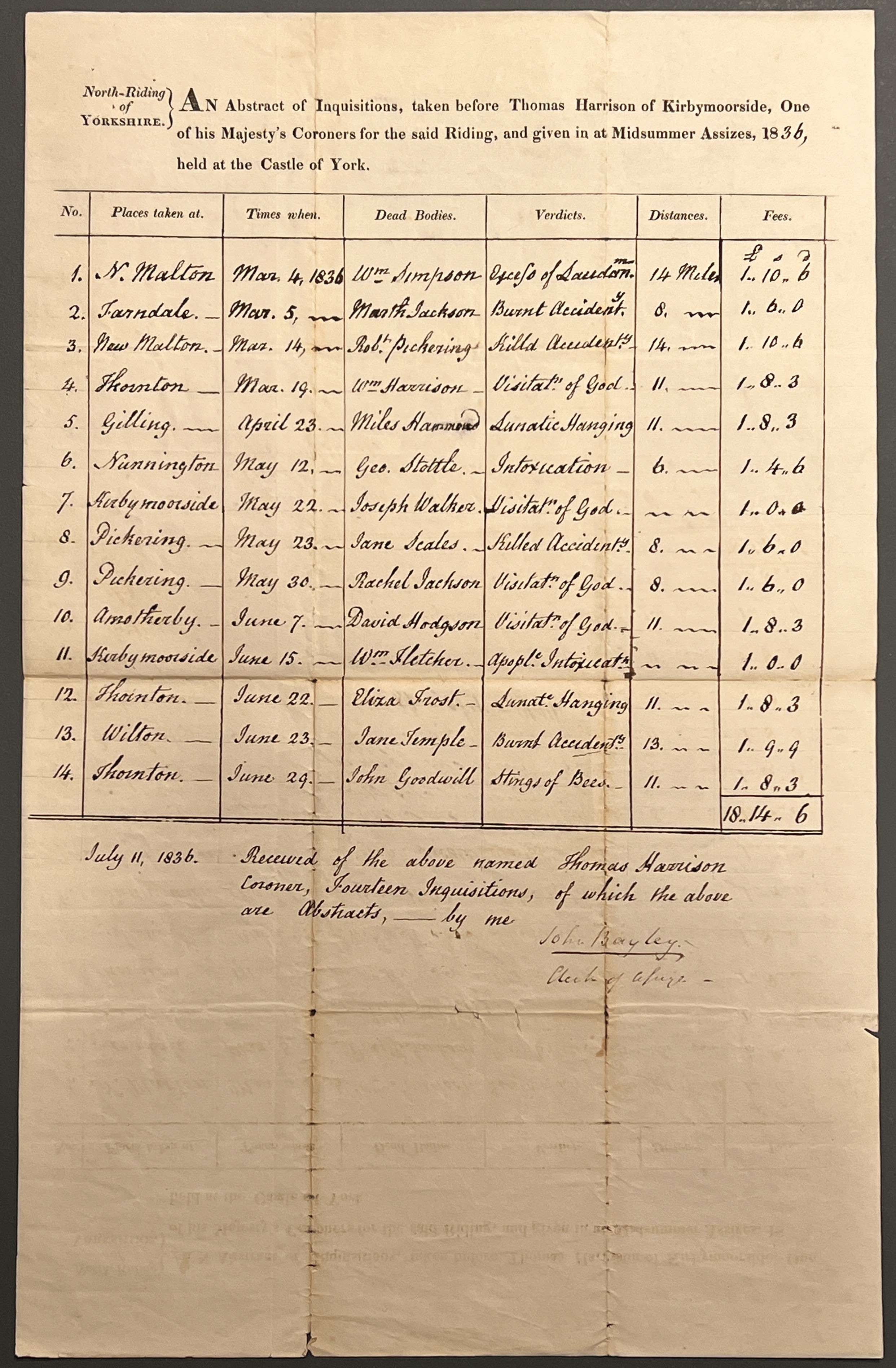
Abstract of the inquisitions taken before coroner Thomas Harrison of Kirkbymoorside, recording the locations and dates of the inquests held, names of the deceased and their causes of death, distances travelled by the coroner and his fees, given to the Midsummer Assizes held at the Castle of York, 1836 [QSB 1836 4/16]
Reports of coroner’s inquests may also be found in contemporary newspapers, which may contain additional details not found in the papers of the Quarter Sessions. Increasing numbers of local newspapers are now available to search online via the British Newspaper Archive subscription website. This resource is available to search via computers in most North Yorkshire libraries as well as our Archives’ searchroom, by appointment.
Other blog posts on the North Riding Quarter Sessions:
- Introducing the Quarter Sessions and those who attended: All Human Life: North Riding Quarter Sessions, 1660-1971
- The various types and subjects of the Records of the North Riding Quarter Sessions
- Juvenile offenders in the North Riding Quarter Sessions
- North Riding Quarter Sessions’ scandals
- Previous blogs on stories of criminal women who appear in North Riding Quarter Sessions’ records
Further reading:
Dickinson, William, 1815. A Practical Guide to the Quarter and other Sessions of the Peace adapted to the use of young magistrates and gentlemen of the legal profession, at the commencement of their public duties, Reed and Hunter: London.
General Rules for Regulating the Practice of the Court of General Quarter Sessions of the Peace for the North Riding of the County of York printed by E. Langdale: Northallerton, 1833.
The National Archives’ online guide: How to look for records of criminal court cases: assize courts 1559-1971.
Pritchard, Thomas Sirrell, 1875. The Jurisdiction, Practice & Procedure of The Quarter Sessions in Judicial Matters – Criminal, Civil and Appellate, Stevens & Sons Ltd: London.
Ratcliffe, Richard, 2007. Basic Facts about … Quarter Session Records, Federation of Family History Societies (Publications) Ltd.
Thorp, Linton K.C. and Raymond E. Negus, 1946. Quarter Sessions Handbook (2nd edition), Stevens & Sons Ltd: London.
Wigram, W Knox & Archibald Henry Bodkin, 1892. The Justice’s Note-Book containing the jurisdiction and duties of Justices and an epitome of criminal law (6th edition), Stevens & Sons Ltd: London.
 North Yorkshire Archives Blog