
by Rachel Greenwood, Conservation and Digitisation Manager
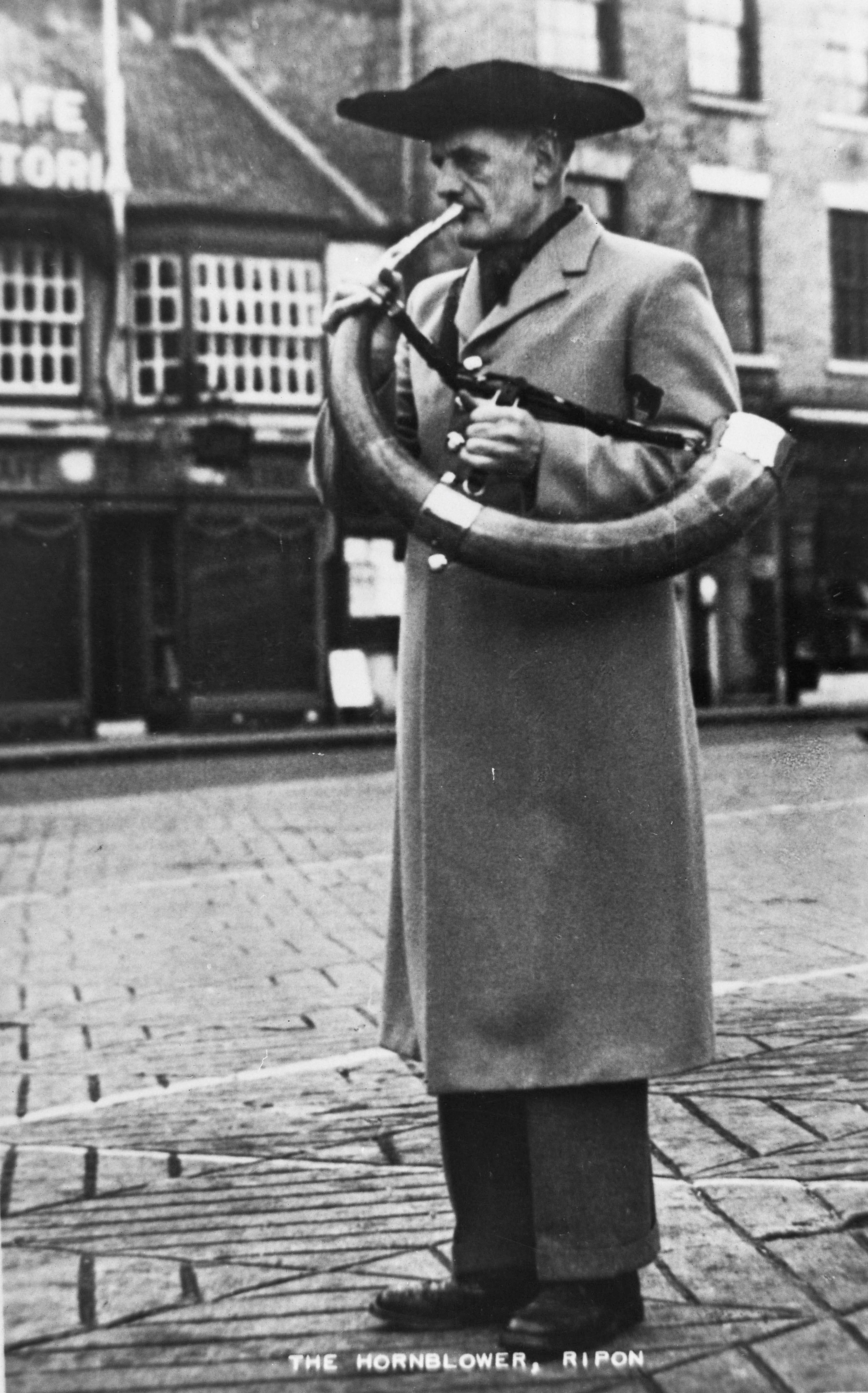
The Ripon Hornblower is one of the oldest and longest unbroken traditions in England. In the year 886, when Viking incursions were regular events, King Alfred the Great was impressed with Ripon and the support he received, so he granted a Royal Charter in the unusual shape of a Horn, known as ‘The Charter Horn’.
Every day at dusk, the “Wakeman” blew the horn at all four corners of the market cross, setting the ‘watch’ over the city, allowing the residents to sleep safely till dawn. The Wakeman had the power to police the streets and exact fines, but was also required to make compensation in the event of burglary during the hours of the watch.
As the Wakeman’s power grew, reforms were introduced in 1598 with a new, fourth, Town Book setting out duties, responsibilities, and penalties. In 1604, following a second Charter from King James I, the position of Wakeman was discontinued and replaced by a mayor, elected by public vote. Hugh Ripley was the last Ripon Wakeman, and then the first Mayor of Ripon. The mayor appointed the Hornblower to continue setting the watch.

The Charter Horn, no longer used as a blowing horn and now only used for ceremonial purposes [Ripon Re-Viewed collection EF446-A1804]
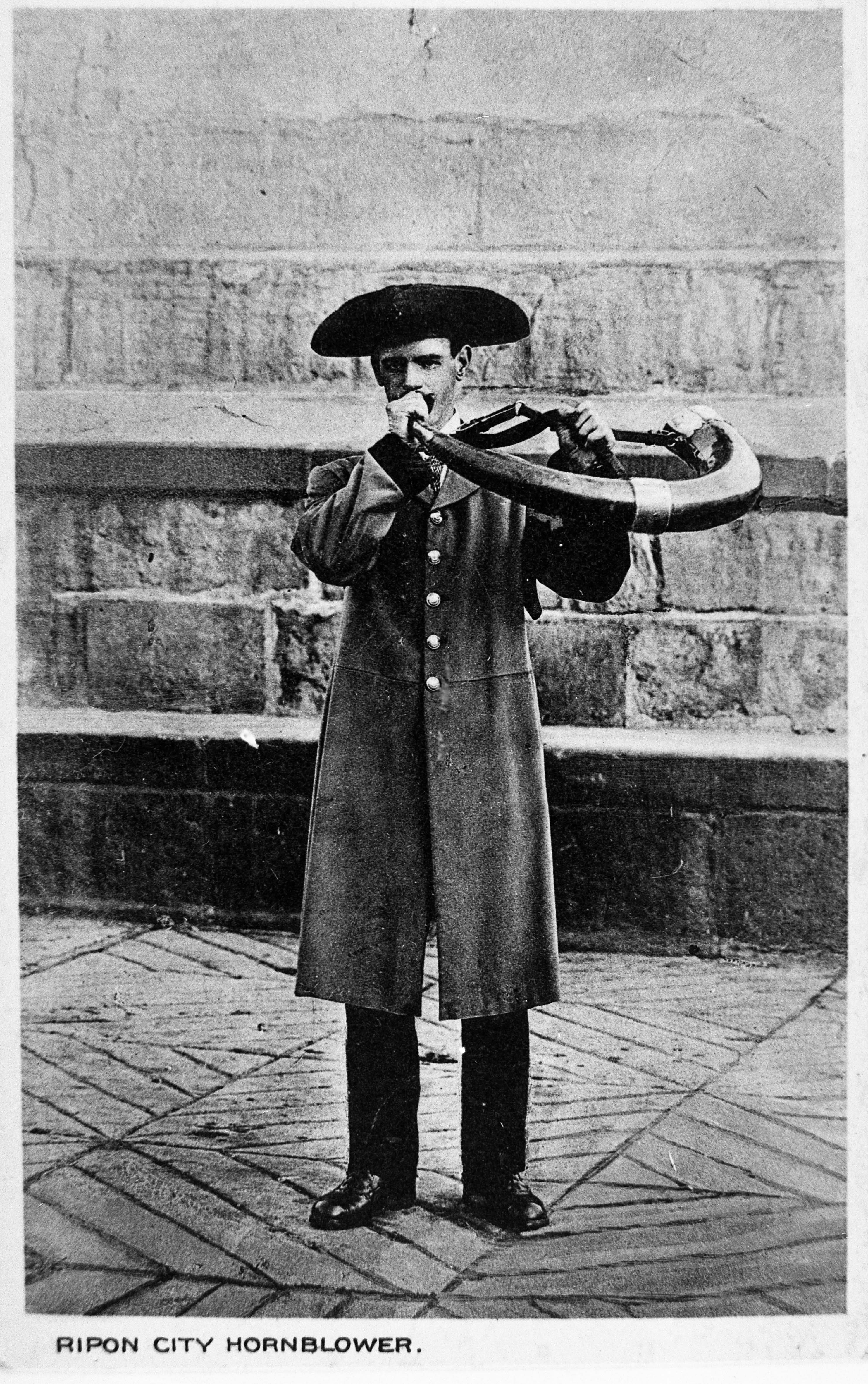
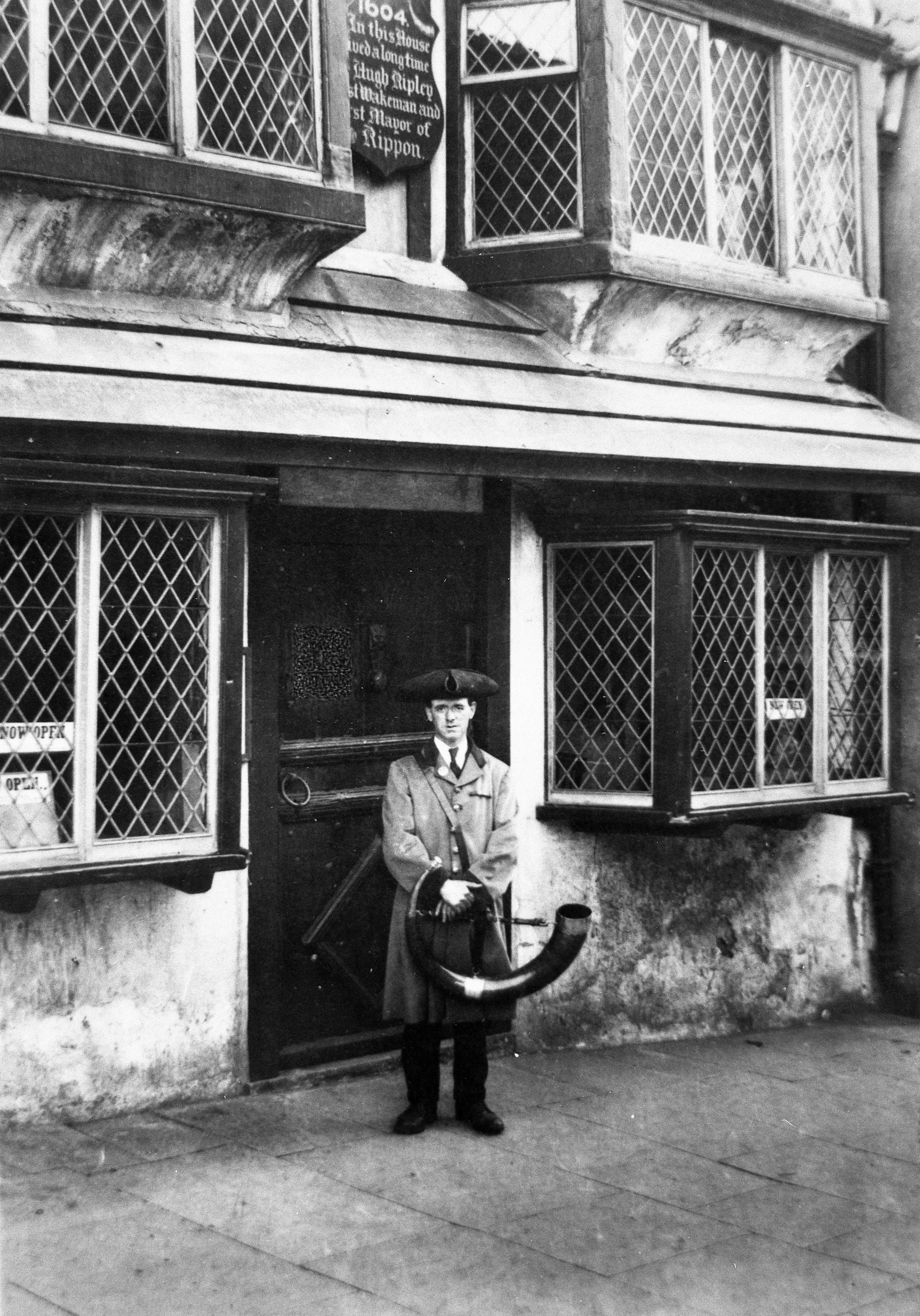
- Left: The Ripon Hornblower in front of the obelisk [Ripon Re-Viewed collection EF446-E2111]
- Right: The Hornblower in front of Wakeman’s House, Market Square, Ripon [Ripon Re-Viewed collection EF446-F2109]
Now a ceremonial duty rather than one of defence, the horn is blown every day at 9pm at all four corners of the obelisk, the hornblower must then find the mayor to report the start of their duty. Today, Ripon has a team of four hornblowers who share the role, including Allison Clark the first female hornblower (pictured below); each has their own horn.
The oldest horn still in use was purchased in 1690 by the Corporation for a fee of 6s 8d (about 34 pence today) as recorded in the Ripon Corporation Minute Book, 1691.
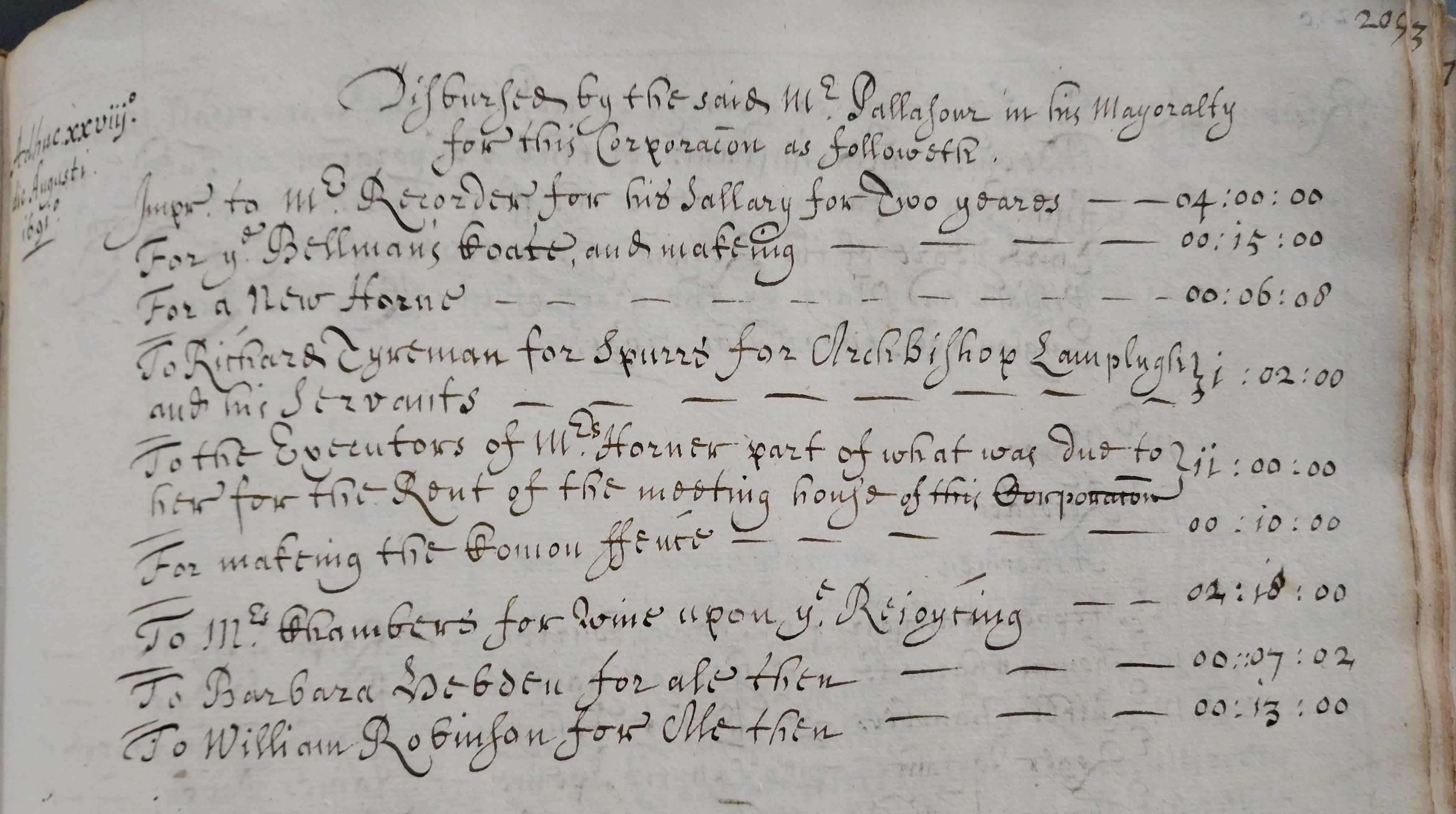
Extract from the Ripon Corporation Minute Book, 1691 recording expenditure ‘For a New Horne’ [DC/RIC II 1/1/2]
In 1865, the then Mayor of Ripon, purchased the next and largest of the horns. To celebrate 1100 years of Ripon City, Sigma Antiques presented the next horn and, most recently in 2019, the McHardy Quest Horn was added; this is the horn Allison uses.

Allison Clark, one of the current team of four Ripon Hornblowers, standing beside the obelisk in Ripon Market Square in her traditional grey and red uniform and tricorn hat, with the McHardy Quest Horn (picture courtesy of Allison Clark).
The Ripon Hornblower embodies the history, culture, and community spirit of Ripon. It is a living testament to the City’s enduring legacy and serves as a unique tradition for both locals and visitors alike.
Images of previous Ripon Hornblowers
The Ripon Re-Viewed Project collection includes a number of photographs of previous holders of the position of Ripon Hornblower, which are shown below.

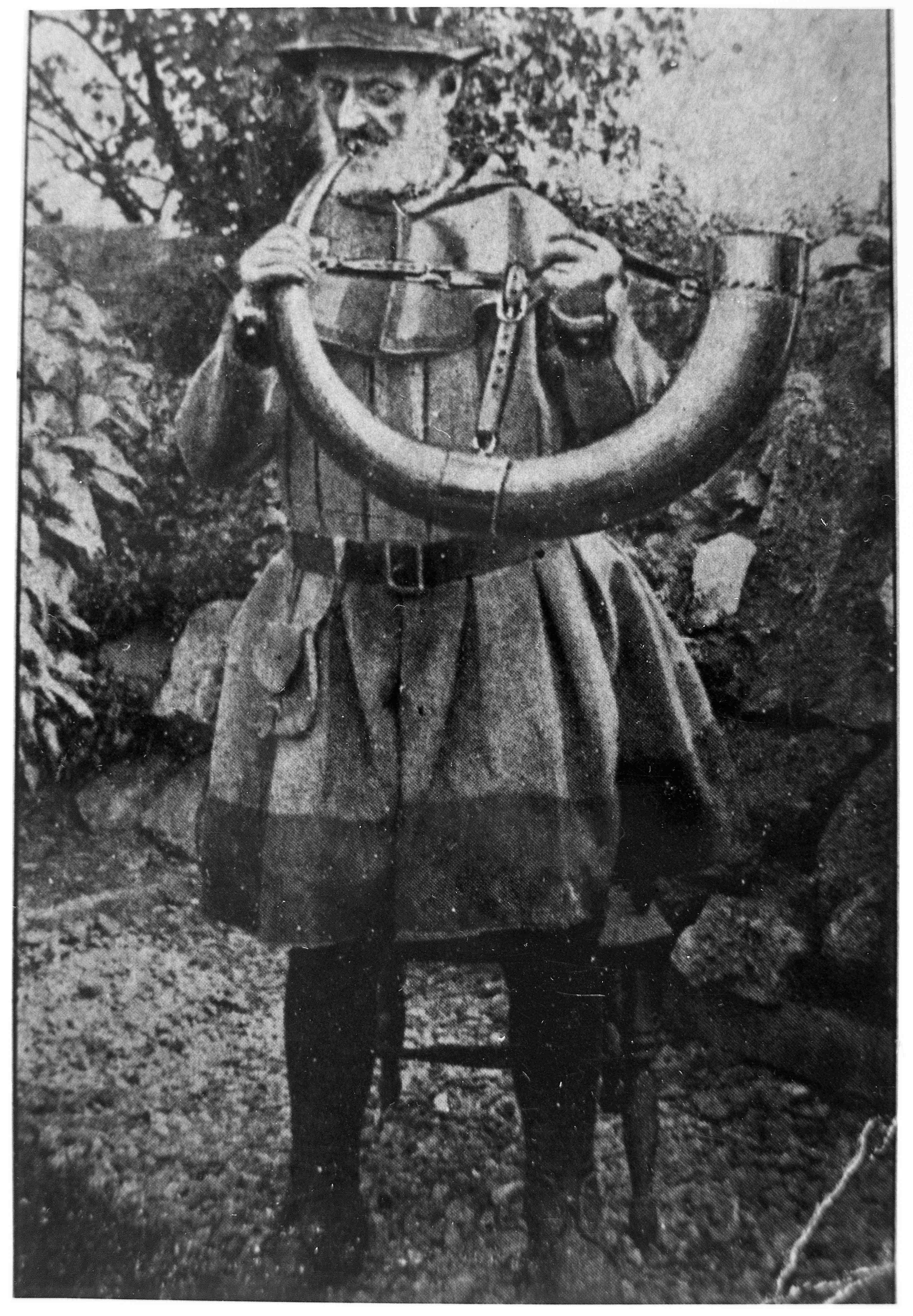

- Left: Benjamin Simmonds, Ripon Hornblower 1814-1846 [Ripon Re-Viewed collection EF446-E4011]
- Centre: John Simmonds, Ripon Hornblower, 1846-1887, who succeeded his father in this position [Ripon Re-Viewed collection EF446-E4010]
- Right: Edward Heward, Ripon Hornblower, 1903-1915 [Ripon Re-Viewed collection EF446-A1802]


- Left: Thomas Hawley, Ripon Hornblower 1915-1922 & 1944-1954 [Ripon Re-Viewed collection EF446-A1803]
- Centre: Jack H Ellis, joint Ripon Hornblower, 1955-1964 [Ripon Re-Viewed collection EF446-D4205]
- Right: Brian Waines, Ripon Hornblower, 1968-1972 & 1974-1977 [Ripon Re-Viewed collection EF446-141729]
Ripon obelisk
Standing some eighty feet high in the Market Square, the Ripon obelisk forms the focal point of the hornblower’s nightly ceremony. Built to replace an earlier market cross, it was designed by Nicholas Hawksmoor and constructed in 1702 with the support of John Aislabie, Member of Parliament for Ripon.
In 1781, the monument was restored by John’s son, William Aislabie, to celebrate his sixty years as Member of Parliament for Ripon. At this point, a weather vane was added in the style of the Wakeman’s horn, which can be seen in the photographs below. A plaque was added soon afterwards, which misleadingly implies that William was the builder of the monument. The obelisk was listed as Grade I in 1949 in recognition of its architectural significance. It is the earliest surviving free-standing monumental obelisk in Great Britain.
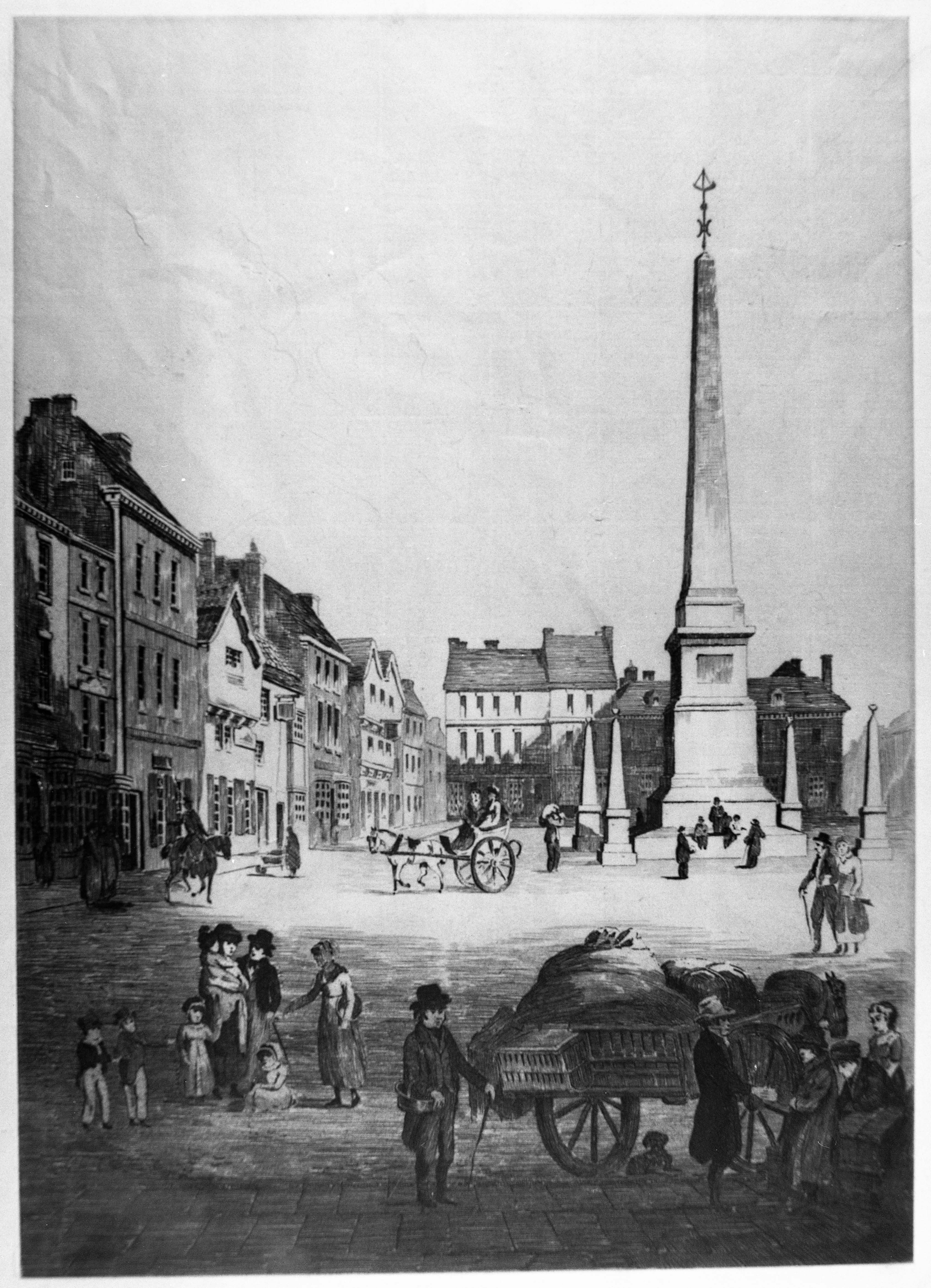
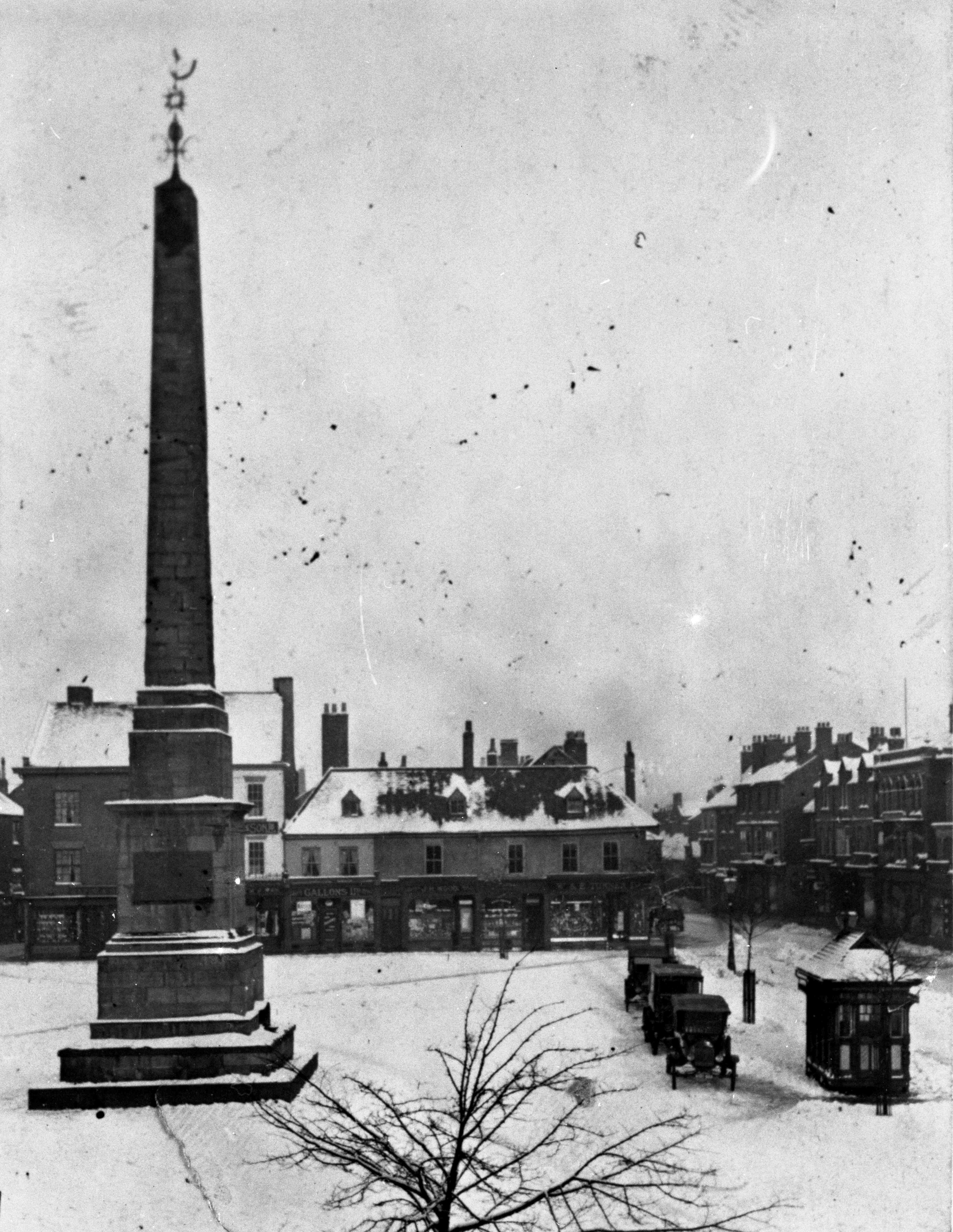
- Left: Sketch of a scene in Ripon Market Place on a Christmas card, taken from an original painting dated 1781 [Ripon Re-Viewed collection EF446-D6401]
- Right: Photograph of Ripon obelisk in the snow, undated [Ripon Re-Viewed collection EF446-141607]
In the Christmas card scene illustrated above, four smaller stone obelisks are clearly visible surrounding the base of the obelisk, adorned with decorative half-spheres. These may have been added by William Aislabie. Later, lamps were installed on top of these stone posts in October 1830, with the first illumination taking place in November of the same year. They were eventually removed in June 1882.
The document below records the monies raised by public subscription in 1702 to build the obelisk and pave the Market Square, naming all the contributors. It also identifies the names of all the workmen involved, the works they carried out and how much each was paid.


Copy account of the subscriptions and expenses for building the obelisk and paving Ripon Market Square, 1702 (19th-century copy) [DC/RIC VII 1/1/1]
The cost of building the obelisk in 1702 was £484 11s 9d [the equivalent of just over £96,000 today]. Paving the Market Square cost an additional eighty pounds [the equivalent of c.£16,000]. The total cost of the works was therefore £564 11s 9d, £238 and 8 shillings of which was raised by public subscription, including £50 [the equivalent of c.£10,000] as a legacy from Alderman Gibson, £50 from the Archbishop of York and £20 from the Dean and Chapter of Ripon.
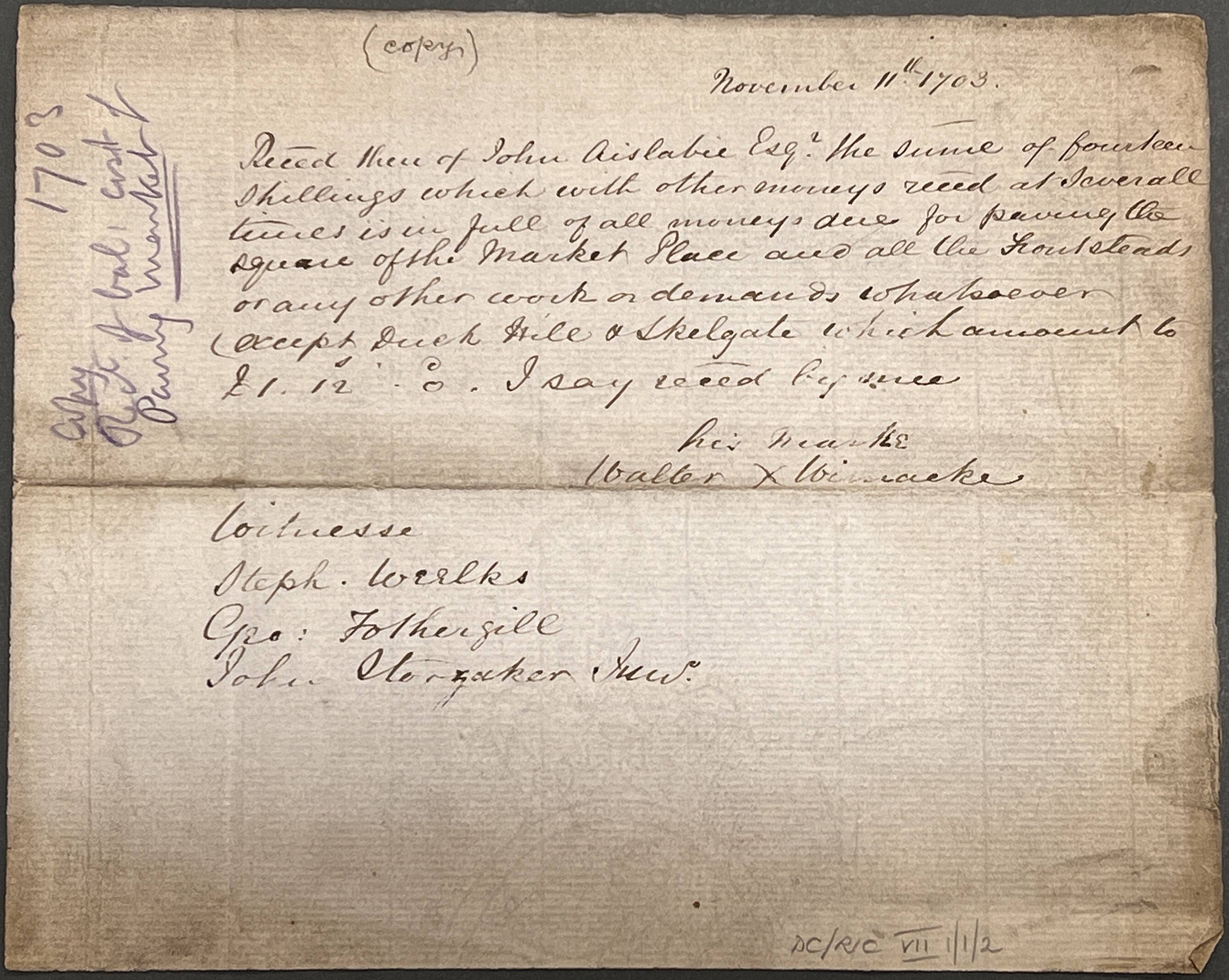
Copy receipt for the sum of 14 shillings received by Walter Wimacke from John Aislabie as the final instalment of the £62 [equivalent to over £12,000 today] that he was paid for paving the Market Square, Ripon, 11 November 1703 (19th-century copy) [DC/RIC VII 1/1/2]
Acknowledgements
Several images used in this blog come from the Ripon Re-Viewed collection created by Ripon Civic Society and supported by the National Lottery Heritage Fund. Many of the photographs from the Ripon Re-Viewed collection can be viewed and purchased via North Yorkshire Archives’ online shop.
Price changes over time have been calculated using the Bank of England Inflation calculator.
 North Yorkshire Archives Blog