
The Record Office holds an extensive documentary archive relating to the North Riding Quarter Sessions, covering a period of just over 300 years from 1660 to 1971. These Quarter Sessions were convened four times a year by the Justices of the Peace at various places throughout the North Riding of Yorkshire. They were responsible for dealing with judicial matters and with the administration of the county.
The title ‘All Human Life’ comes from the name of our cataloguing project, reflecting the richness of these Quarter Sessions’ records as a key source of historical information about many aspects of daily life in the North Riding in previous centuries. Quarter Sessions dealt not only with crime, but also with other matters affecting the whole community, including bridges, weights and measures, cattle plague and the militia, to name just a few. These records can tell us a wealth of information about the people and the places of the county and are a great resource for family, local and social history.
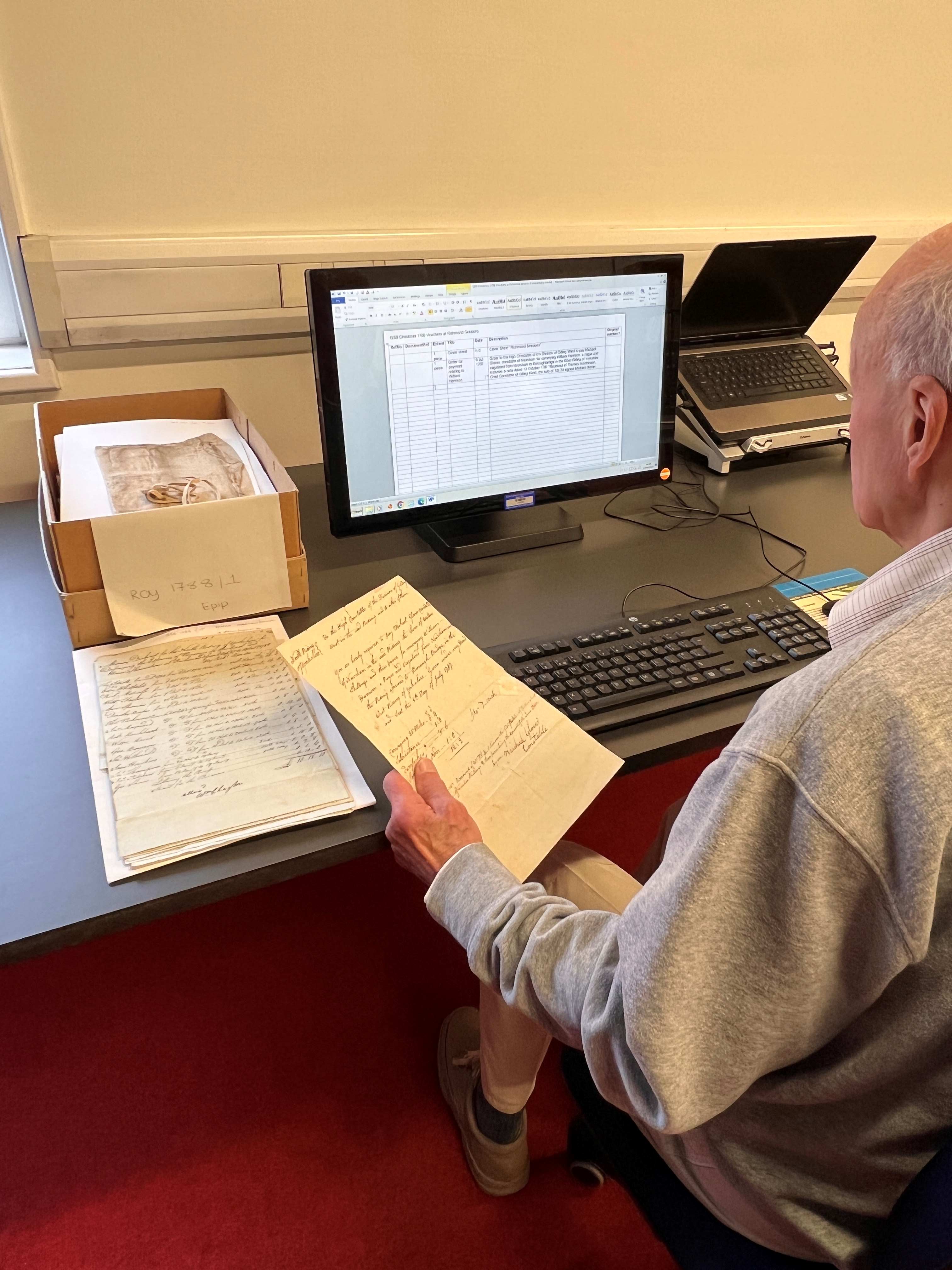
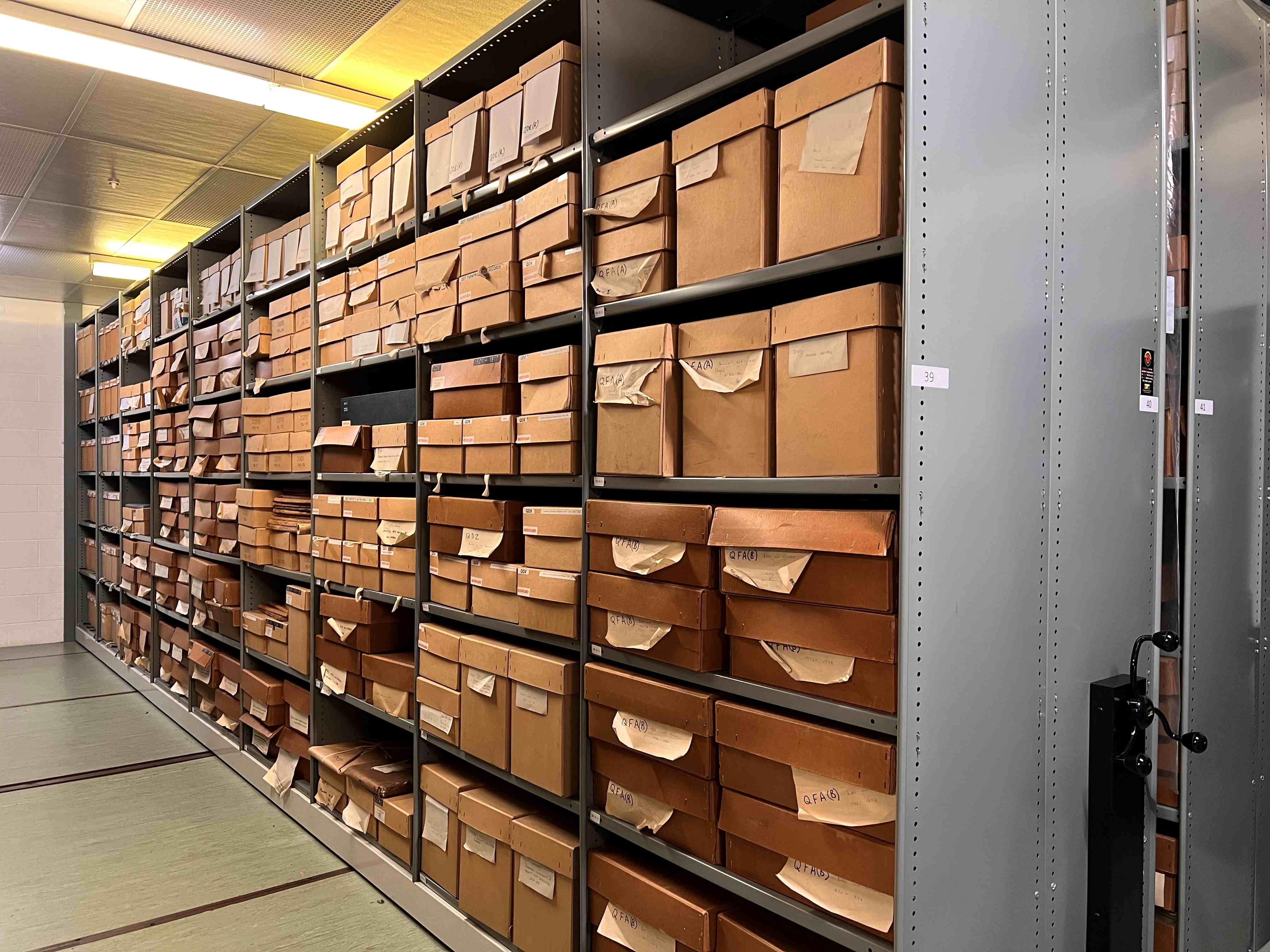
- Left: Long-term volunteer Mr R.G. Corner entering data from records within Quarter Sessions bundles for Epiphany 1788 so they can be added to our collections database and accessed via our online catalogue
- Right: One of several aisles of shelving housing boxes of Quarter Sessions’ records in one of our Record Office strong rooms
To quote one of our volunteers:
“These manuscripts are of great interest to those researching local and family history because they reveal the lives of ordinary people: their assaults on their neighbours, the petty theft, the poaching. Opening the documents is like reading the story line of a modern ‘soap’ and over the years the rogues of the community emerge.”
This is the first in a series of posts providing an introduction to the Quarter Sessions and the different types of records that exist within the collection.
A brief history of Quarter Sessions
In the year 1195, a number of knights of the realm were appointed by King Richard I to act as ‘Keepers of the Peace’ in an attempt to preserve the peace in unruly areas of the country, and to assist the county sheriffs with the administration of justice. During the reign of Edward III, these ‘Keepers’ became known as Justices of the Peace.
A statute passed in 1388 stated that the Justices had to hold their courts in every quarter of the year, hence the name Quarter Sessions. By 1461, the Justices were dealing with cases of murder, theft, riot, assault and poaching.
The Sessions were named after the times of year when they were held – Epiphany (also called the Christmas Sessions), Easter, Midsummer and Michaelmas. They had to be presided over by no fewer than three Justices. The number of Justices gradually increased until, by the 16th century in the reign of Queen Elizabeth I, there were between 30 and 40 Justices of the Peace for each county. As the duties of the Justices increased, those of the sheriff were reduced, and gradually the Justices replaced the sheriff as county administrators. The more serious crimes began to be tried at the Assize Courts rather than at Quarter Sessions.
As the population of England increased in the 18th century, so did the amount of business in Quarter Sessions. In 1888, the Local Government Act transferred the administrative control of the county from Quarter Sessions to County Councils. Quarter Sessions continued to perform a judicial role until 1971, when they were replaced by Crown Courts.
The role of Quarter Sessions
Quarter Sessions were empowered to enforce national political, administrative and religious policy, including the criminal law, taxation, the poor law, maintenance of gaols, roads and bridges, regulation of wages, prices and alehouses.
In its judicial role, the court of Quarter Sessions heard criminal cases relating to ‘personal’ crimes such as theft and riot, as well as ‘communal’ offences, for example, failure to maintain roads and bridges.
In its administrative capacity, the court gradually gained an extensive range of regulatory and administrative responsibilities relating to asylums, bridges, cattle plague, deeds registration, elections, friendly societies, gamekeepers, licensing, militia, naval recruitment, papists and recusants, poor relief, police and public order, printing presses, prisons, railways, turnpikes, weights and measures and much more. In this administrative role, the court of the Quarter Sessions was the forerunner of the North Riding County Council, which was created in 1889.

John Richard Westgarth Hildyard (1813-1888), Chairman of the North Riding Quarter Sessions from 1868 to 1881 [EF 242]
Justices of the Peace
As mentioned above, Justices of the Peace first emerged at the very end of the 12th century under the name of ‘Keepers of the Peace’, when Knights were appointed by King Richard I in an attempt to keep the peace in disruptive areas of the country. Following an Act of 1327, these Keepers became known as Justices, when King Edward III called for good men to ‘Guard the Peace’.
The Justices of the Peace were generally recruited from the landed gentry and appointed by the monarch. They were intended to be men who were so well regarded, either because of their social position or economic power, that their authority went undisputed. In the 17th century, the only qualifications for being a Justice of the Peace were that they be a Gentleman of the Law and an Esquire or Knight residing in the county, and that they own an estate worth at least £20. In later years, this land value requirement was increased to £100. A Justice also had to take an oath of allegiance to the sovereign and to the Church of England.


Precept to the sheriff dated 10 September 1782 to summon jurors for the Michaelmas Quarter Session to be held at Northallerton on 8 October 1782, signed by two Justices of the Peace – Thomas Hayes and William Strickland (right); folded in with the call roll and jury lists (left) [QSB 1782 4/1]
Justice’s oath, Michaelmas Sessions, 1843
In order for Thomas Hincks of Breckenbrough to serve as a Justice of the Peace, he had to swear that his estate was of sufficient value to qualify him. In this example, although his property was in Leicestershire, it was substantial enough to qualify him to serve as a Justice of the Peace in the North Riding.
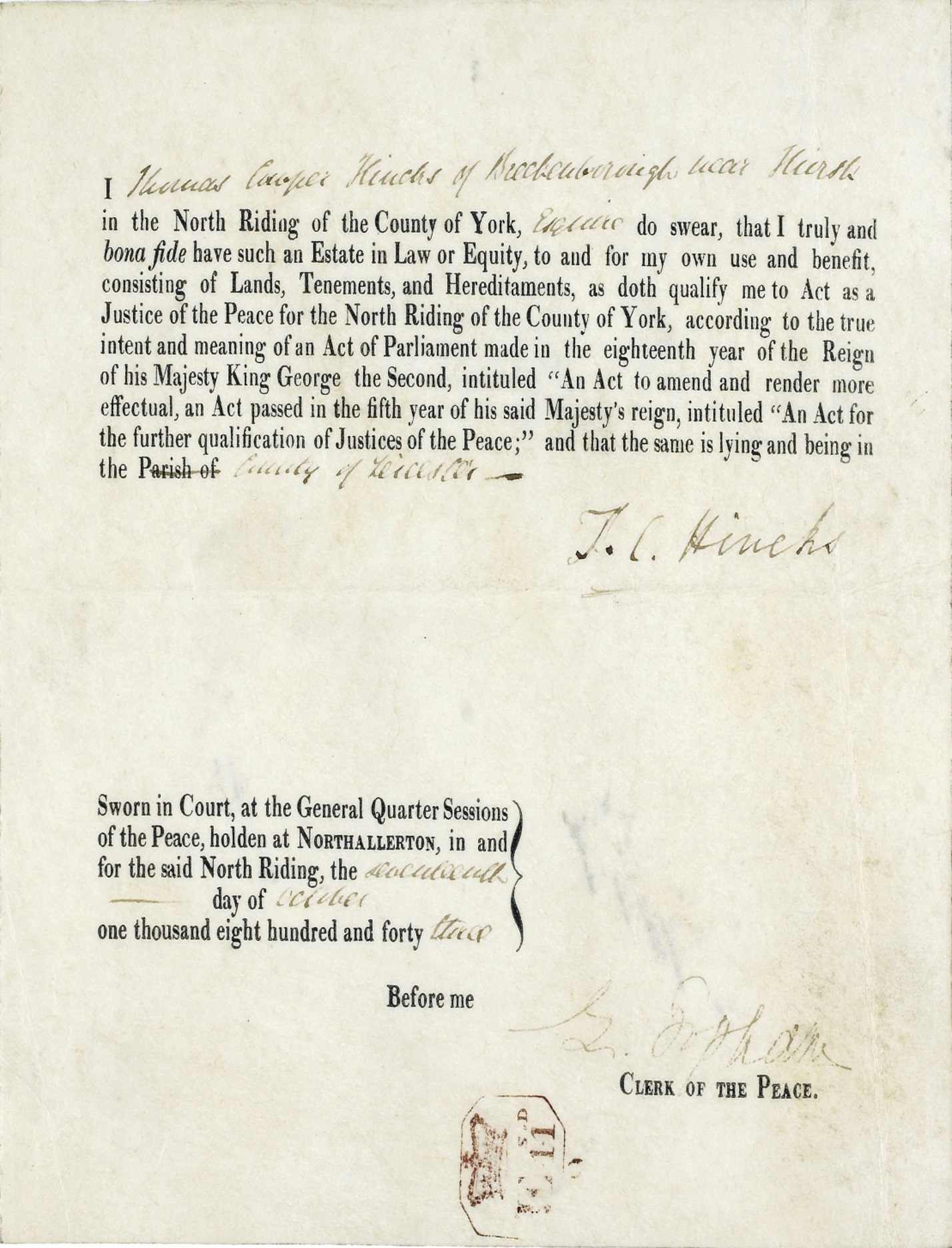

Justice’s oath, Michaelmas Sessions, 1843
Thomas Hincks declares that he will never exercise any power, authority, or influence to injure or weaken the Protestant Church whilst serving in his office of Justice of the Peace.
The role of Justice was time-consuming and hard work. The Quarter Sessions were local government and local justice rolled into one but, despite this, the Justices received no salary for the job they did.
The Juries
Names of those summoned to be jurors can be found in the jury lists within the records relating to attendance at the Quarter Sessions. These lists sometimes include occupations, as well as who was to serve as the Jury foreman.
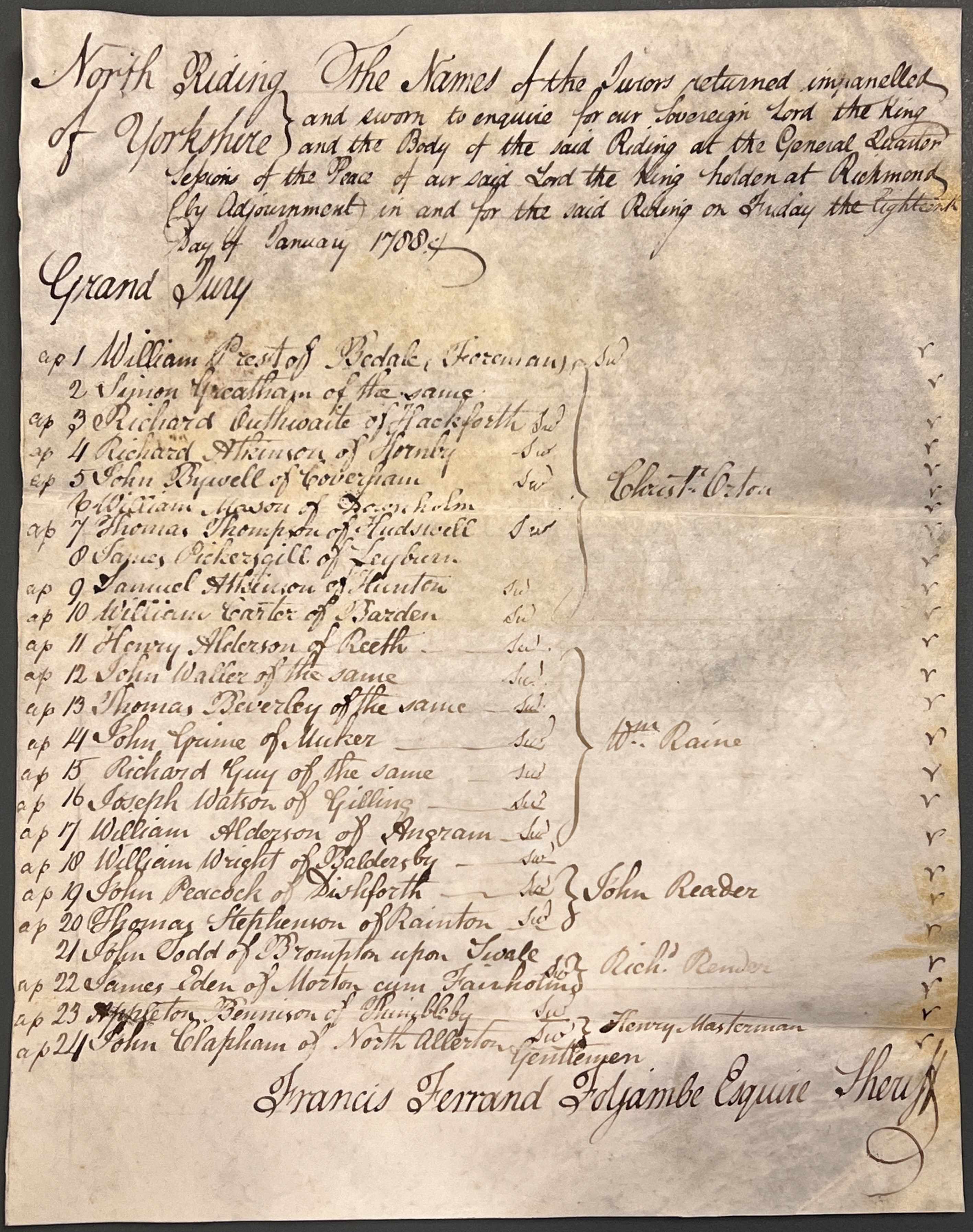

Jury lists for the Grand Jury (left) and Traverse Jury (right) at the Quarter Sessions to be held by adjournment at Richmond on 18 January 1788, signed by Francis Ferrand Foljambe esquire, Sheriff [QSB 1788 1/1]
The Grand Jury: the Grand Jury occupied a key position at Quarter Sessions and would be drawn from between 12 and 24 of the more significant residents of the county. They served without remuneration and, if they failed to attend court, they could be fined. The Grand Jury would hear evidence for the prosecution only and would decide whether the case was sufficiently well founded to send the accused for trial (known as a ‘true bill’).
The Traverse Jury: If the Grand Jury found that there was a case to answer, the accused could plead ‘guilty’ or ‘not guilty’. If ‘guilty’, he or she would be sentenced. If they pleaded ‘not guilty’, a Traverse (or Petty) Jury of 12 men would be sworn in to try the case.
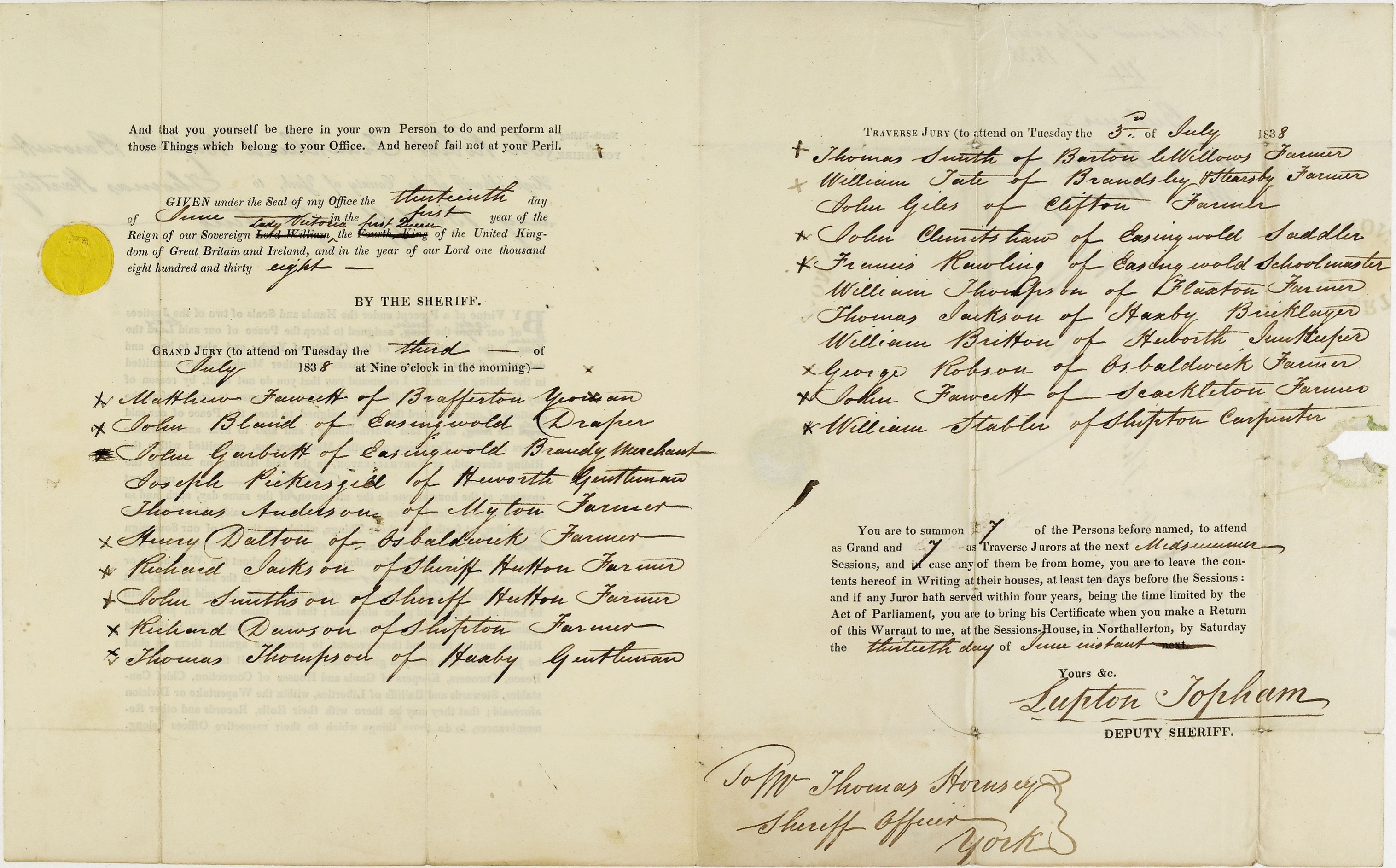
Warrant to a Bailiff, Midsummer Sessions, 1838
The Deputy Sheriff supplied the Bailiffs with lists of persons who could be summoned to either the Grand Jury or the Traverse Jury.
This warrant, issued to Thomas Hartley by Lupton Topham, requires Hartley to summon seven men for the Grand Jury and seven for the Traverse Jury from the list provided.
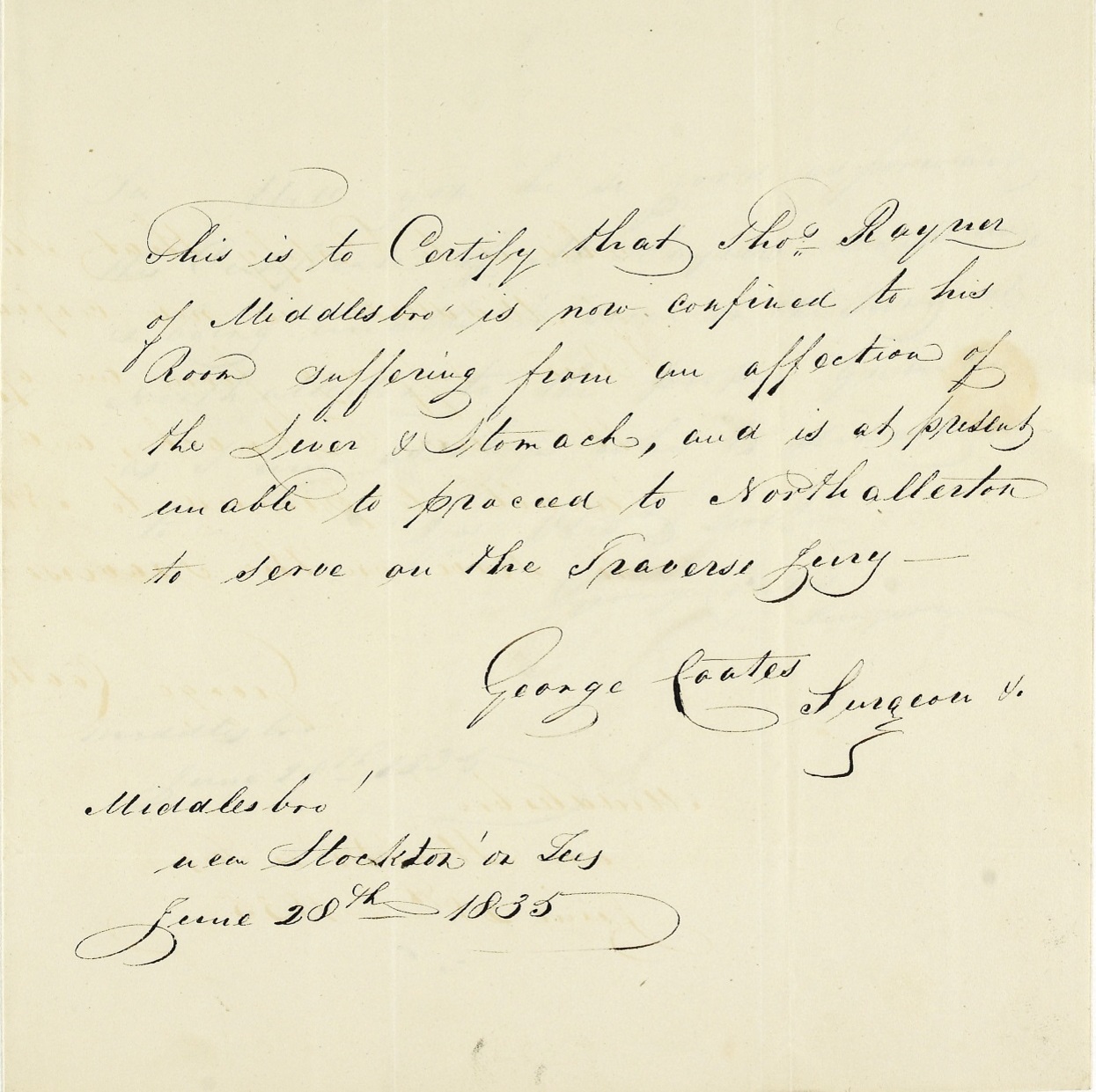
Juror’s sick note, Midsummer Sessions, 1835
A certificate from a surgeon was required in order to excuse a juror from service if he was too ill to attend.
This certificate, issued by George Coates, certifies that Thomas Rayner of Middlesbrough was confined to his room owing to an ‘affection of the liver and stomach’.
Certificate of service on a Grand Jury, Christmas Sessions, 1843
A juror could receive a certificate of service which would exempt him from further jury service.
This document certifies that William Graham of Osmotherley served on the Grand Jury at the Quarter Sessions on 4th January 1843.

Who else would attend Quarter Sessions?
Virtually all those who held positions of importance in the county would attend Quarter Sessions, including the High Sheriff, Deputy Sheriff, the Clerk of the Peace, the County Coroners, Keepers of Houses of Correction or Gaols, Attorneys, Chief Constables, Stewards and Bailiffs. The names of these people were recorded in the call roll for each session, as in the examples below. It is this level of detail that is gradually being transcribed by volunteers and added to the Record Office’s online catalogue.
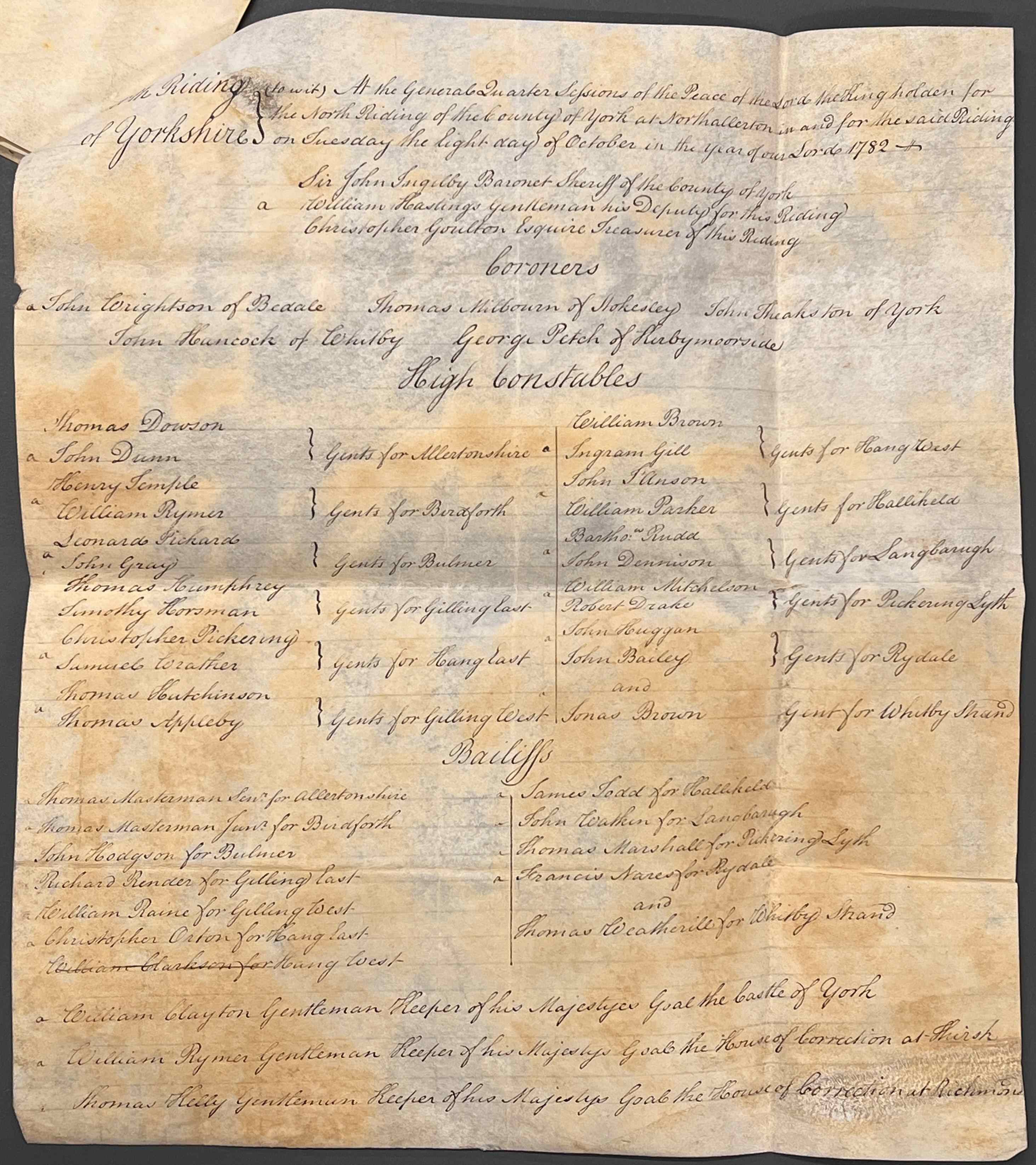

Call rolls from the Michaelmas Session held at Northallerton on 8 October 1782 (left) [QSB 1782 4/1] and the Epiphany Session held at Richmond on 18 January 1788 (right) [QSB 1788 1/1], recording the names of the County Sheriff, his Deputy for the North Riding, the Treasurer, Coroners, High Constables and Bailiffs for each wapentake as well as the Keeper of Gaols and Houses of Correction at York, Thirsk and Richmond
Further information and reading:
You can read more about the records of Quarter Sessions and the bundles of working papers in our other blog posts:
- The various types and subjects of the Records of the North Riding Quarter Sessions
- The Working papers of the North Riding Quarter Sessions
- Juvenile offenders in the North Riding Quarter Sessions
- North Riding Quarter Sessions’ scandals
- Previous blogs on stories of criminal women who appear in North Riding Quarter Sessions’ records
The Boroughs of Richmond and Scarborough held their own Quarter Sessions, records of which may be found under catalogue references DC/RMB and DC/SCB respectively.
The Liberty of Ripon was subject to its own court, independent of the West Riding, and a few records may be found with the Ripon Corporation archive [DC/RIC]. The majority of the Liberty’s records are housed with the West Yorkshire Archive Service at Wakefield.
Separate Quarter Sessions were also held for the West Riding (held at the West Yorkshire Archive Service), the East Riding (held at the East Riding Archives) and York (held at Explore York Archives).
Gibson, Jeremy et al. 2007 Quarter Sessions Records for Family Historians: A Select List, 5th edition. Bury: The Family History Partnership.
Ratcliffe, Richard, 2007. Basic Facts about … Quarter Session Records. Federation of Family History Societies (Publications) Ltd.
 North Yorkshire Archives Blog