By Sarah Pearey, Record Assistant
To improve the discoverability of the collections we hold, we are currently working alongside a team of volunteers to retro-convert entries from our paper lists into our online catalogue, which can be freely searched online. As part of this ongoing work, we have recently added over 6000 item-level references from the Cholmeley of Brandsby archive [ZQG]. Read on for a brief background of this collection and some highlights handpicked in the process.

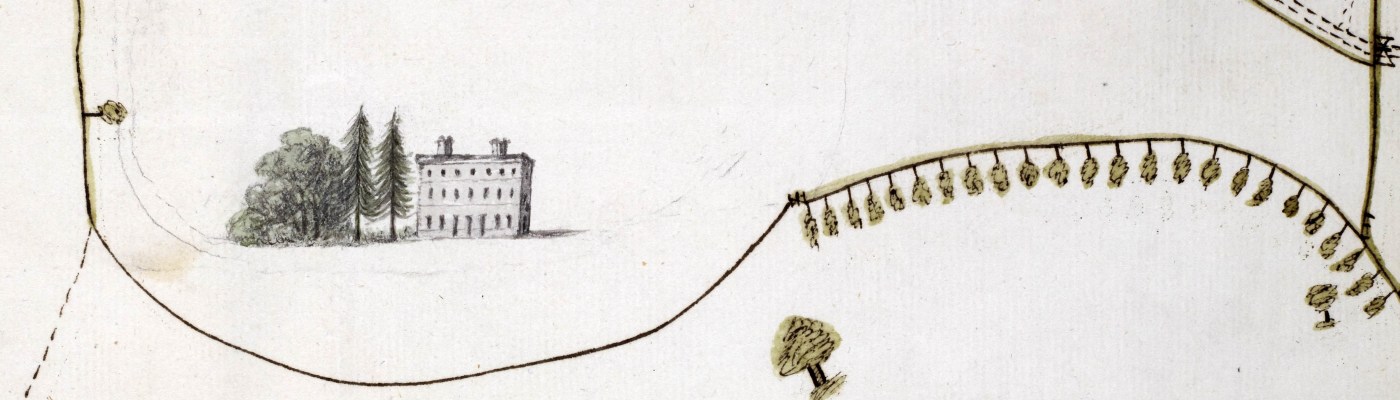
Plan of Brandsby Hall showing hall, fishpond, and park: endorsed “crofts, lea close, leas, pleasure ground, garden, stable yard, chicken yard, back plantation, churchyard and back garth”, 1798 [ZQG IV 16/4]
The Cholmeley family of Brandsby
Both the Cholmeleys of Brandsby and the Cholmleys of Whitby are descendants of Sir Richard Cholmeley of Roxby (c.1516-1583). Roger Cholmeley (d.1577) was the second son of Sir Richard from his first wife, Margaret, the daughter of William Lord Conyers. Roger married Jane de la River, the eldest daughter of Thomas de la River of Brandsby. When Thomas died without male heir, Roger inherited his Brandsby and Brafferton estate. The Brandsby estate belonged to the Cholmeley family up until the death of Hugh C. Fairfax-Cholmeley in 1940.

An accurate survey of the lordship of Brandsby, the estate of Francis Cholmeley esq., surveyed and drawn by John Haynes, 1746 [ZQG XIV 2]
ZQG is a large collection comprising records dating back to the 12th century, and containing everything from medieval deeds and manorial records, to all papers relating to the administration of the Brandsby estate, alongside a large series of correspondence.
Medieval deeds
Many of the earliest records from this collection are the medieval title deeds [ZQG I]. These include deeds relating to the de la River family, from whom Roger Cholmeley inherited the estate. One example of these, which remains in very good, legible condition is a lease of 1326, in which Lord Thomas de la Ryvere leases to William Estiby of Brandsby for ten years:
“Two watermills in Brandsby with all suits of court, services, works and customs of the villages of Brandsby and Steresby, belonging to the same by right and ancient custom.” [ZQG I]

Lease for 10 years concerning two watermills in Brandsby &c, 11 Nov 1326 [ZQG I]
Transcript of the above deed:
“Lease for 10 years
- Lord Thomas de la Ryvere
- William Estiby of Brandsby
Two watermills in Brandsby with all suits of court, services, works and customs of the villages of Brandsby and Steresby, belonging to the same by right and ancient custom.
To hold for 10 years beginning at the feast of St Martin in Winter 1326.
Rent. 4 marks per annum: 2 marks at Pentecost, 2 at feast of St Martin in winter.
William from the beginning of the said term to do all works of the said mills for the same Lord which are owed by right and custom. And the Lord shall find for the said William sufficient timber as often as it is necessary to repair the said mills, as is the custom. And the said William shall keep the said mills in good and sufficient state, both the mill wheels and all other necessary things to the end of the term of ten years, according to the view and consideration of trustworthy men. Unless it happens that by the misfortunes of war the mills are burnt or destroyed [then] William will be immune from repairing or rebuilding them anew. If the said William perform any other work that the said two villages by right and custom ought to do, the said Lord Thomas wishes that the work be reasonably allowed.
Witnesses: Richard de Steresby, Thomas de Allerton, Peter Iouen de Brandesby, Robert de Dalby and others. 11 November 1326“
Seal tag pendant
There are also deeds for Yorkshire estates and others throughout the country, and later Cholmeley of Brandsby deeds in this collection.
The Memorandum Book of Richard Cholmeley of Brandsby [ZQG XII/4/1]
Richard Cholmeley (died c.1623) succeeded to the two manors of Brandsby and Brafferton upon the death of his brother, Marmaduke, who died without children. He began to record notes on the administration of his estates, referring to matters including personal, household and husbandry expenses, letting of farms, legal disputes, and the hiring of servants. Richard was a Catholic at a time when anti-Catholic persecution was rampant, and whilst there are not many references to Catholic life in his notebook, there are payments recorded in cypher, which may have been to priests or recusant servants. Recusants could be subject to many fines, which were occasionally recorded in Richard’s notebook.
When found in 1969, the book was in very fragile and decayed condition. It has since been repaired and can be viewed on microfilm in the searchroom. Its 138 folios of notes have been transcribed and published by the Record Office.

Notebook of Richard Cholmeley, 1602-1623. Folio 134 showing survey of Steresbye [Stearsby] & Fouleryse [Foulrice] with names of tenants, description of lands, acreage, rental value [ZQG XII 4/1]
Correspondence of Francis Cholmeley (d.1854) [ZQG XII/12/1]
There are nearly 4000 items of correspondence, many between members of the immediate and extended family. The largest proportion (over 2500) of these are the letters addressed to Francis Cholmeley (d.1854), a number of these being from his mother, Teresa Ann Cholmeley. From 1794, when Francis was 11, until her death in 1810, she wrote to her son every week, sometimes more often.
She writes of all subjects, from balls and books to politics, poverty and religion. She writes of her friends, acquaintances, and other landed families often. Names that have popped up include Lord Palmerston (then the future Prime Minister), the Dundas family, and the Morritts of Rokeby. In one scathing postscript regarding the society kept at York she writes:
“I think people here are in general really very ignorant and stupid and read and know less than ever. I should be sorry to pass a winter among such a set of card playing gossips and envious Misses.” [ZQG XII/12/1/240]
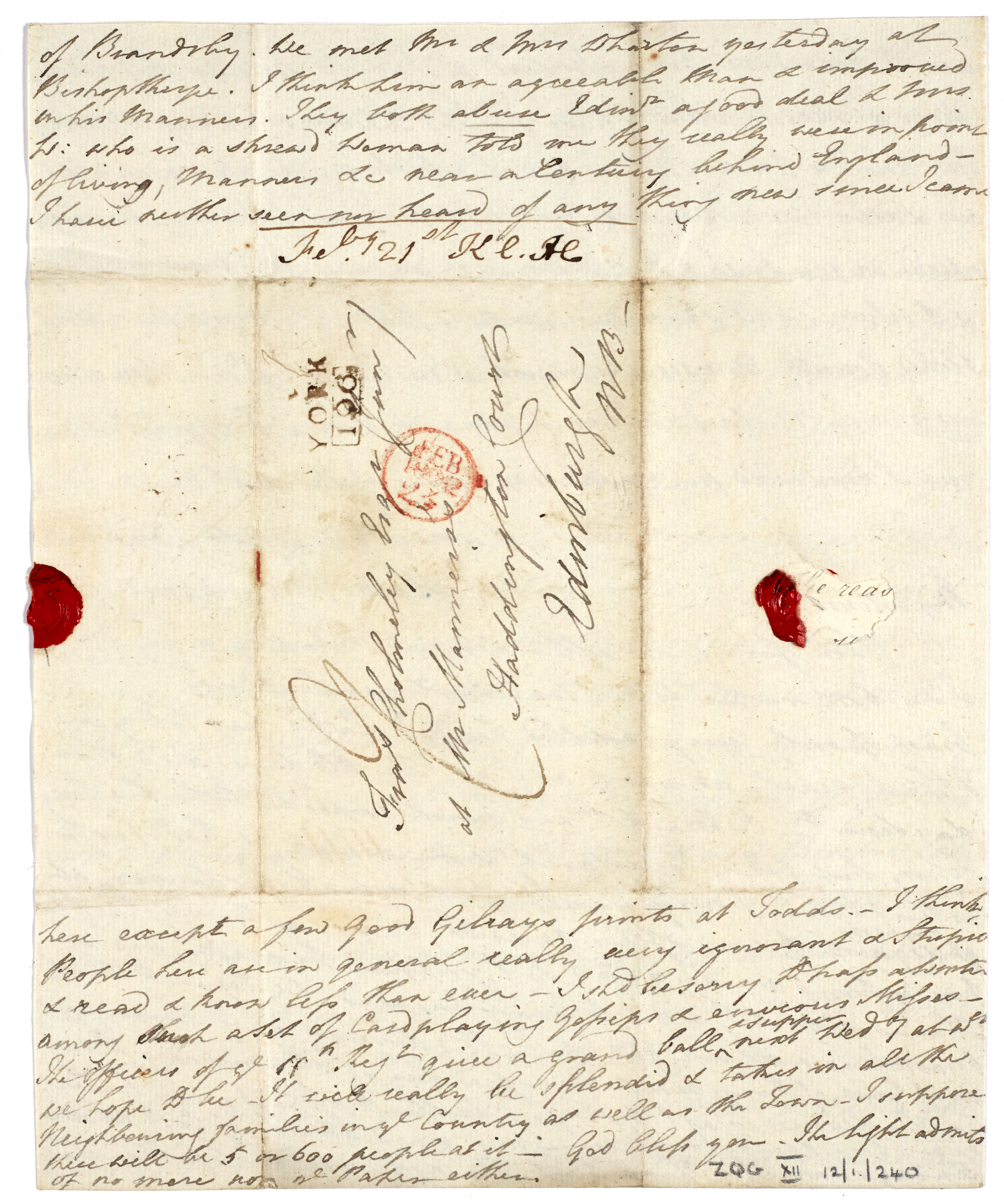
Letter from Teresa Ann Cholmeley (York) to Francis Cholmeley (Edinburgh), 21 Feb 1802 [ZQG XII 12/1/240]
There are also vast numbers of letters from Francis’ sisters, his brother-in-law, W J Charlton at Hesleyside in Northumberland, and uncle Sir Henry Englefield at Petersham. Some letters were sent by notable figures of the day, including artist John Sell Cotman (1782-1842) and Francis Wrangham (1769-1842), Archdeacon of the East Riding, author, translator, and abolitionist.
A Copy of His Majesty’s proceedings and directions for the perpetual establishment of the jurisdiction of the Court of Chancery made 1620 [ZQG XIV/2]
The miscellaneous papers of the Cholmeley of Brandsby archive contain several interesting documents. One is a letters patent (a written order issued by the monarch) from Queen Elizabeth I, dated 1597, granting special pardon to Miles Dawson, a Roman Catholic Seminary priest for taking the prescribed oaths [ZQG XIV/1]. Another is a notebook, endorsed with the header ‘A copy of His Majesty’s proceedings and directions for the perpetual establishment of the jurisdiction of the Court of Chancery made 1620‘ [ZQG XIV/2]. It is a paper booklet containing questions, copies of letters, etc. from between 1615-1616, signed by such names as Sir Francis Bacon, Lord Chancellor Ellesmere (Thomas Egerton), Sir Henry Yelverton, amongst others. At the time when this document was written, Ellesmere was Lord Chancellor of the High Court of Chancery, soon to be succeeded by Bacon in 1617, and later Yelverton in 1621. How or why this document came to be part of the Cholmeley of Brandsby archive is, as yet, unclear.


Pages from ‘A Copy of His Majesty’s proceedings and directions for the perpetual establishment of the jurisdiction of the Court of Chancery made 1620‘ with detail of the signatures of Sir Francis Bacon and Sir Henry Yelverton [ZQG XIV 2]
The updated catalogue descriptions for ZQG, the Cholmeley of Brandsby archive, can be viewed on our online catalogue here.
Further reading:
The Memorandum Book of Richard Cholmeley of Brandsby 1602-1623. Northallerton: North Yorkshire County Record Office Publication No. 44.
Holcombe, Adele M. and Ashcroft, M.Y. (eds.) (1988) John Sell Cotman in the Cholmeley Archive. Northallerton: North Yorkshire County Record Office Publication No. 22.
Page, William (ed.) 1923 ‘Parishes: Brandsby with Stearsby’, in A History of the County of York North Riding: Volume 2, British History Online.
 North Yorkshire Archives Blog