by Cordelia Beattie, Professor of Women’s and Gender History, University of Edinburgh & Gail Falkingham, North Yorkshire County Record Office
Introduction
The archive collections of the North Yorkshire County Record Office contain a number of 17th- and 18th-century documents relating to Alice Thornton, née Wandesford (1626-1707), who lived in North Yorkshire for much of her life. She was born, and spent her early childhood, at Kirklington Hall, between the towns of Bedale and Ripon. She later resided at Hipswell Hall, a few miles further north, where her mother held an estate close to the town of Richmond. Following her marriage to William Thornton in 1651, Alice continued to live at Hipswell until 1660, after which they moved to Ryedale. From 1662, until her death aged 80, she lived at East Newton Hall in Ryedale, north-west of the village of Stonegrave.
This collaborative blog post has been written to accompany an afternoon of Alice Thornton-related events at the Record Office, held in conjunction with the Alice Thornton’s Books project team on 5th July 2024. Original documents will be on display, to accompany an illustrated talk by Cordelia Beattie, the Project’s Principal Investigator, on ‘Yorkshire gentlewoman Alice Thornton (1626-1707)‘, and a performance of the play, ‘The Remarkable Deliverances of Alice Thornton’, written and performed by Debbie Cannon.
Surviving archive material held at the Record Office relating to Alice’s life and family in North Yorkshire includes parish register entries for her baptism in Kirklington in 1626 [PR/KRT 1/1], and for her burial in her local church at Stonegrave Minster in 1707 [PR/STV 1/1]. There is also material in two other key estate collections. Letters written by Alice to her relatives Thomas Danby and Abstrupus Danby can be found in the Swinton Estate archive [ZS], as can material relating to her niece, Anne Danby. In the Prior-Wandesforde of Kirklington records [ZKW], there is documentation relating to the Thornton family settlement in 1668 and to a case brought before the North Riding Quarter Sessions at Thirsk concerning the theft of sheep from Mrs Alice Thornton in 1678.
Images of these documents are reproduced below, with brief summaries of their context and content written by Cordelia Beattie. [Click on images to open full-screen versions]
Alice Thornton (née Wandesford): her early life and marriage
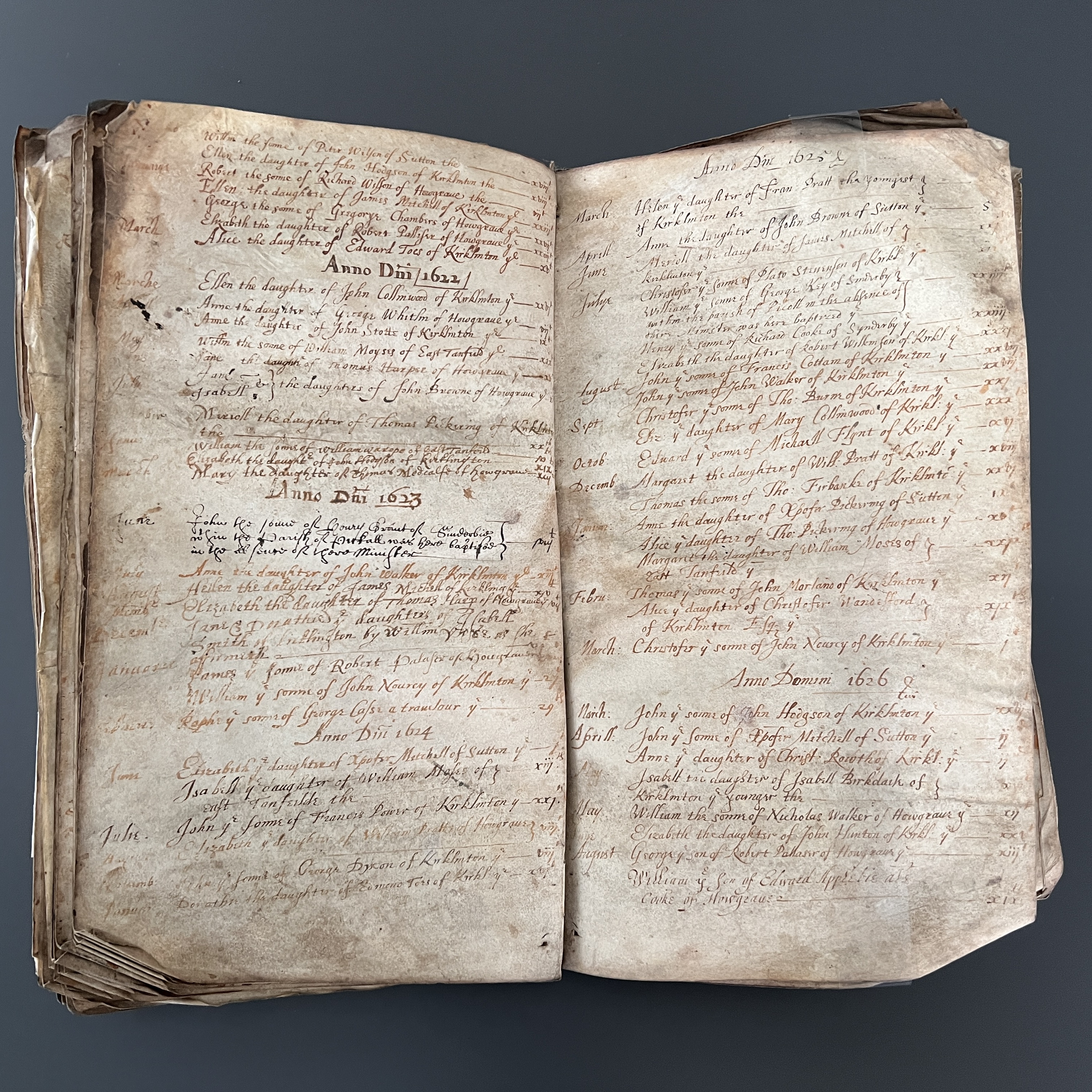
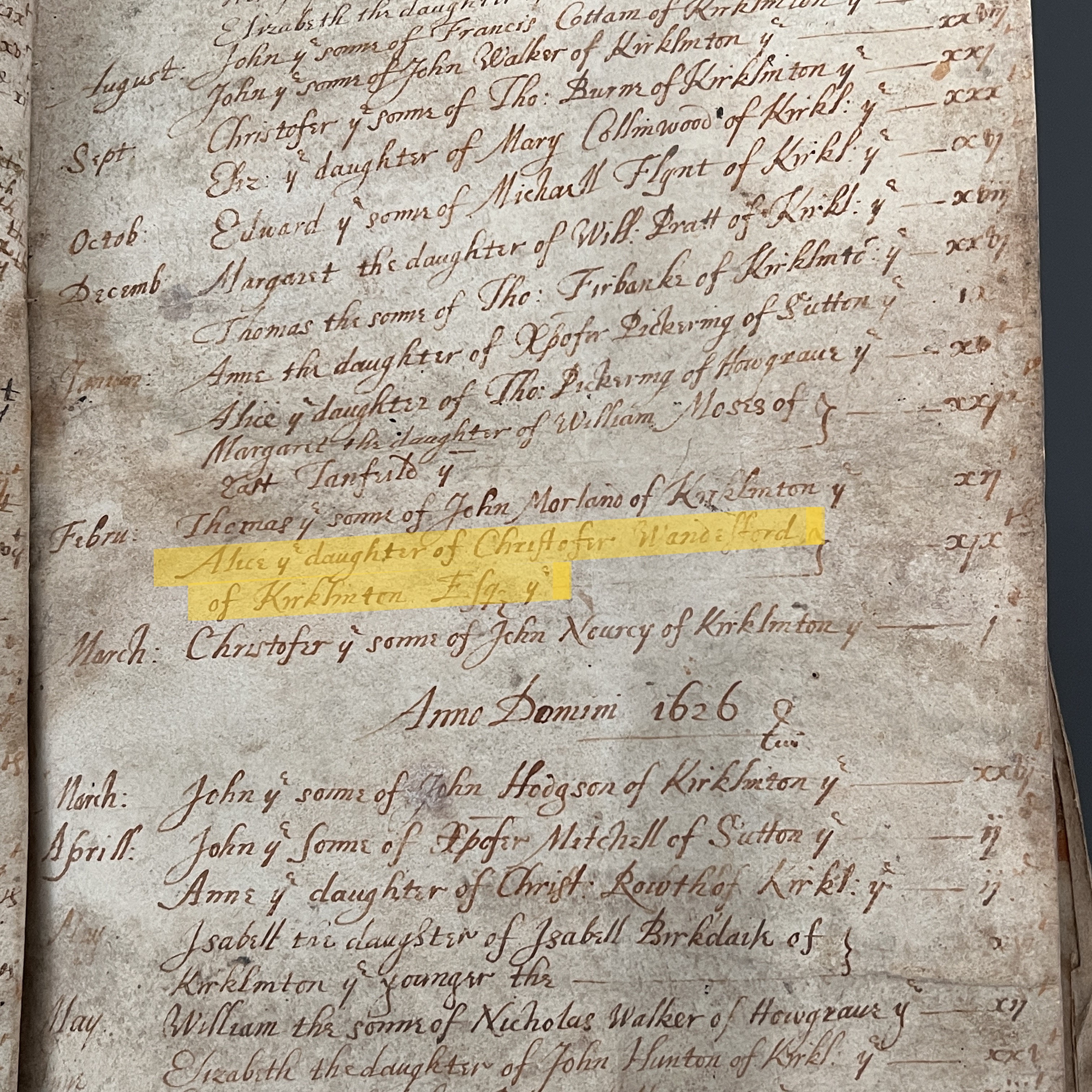
Kirklington parish register recording the baptism of Alice, daughter of Christopher Wandesford on 19 February 1626 (entry highlighted) [PR/KRT 1/1]
Alice was born on 13 February 1626 to Christopher and Alice Wandesford who lived at Kirklington Hall. She was their fifth child. This entry in the parish register describes her as the ‘daughter of Christofer Wandesford’, who was then a local MP [PR/KRT 1/1]. When she references her baptism in two of her books, she mistakenly records it as happening the day after her birth, rather than six days later.
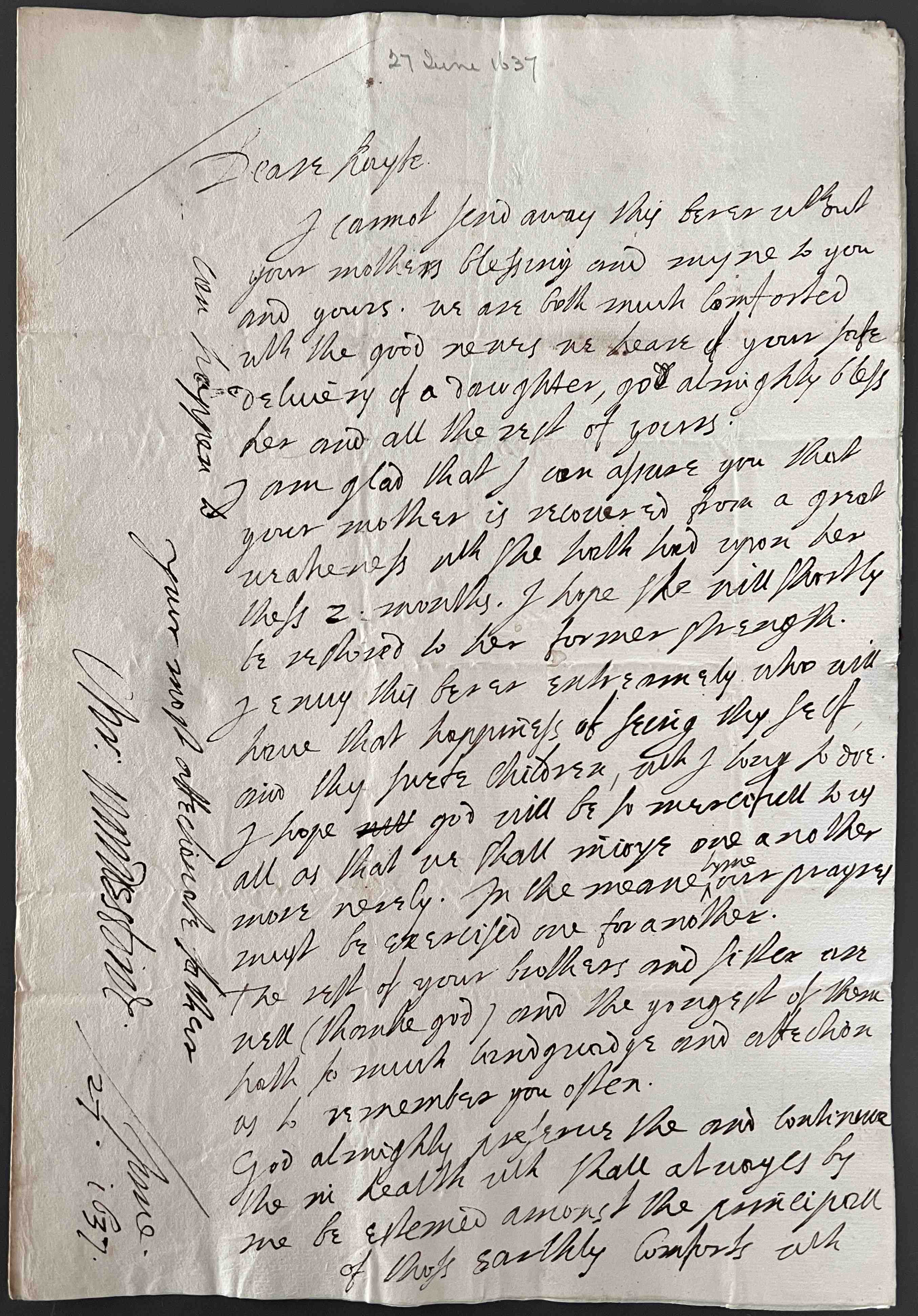
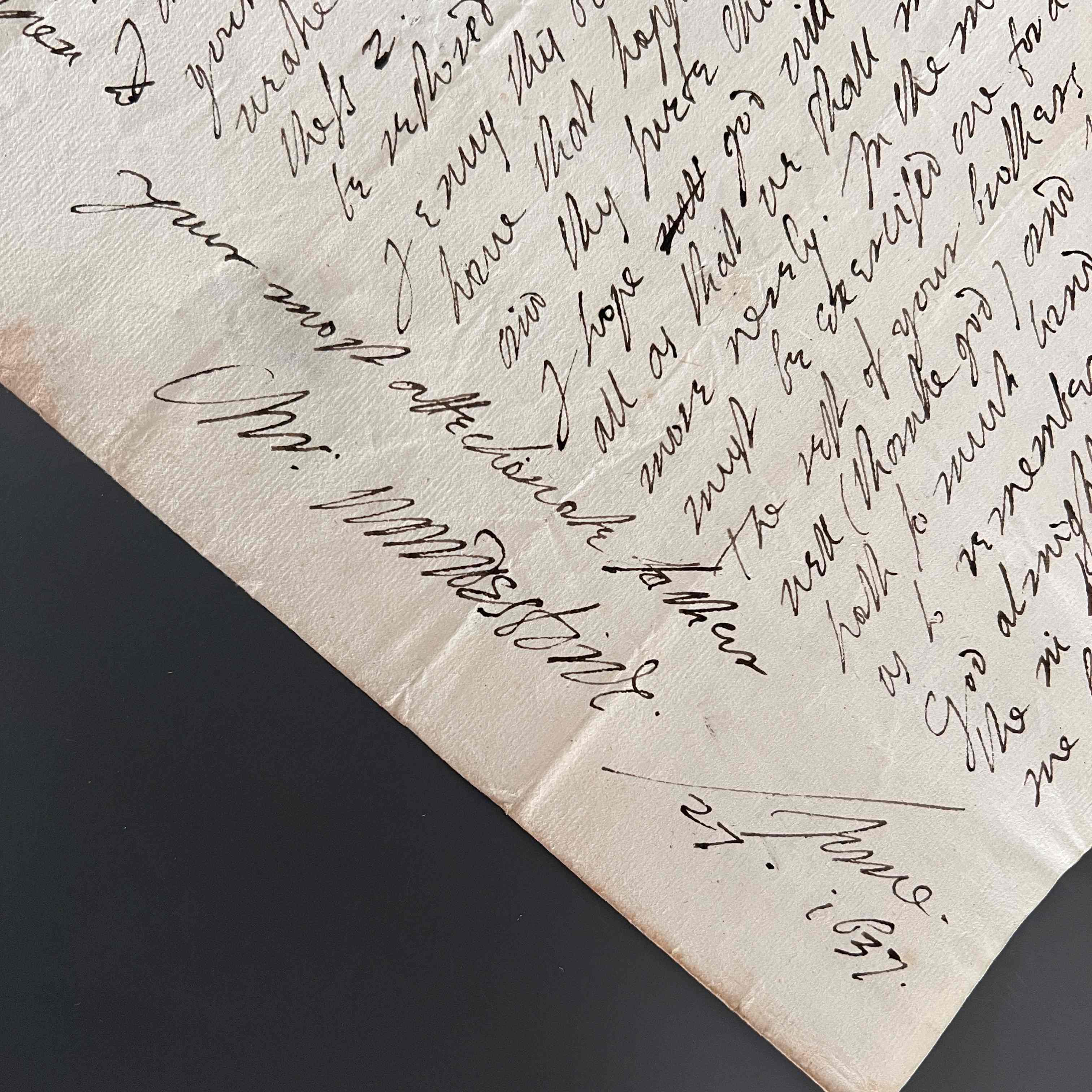
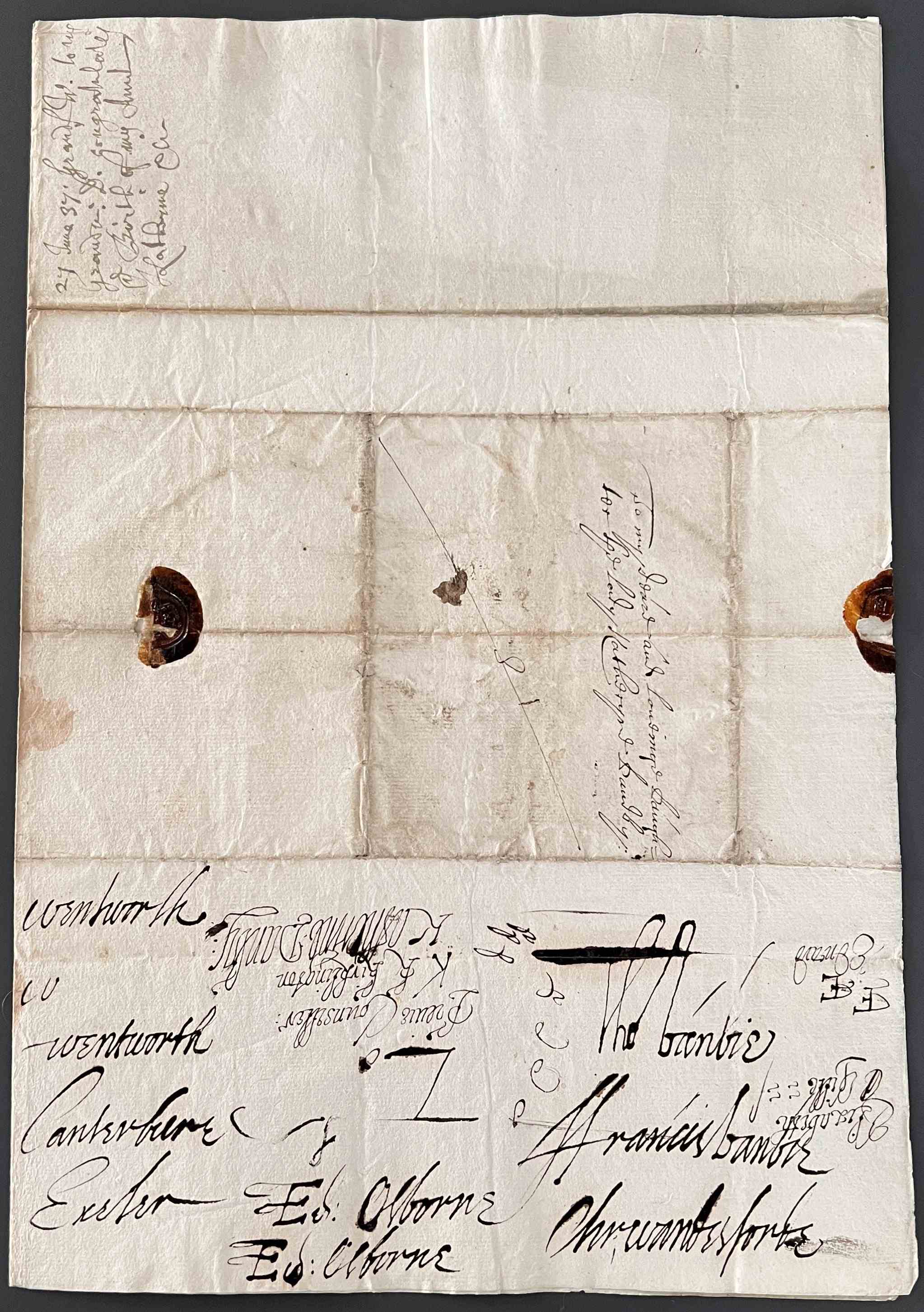
Letter from Christopher Wandesforde to his daughter Lady Katherine Danby on the birth of her fourth child at Richmond, 27 June 1637 [ZS]
By 1637, the Wandesford family had relocated to Dublin, where Christopher Wandesford was Master of Rolls. Alice’s older sister, Katherine, had married Sir Thomas Danby and was living in Yorkshire. Christopher Wandesford wrote to his ‘deare and loueinge daughter’ to congratulate her on her fourth child, who had been born in Richmond on 25 May 1637: ‘we are both much comforted with the good newes we heare of your safe deliuery of a daughter’ [ZS]. Katherine Danby died in 1645 after the birth of her tenth child.
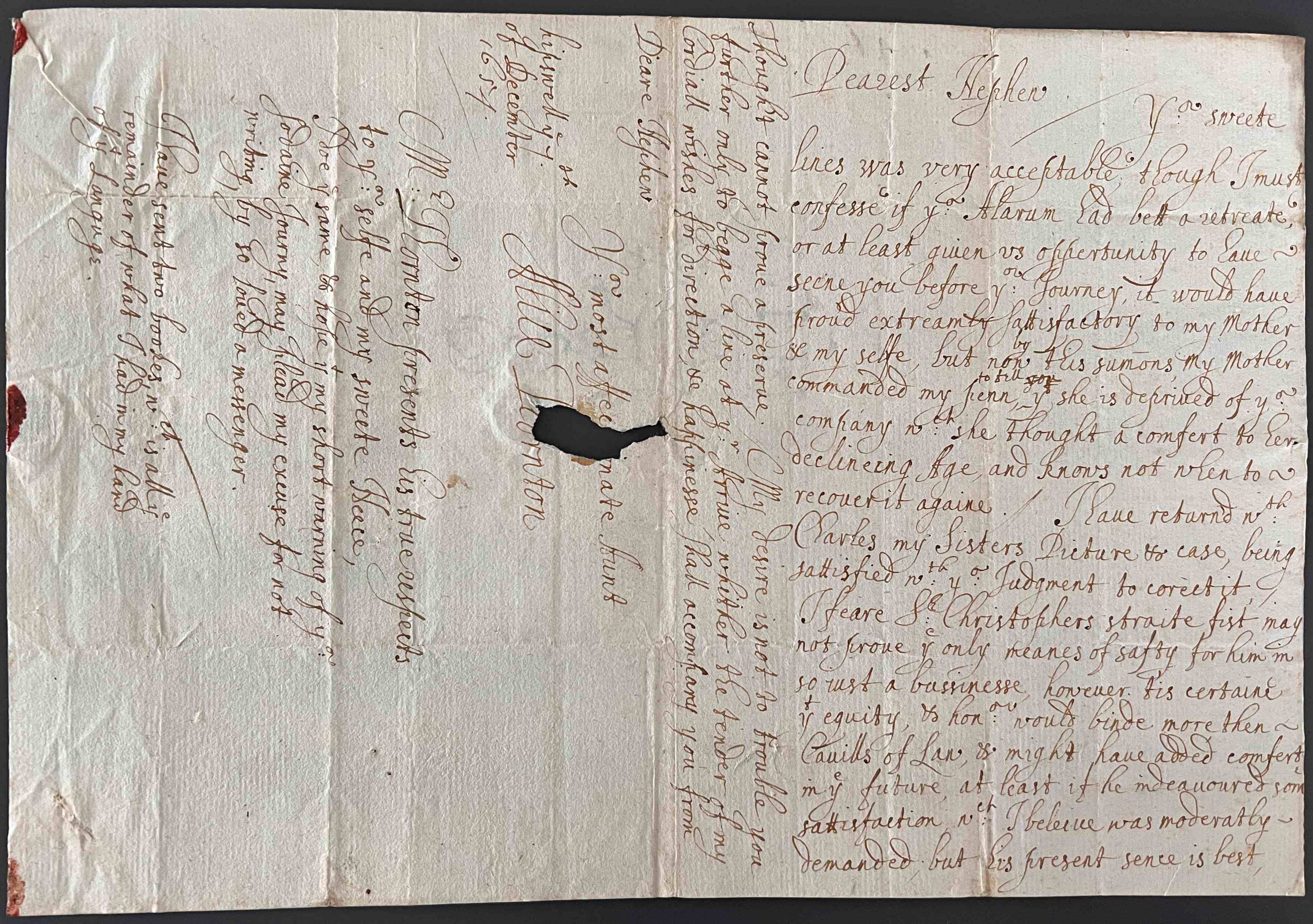
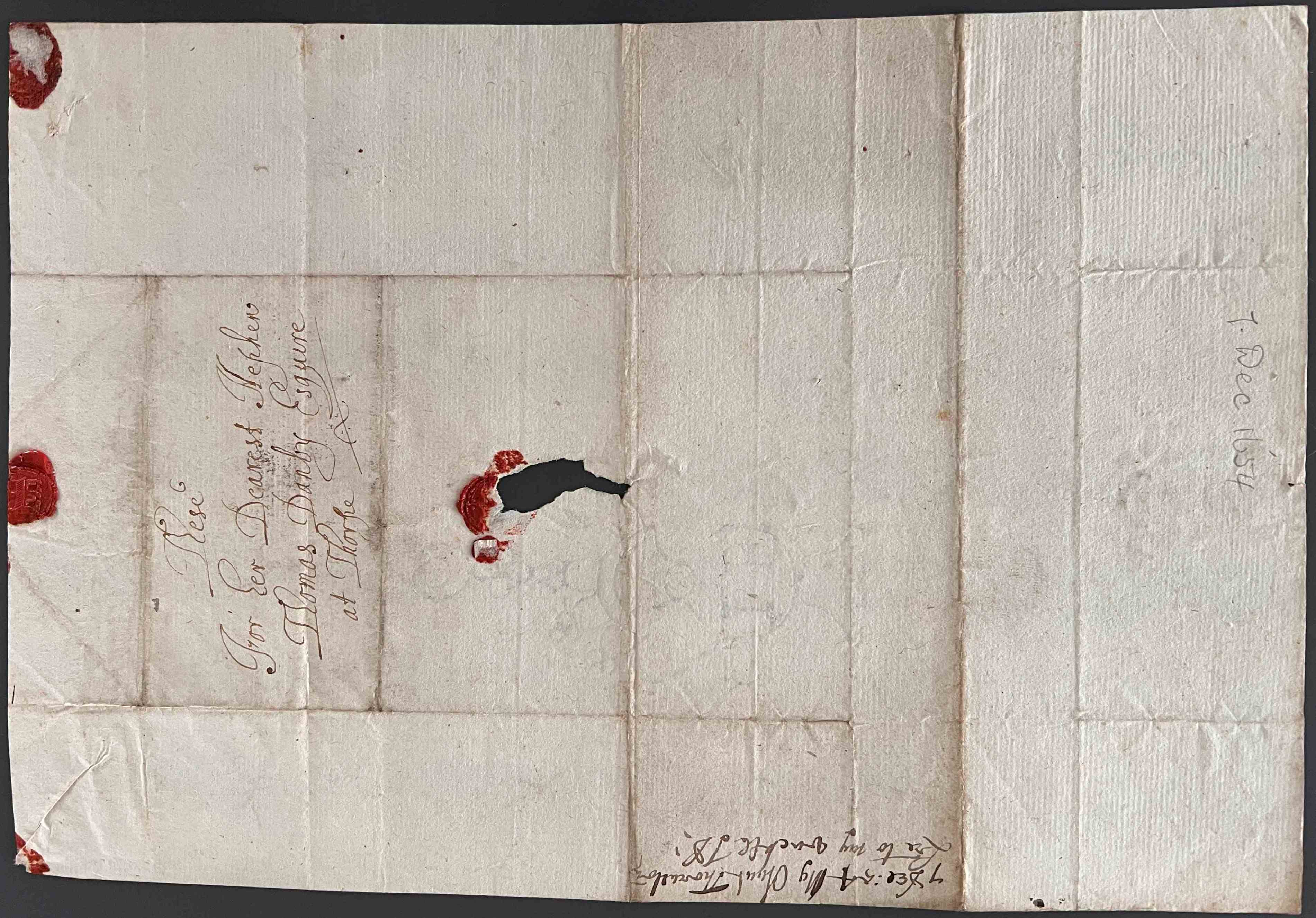
Letter from Alice Thornton, Hipswell, to her nephew Thomas Danby esq., Thorpe, 7 December 1654 [ZS]
Alice married William Thornton in 1651 but the couple continued to live at Hipswell Hall with Alice’s mother, Alice Wandesford. In 1654, she wrote to her late sister’s oldest child, her ‘dearest nephew’ Thomas, who was about to go on a trip: ‘my mother commanded my penn, to tell you that she is depriued of yor company which she thought a comfort to her declineing Age’ [ZS].
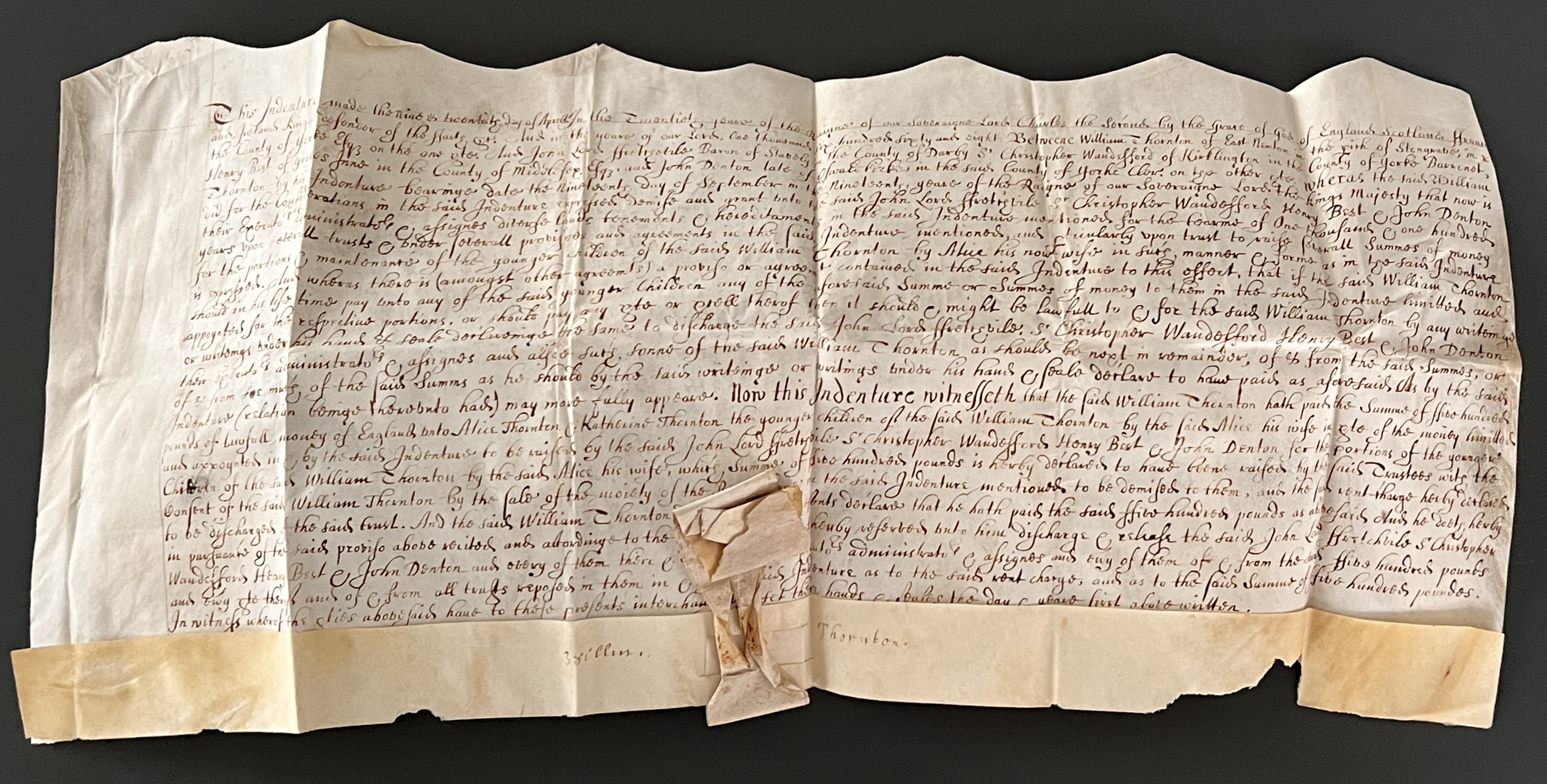
Thornton family settlement, 1668 [ZKW]
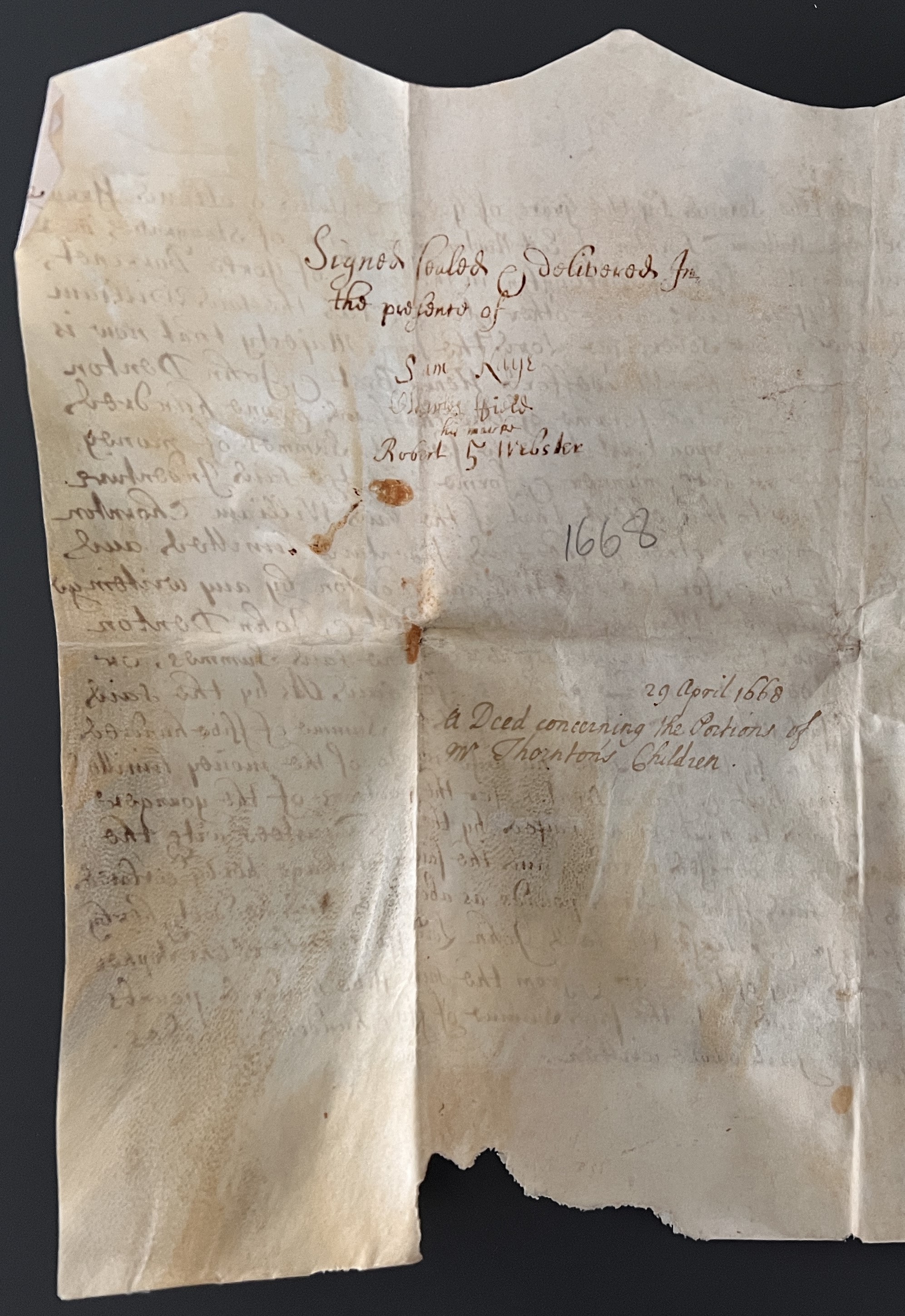

Details from the reverse of the Thornton family settlement, 1668 [ZKW]
By 1668, the Thorntons only had three living children: Alice, Katherine and Robert. The son would inherit the main estate but, given William’s debts, provision for his daughters was one of Alice Thornton’s long-running battles. On 29 April 1668, a number of male relatives, who had acquired some of the land originally intended for the younger children, paid the girls £500, as set out in this legal settlement. Alice (age 14) and Katherine (age 11) signed the document on the back (see detail 3 above) [ZKW].
Alice Thornton: her later life and widowhood
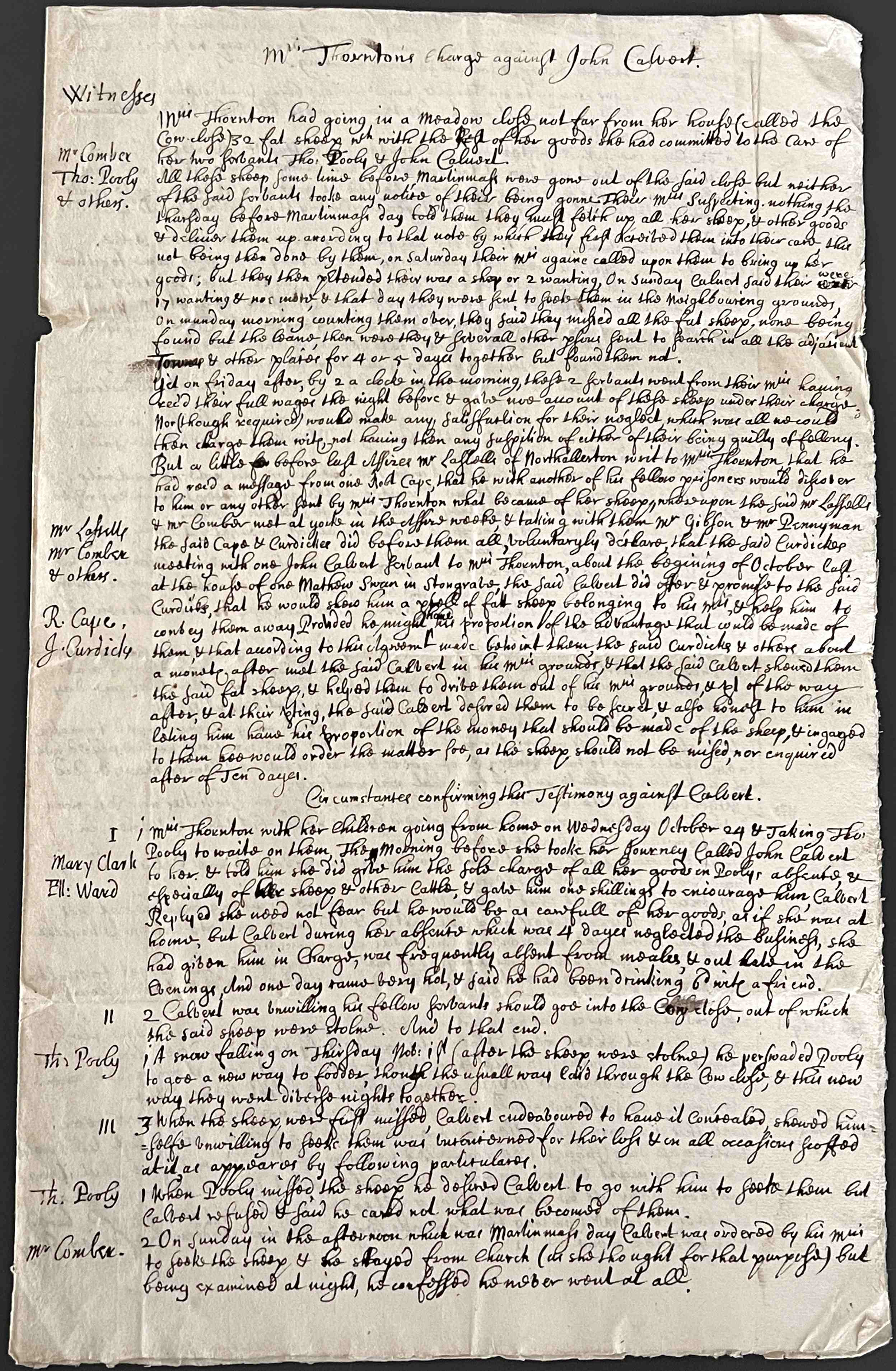
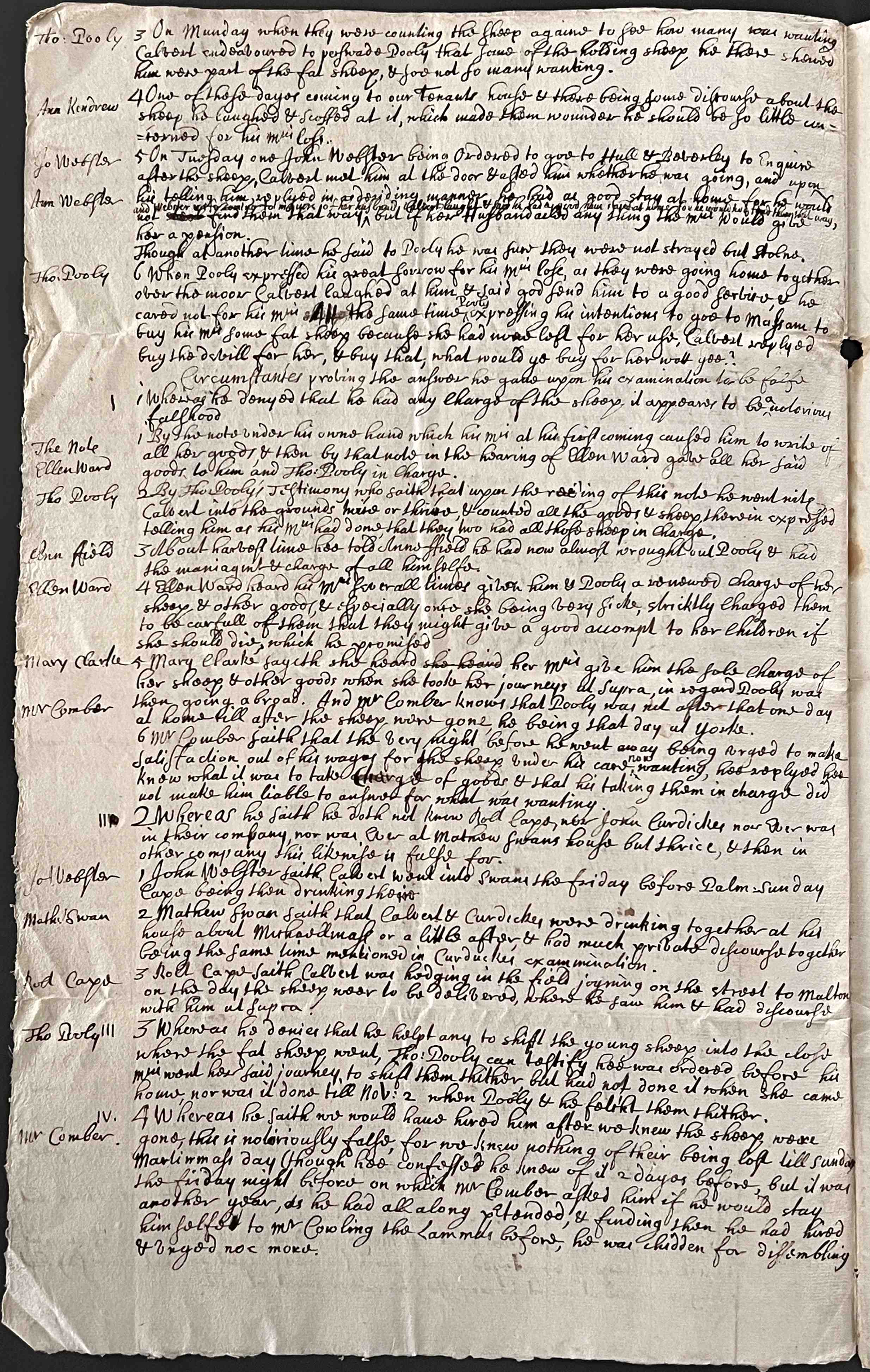
Evidence relating to theft of sheep from Mrs Alice Thornton, presented at the North Riding Quarter Sessions, Thirsk, 10 April 1678 [ZKW]
In September 1668, Alice Thornton was widowed and responsibility for overseeing the lands around East Newton Hall in Ryedale now fell to her. One document attests to the perennial problem of sheep stealing [ZKW]. In late 1677, Thornton owned 32 ‘fat’ sheep (i.e., ready for slaughter) but they all mysteriously disappeared from the meadow near her house. She subsequently learnt from Mr Lascelles of Northallerton that her former servant, John Calvert (who ‘cared not for his Mrs’), had offered them to some men he had been drinking with, in return for a proportion of the sale.
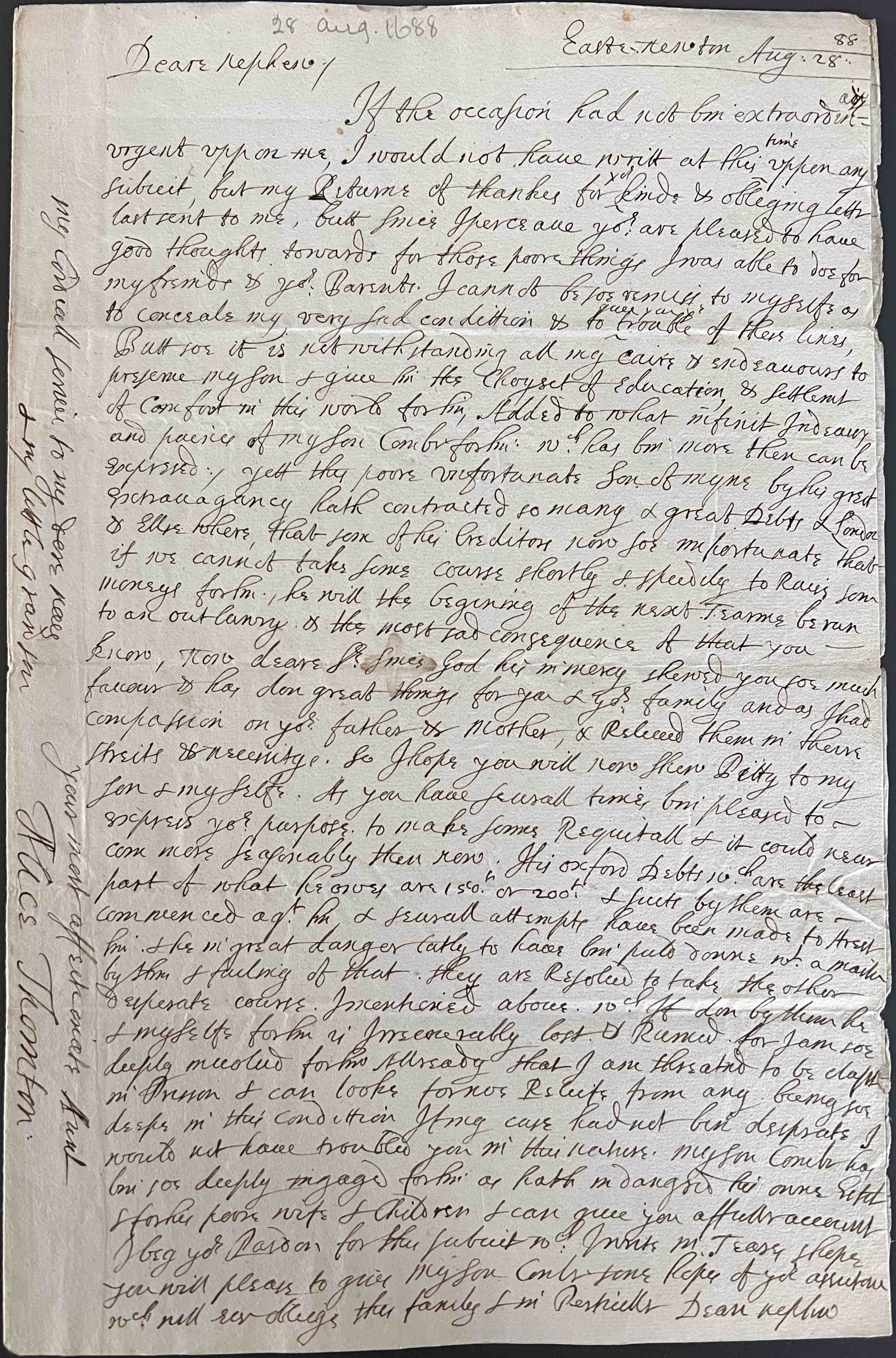
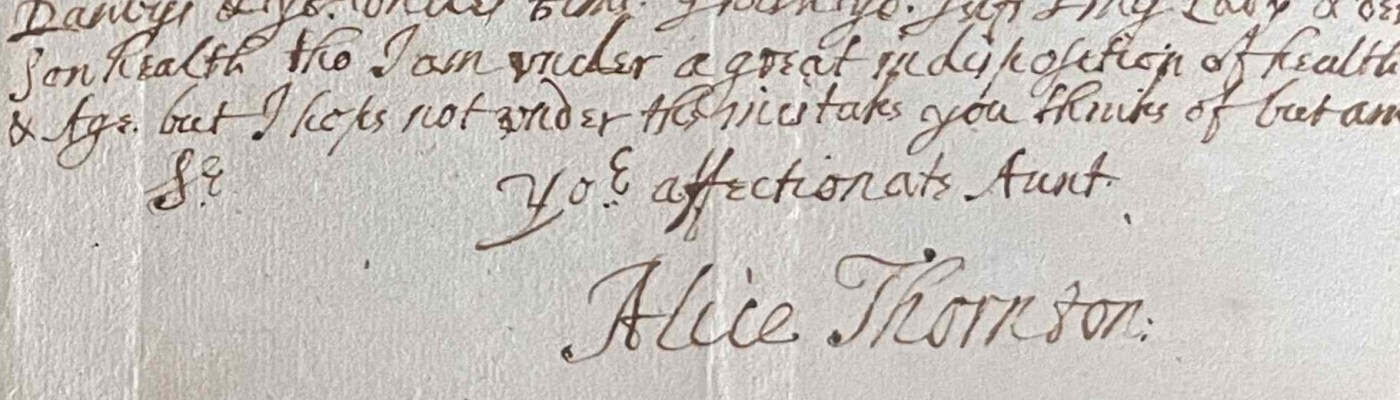
Letter from Alice Thornton to Abstrupus Danby, 28 August 1688 [ZS]
In April 1680, Thornton’s son, Robert, left home to study at the University of Cambridge, aged 17, then moved to the University of Oxford in May 1682. By 1688, he was in considerable debt and his mother was forced to write to her great-nephew, Abstrupus Danby, to ask for financial help: ‘I am soe deeply inuolued for hm Allready that I am threatnd to be clapt in Prison’ [ZS]. Abstrupus was the son of Christopher and Anne Danby and he had inherited the Danby estate in 1683 and was turning its fortunes around.
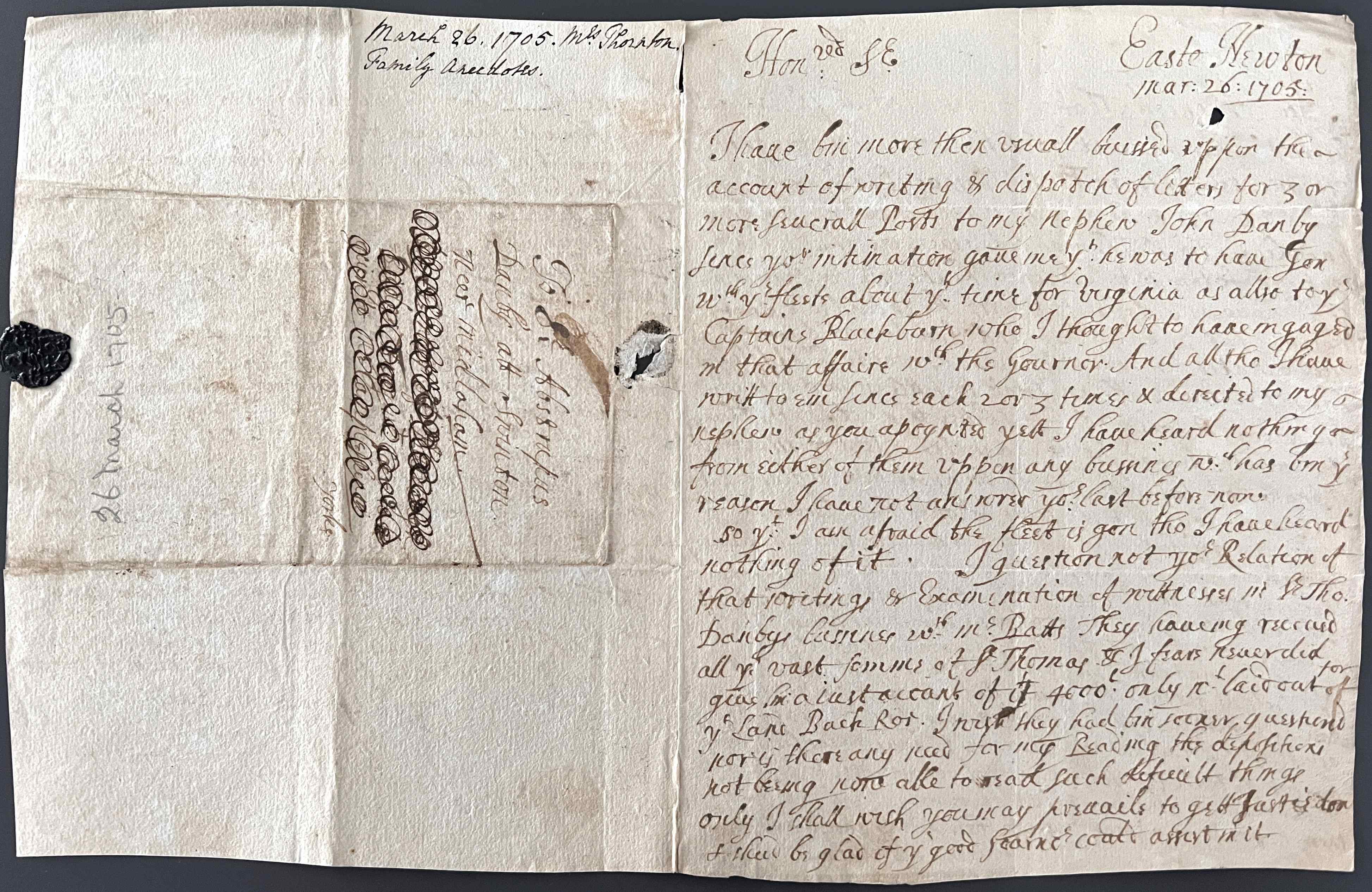
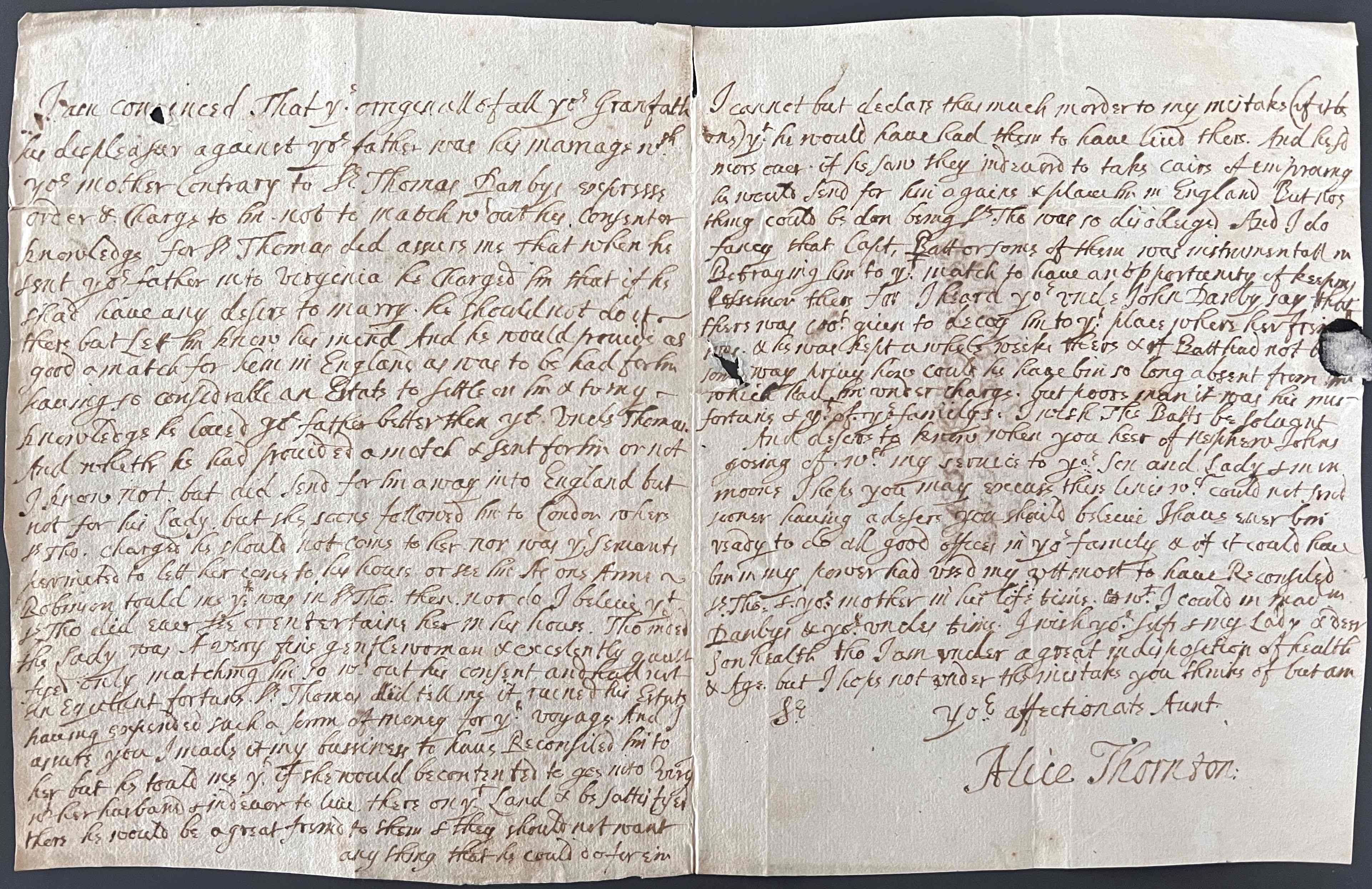
Letter from Alice Thornton, East Newton to Abstrupus Danby, Swinton, 26 March 1705 [ZS]
Thornton’s correspondence with her great-nephew continued over the decades and, in March 1705, she wrote to him, now Sir Danby of Swinton, near Middleham [ZS]. Abstrupus Danby was pursuing his late grandfather’s claims to land in Virginia (now in the United States of America) and Thornton was writing letters on his behalf and setting out her own memories of what she had heard happen there in the early 1650s.
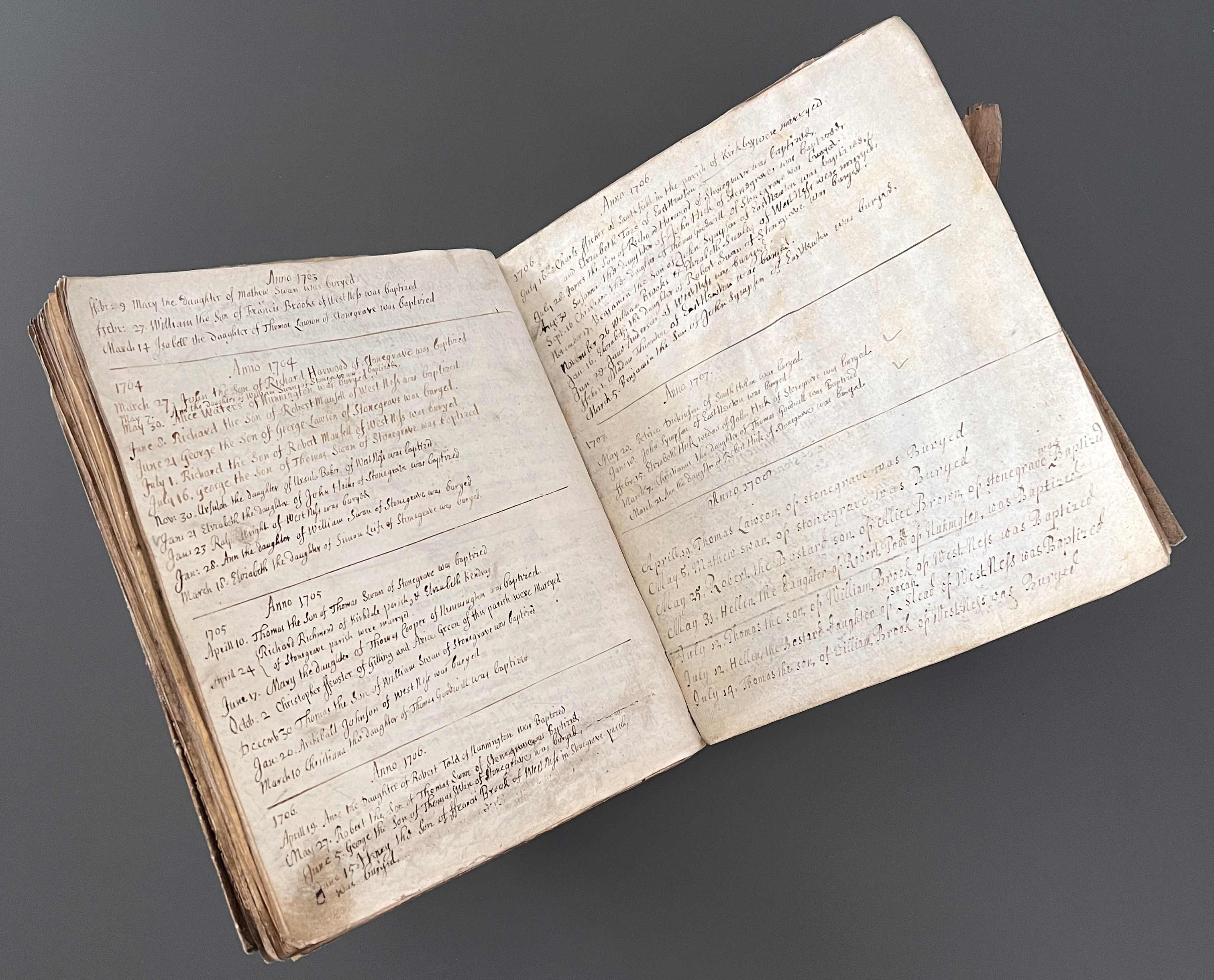
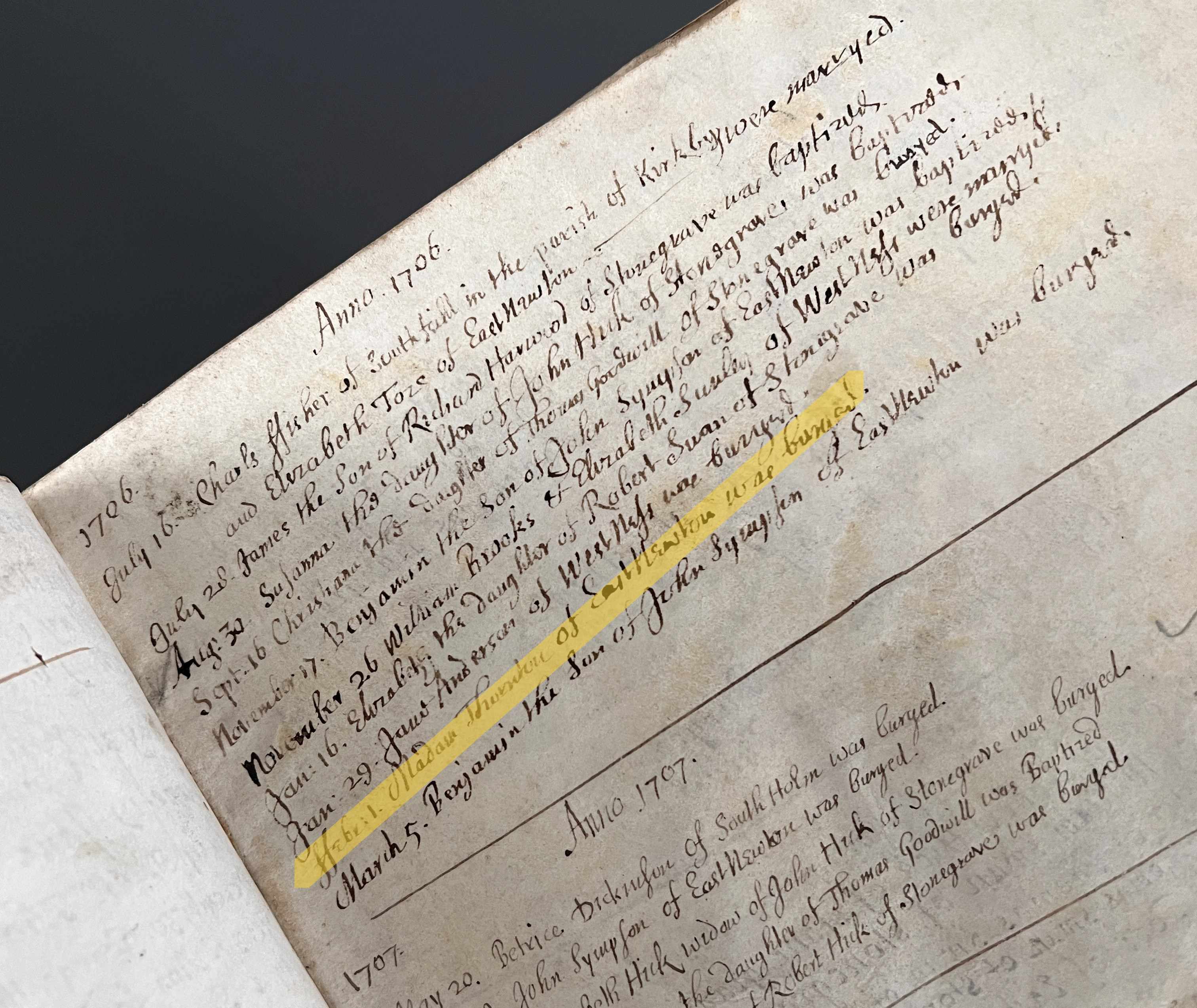
Stonegrave parish register recording the burial of ‘Madam Thornton’ on 1 February 1707 (entry highlighted) [PR/STV 1/1]
Alice Thornton died at some point in January 1707, just shy of her 81st birthday. She was buried in Holy Trinity church, also known as Stonegrave Minster, on 1 February. The parish register describes her simply as ‘Madam Thornton’; the date is given as 1706 as the register uses the old style of dating in which the new year only started on 25 March.
Documents relating to Anne Danby, Thornton’s niece
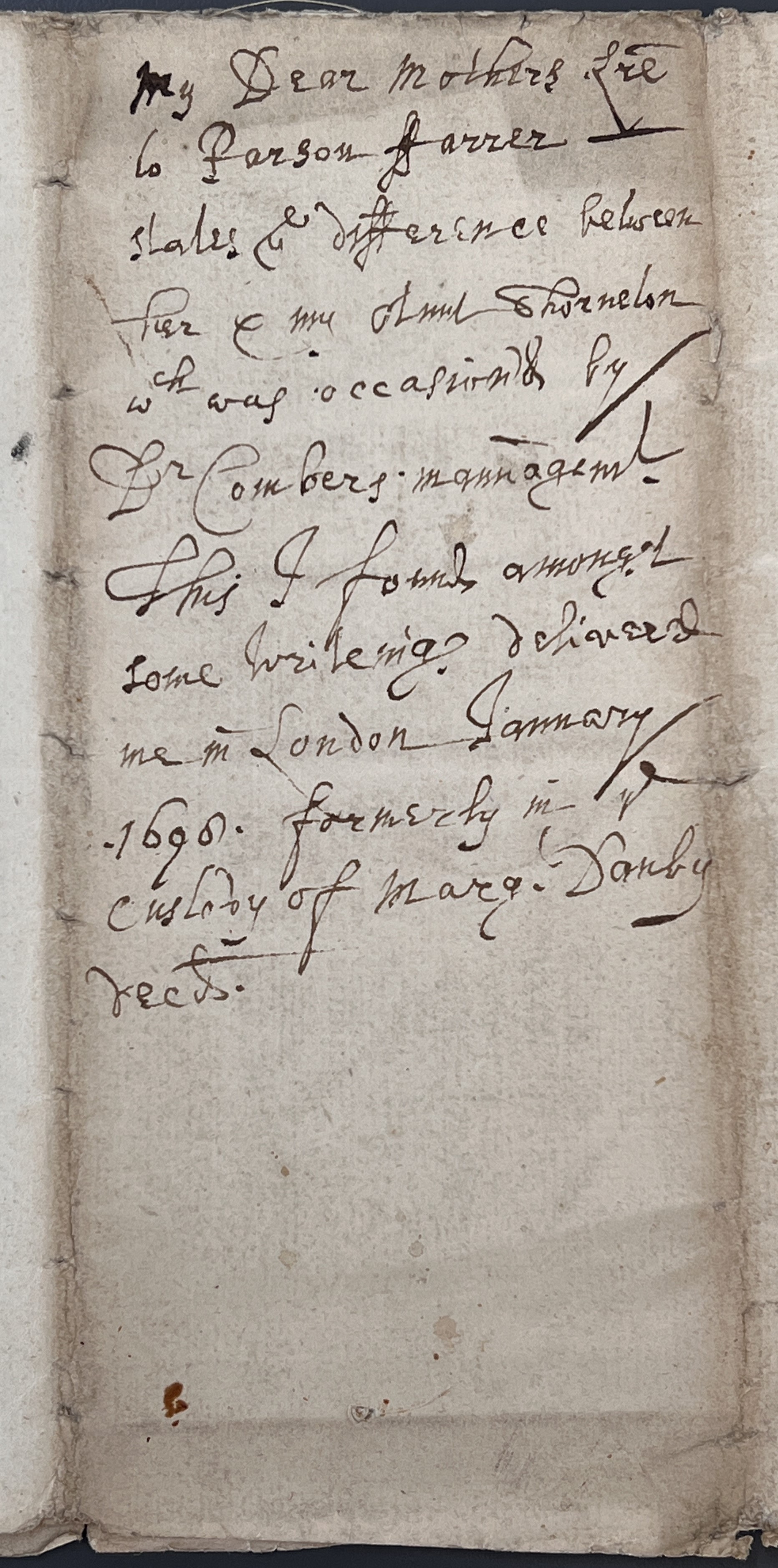
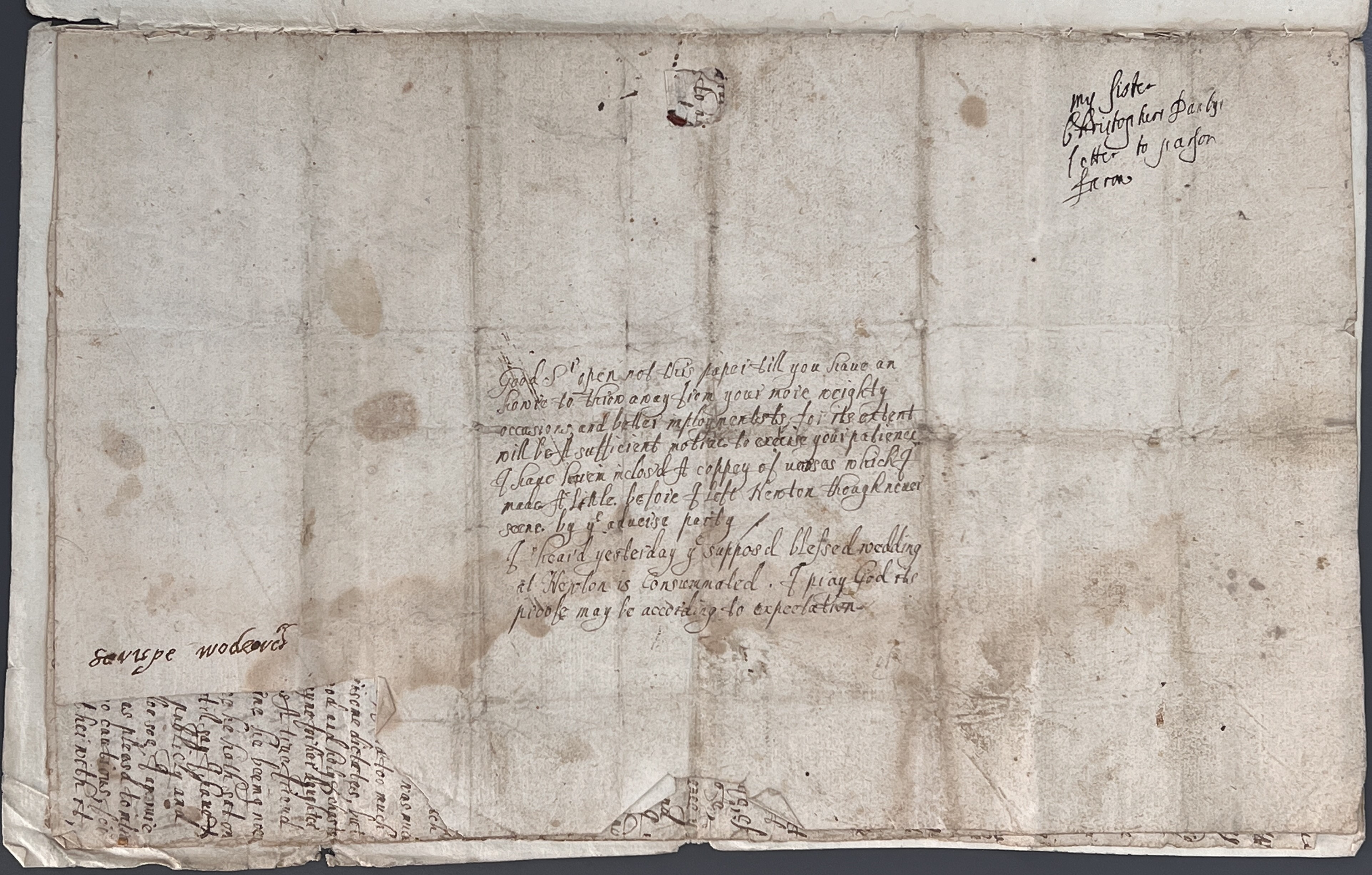
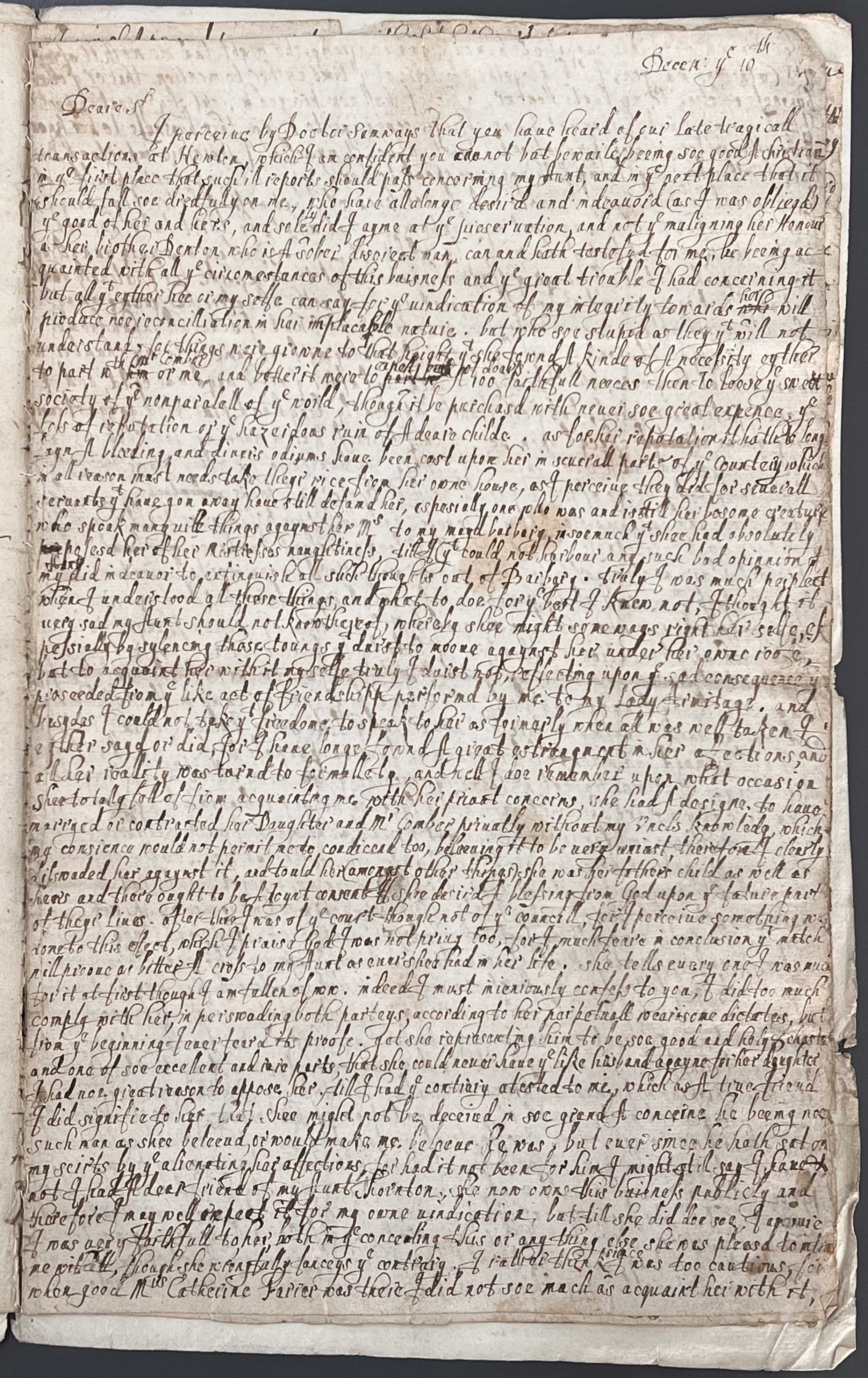
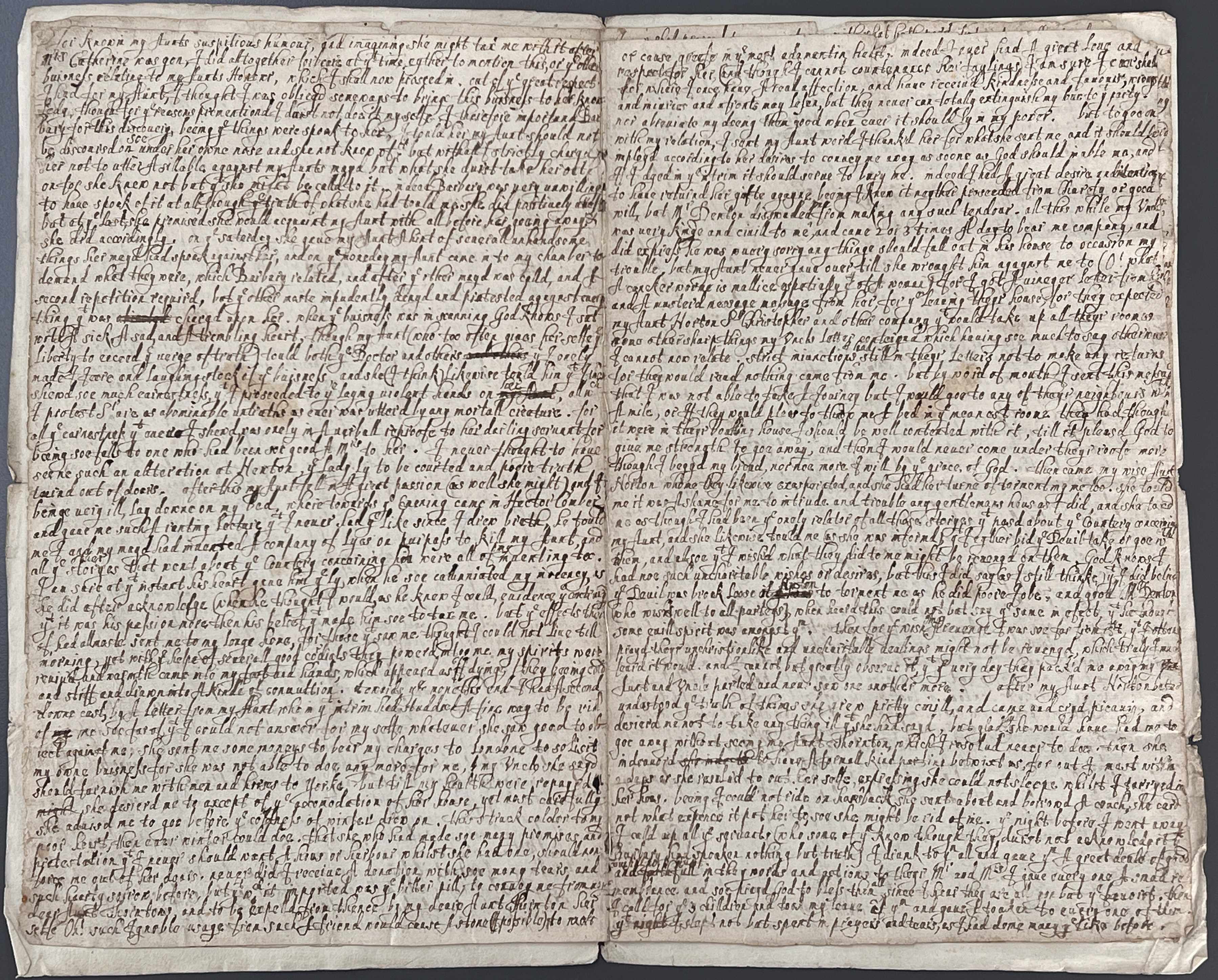
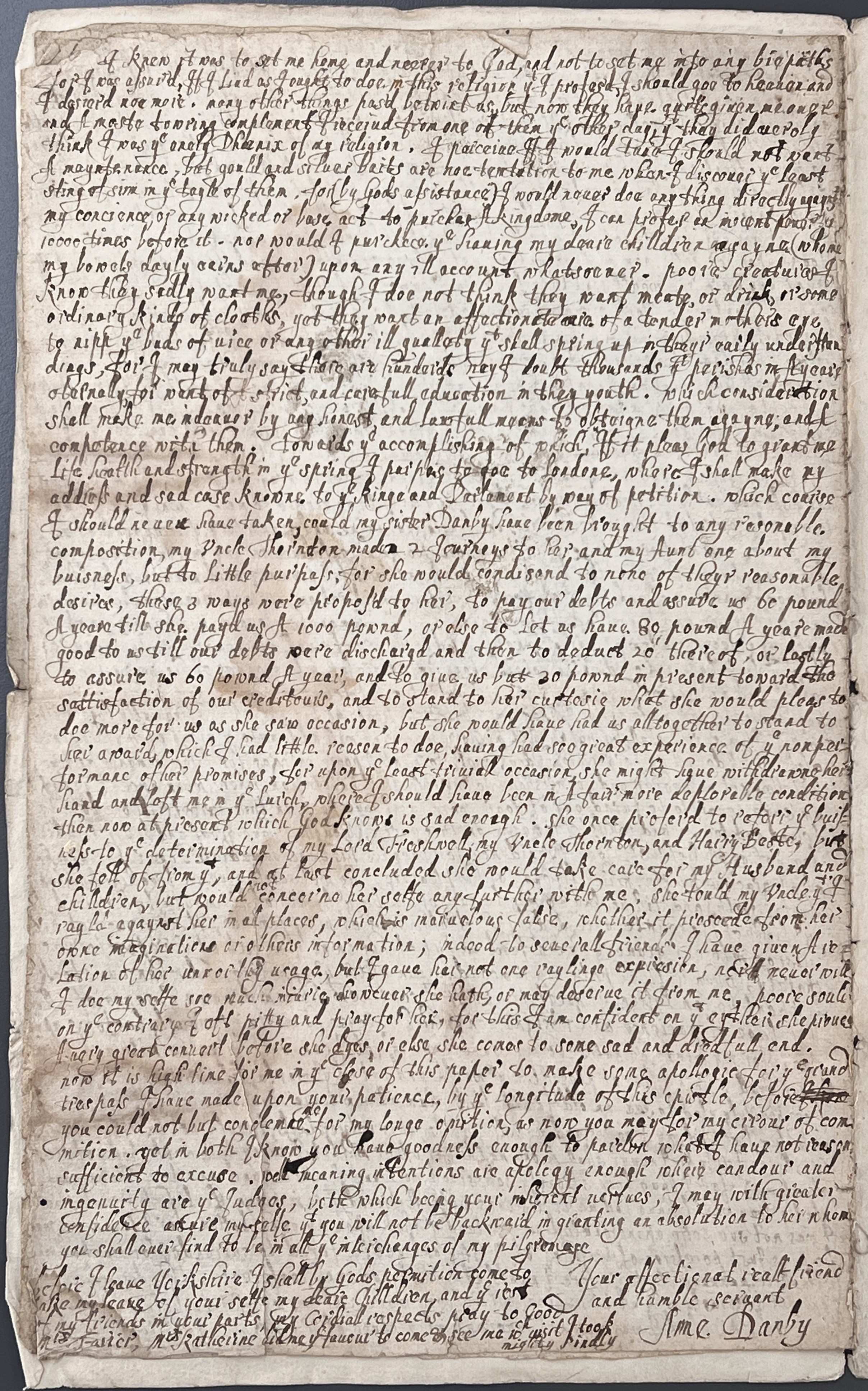
Letter from Anne Danby to Parson Farrer, c.1668 [ZS]
A key incident in Thornton’s books of her life was a falling out with her niece by marriage, Anne Danby (mother of Abstrupus). A letter from Anne Danby to George Farrer, written either in late 1668 or 1669, seems to be the only extant account of this disagreement from Anne’s perspective: ‘had it not beene for him [Thomas Comber] I might still say I haue not I had A deer friend of my Aunt Thornton’ [ZS]. For further details of the disagreement see this related Alice Thornton’s Books project blog post – ‘Tragical transactions at Newton’: Thornton’s niece responds.
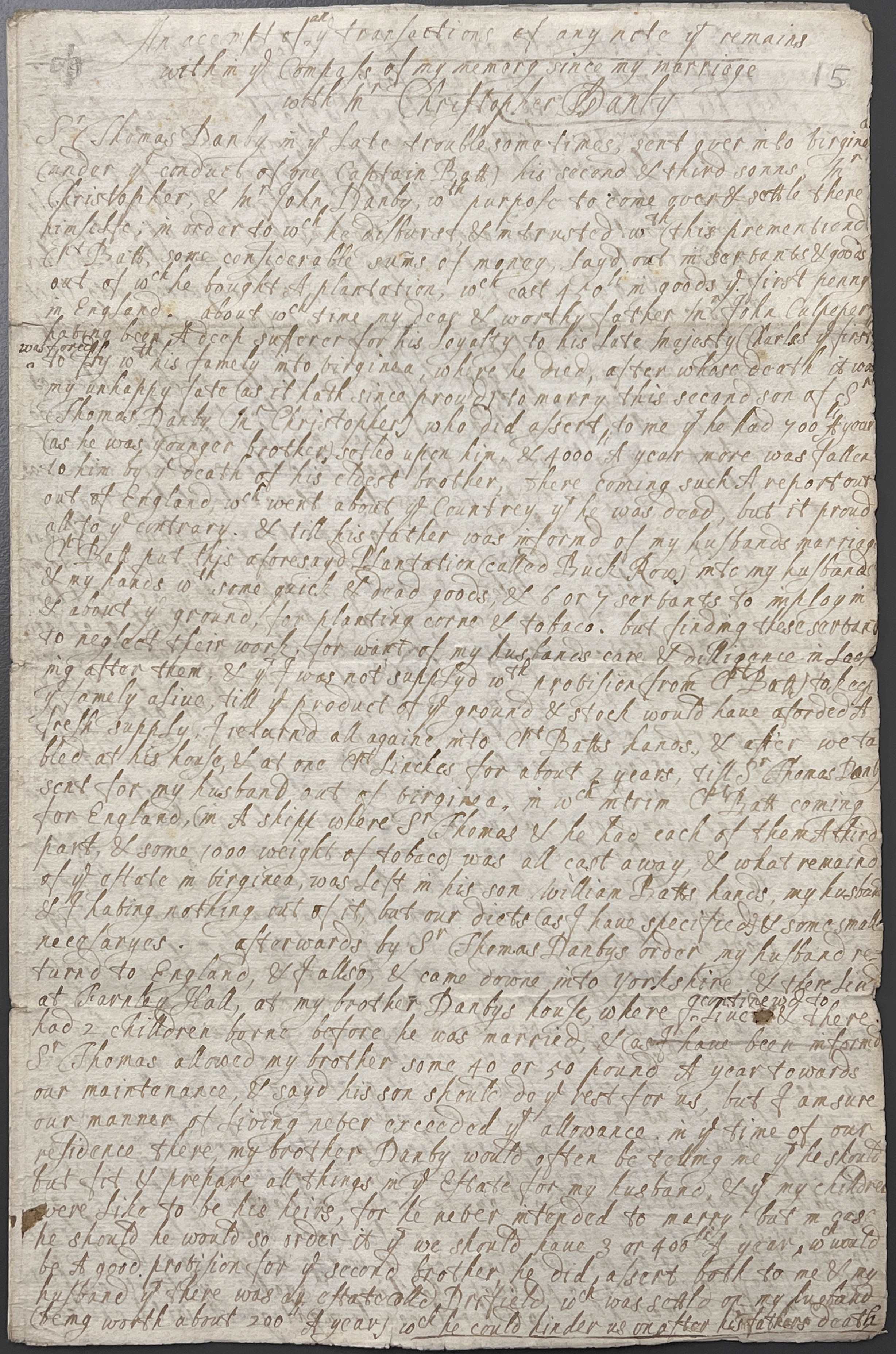
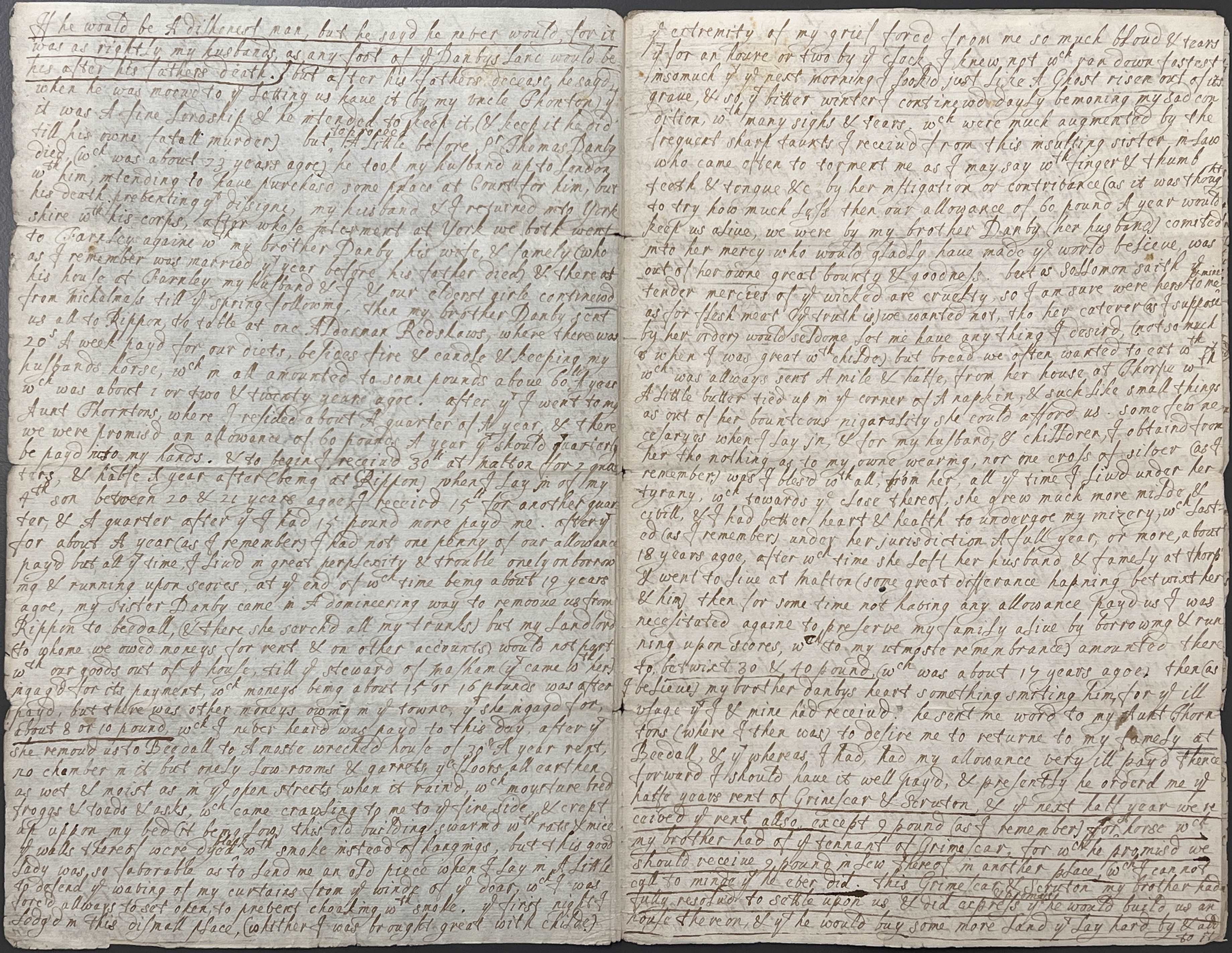
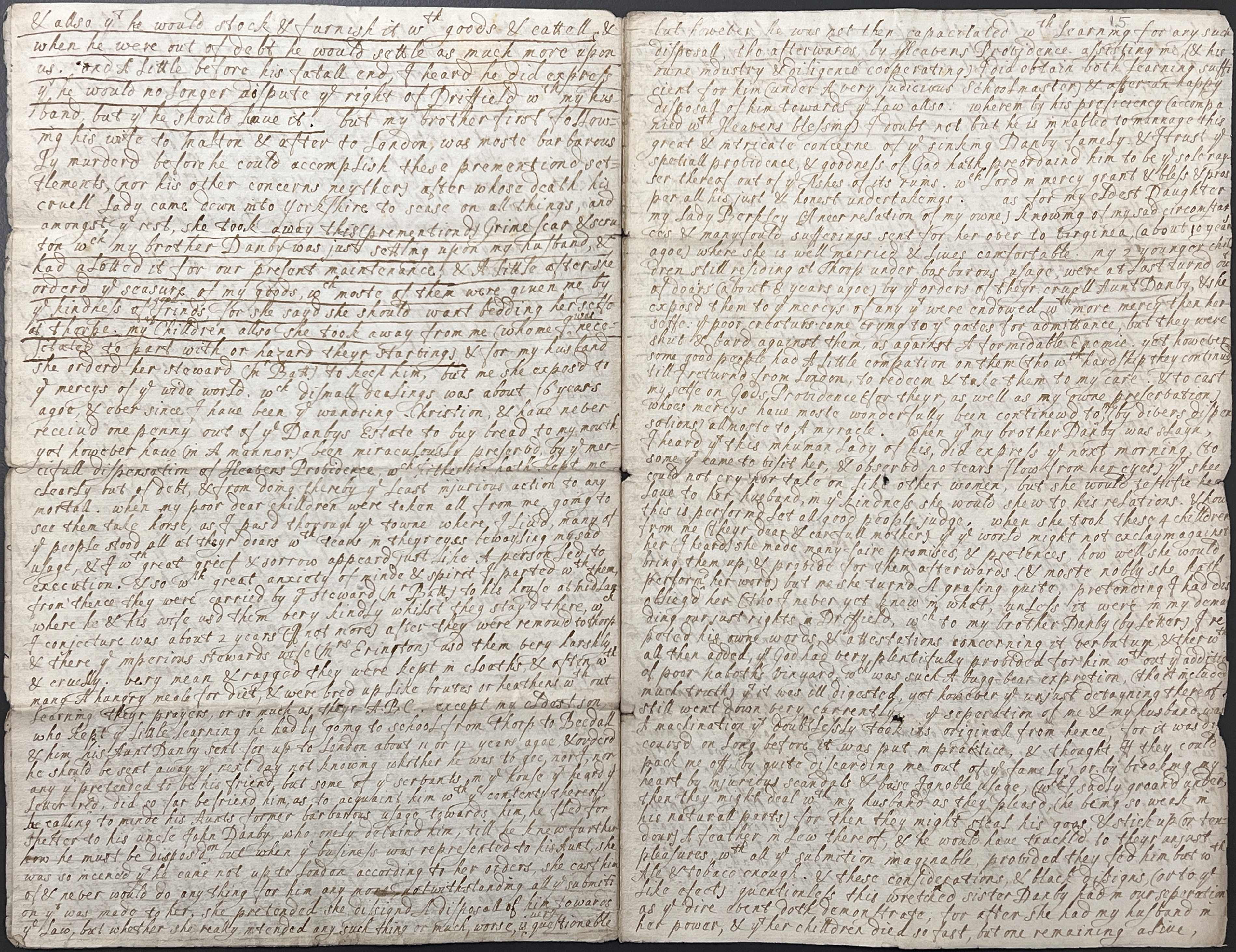
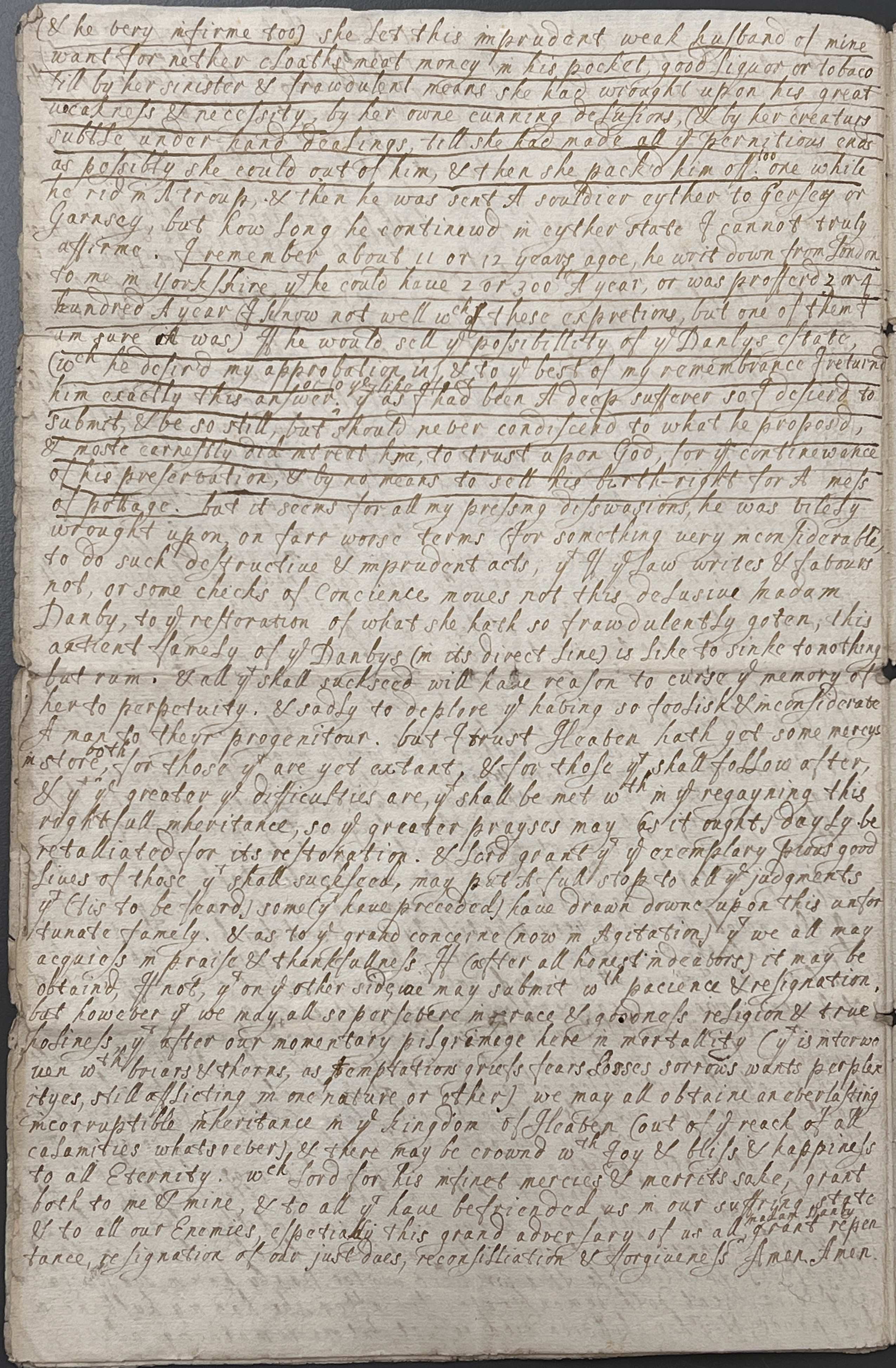
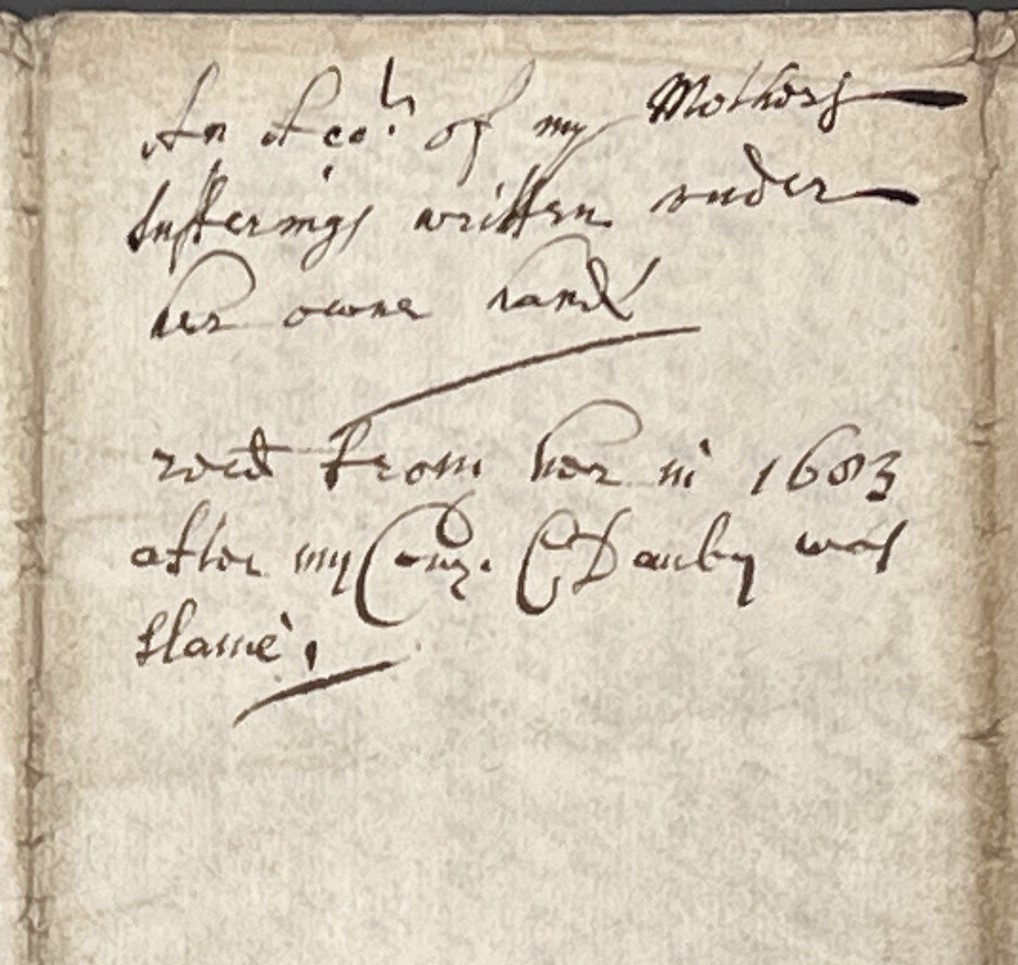
Anne Danby’s ‘Accompt’, 1683 [ZS]
Anne Danby also wrote a short account of her life ‘since my marriage with Mr Christopher Danby’, which she sent to her son, Abstrupus [ZS]. It was written in 1683, when Abstrupus was involved in a legal battle over the family estates with his aunt, Margaret Danby (widow of Sir Thomas Danby), and has a clear focus on financial transactions. Anne explained that when she married Sir Danby’s second son, Christopher, in Virginia, there was a rumour that his older brother had died and that Christopher was therefore worth £4,000 a year more. Unfortunately for Anne, this was not true.
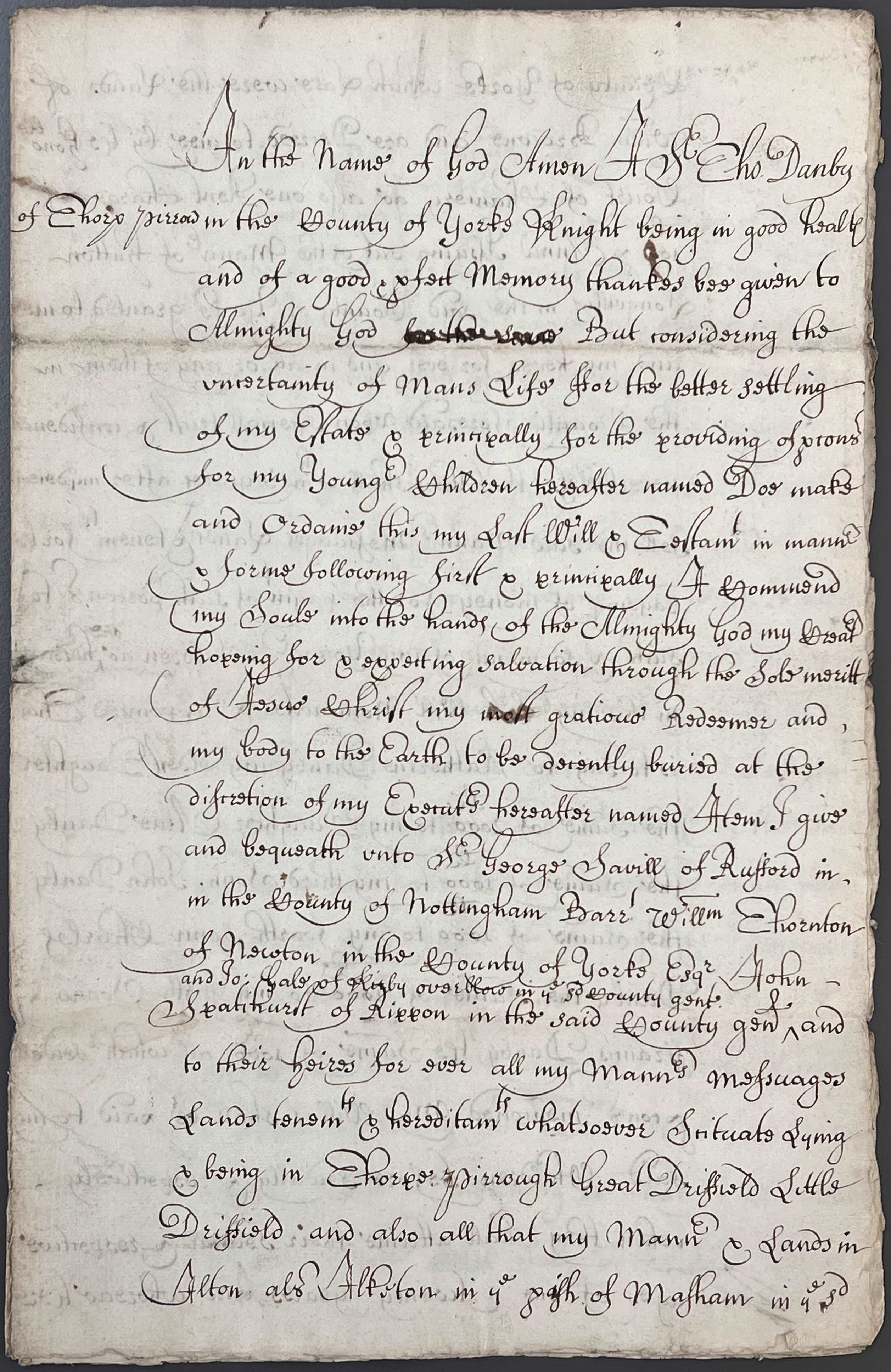
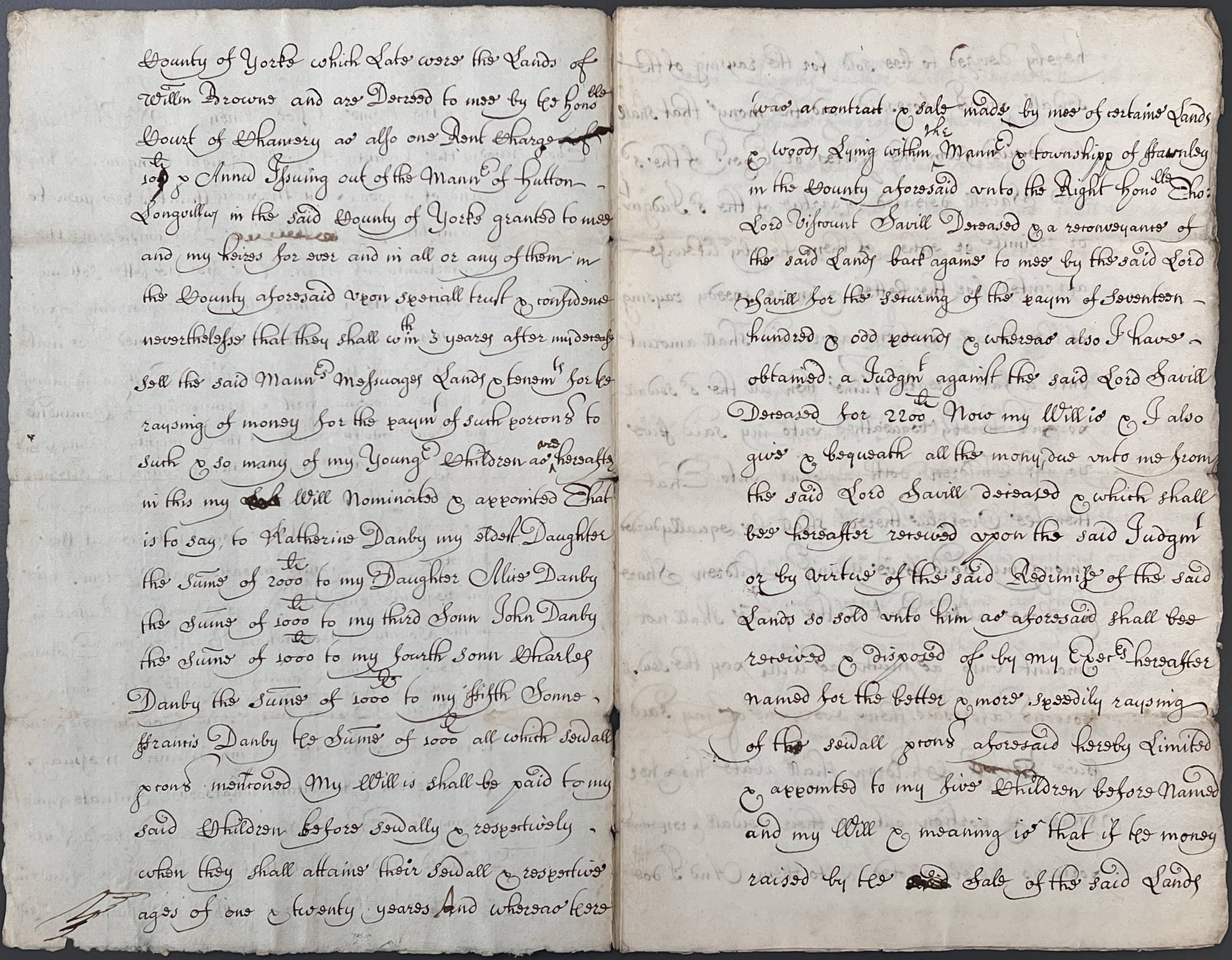
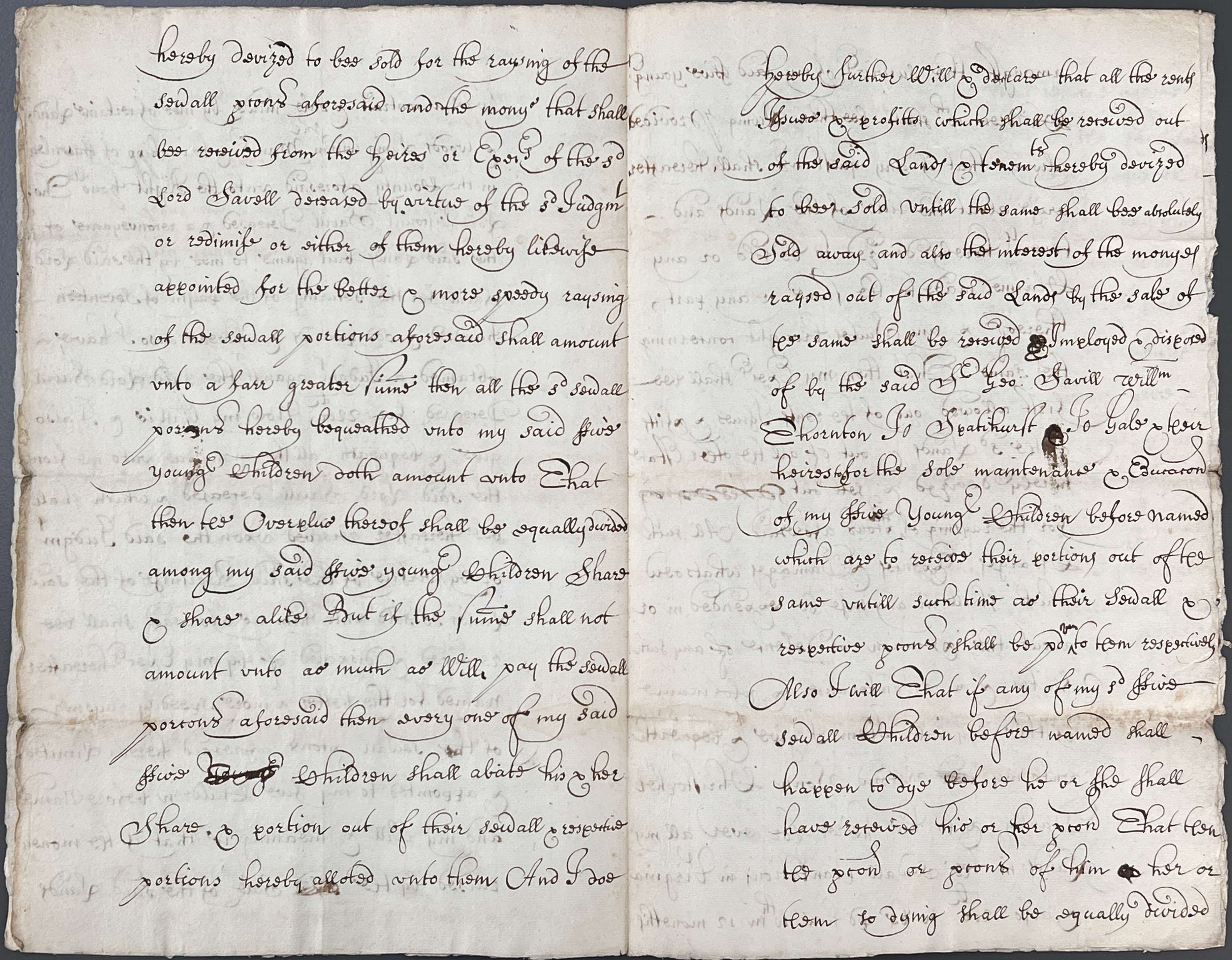
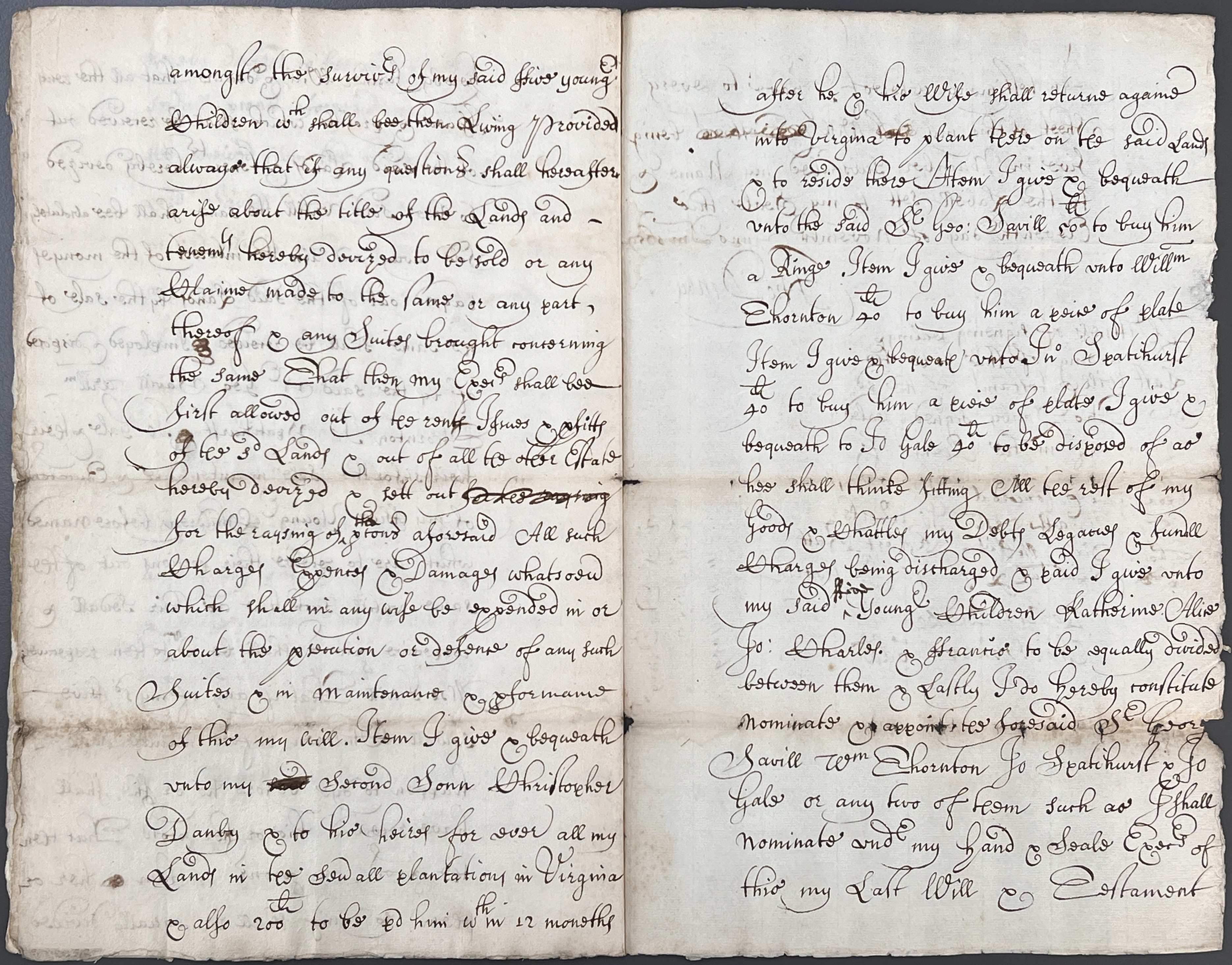
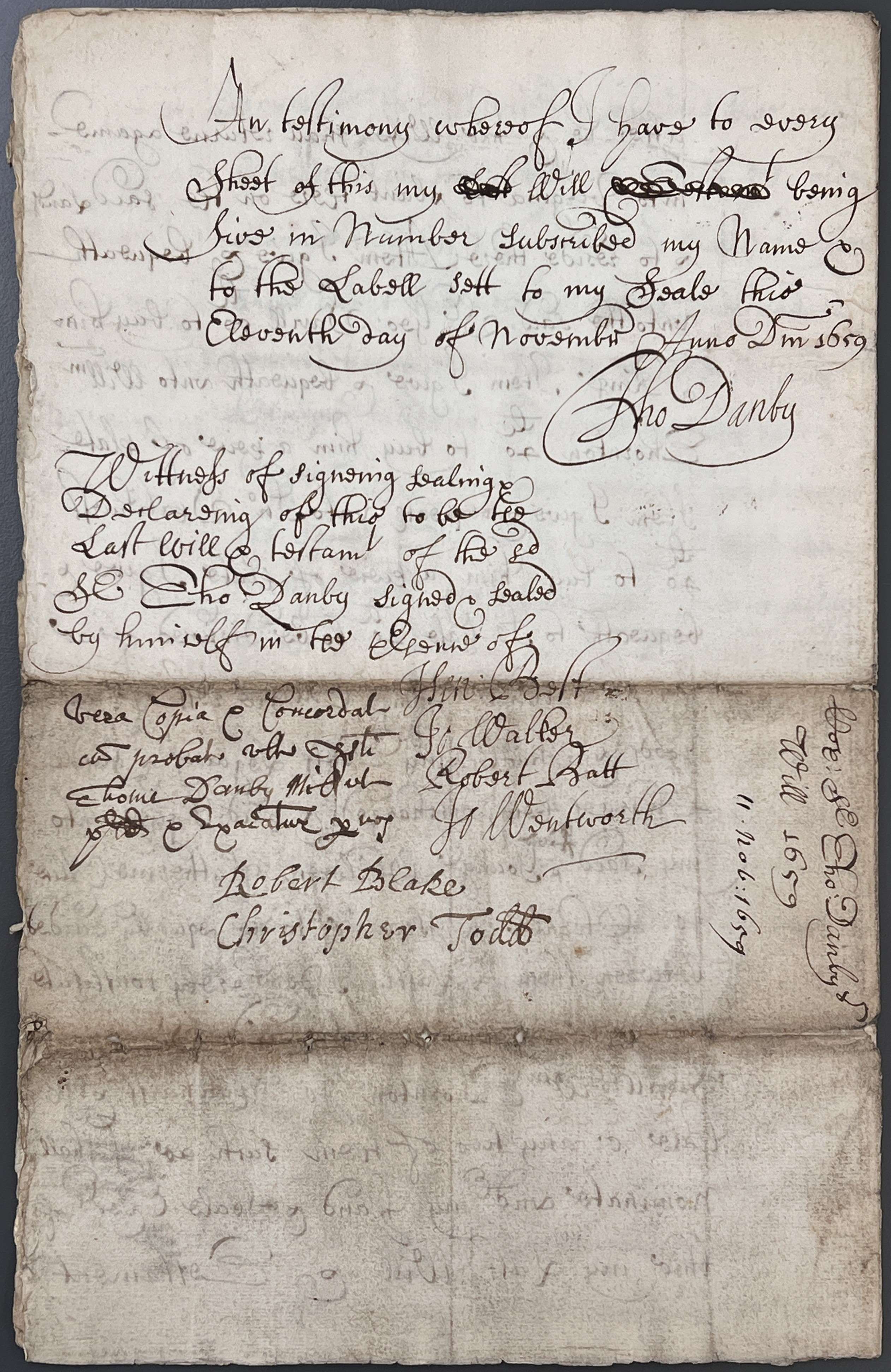
Will of Sir Thomas Danby of Thorpe Perrow, knight, 11 November 1659 [ZS]
Sir Thomas Danby was Thornton’s brother-in-law. He was knighted in 1633 and elected MP for Richmond in 1640, but banned from sitting in Parliament after 1642 and fined heavily for his loyalty to Charles I. When he made his will in 1659, he was keen that Christopher and Anne Danby should return to Virginia: ‘I giue and bequeathe unto my Second Son Christopher Danby and to his Heires for Euer, All my Lands in the Severall plantac[i]on of Virginia and also two hundred pounds to be paid him in with 12 months after he and his Wife shall returne againe into Virginia to plant there upon the said Land and to reside there’ [ZS]. They did not take up this offer.
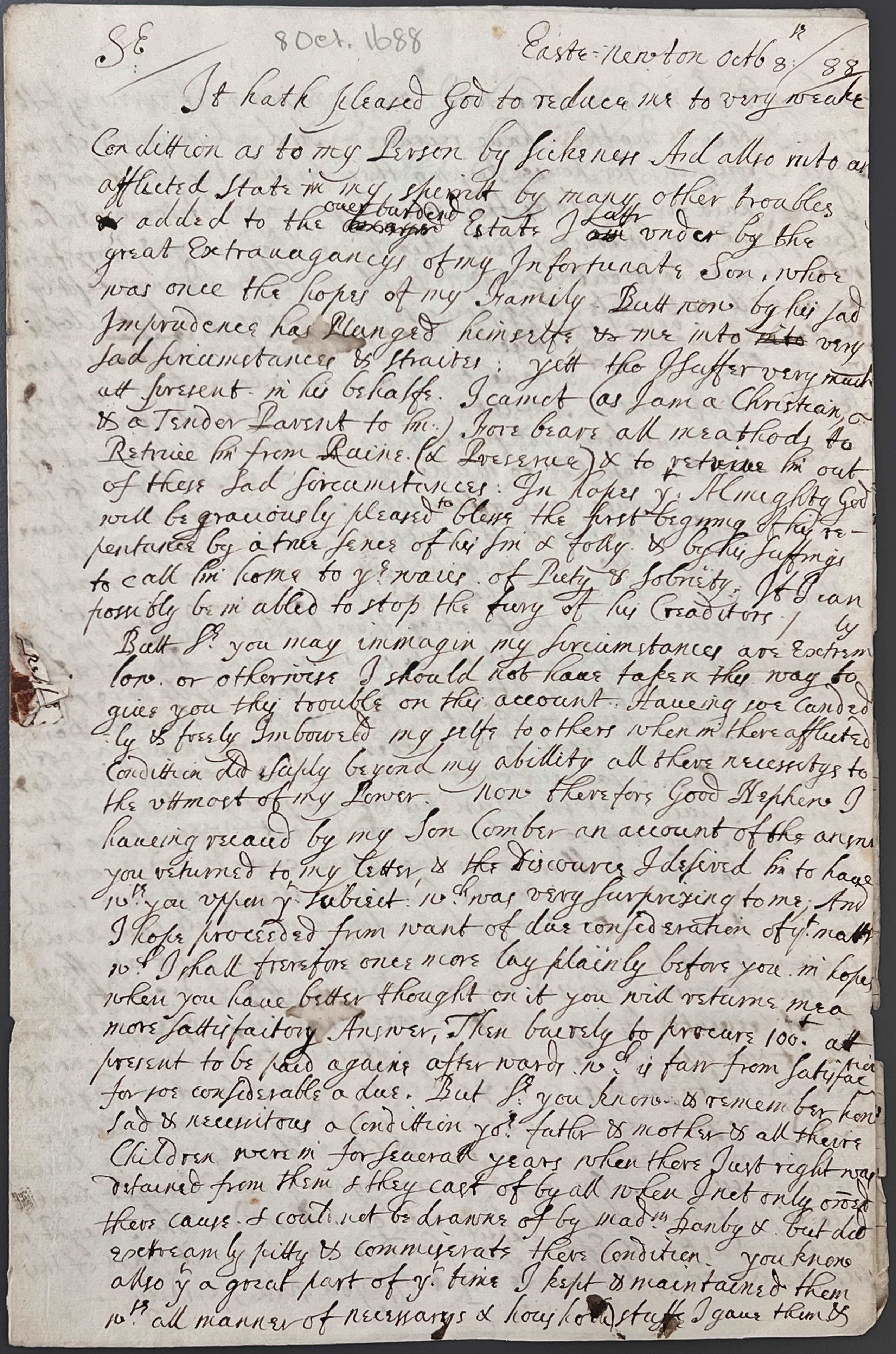
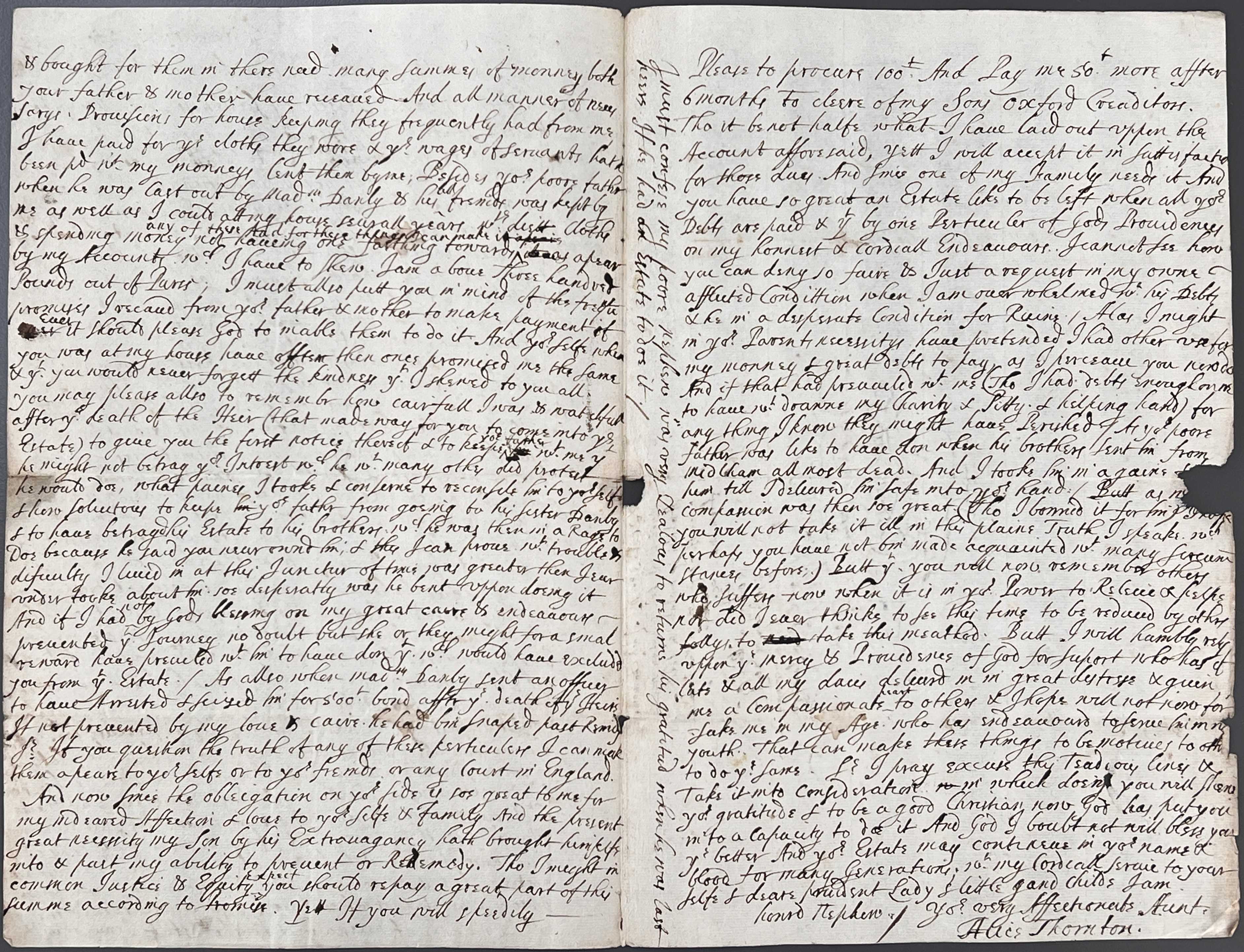
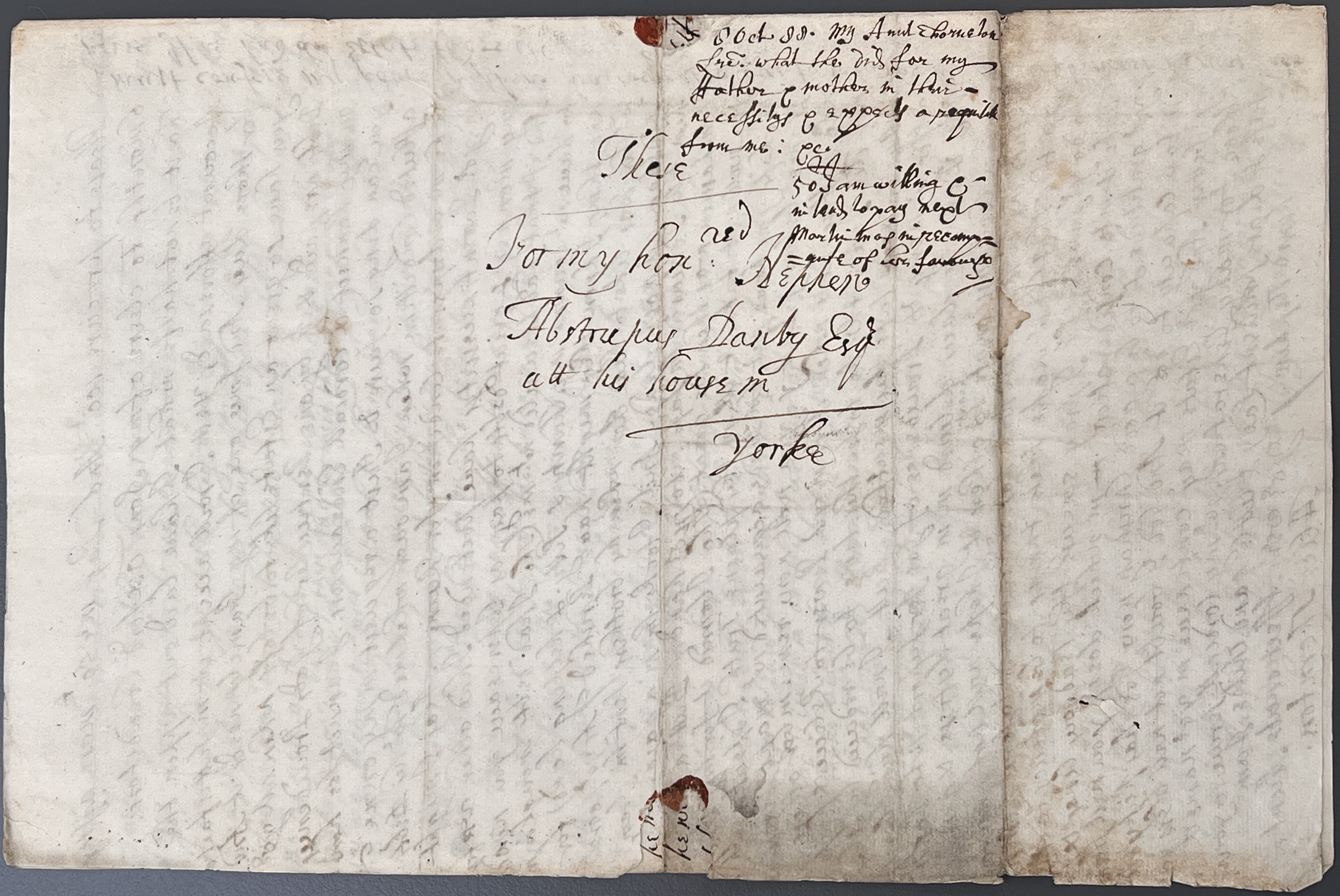
Letter from Alice Thornton to Abstrupus Danby, 8 October 1688 [ZS]
In a letter, dated 8 October 1688, Thornton again sought help with her son’s debts from her great-nephew, Abstrupus Danby [ZS]. She reminded him at length what she had done for his parents, Christopher and Anne Danby, and his siblings: ‘you know & remember how sad & necessitous a Condittion yo.r fathr & mother & all theire Children were in for seuerall years when there Just right was detained from them & they cast of by all’. Abstrupus noted at the top of the letter that he was willing to pay £50 in recompense (she had asked for £150, claiming to have spent over £300).
Further information
Alice Thornton’s Books project website – ‘Alice Thornton’s Books’ is a collaborative AHRC-funded research project, in partnership with Durham Cathedral, which brings together historians, literary scholars and digital analysts from the University of Edinburgh and King’s College London Digital Lab. The project is creating an online digital edition of all four of Alice Thornton’s autobiographical manuscripts, which will enhance understanding of the lives and works of early modern women.
 North Yorkshire Archives Blog