
An interesting collection of records is held by the Record Office that gives some idea of life in wartime Harrogate for an ordinary family (Z.1010). The Hay family moved to Harrogate at the beginning of the war and, after a short time staying in Park Parade, took a lease of a house in Springfield Avenue in April 1940. Shortly after this, Mr Hay was sent back to London to work for the Ministry of Aviation, but the rest of the family remained in Harrogate until 1946.

When they left Harrogate, the Springfield Avenue property seems to have been sold by the landlord, as the collection includes a sale catalogue for the house in 1946. The house had 6 bedrooms with a scullery, housemaid’s pantry with copper sink and a staff W.C. (water closet, i.e. toilet). It had previously been occupied by a doctor and was marketed as being “highly suitable for others in a similar profession“.
Z.1010 Sale catalogue for ‘Bramhope’, 2 Springfield Avenue, Harrogate, 17 July 1946
A large house was certainly needed, for the household at first consisted of Mr and Mrs Hay, their two children, a nanny and a maid. In 1944, two bedrooms, a sitting room and kitchen were let to a Mrs Apcar, and in 1945 the family were joined by Mrs Hay’s recently widowed mother. This addition to the household meant extra rooms to be heated, and an application for extra fuel was made to the Local Fuel Overseer to enable the fire in the dining room to be lit; however, this application was refused.

Z.1010 Copy of a letter from Mr Hay to the Local Fuel Overseer Harrogate, asking that they reconsider the decision to refuse to grant additional fuel, 17 February 1945

BU07704 Photograph of The Majestic Hotel, Harrogate, by Bertram Unné, 1965
In September 1940, Harrogate was bombed without warning, the bombs landing in Ripon Road, in the grounds of the Majestic Hotel and on the hotel’s east wing. The Majestic Hotel stood opposite the Hay’s house, which suffered some bomb damage. The attack happened around lunchtime, when Mrs Hay was in the scullery preparing the lunch for her children and her parents in law, who had arrived the day before. In a letter to her husband (see images below), she describes how the whole family, including the dog and cat, took shelter in the cellar and emerged to news that there was an unexploded bomb in the Majestic. They returned to the cellar, clutching the rest of their lunch – rice pudding and apples – but were shortly advised by a policeman and warden, who appeared at the cellar door, that they should evacuate the house immediately. They all clambered into the car and, as Mrs Hay put it, “fled towards Ripon“. The cat escaped at the last moment, but as “the place was swarming with wardens” they left it to the care of a neighbour.

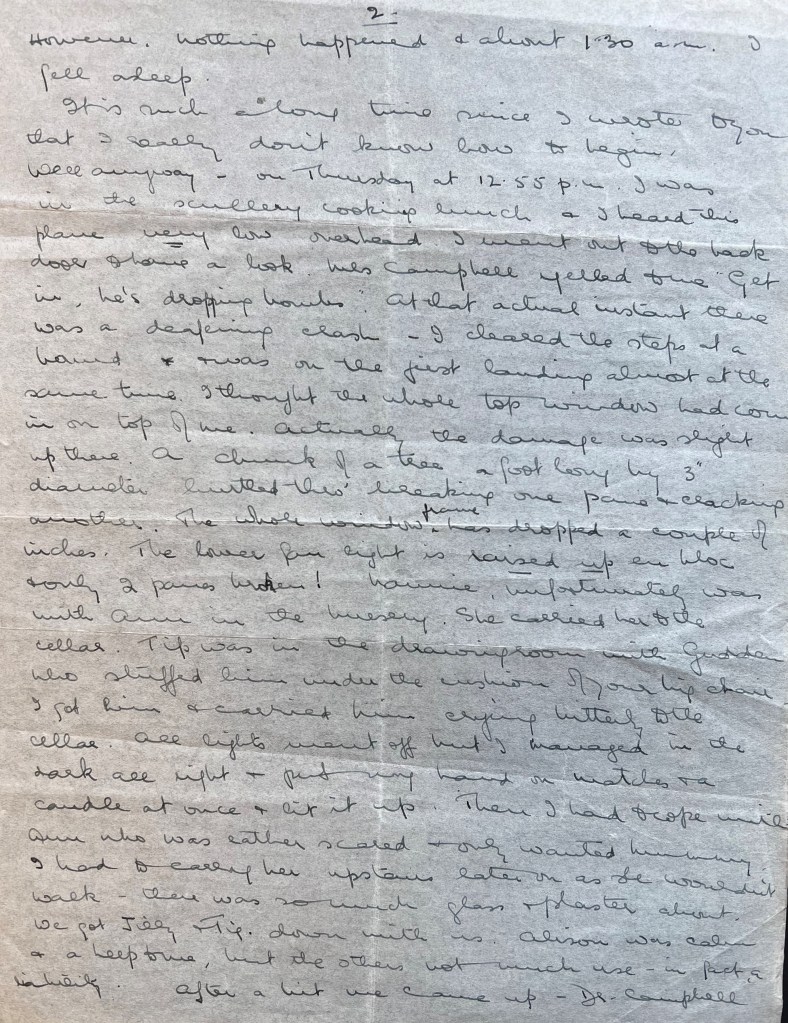
Z.1010 First two pages of a letter from Mrs Hay in Harrogate to her husband at the Ministry of Aviation in London describing the bombing of Harrogate, 14 September 1940
After taking tea at the Drovers Inn, Bishop Thornton, they returned to Harrogate and made enquiries at the police station, where they were informed that it could be four days before they could return and, if the bomb exploded, they might have no house to return to. All the hotels were full, so Mrs Hay had to beg accommodation from friends. Her parents in law went to one friend, the nanny to another, the maid and dog to a third, and Mrs Hay and the children to a fourth. The next day they were able to return to the house to clear up. Many windows had been cracked or broken but the damage seems to have been less severe than that suffered by some of their neighbours. Reports circulated that the unexploded bomb had been defused with only fifteen minutes to spare!
The collection also includes household bills for food, medicines, schooling, laundry and fuel. A bill for curtaining specifies lining with blackout cloth.
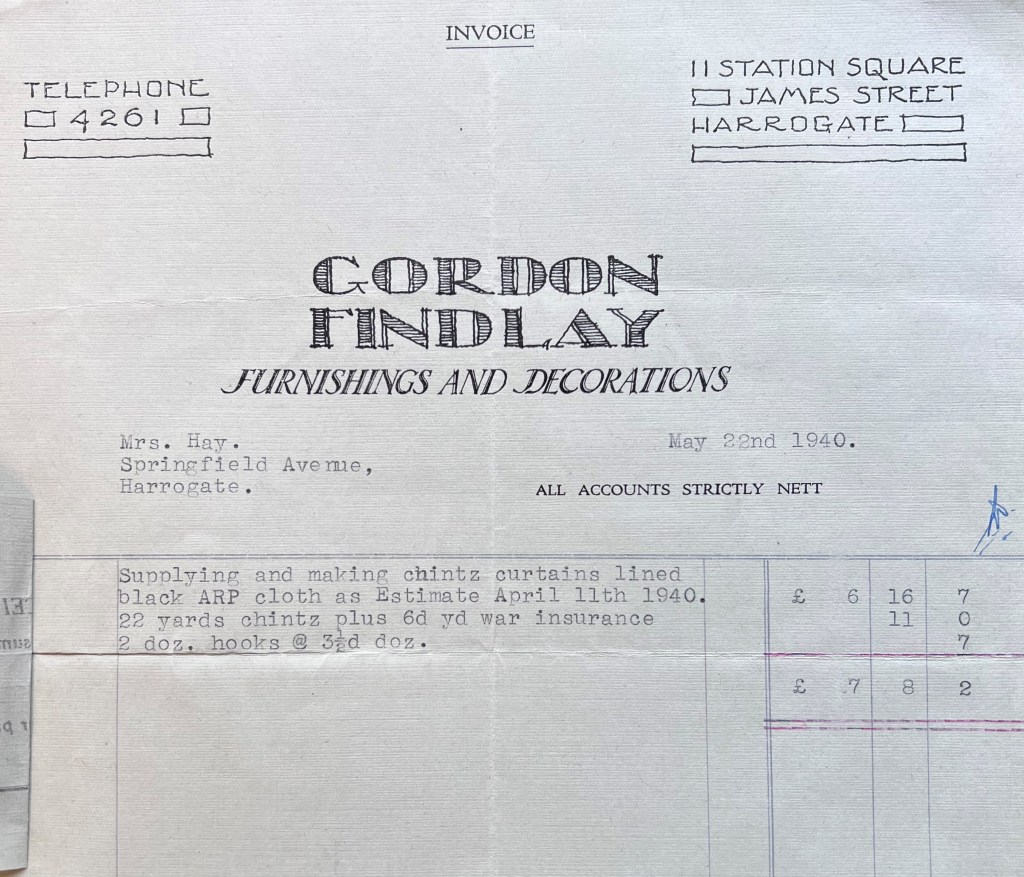

- Z.1010 Left: Invoice for supplying & making chintz curtains lined with black ARP cloth, 22 May 1940
- Right: Bill for overhauling & attending to Marconi Radiogram, November 1943
A fire-watching chart shows how seriously the residents of the area took the threat of attack, but ordinary social life also continued. There are a number of programmes (pictured below) for concerts given by John Barbirolli and the Hallé Orchestra at the Royal Hall, Harrogate.


Z.1010 Selection of programmes for concerts given at the Royal Hall, Harrogate in 1944 and 1946, including by John Barbirolli and the Hallé Orchestra (centre and right)
 North Yorkshire Archives Blog