by Gail Falkingham, Record Assistant
Lying to the south-west of the village of Kirby Wiske, on the north bank of the River Wiske between the towns of Thirsk and Northallerton, the house at Sion Hill is described as ‘a masterpiece in the neo-Georgian style’. This Edwardian, Grade II* listed building was one of the latest country houses to be built in England at the beginning of the 20th century, completed in May 1914, just before the outbreak of the First World War.
The fascinating story of the building of the house can be told through the records that survive within the archive collection of Stancliffe family letters and papers held at the County Record Office [ZXW]. This collection includes documents and correspondence relating to the purchase of Sion Hill in 1911 by Percy and Ethel Stancliffe, the subsequent demolition of the existing house and the building of a new house between 1912 and 1914, designed by Walter H. Brierley of York.
The archive sheds light on the various people involved and the relationships between them: Percy Stancliffe; his agent: H. Coverdale; Stancliffe’s co-purchaser: Francis Samuelson; the architect: Walter H. Brierley and the builder: Thomas Lumsden of Jarrow-on-Tyne. Although there are no copies of Stancliffe’s letters, there are numerous replies from Brierley over the two-and-a-half-year-period of their correspondence. From these, we can see that Stancliffe was an exacting, and at times trying, client and that Brierley was a busy, yet extremely thorough, patient and accommodating architect, who responded promptly to letters and telegrams. He visited site regularly throughout the period of construction and made changes to the design at the request of his client, whilst diplomatically expressing his reservations about doing so. We also get a glimpse into Brierley’s design aesthetic, the intentions behind his choice of layout, and his minute attention to detail, right down to the types of small brass screw to be used for hanging pictures on the walls of the panelled boudoir.
The purchase of the Sion Hill Estate
Following the death of the Hon. George Lascelles, who had owned Sion Hill since 1867, the Sion Hill Estate was offered for sale by auction in York on 26 October 1911. In the sale catalogue (see pages pictured below), the house at Sion Hill was described as a ‘moderate-sized mansion’ [ZXW 2/1].


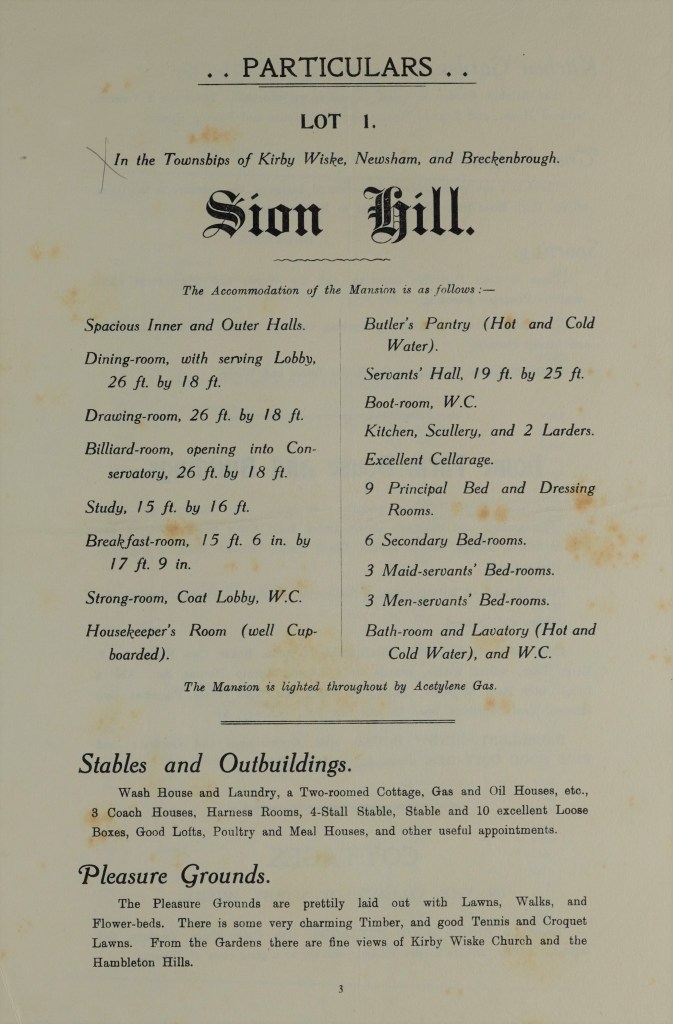

ZXW 2/1 Pages from the Sion Hill Estate sale catalogue, 26 October 1911
Prior to the auction, there were discussions between Percy Stancliffe and Francis Samuelson of nearby Breckenbrough Hall regarding the possibility of buying the estate together and becoming neighbours [ZXW 2/2]. Stancliffe was interested in Sion Hill, the gardens, pleasure grounds, mansion, out offices, buildings, yards and stables, road and eight cottages in Kirby Wiske village. Samuelson, who took the lead on the purchase, was interested in Breckenbrough Castle Farm and land to the south of the Wiske.
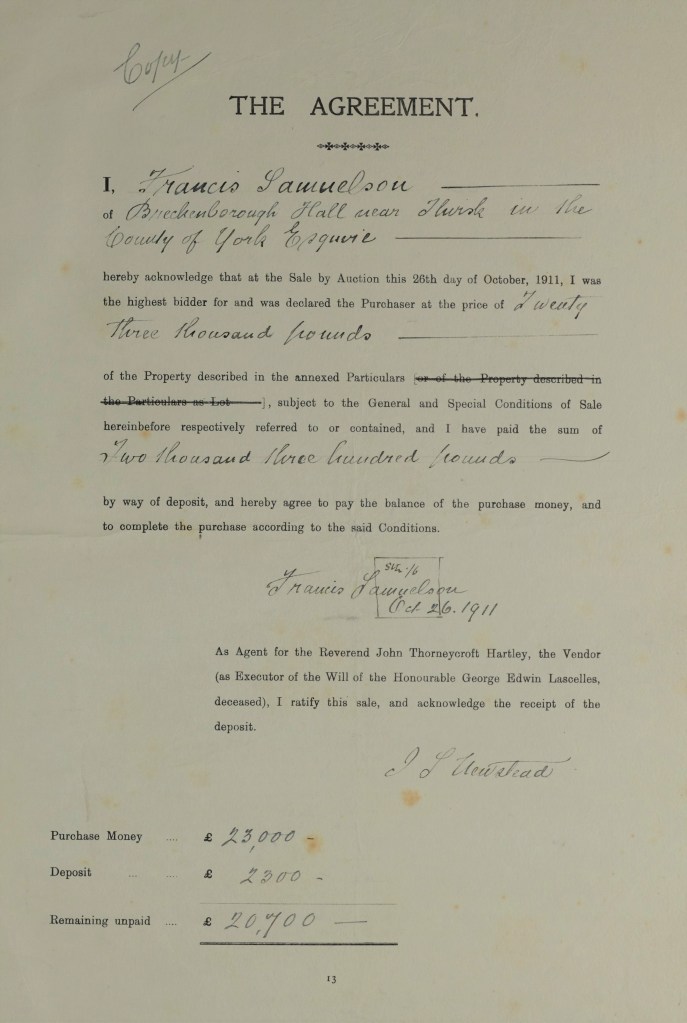
At the time, Stancliffe was residing at Solberge Hall, close to Sion Hill. However, he was not present at the auction, he was in Scotland at the Tor-Na-Coille Hotel in Banchory, where Samuelson sent him a telegram on 26 October 1911 to confirm his success and how they would split the purchase price: “Bought whole twentythree you pay fourteen.” Samuelson also sent a letter the same day providing more details:
“My dear Stancliffe, I had to go to £23,000 or let it be put up again in lots and I was afraid that might not do us any good. There were very few people in the room and my opening bid of £18,000 was the only bid. So they withdrew the property and asked me to come up and talk to them. They asked £23,000. I offered them £22,000, but it was no use, they wouldn’t have it…. I think you have done very well to get the place as a residential property for £14,000….I hope that you will get the water and that you and your wife and your boys will like the place and be very happy there and that we shall be good and happy neighbours for many years” [ZXW 2/2].
The deed of conveyance for the purchase of the estate was completed on 1 February 1912, naming Lascelles’ sons and son-in-law as the vendors, who were executors of his estate. One, the Hon. Alfred George Lascelles, was Chief Justice of Ceylon (now known as Sri Lanka). The conveyance was registered with the North Riding Registry of Deeds on 2 May 1912. In this deed, Francis Samuelson is named as the ‘original purchaser’ and Ethel Stancliffe, Percy’s wife, as the ‘sub-purchaser’ [NRRD 233/1417/474].
The existing house at Sion Hill
Prior to the Hon. George Lascelles, Sion Hill had been owned by the Crompton family until 1867 [NRRD KM/205/324]. The Kirby Wiske tithe map of 1840 and a watercolour of 1848 (see below) provide us with an indication of the extent of the estate and the footprint of the house at the time it was owned by Joshua Samuel Crompton (1799-1881).


T Extract from Kirby Wiske tithe map and apportionment, 1840, showing the Sion Hill estate (coloured green)
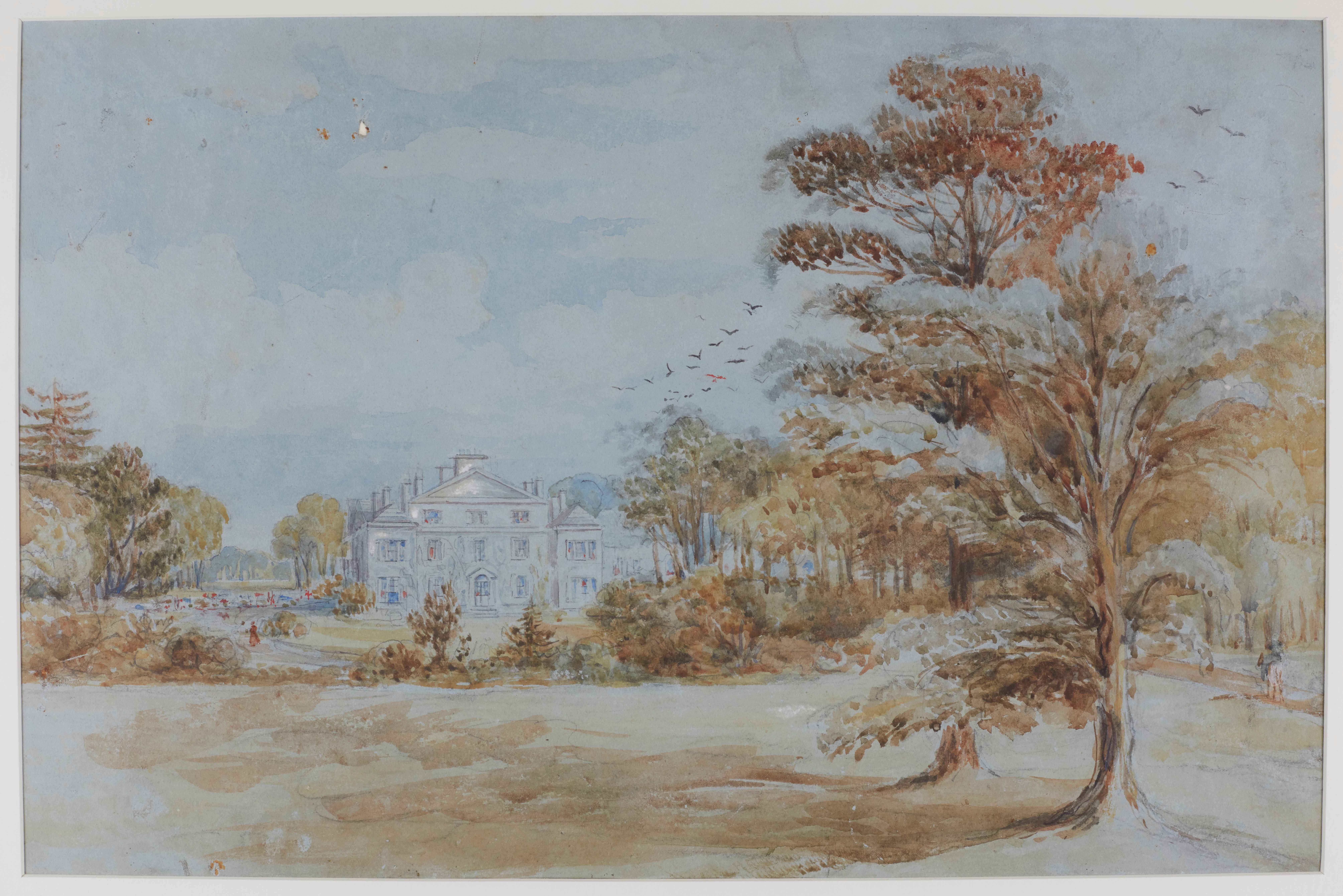
This watercolour by Henrietta Matilda Crompton (1793-1881) is titled ‘Sion Hill the place of Joshua Samuel Crompton & Mary Crompton his wife. Helenora MC on horseback 13 years old‘.
Henrietta was Joshua’s elder sister; his wife was Mary Alexander, who he married in 1834; Helenora was their daughter.
ZCM Watercolour of Sion Hill by Henrietta Matilda Crompton, 1848
The 1911 sale catalogue in the archive is missing its accompanying plan, but contains two photographs of the house and gardens (see below). The Ordnance Survey 25-inch to the mile map sheet, published in 1912, was surveyed in 1910 before the old house was demolished, and thus still shows its footprint.
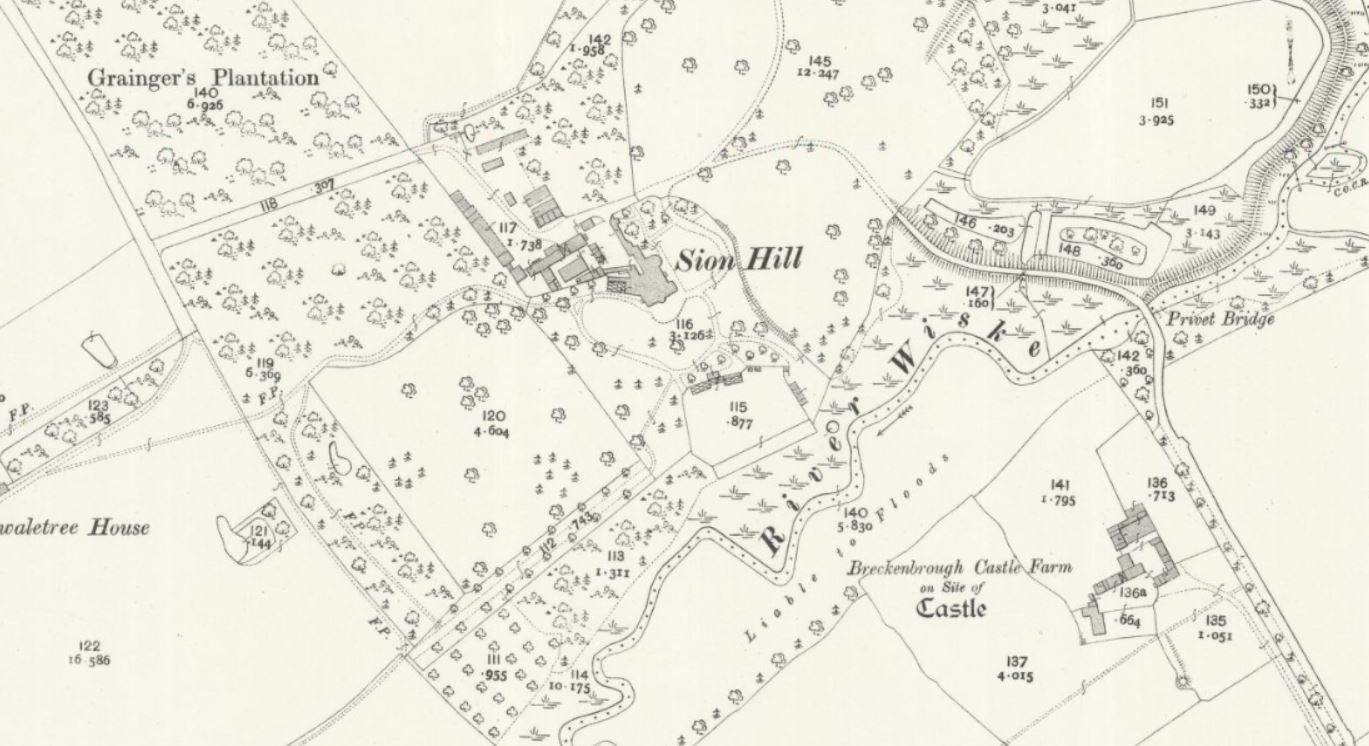
Extract from Ordnance Survey 25-inch sheet 87.5, surveyed 1910, published 1912, showing the earlier house at Sion Hill
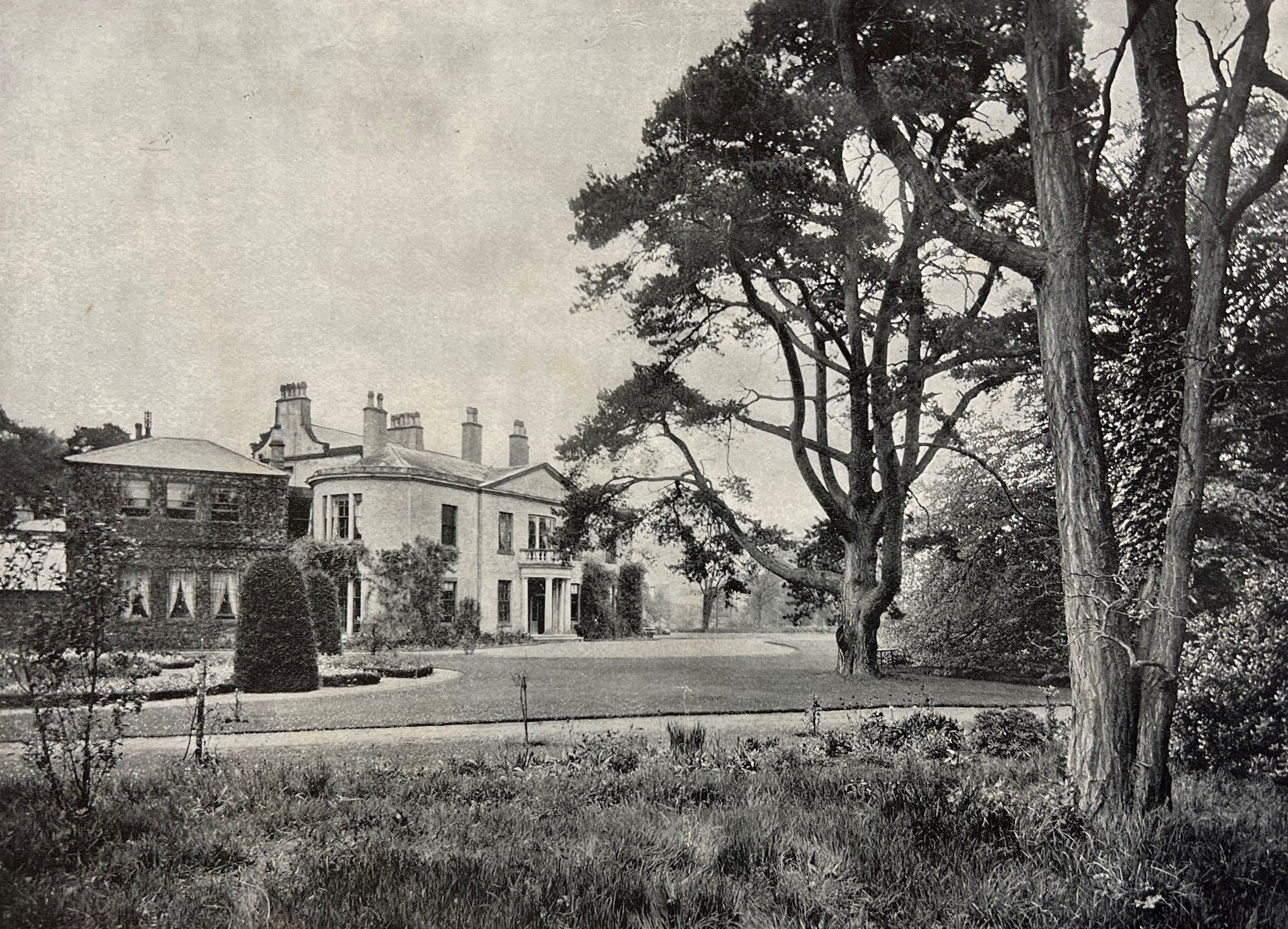
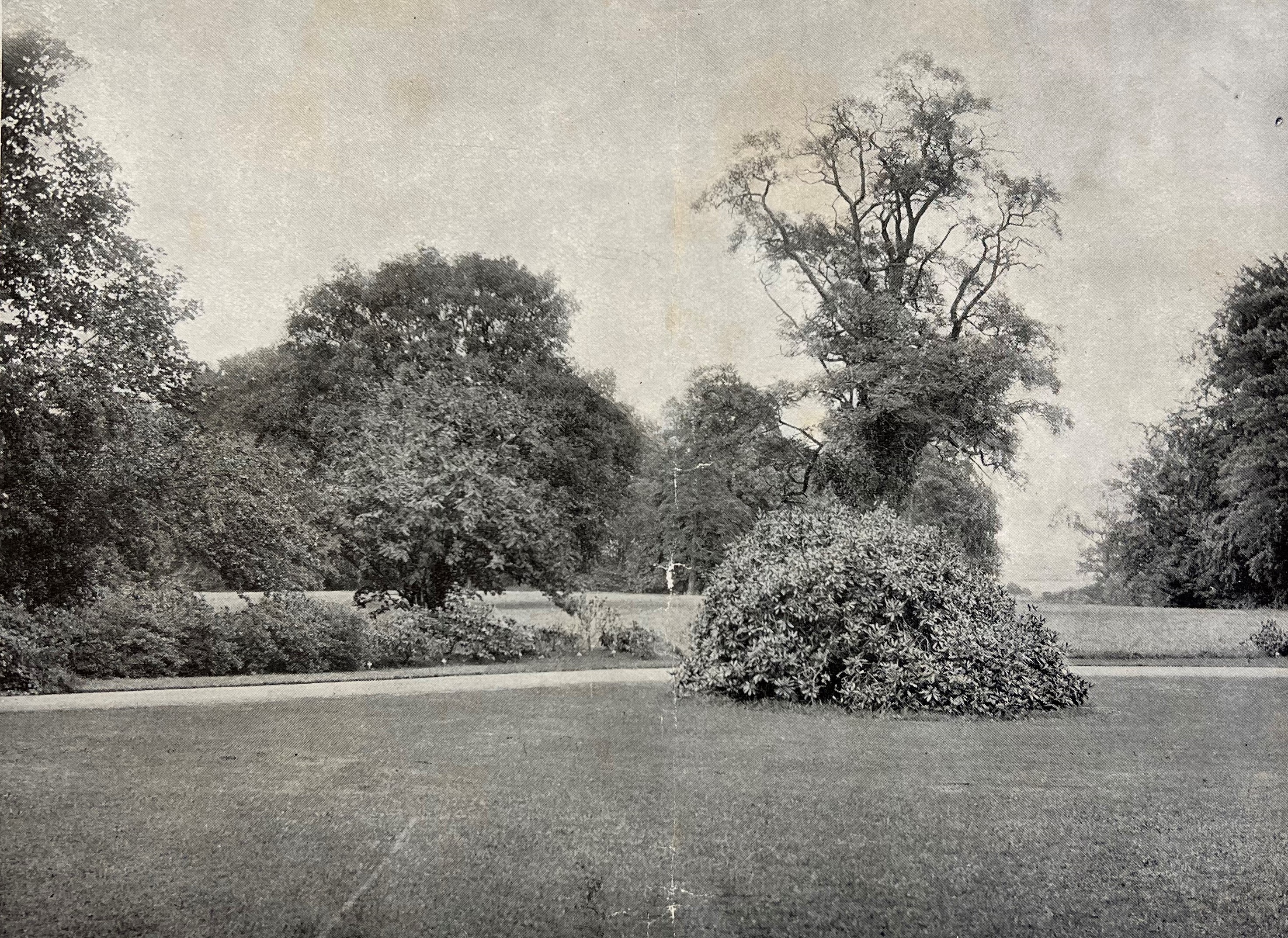
ZXW 2/1 Photographs of the house and gardens from the Sion Hill Estate sale catalogue, 1911
From a letter written prior to the auction, dated 18 October 1911, from Stancliffe’s agent Coverdale to Mr Peirson, the estate agent for the sale, we learn that there was no drinking water in the old house. Water had to be brought from a well in the garden, which could be pumped dry in 20 minutes and was deemed “quite insufficient” (the issue of obtaining a mains water supply to the house is one that took Stancliffe several months to resolve). After visiting the property, Coverdale also concluded:
“…the outside appearance and the internal construction, with the exception of a few good rooms referred to, are so faulty that it would be necessary to pull the house down and rebuild. From Mr Stancliffe’s point of view, therefore, he is left merely with the building material and a site” [ZXW 3/1].
Designs for the new house
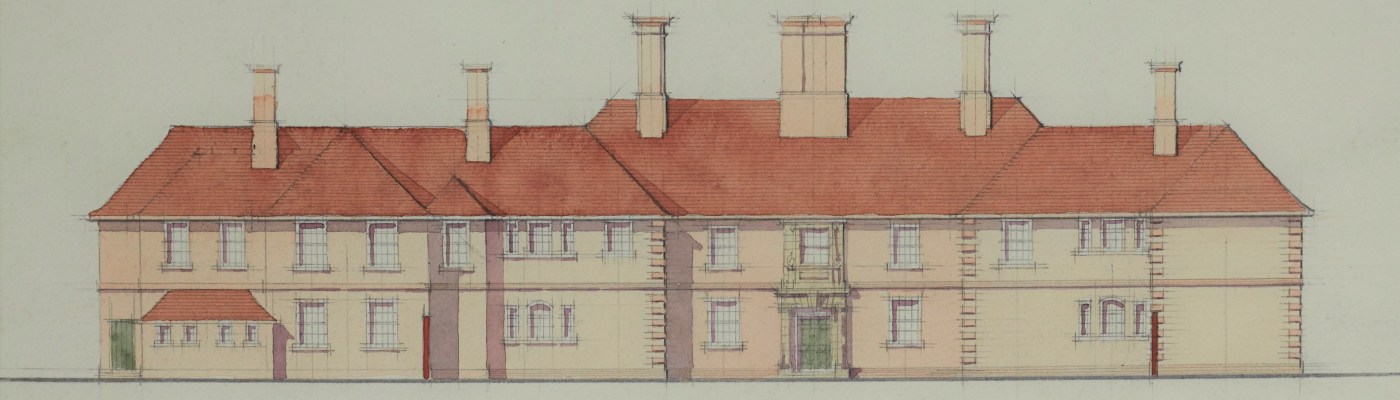
Soon after the auction, and before the purchase was completed, Stancliffe took Coverdale’s advice and set in motion a project to build a new house at Sion Hill, approaching architect Walter H. Brierley (1862-1926) of 13 Lendal, York in November 1911. The earliest surviving correspondence from Brierley is dated 18 December 1911, in which he provided an update on his progress drawing up the plans. A month later, on 18 January 1912, the initial designs were sent to Stancliffe, accompanied by a four-page letter from Brierley outlining his approach to the layout and design, and inviting Mr & Mrs Stancliffe to his own house at Bishopbarns in York to see the fittings (see designs and letters pictured below).


ZXW 9 Initial elevation designs for the north and south front of the new house at Sion Hill by Walter H. Brierley for Percy Stancliffe, January 1912
Brierley says of these designs in his letter of 18 January 1912:
“I have given a lot of time and thought to their arrangement and am sure if carried out they will result in a very interesting and comfortable house.” In the same letter, he concludes: “Architectural elevations always look flat and are very deceptive to the lay mind as they give a very poor idea of the way the fronts are broken up, and of how picturesquely the roofs will group and pile together, and so please don’t consider them too literally for you may rest assured that they will turn out all right. I am sorry to have been rather a long time in getting the plans to my satisfaction, but I do feel that the result is worth it, and that the scheme submitted is really a good one” [ZXW 9].

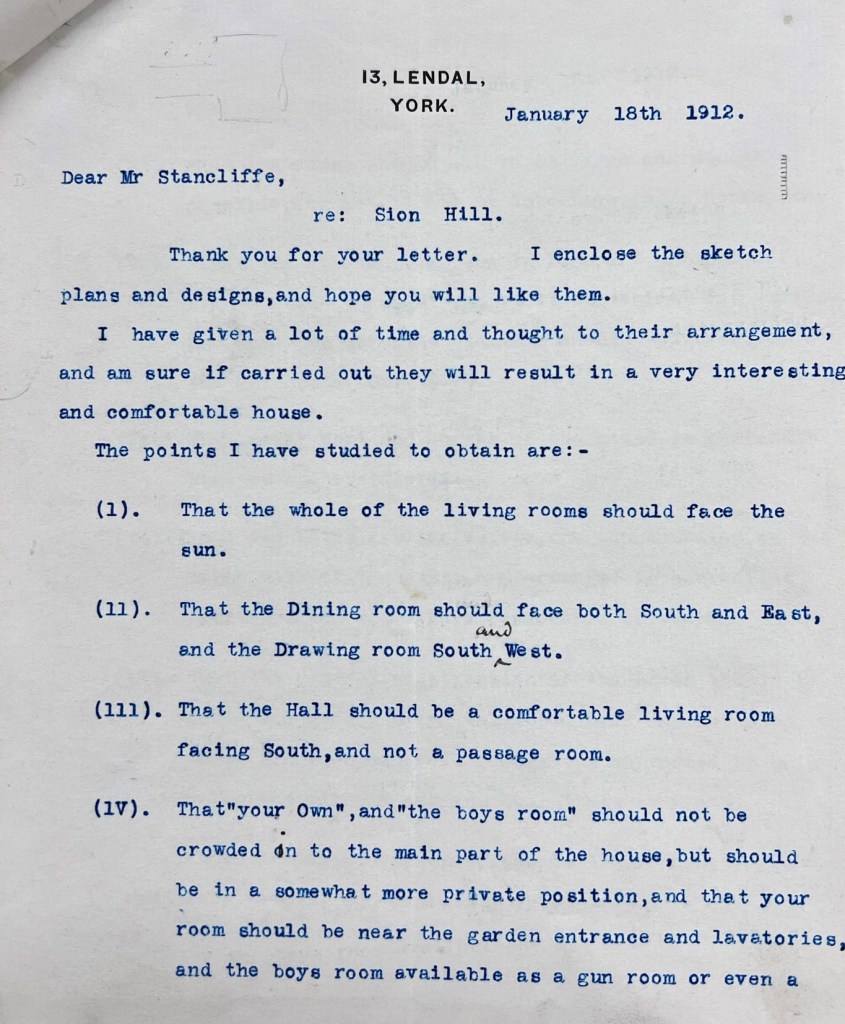
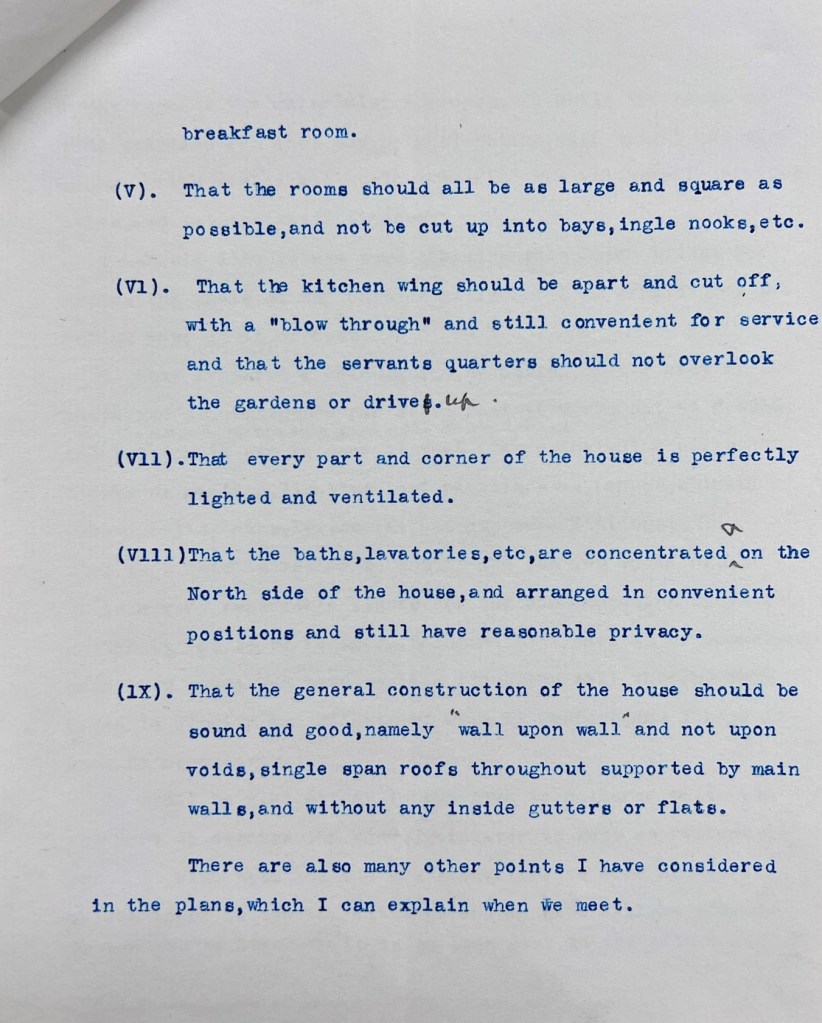


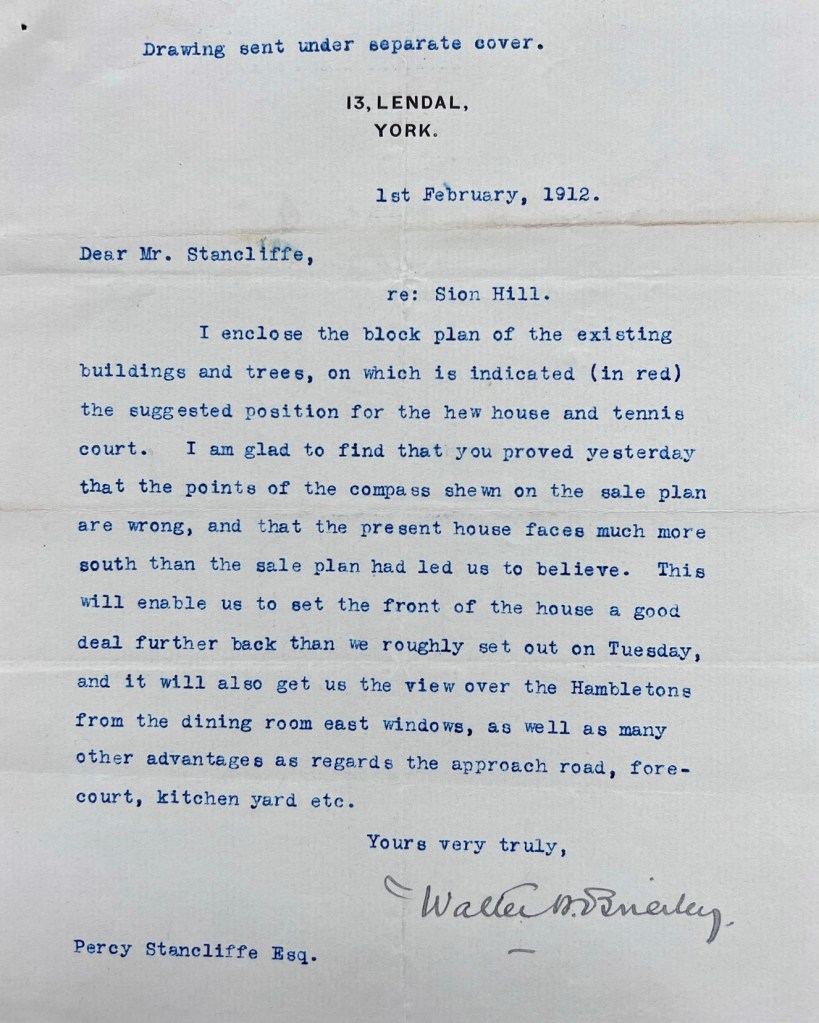
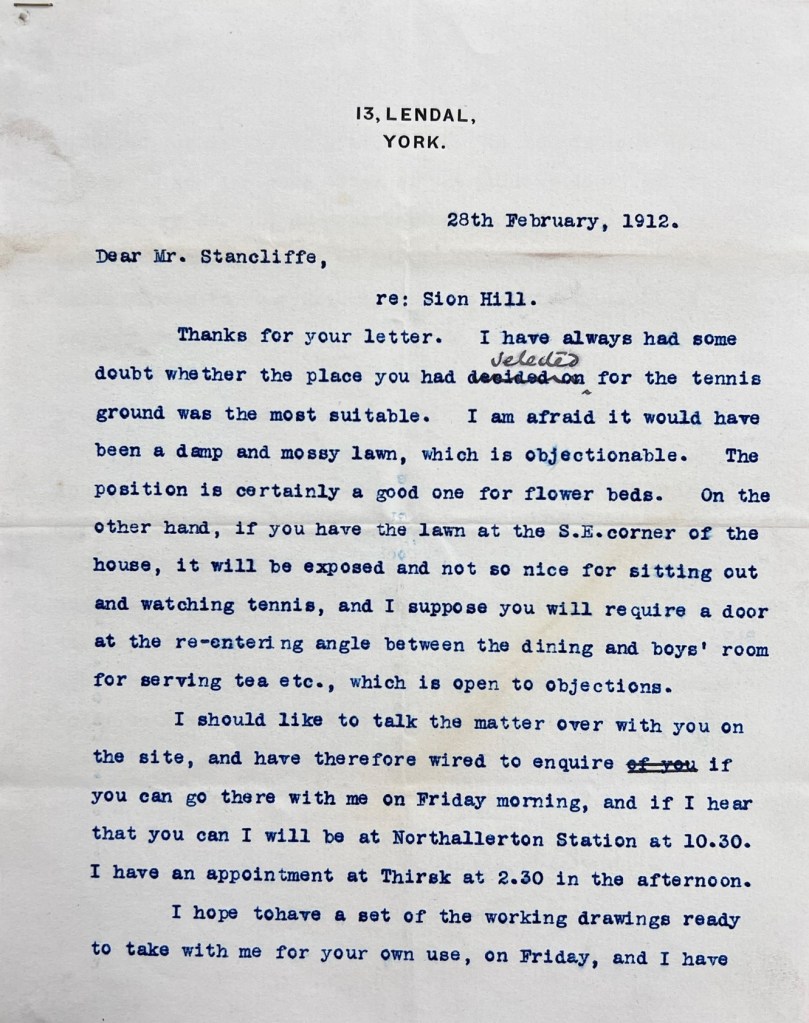
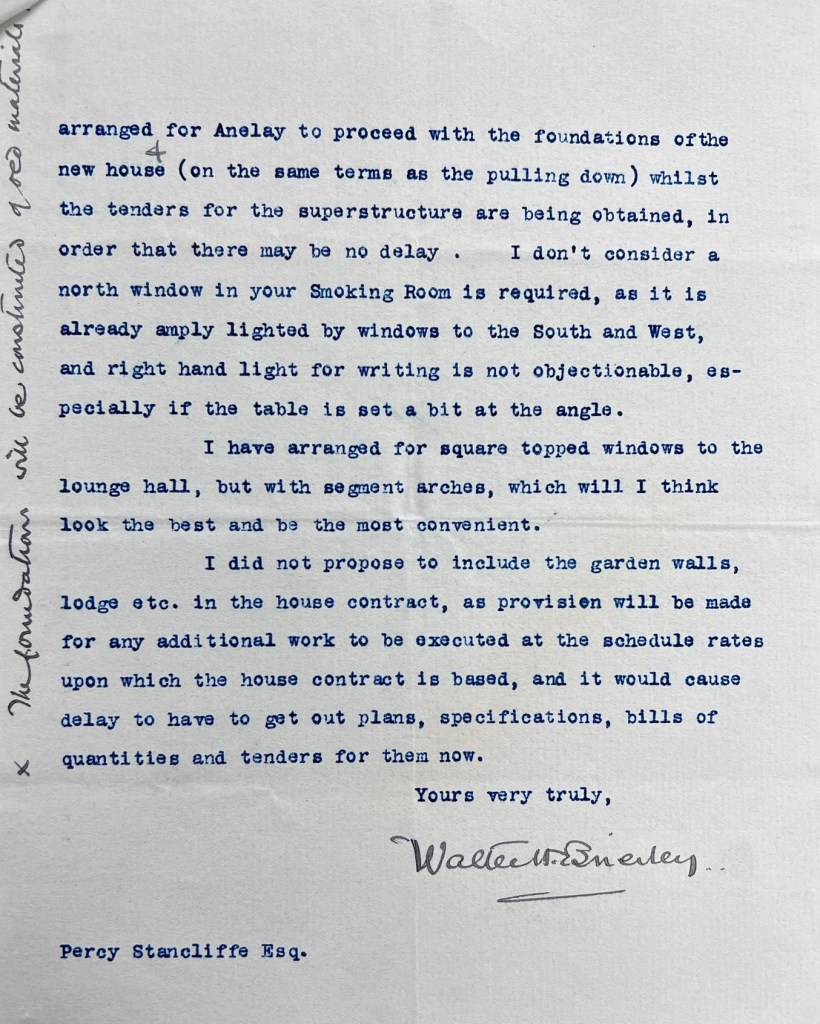
ZXW 9 Letters from W. H. Brierley to P. Stancliffe:
- 18 December 1911 regarding supply of sketch plans in the new year (1 page)
- 18 January 1912 containing Brierley’s explanation of the aims of his design (4 pages)
- 27 January 1912 confirming arrangements for Anelay to commence demolition of the old house (1 page)
- 1 February 1912 enclosing a block plan of existing buildings & proposed new house (1 page & see plan below)
- 28 February 1912 regarding position of tennis court and flower beds and seeking tenders (2 pages)
The design of Sion Hill is said to have been loosely based on the house at Middlefield, near Cambridge, designed by Sir Edwin Lutyens, 1908.

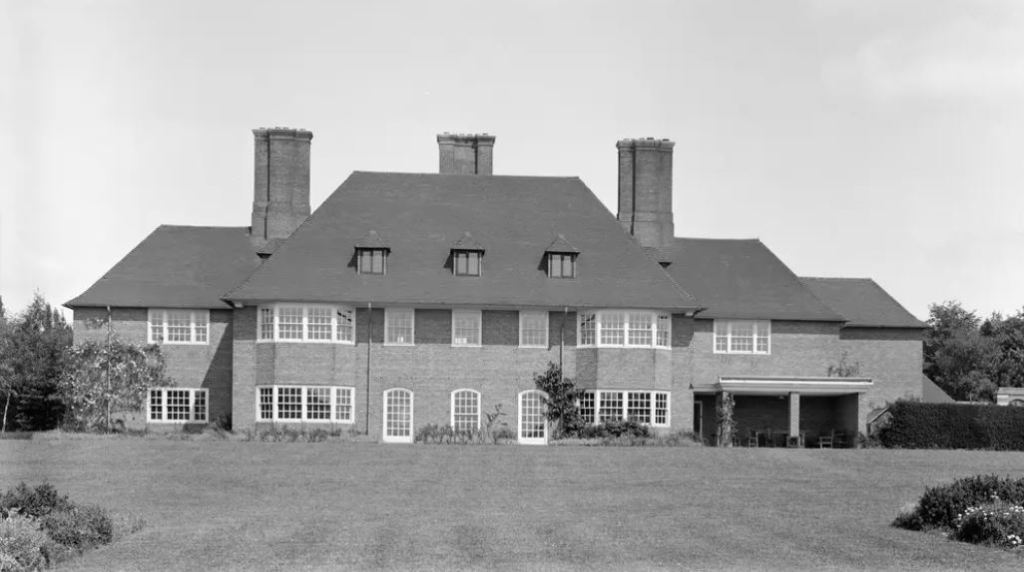
- L: Photograph of Middlefield, Stapleford, Cambridgeshire. Source: Historic England, ref: AA002557, 1927-1930
- R: Exterior view of garden front, Middlefield, Stapleford, Cambridgeshire. Source: Historic England, ref: CC001082, June 1927
Tenders for construction and the appointment of Thomas Lumsden as builder
At the beginning of February 1912, with the Estate purchase completed and designs for the new house prepared, Brierley had arranged with William Anelay of Doncaster to commence demolition of the existing house and sent Stancliffe a site plan showing the existing and proposed buildings (see letters of 27 Jan & 1 Feb 1912 above, & plan below). In a letter of 28 February (see above), we see that Brierley had also instructed Anelay to proceed with construction of the foundations of the new house, whilst the tenders for the superstructure were being arranged.

ZXW 9 Tracing of block plan showing position of new house (in red) and tennis courts etc, at Sion Hill Estate, drawing 3A by W.H. Brierley, February 1912
Stancliffe was clearly keen to hear the results of the invitations to tender, which Brierley sent to him on 19 April (see Brierley’s letters of 1 & 19 April 1912 below). Brierley commented on the tenders, which ranged from £6,219 to £7,547 16s as follows:
“They vary considerably, and on the whole are lower than I expected….They are all from selected builders of good repute. Lumsden you will see is considerably the lowest, and I don’t think he can do the work satisfactorily and make any profit at his price but I suppose that is his look out. He is at present building a large block of banking premises for me at Newcastle, and has so far given me every satisfaction. He has got on well with his work, and is energetic and business-like, and he is good to deal with, and I believe he is financially sound. I have therefore no alternative but to advise that you accept his tender. I am sorry Anelay is so far out of it, and that Slack will probably have to retire from the command as soon as the foundations are built.” Despite his reservations about the feasibility of Lumsden’s quoted price, Brierley went on to note that “I am glad to find that Lumsden’s tender for the house is within £160 of my original estimate.”
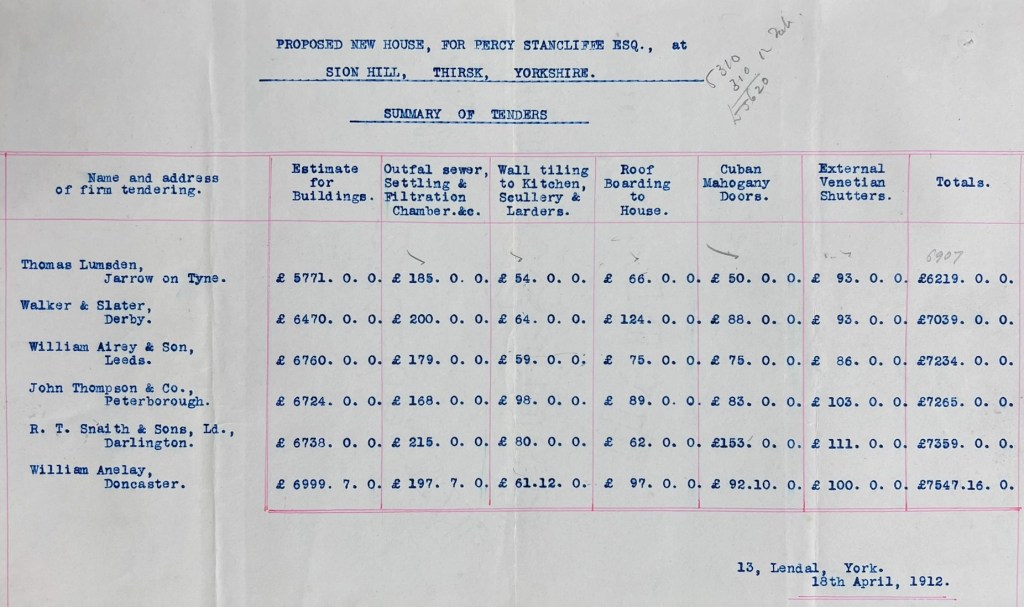
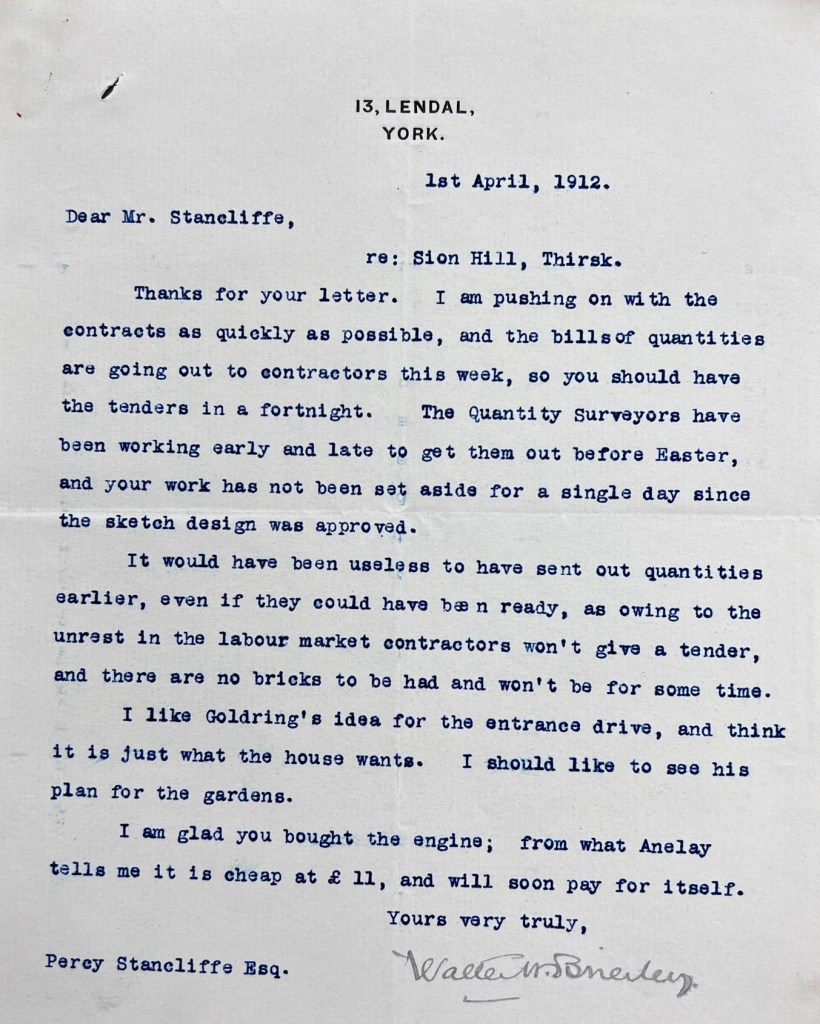


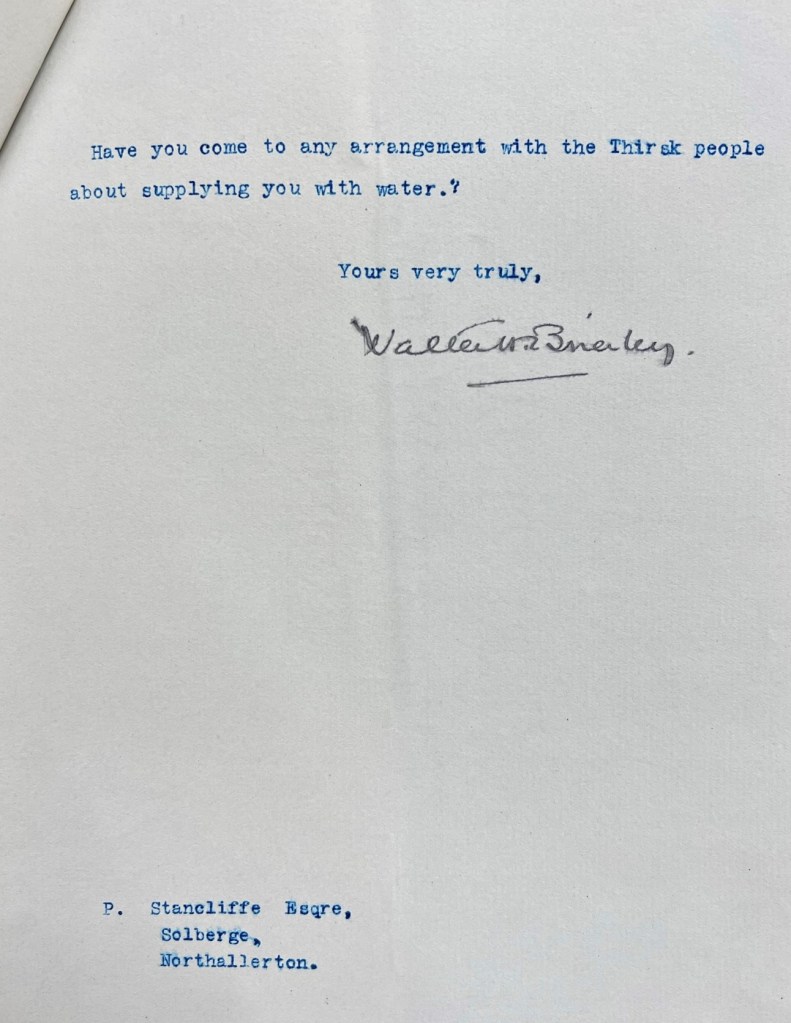
ZXW 9 Correspondence from W.H. Brierley to P. Stancliffe:
- 18 April 1912 Summary of tenders for proposed new house at Sion Hill (1 page)
- 1 April 1912 letter regarding contracts & Goldring’s plan of the garden (1 page)
- 19 April 1912 letter with comments on tenders (3 pages)
With the foundations completed by Anelay in June 1912, and Lumsden on site commencing work on the building of the new house, Stancliffe sought Brierley’s advice on the foundation stone-laying ceremony, to which he replied in a letter of 29 July 1912:
“As regards the stone laying ceremony, I am writing Shearsmith [the clerk of works] with instructions, and he will initiate you into the mysteries attendant. I will get over again before you go to Scotland if I can but at present I am pulled out of the place with work. There is no definite rule as to drinks, etc, but most people prefer to give a sum of money, say a couple of pounds, to the foreman of the building, and he divides it amongst the men employed at the time.”
The new entrance lodge and reuse of existing outbuildings
In June 1912, Brierley prepared plans and elevation drawings for a new entrance lodge, situated beside the drive off the road from Kirby Wiske village to the north. Construction of the lodge was undertaken by Lumsden, but as a separate contract to the building of the main house, which also included alterations to existing outbuildings and the erection of new greenhouse and garden walls etc. In November 1912, Brierley prepared options for reuse and alterations to the layout of the existing outbuildings to the north-west of the new house, with different arrangements for a motor house and covered motor wash (see below).

ZXW 9 Plans and elevations for proposed new entrance lodge at Sion Hill by W.H. Brierley, June 1912


ZXW 9 Alternative options for alterations to, and reuse of, outbuildings at Sion Hill, plans ‘No.2’ & ‘No.3’ by W.H. Brierley, November 1912
The building of the new house
A few months into the house build, there were issues with rising costs and a shortage of materials. Lumsden wrote to Brierley on 4 September 1912:
“… the cost of materials has seriously increased, indeed, it is not possible to get common bricks in the district, and owing to the high freights and short shipments, good quality timber is scarce and dear.” Brierley replied on 5 September “… it is decided to reuse as much of the old materials as possible.”
A later letter of 28 September refers to credits for the old lead, conservatory and boiler, old sashes and corrugated iron. In the final accounts of May 1914 (see below), there is a note that £300 has been saved due to the reuse of materials.
By the end of October 1912, work was well under way and Brierley wrote to provide instructions on matters of detail. For example, in a letter of 21 October 1912:
“All the doors, except those that are mahogany, are to be painted (some of them are old doors reused). Those in the servants quarters and kitchen wing could be painted brown oak colour and varnished, which is very serviceable, but white is the best for the bedroom doors, it always looks nice in the country and doesn’t tie you as regards carpets, curtains and wall papers.” Writing to Stancliffe on 4 December 1912, Brierley requested: “Will you kindly ask Mrs Stancliffe whether she would prefer the windows of the bath rooms, lavatories and Butlers pantry and bedroom glazed with clear or obscure glass. I prefer clear glass and muslin curtains on the inside, as I think it looks so much better from the outside.”
It appears that Stancliffe requested amendments to the design throughout the contract. From Brierley’s letters, we can see that he was always diplomatic in his responses, even when he did not agree with the changes. For example, in a letter of 21 June 1912 to Stancliffe, Brierley wrote:
“I enclose a plan marked ‘A’ of the alterations I think you want in the kitchen, and also one marked ‘B’ of an alternative that seems to me more convenient, but I am doubtful whether either is as good an arrangement as the contract plan, which is one that I have had built several times before and has proved satisfactory.”
A few months later, on 29 October 1912, Brierley reassured Stancliffe that:
“I am most anxious you should have everything you like, and I want to help you to obtain it in every way I can, and as you know I don’t mind trouble and alterations in reconsidering and revising things but of course it must mean delay.”
The following year, on 6 and 8 May 1913, there had clearly been disagreement over the carving above the front door, which was not to Stancliffe’s liking, and Brierley wrote two letters (see below):
“I am very sorry that you take such objection to the one bit of playfulness in the house, viz: the carving over the front door. It has been shewn on all the drawings, and is included in the contract, and it is in perfect harmony with the size and style of the house, and an important part of the composition.” However, Stancliffe got his way and the design was changed.
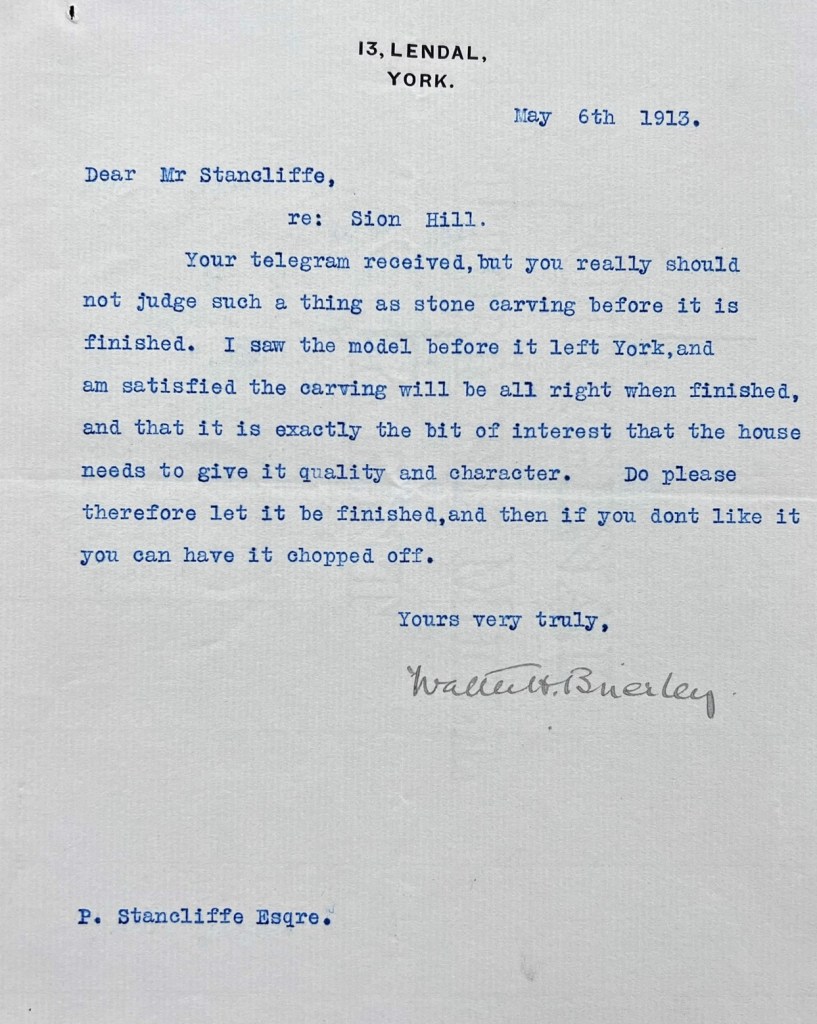

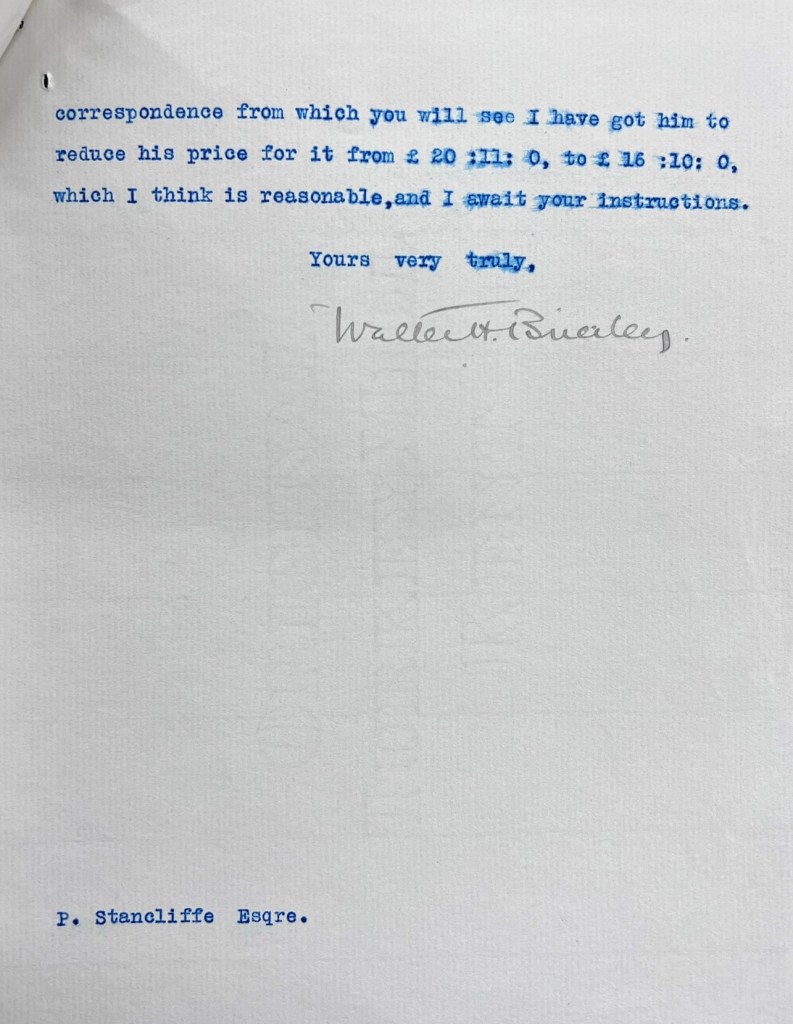
ZXW 9 Correspondence from W.H. Brierley to P. Stancliffe regarding carving above front door, 6 & 8 May 1913 (3 pages)
Percy and Ethel Stancliffe moved into their new house in July 1913, several months before the work was fully completed. At this time, letters were being sent frequently, almost every week, between Brierley and Stancliffe. From these letters, it is clear that Brierley was very busy with other work and, when he went to Sion Hill from York, generally travelled by train to Northallerton or Thirsk, or sometimes motored over by car. He combined his visits, where possible, with meetings at County Hall in Northallerton (which he designed in 1904 as architect for North Riding County Council from 1901-1923), or with visits to his other projects nearby (such as Thirsk Town Hall, and Sowbergate for Mr Hutton). Just before the Stancliffes moved in, on 28 June 1913, we see the closest Brierley came to expressing his frustration, writing to Stancliffe:
“It is an awful worry trying to get the work done in time, and I am nearly ‘fed up’ with it, and all this rush is bound to be detrimental to the general quality of the work.” A month later, on 28 July, he said: “I hope they will get on faster with the house now that you are in it.”
Advice on interior decoration
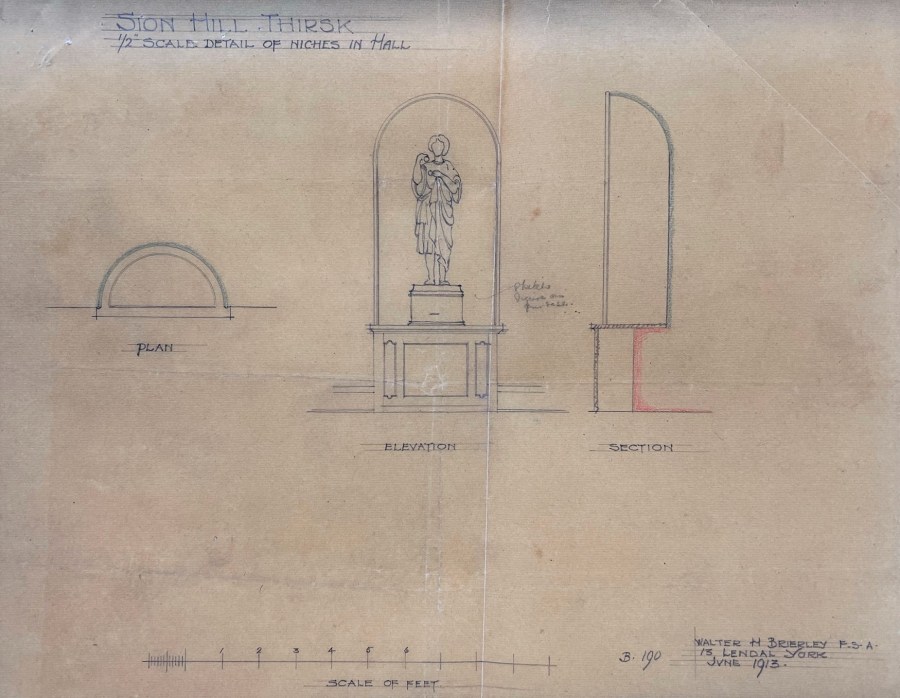
Brierley also provided advice on aspects of the interior decoration of the house. On 1 July 1913, for example, he suggested statuary for the niches in the hall, as opposed to shelves for china (see below – but from the present arrangement of the house, it appears the Stancliffes got the shelves they desired instead). He also suggested on 18 November 1913:
“There should be very few pictures in the boudoir, and they should be small and exceptionally choice, either water colours, pastels or single figure mezzo tints after old masters; oil paintings or black and white engravings should on no account be admitted.” This same letter goes on to specify the types of brass screws and hooks to hang such pictures on, even including small drawings of them (see pages 5 & 6 pictured below).
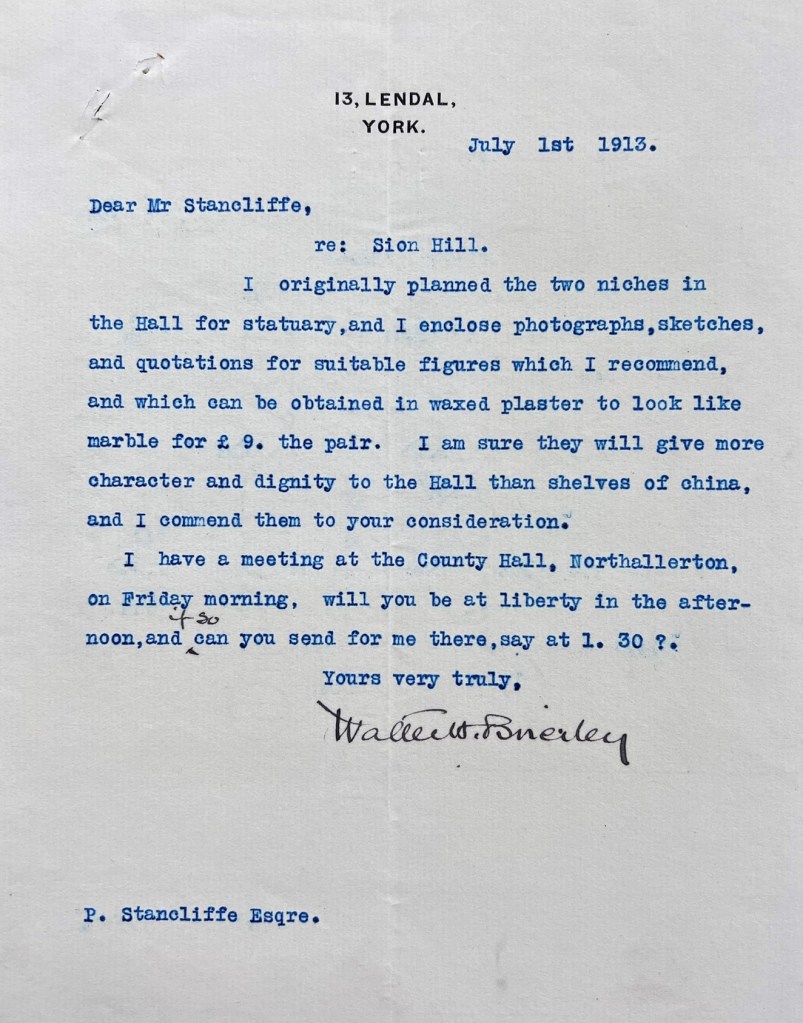
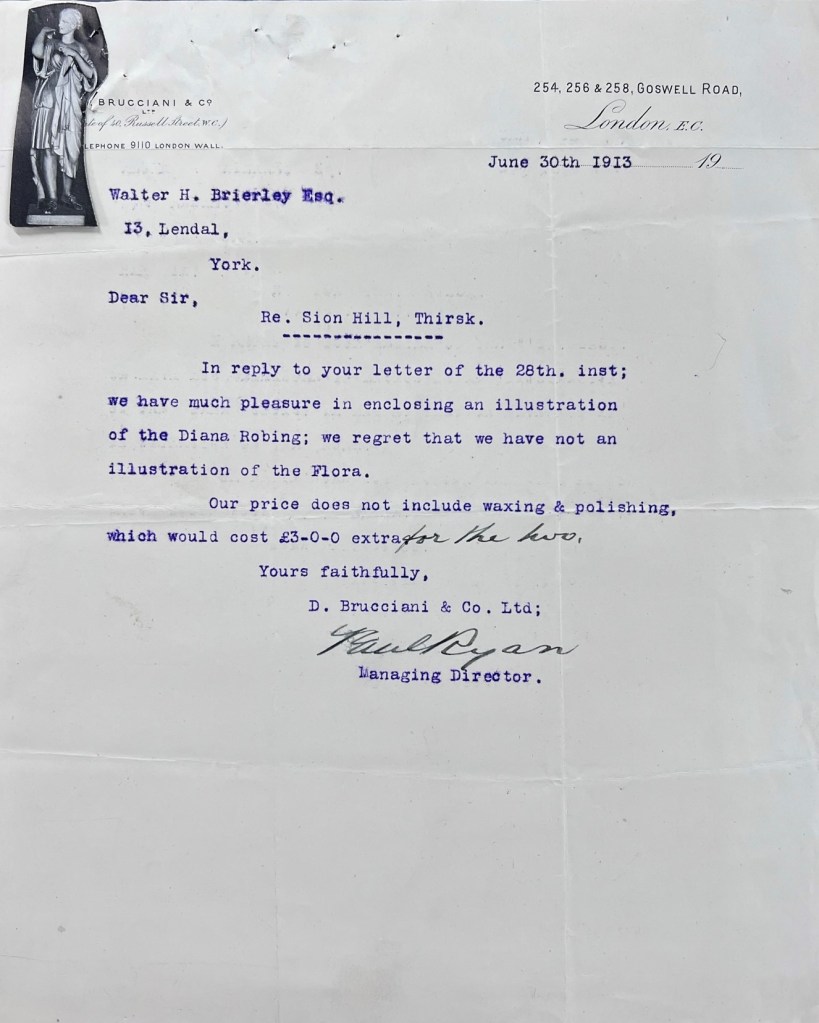

ZXW 9 Letters from W.H. Brierley to P. Stancliffe:
- 1 July 1913 regarding statuary for hall niches, including letter of 30 June from D Brucciani & Co. plus drawing (3 pieces)
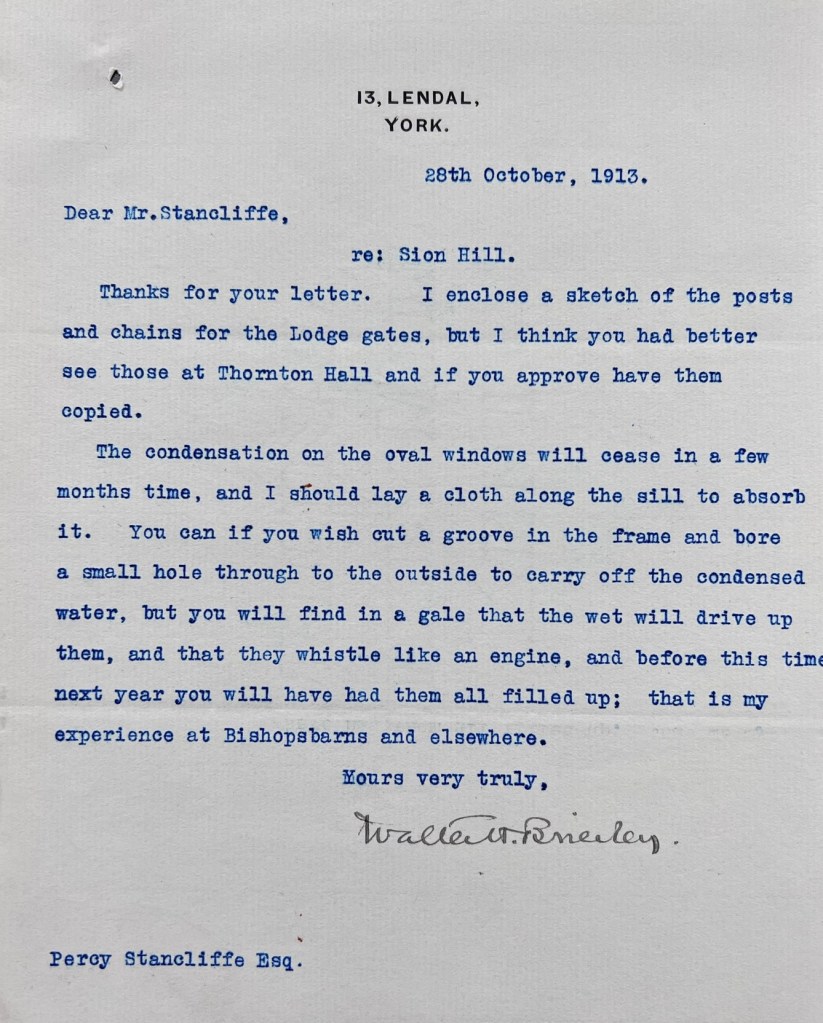
- 28 October 1913 regarding condensation in oval windows (1 page)
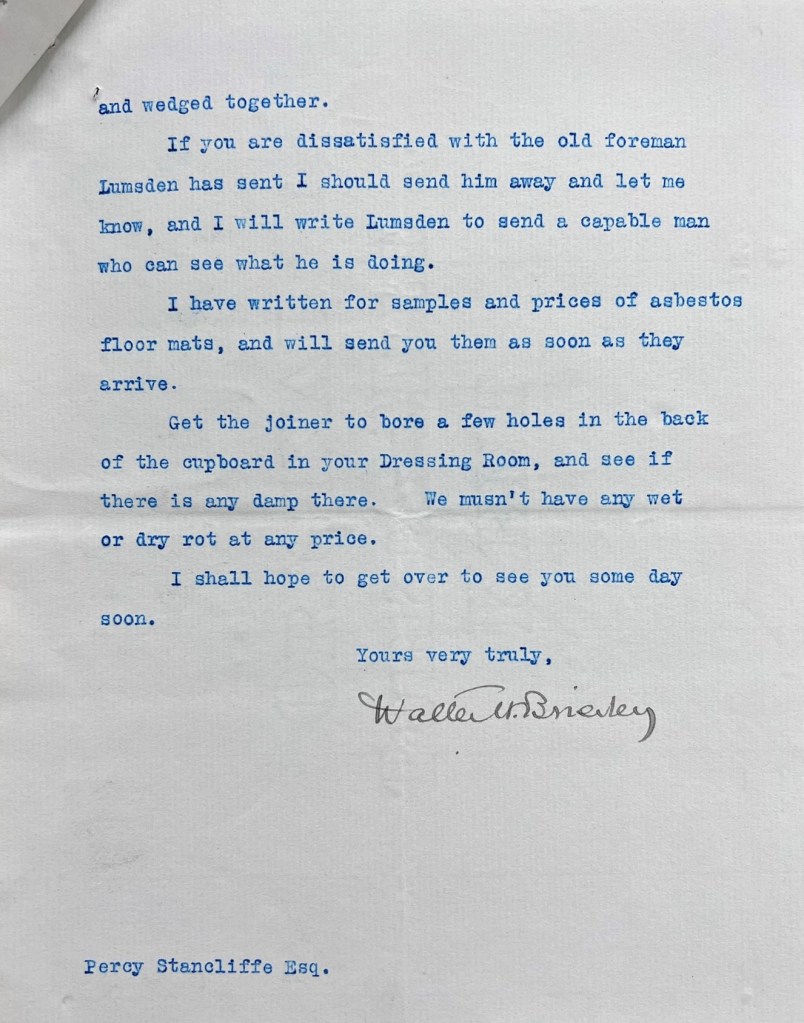
- 18 November 1913 regarding suggested pictures for boudoir, which screws to hang them with, and potential damp behind dressing room cupboard (2 pages)
In letters of 28 October and 18 November (see above), Brierley also advised on remedies for condensation and damp:
“The condensation on the oval windows will cease in a few months time, and I should lay a cloth along the sill to absorb it. You can if you wish cut a groove in the frame and bore a small hole through to the outside to carry off the condensed water, but you will find in a gale that the wet will drive up them, and that they whistle like an engine, and before this time next year, you will have had them all filled up; that is my experience at Bishopbarns and elsewhere.” “Get the joiner to bore a few holes in the back of the cupboard in your Dressing Room, and see if there is any damp there. We musn’t have any wet or dry rot at any price.”
The completion of the house and final costs
On 19 March 1914, as the works neared their completion, Brierley wrote to Stancliffe with an approximate statement of final costs (see below):
“All additions and variations on the house have been done at contract rates, but nothing outside the house has been done at those rates, as you will remember Lumsden would not take on any more work than he was compelled at those rates, which he said were losing prices. He tells Priestleys he has lost over £1000 on the job, and that he is giving up contracting.” This echoes Brierley’s comments about Lumsden not making any profit on their original tender price in April 1912 (see above). The final paragraph of his March 1914 letter reads: “A good comfortable house is expensive, and requires a great effort to produce and pay for, but once paid for one forgets it, whereas cheap work is always there to remind and annoy us.”
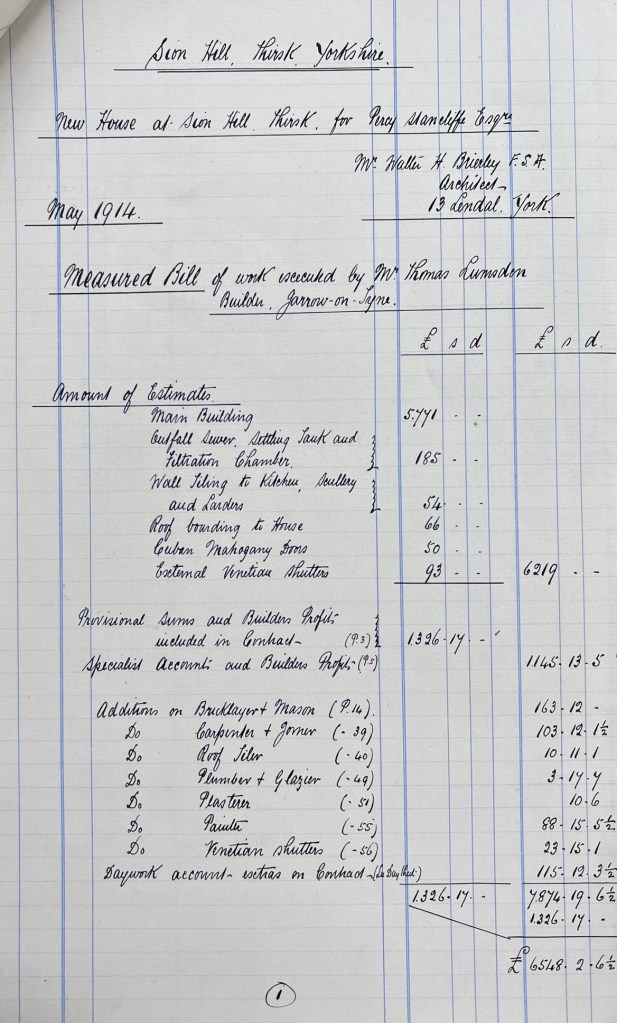
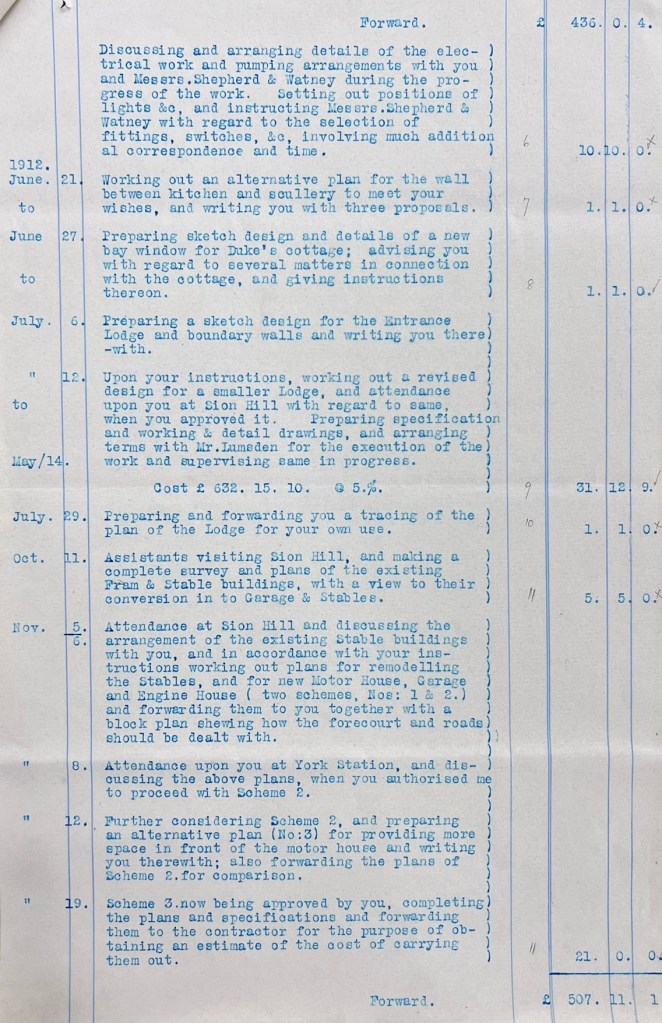
A few weeks later, on 14 April 1914, Brierley wrote to Stancliffe: “Thanks for your letters. The only reason I have not been over is that I have been too busy to find the time.” From the five-page statement of account for professional services submitted by Brierley in May 1914 (see below), which itemises the work he had carried out on the project, we can see that he sent his personal clerk of works to inspect the build five times during April and May 1914 to the point of completion, the final visit taking place on 27 May 1914. Brierley’s costs between November 1911 and May 1914 totalled £632 9s 2d. From the measured bill submitted by Lumsden (see below), the total costs for the house build were £6,937 8s 2d and with additional works to the outbuildings, stables, building the entrance lodge to the north, new walls, paving etc, the total sum overall came to £9,864 19s 2d, in addition to the original £14,000 Stancliffe paid for his portion of the estate following the October 1911 auction. By now, we should not be surprised to learn that Stancliffe, via his agent Coverdale, raised a number of queries about these final costs, to which Brierley responded on 11 June 1914 (see below).


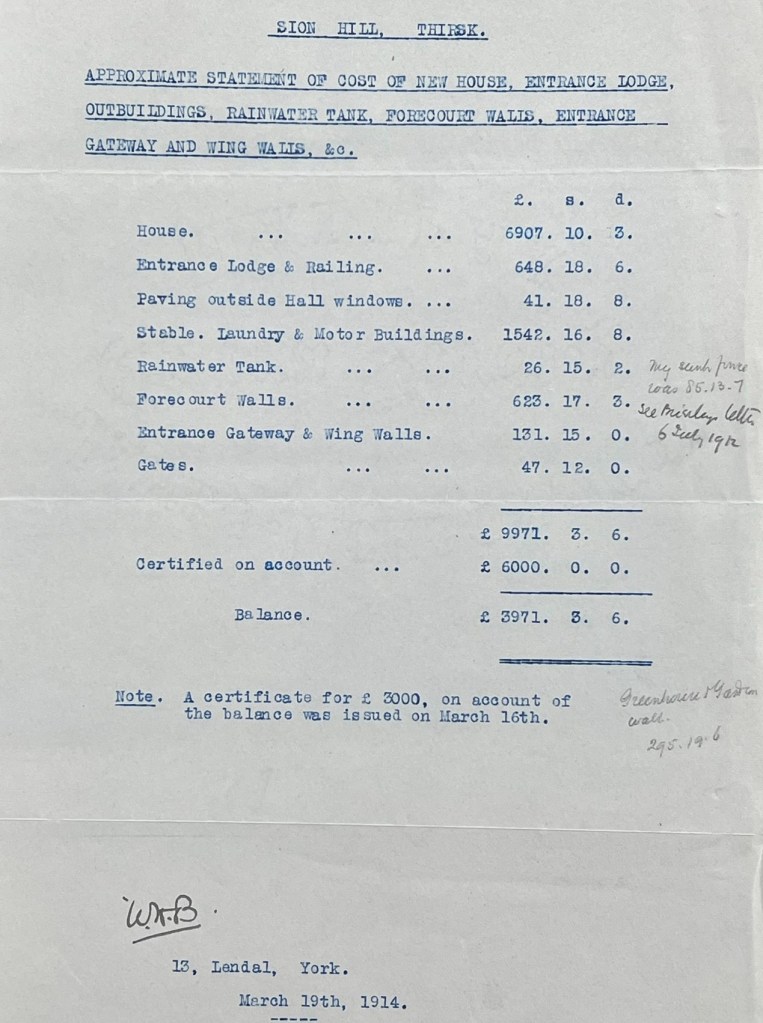
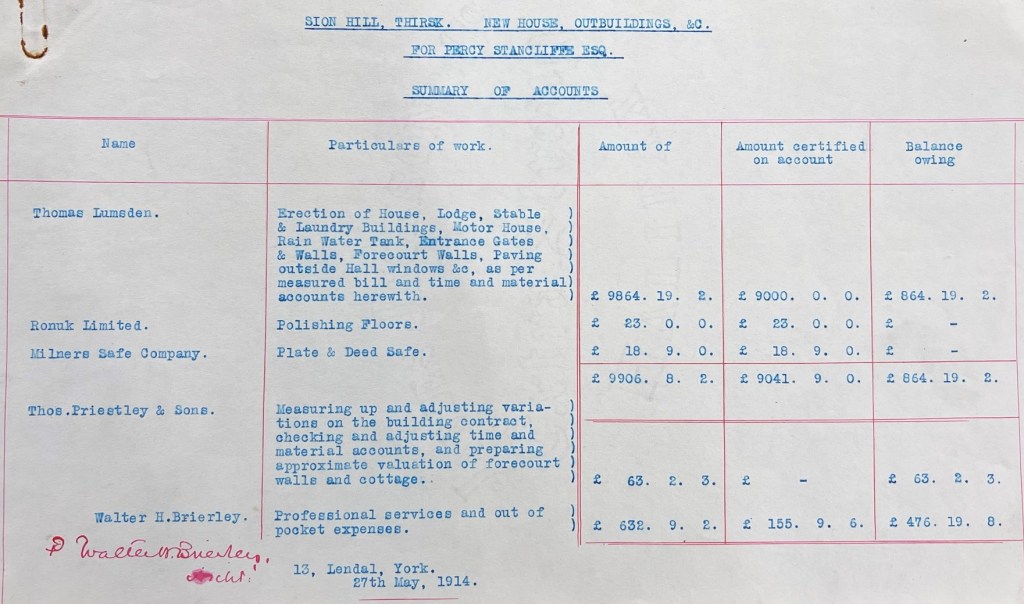






- ZXW 9 Letter from Brierley to Stancliffe with approximate statement of costs, 19 March 1914 (3 pages)
- Summary and breakdown of account for the building of the new house at Sion Hill, 27 May 1914 (2 pages)
- Extracts from the measured bill for the project from Lumsdens, May 1914 (3 pages)
- Statement of account from W.H. Brierley for professional services, 27 May 1914 (5 pages)
- Response by W.H. Brierley to queries on the statement of his account, 11 June 1914 (2 pages)
In one of the latest letters from Brierley in the archive, writing to Stancliffe on 27 June 1914, Brierley concluded:
“The house looked very nice, and I am satisfied that the work is durable and good; it is only in the little finishing touches that Lumsden is not quite up to the mark.” He also wryly adds that: “We can hardly expect him to be up to Anelay’s standard when his price was £1300 lower than Anelay, who was already on site and wanted the job, and £600 lower than any of the other contractors.”
More recent history of the house
The outbreak of the First World War came soon after Brierley’s final letter to Stancliffe dated 1 July 1914. Ethel and Percy Stancliffe were to live in the house until their deaths in 1932 and 1949 respectively, after which the house changed hands a number of times in the 1950s, until purchased by Herbert William Mawer in 1962. By then, the house had been stripped of its contents and Mawer, who lived at Sion Hill with his wife until his death in 1982, filled the house with a collection of fine furniture and decorative art, a tradition continued to this day by trustee Michael Mallaby, who resides at the house. The H. W. Mawer Charitable Trust was established in 1972 to maintain the house and its contents in perpetuity. To find out about opportunities to visit the house and gardens, and for news and events, please see the Sion Hill website.
The gardens and grounds of Sion Hill
To conclude, a few notes on the gardens and grounds of Sion Hill, which were the original focus of this research, before it quickly became clear that there was more of a story to tell about the house itself. An overview of evidence for the gardens is provided in the attached document (opens as pdf), which should be read in conjunction with the images of some of the related archive items pictured above and below.
In summary, the 1911 sale catalogue and a letter from the Lascelles’ gardener in December 1911 provide evidence for the gardens at that time. It appears that Brierley had limited involvement with the gardens and grounds at Sion Hill, commenting on a plan for the gardens prepared by William Goldring of Kew in early 1912 (see above), and submitting a plan for a garden ‘temple’ to be constructed from the semi-circular porch of the old house in September 1913 (* see note below); unfortunately, neither plan survives within the archive, indeed the ‘temple’ plan may have been lost in transit. Goldring mentions tennis and croquet lawns, as well as rose beds. Brierley refers to the levels of the tennis court in March 1913 (see below). Accounts record repairs to existing greenhouses in 1913 and the building of new greenhouse and garden walls and a sunk wall in the same year. See the pdf link above for more details.

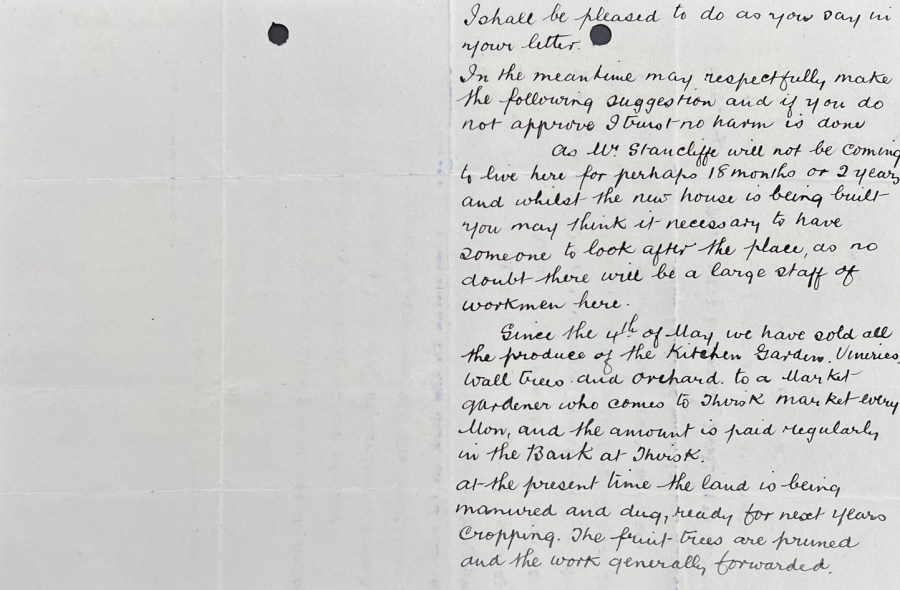


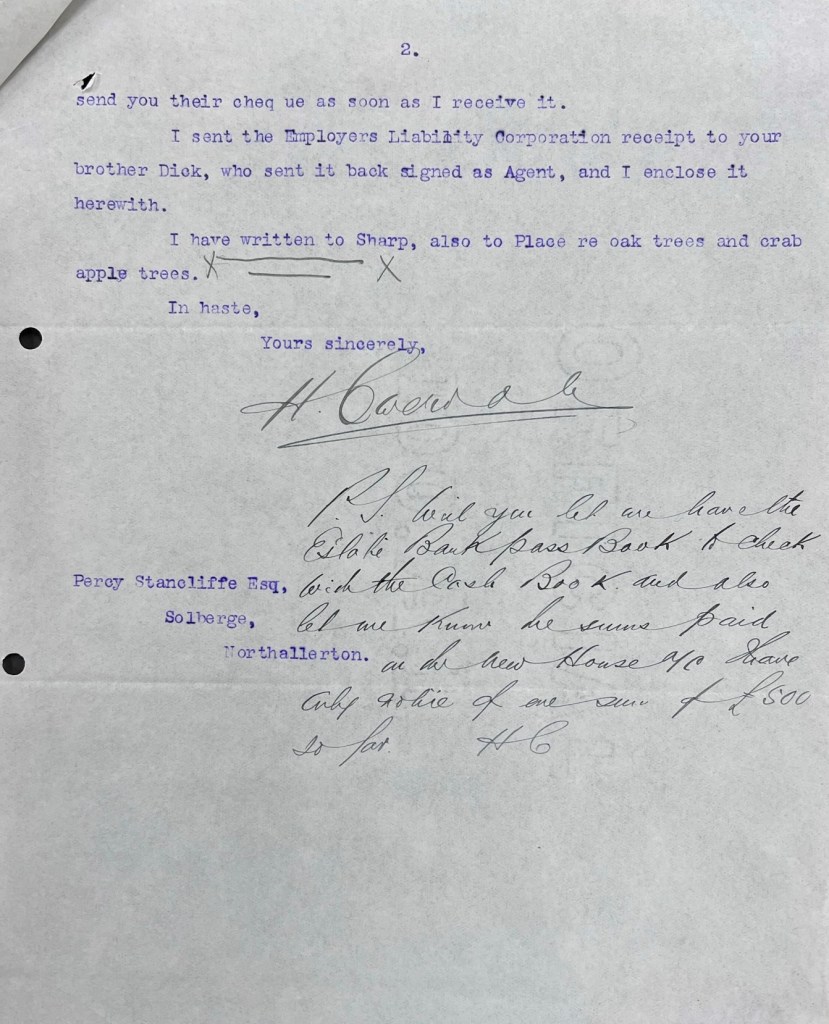
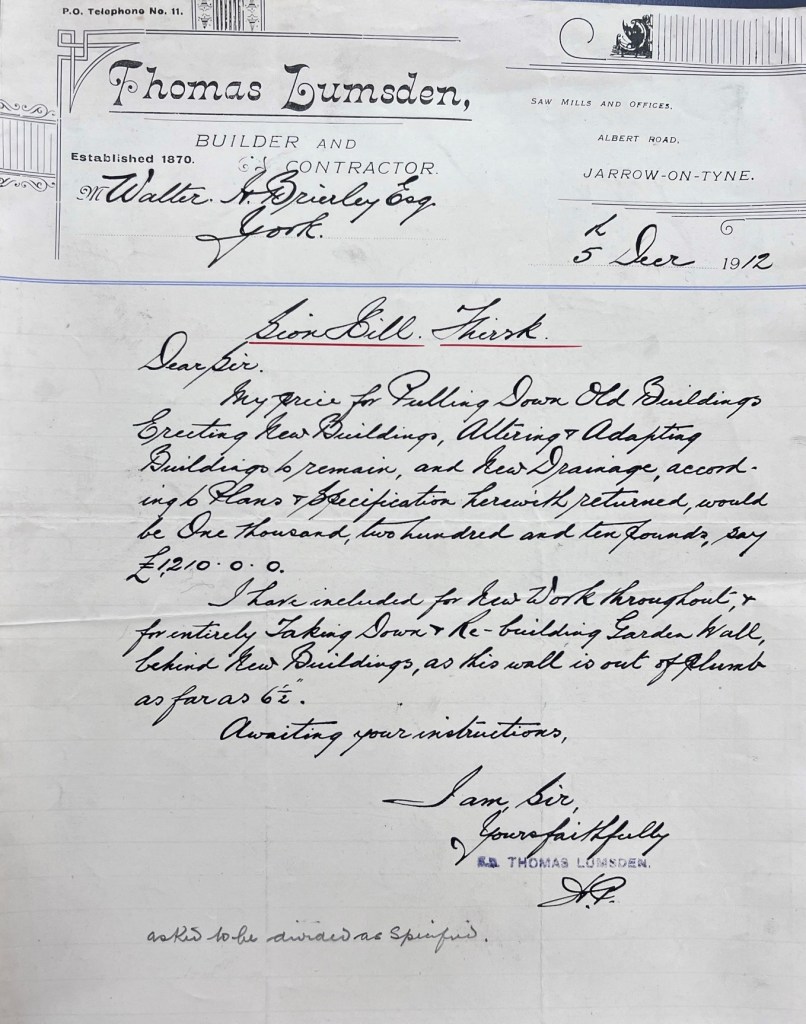


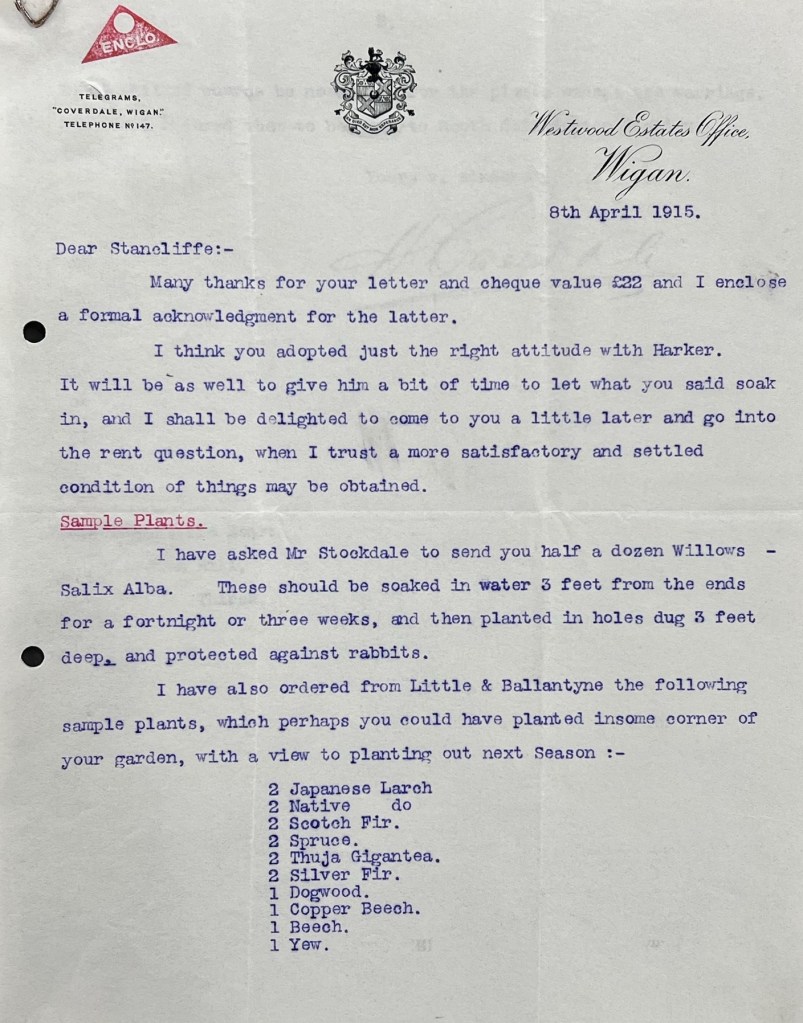

ZXW 9 Items relating to the gardens of Sion Hill
- Letter from C. Masters (Lascelles’ gardener) to H. Coverdale regarding garden work, 28 December 1911 (2 pages)
- List of plans etc. referencing ‘Drawing of Old Garden’ [not found within the archive], undated (1 page)
- Letter from H. Coverdale to P. Stancliffe regarding quote for 2 greenhouses, 4 December 1912 (2 pages)
- Quote from T. Lumsden regarding work to garden walls etc, 5 December 1912 (1 page)
- Letter from W. Goldring regarding revised plan of gardens, 16 January 1913 (1 page)
- Letter from W.H. Brierley regarding levels of lawn and Goldring’s plan, 12 March 1913 (2 pages)
- Letter from H. Coverdale to P. Stancliffe regarding free sample plants, 8 April 1915 (2 pages)
It does not appear that much else was done to the grounds and gardens in Stancliffe’s time, with large expanses of flat lawn surrounding the house. The beautiful gardens that exist at Sion Hill today, as described on the Sion Hill website, have been created by Michael Mallaby since the 1980s. The former walled kitchen garden at Sion Hill is now home to the Thirsk Birds of Prey Centre.
Further information:
- As well as this collection held by the County Record Office (which represents the client’s surviving archive): Stancliffe family letters and papers – online catalogue entry [ZXW], related material is also held at:
- The Borthwick Institute, York: Records of Atkinson Brierley – online catalogue entry [ATKB] (which represents the architect’s surviving archive), includes later plans and elevation drawings of the house than those held at NYCRO and Lumsden’s costed specification of works.
- University of Leeds Special Collections: Stancliffe family of Yorkshire archive – online catalogue entry [MS 1578]
- Nuttgens, Patrick, 1984 Brierley in Yorkshire: The Architecture of the Turn of the Century (York: York Georgian Society)
- The house was featured at the time in The Building News and Engineering Journal, 10 May 1912 (No.2992, p.666), and described:
“The new house is planned so that the principal rooms all get as much sunshine as possible, and face the gardens and river, and several of the windows command fine views of the Vale of York and the Hambleton Hills. The house is being built with 20in. thick cavity walls, the outer facing being of 2in. thick red hand-made bricks, and the roofs are to be covered with thick, red, hand-made, sand-faced tiles. The entrance porch shown by the view is of Portland stone, which is also used sparingly for windows, sills, strings, etc. The interior is to be treated in a simple but effective manner”, with an illustration “reproduced from Mr. Gascoyne’s water-colour, now on view at the Royal Academy Exhibition.”
- The house also appeared in an article on Recent designs in domestic architecture, in The Studio: An Illustrated Magazine of Fine and Applied Art, 15 October 1912 (Vol. 57, no. 235, pp.33-35), including a colour reproduction of Gascoyne’s watercolour drawing.
* Note on the garden ‘temple’
With reference to the garden ‘temple’ mentioned by Brierley, since writing this blog, I am indebted to Karen Lynch for drawing my attention to her article ‘Summerhouse, Leeming Garth’, co-written with Helen Lazenby for ‘Follies, the international magazine for follies, grottoes and garden buildings‘, published by The Folly Fellowship in Spring 2002, issue 51, Vol. 13 no.3, p.11 and also to photographs of the summerhouse, taken in 2009, on Ray Blyth’s Fabulous Follies website. Although the ‘temple’ was not constructed at Sion Hill, it had a new life at Leeming Garth, Leeming Bar (between Northallerton and Bedale), where the four columns and entablature of the semi-circular porch (which can be seen in the 1911 Sion Hill Estate sale catalogue photograph of the old house above) were enlarged and enclosed at the back to form a summerhouse, inscribed “PORCH FROM SION HILL HOUSE MARCH 1922”.
This is not quite as much of a coincidence as it might seem, as there is a Lascelles connection between the two properties. Leeming Garth was owned by Captain David Lascelles, one of the parties who signed the February 1912 conveyance, alongside his brother Alfred, when Sion Hill, formerly the Lascelles’ family home, was sold to Francis Samuelson and Ethel Stancliffe. However, what happened to the porch between 1913 and 1922 remains a mystery…
 North Yorkshire Archives Blog
Hello Gail,
I am delighted to find your article on Sion Hill as I live opposite to it in my family’s home for over 65yrs. Good project .Lovely images!
Best wishes ,
Mandy Griffiths
Hello Mandy, lovely to hear form you! I’m so glad you enjoyed the blog. You might be interested to know that I’m giving a lunchtime talk on the building of Sion Hill at the Record Office on Friday 26th January 2024 at 12.30pm. Admission is £2, including refreshments. – booking not necessary. All the best, Gail